


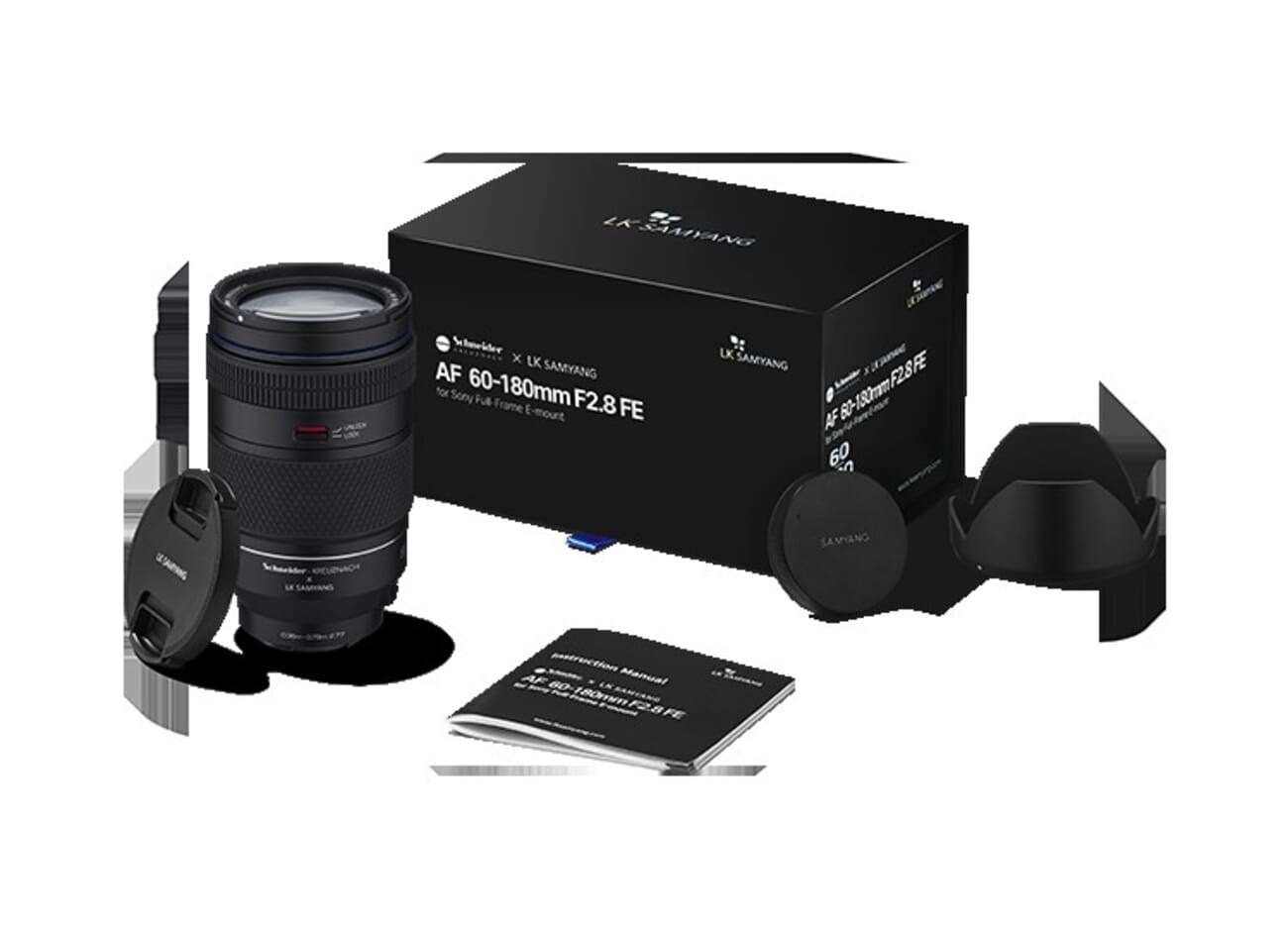
- Samyang announced the AF 60-180mm f/2.8 FE for Sony E-mount, co-developed with Schneider-Kreuznach, at roughly $1,000 (preorder).
- At 730g it is far lighter than a traditional 70-200mm f/2.8 (Sony’s GM II is 1,045g) and costs well under half as much ($2,798).
- It completes Samyang’s “Compact Zoom” trinity — the 14-24mm and 24-60mm f/2.8 already exist, so three lenses now cover 14-180mm at a constant f/2.8.
- Specs: constant f/2.8, Linear STM autofocus, 22 elements/17 groups, 9 blades, 77mm filters, 35cm minimum focus, AF/MF switch, focus-hold buttons, zoom lock and a USB-C port.
- The trade-off vs Sony: 20mm less reach (180 vs 200mm) and no in-lens stabilization, in exchange for big weight, size and price savings.
Constant f/2.8 zoom coverage on Sony has, until now, mostly meant paying Sony G Master money. Samyang just changed that math. The company announced the AF 60-180mm f/2.8 FE today, a telephoto zoom for Sony E-mount that lands at roughly $1,000 — less than half the price of Sony’s 70-200mm f/2.8 GM — and weighs a backpack-friendly 730 grams.
More than another budget alternative, Samyang is framing it as the final piece of a system. With the 14-24mm and 24-60mm f/2.8 zooms already on sale, the 60-180mm completes what the company calls its “Compact Zoom” trinity: three lenses, a constant f/2.8, and continuous coverage from 14mm to 180mm at a fraction of the weight of the equivalent first-party glass.
What Samyang Announced
The Samyang AF 60-180mm f/2.8 FE is a constant-aperture telephoto zoom built around portability. It weighs 730g and measures 149mm at the wide end, extending to 174mm at 180mm — noticeably smaller and lighter than the 70-200mm f/2.8 lenses it competes with. Optically it uses 22 elements in 17 groups with a 9-blade aperture, and focusing is handled by a Linear STM motor.
The control set is genuinely pro-grade rather than stripped-down: a 77mm front filter thread, an AF/MF switch, customizable focus-hold buttons, a zoom lock, and a USB-C port for firmware updates. Minimum focusing distance is a close 35cm, useful for tighter detail and near-macro framing. It goes on sale starting today through major retailers, with preorders opening at B&H and others.
What the Schneider-Kreuznach Badge Means
The lens is co-branded with Schneider-Kreuznach, and that is not just decoration. Schneider-Kreuznach is a storied German optical maker (founded 1913) best known for high-end cinema and large-format lenses. The partnership signals that these zooms are pitched a tier above Samyang’s budget primes — a credibility play aimed at professionals who would otherwise dismiss a third-party lens out of hand. Whether the optics fully live up to the name is for the review samples to decide, but the intent is clear: this is meant to be taken seriously.
Completing the Lightweight Trinity
The headline isn’t really one lens — it’s the system. Samyang’s Compact Zoom series now has all three pieces: the AF 14-24mm f/2.8 (445g), the AF 24-60mm f/2.8 (494g), and this new AF 60-180mm f/2.8 (730g). Together they cover 14mm to 180mm at a constant f/2.8 with no focal gaps, and the whole kit weighs less than 1.7kg. A comparable first-party f/2.8 trinity is both heavier and several times more expensive.
For photographers who carry the classic three-zoom kit — wide, standard, telephoto — that weight saving is the entire pitch. It is the difference between a bag you bring everywhere and one you leave at home. For more on how E-mount stacks up against rival systems for third-party support, see our guide to mirrorless lens mounts, and our look at how third-party lens makers are reshaping the Sony ecosystem.
Versus Sony’s 70-200mm GM — and Who It’s For
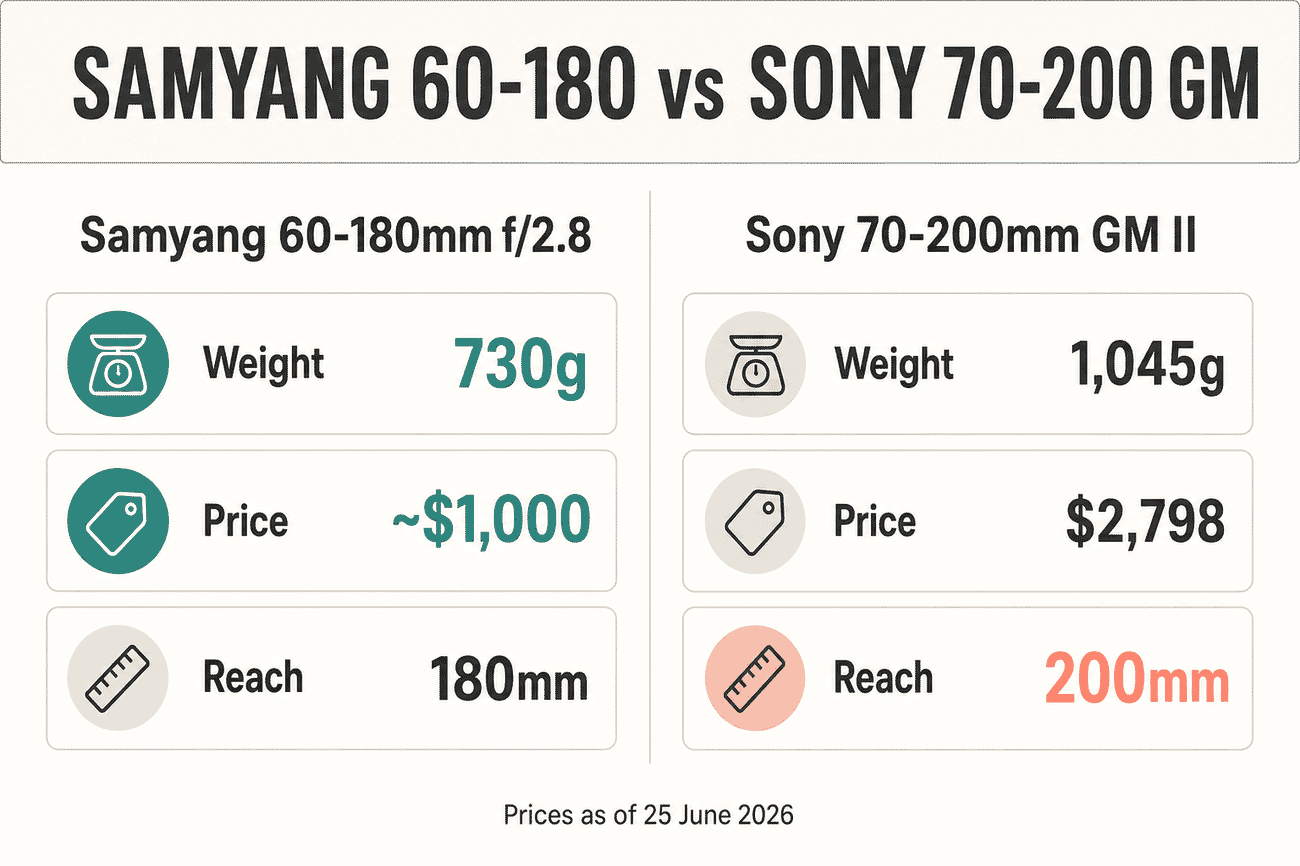
Against the Sony FE 70-200mm f/2.8 GM OSS II — the obvious benchmark — the Samyang is about 315g lighter (730g vs 1,045g) and roughly a third of the price ($1,000 vs $2,798). The trade-offs are real and worth naming: the Samyang gives up 20mm of reach at the long end (180mm vs 200mm) and, unlike the Sony, has no optical stabilization, so it leans on the camera body’s in-body IS. It also starts at 60mm rather than 70mm, which is slightly more useful for tighter group shots and environmental portraits.
The Sony community reaction has centered on exactly that calculus: it is not a GM killer on specs, but for many shooters the value and weight win outright. The lens makes the most sense for event and wedding photographers who carry gear all day, portrait shooters who want fast glass without the cost, and budget-conscious wildlife or sports hobbyists who can live with 180mm. For someone who needs the absolute reach, the stabilization, or the last few percent of optical polish, the GM still earns its premium.
Frequently Asked Questions
How much is the Samyang AF 60-180mm f/2.8 FE?
Around $1,000 at launch, with preorders opening at B&H and other major retailers. That is roughly a third of the price of Sony’s 70-200mm f/2.8 GM II.
Does it have image stabilization?
No optical stabilization in the lens — it relies on the Sony body’s in-body stabilization. Sony’s 70-200mm GM, by contrast, includes optical OSS.
What is the “trinity” it completes?
Samyang’s Compact Zoom series: the 14-24mm f/2.8, 24-60mm f/2.8, and this 60-180mm f/2.8. The three cover 14-180mm at a constant f/2.8 with no gaps, at a combined weight under 1.7kg.
Why is it 60-180mm instead of the usual 70-200mm?
The shorter range keeps the lens smaller and lighter, and starting at 60mm pairs cleanly with the 24-60mm sibling. The cost is 20mm less reach at the telephoto end versus a traditional 70-200mm.
The Bottom Line
The AF 60-180mm f/2.8 FE is less interesting as a single lens than as the keystone of a complete, genuinely light f/2.8 system for Sony shooters — one that costs a fraction of the first-party equivalent. It won’t replace a GM for the photographer who needs every millimeter of reach and in-lens stabilization. But for the much larger group who just want fast, constant-aperture zooms they can actually carry all day, Samyang and Schneider-Kreuznach have quietly built one of the more compelling value stories on E-mount.
Primary Coverage
- DPReview — LK Samyang AF 60-180mm F2.8 lens announcement – Full specs and the trinity framing.
- Sony Alpha Rumors — Just announced: new Samyang/Schneider 60-180mm f/2.8 FE – Press text, weights, and community reaction.
Manufacturer
- LK Samyang — AF 60-180mm F2.8 FE product page – Optical construction, AF motor, and control specs.
Image Sources
- Featured & kit images — LK Samyang product renders (featured staged via Photoroom) – Official Samyang product imagery.
- Comparison infographic & Pinterest pin — stylized PhotoWorkout illustrations – Original PhotoWorkout editorial graphics.