


- 7Artisans announced the AF 10mm f/2.5 MAX today, July 28, 2026: a full-frame fisheye with a 185-degree field of view, a 504g metal barrel, and, unusually, autofocus.
- It ships in three mounts at once, Sony E, Nikon Z, and L-mount, which is an aggressive launch for a budget lens maker moving into a specialist category.
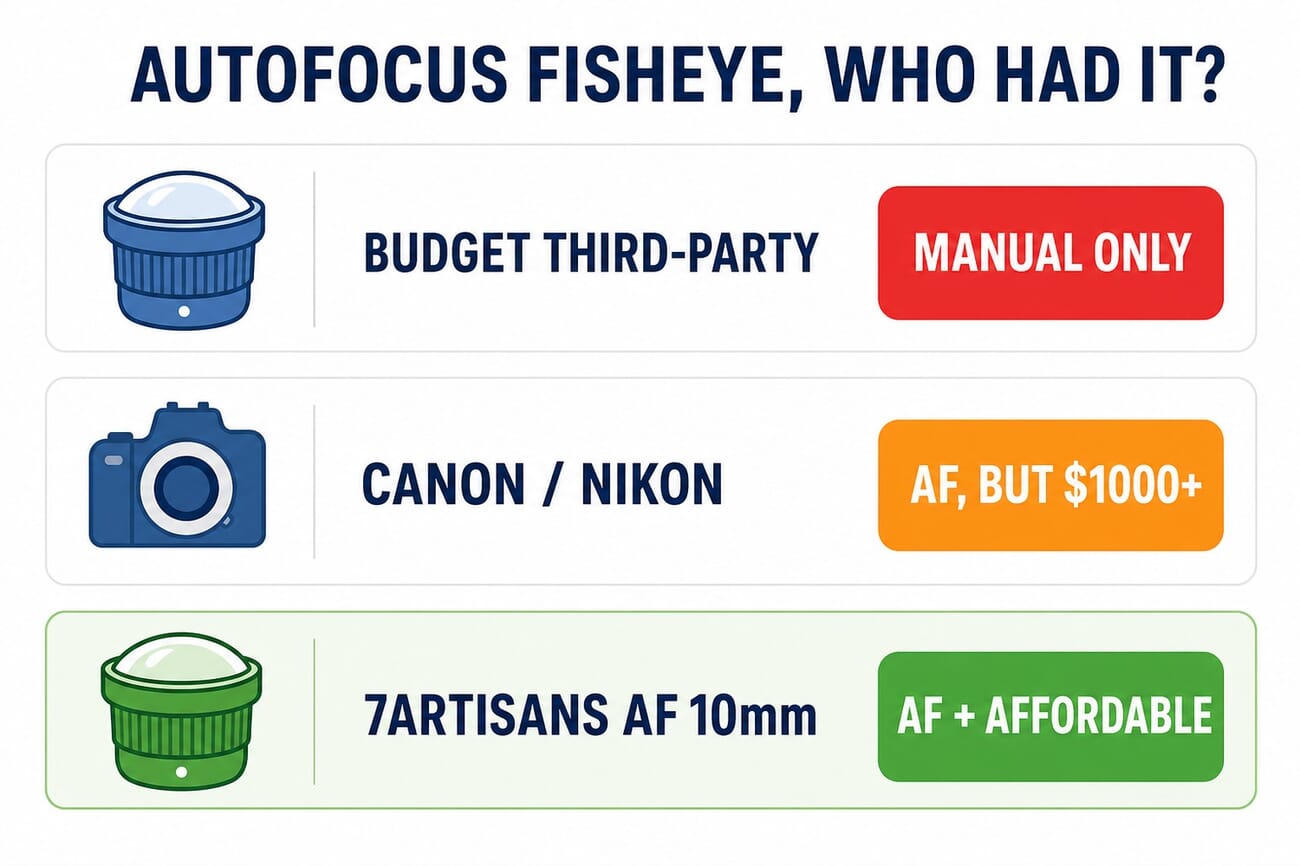
- The headline is the autofocus. In the mirrorless era, full-frame fisheyes have been almost entirely manual-focus, and the only autofocus options were pricey DSLR-era OEM zooms like Canon’s 8-15mm f/4L (around $1,100).
- This is the clean example of third-party glass out-innovating the big brands into the niches they abandoned. Viltrox, Meike, TTArtisan, and 7Artisans keep filling gaps Canon, Nikon, and Sony leave open.
- The catch: 7Artisans had not published a price or full optical data at announcement, and autofocus on a 185-degree lens is unproven in the real world. We will update once units are tested.
Fisheye lenses have been one of photography’s quiet backwaters for years. In the mirrorless era they have come almost exclusively as cheap, manual-focus primes from small third-party makers, or as expensive autofocus zooms that the big brands designed back in the DSLR days and never really modernized. Nobody built an affordable autofocus fisheye for mirrorless, because the niche was seen as too small to bother with.
7Artisans just bothered. Today, July 28, 2026, the budget lens maker announced the AF 10mm f/2.5 MAX, a full-frame fisheye with a 185-degree field of view and, the part that makes this news, autofocus. It launches in three mounts at once. On paper it is a small lens in a small category, but it is also a neat illustration of a much bigger trend: third-party glass is now out-innovating the OEMs straight into the corners of the market the OEMs walked away from.
What 7Artisans Just Announced
The AF 10mm f/2.5 MAX is a full-frame fisheye that projects a 185-degree field of view, wide enough to bend the entire scene, and a touch of what is behind the camera, into a single frame. It weighs 504g in a metal barrel, and it arrives for Sony E, Nikon Z, and L-mount on day one. The f/2.5 aperture is bright for a fisheye, which helps in the low-light and night-sky work these lenses are often bought for.
The defining spec is the one in the name: autofocus. It sits in 7Artisans’ newer MAX line of autofocus mirrorless lenses, a clear signal the company is moving beyond its manual-focus roots. What 7Artisans did not publish at announcement is a price or a complete optical breakdown, so minimum focus distance, close-focus behavior, and edge sharpness are still open questions. Those matter a lot on a lens this extreme.
Why an Autofocus Fisheye Is Actually a Big Deal
It is fair to ask why autofocus matters on a lens with a 185-degree view, where almost everything is in focus almost all the time. The answer is workflow. Manual-focus fisheyes are fine on a tripod for landscapes and astro, but they are a hassle for the fast, moving work fisheyes are increasingly used for: action and skate video, real estate and interiors walkthroughs, event and party coverage, drone-style handheld vlogging, and close-focus creative shots where the subject is inches from the front element. Autofocus, especially reliable close-focus autofocus, turns a specialist tripod lens into a run-and-gun tool.
Here is the part the “first autofocus fisheye” headlines gloss over, stated honestly: autofocus full-frame fisheyes do technically exist. Canon’s EF 8-15mm f/4L Fisheye USM (around $1,100) and Nikon’s AF-S 8-15mm f/3.5-4.5E (around $1,250) both autofocus. But both are DSLR-era zooms, big and expensive, usable on mirrorless only through an adapter. What has not existed is a native, affordable, autofocus fisheye prime built for mirrorless mounts. That is the specific gap 7Artisans is filling, and it is a real one.
The Real Story: Third-Party Glass Keeps Filling the Gaps OEMs Ignore
Zoom out and this launch fits a pattern that has been building for two years. The Chinese third-party lens makers, 7Artisans, Viltrox, Meike, TTArtisan, Brightin Star, and others, have stopped simply making cheap manual copies of existing lenses. They are now shipping autofocus glass into categories the majors treat as afterthoughts. We have covered Viltrox bringing autofocus primes to Micro Four Thirds, Meike’s fast autofocus portrait glass, and 7Artisans’ own move into cine primes. An autofocus fisheye is the next logical square on that board.
Launching in Sony E, Nikon Z, and L-mount simultaneously is the tell. A few years ago a small maker would test one mount and expand slowly. Doing all three on day one signals confidence, tooling, and a read that buyers across systems want the same thing: the specialist lens their camera brand never got around to building. Canon, Nikon, and Sony left the affordable mirrorless fisheye to others, and others took it, then added the feature the OEMs would have charged four figures for.
Who It’s For, and What We Still Don’t Know
If you shoot astro and night skies, skate or action video, real estate interiors, or creative close-focus work, a bright autofocus fisheye at a budget price is genuinely useful, not just a novelty. The 185-degree view and f/2.5 aperture suit the Milky Way and cramped interiors alike, and autofocus makes it viable for handheld and video use that a manual fisheye makes awkward.
The honest caveats are worth repeating. 7Artisans has not confirmed a price, though its track record (the manual 10mm f/2.8 sells for a little over $200) suggests this will land far below the OEM alternatives rather than near them. Autofocus accuracy and speed on such an extreme lens are unproven until reviewers get units, and budget fisheyes can struggle with corner softness, chromatic aberration, and flare. A same-day announcement is a promise, not a verdict. We will update this piece with pricing, availability, and real-world results as they land.
Frequently Asked Questions
Is the 7Artisans AF 10mm f/2.5 MAX really the first autofocus fisheye?
Not the first ever. Canon’s EF 8-15mm f/4L and Nikon’s AF-S 8-15mm are autofocus fisheye zooms from the DSLR era. But it appears to be the first affordable, native autofocus full-frame fisheye prime built for mirrorless mounts, which is the meaningful new thing here.
Which mounts does it come in?
Three at launch: Sony E, Nikon Z, and L-mount (Leica, Panasonic, Sigma). Launching in all three simultaneously is unusual for a specialist lens from a budget maker.
How much does it cost?
7Artisans had not published a price at announcement. Based on the brand’s pricing history (its manual 10mm f/2.8 sells for a little over $200), it should land well below the roughly $1,100 to $1,250 OEM autofocus fisheye zooms. We will update with the confirmed figure.
Why does autofocus matter on a fisheye?
Deep depth of field means much of a fisheye frame is sharp, but autofocus still helps for close-focus creative shots, handheld video, and fast-moving work like skate, events, and real estate walkthroughs. It turns a specialist tripod lens into a run-and-gun tool.
The Bottom Line
On its own, a budget autofocus fisheye is a small story. As a signal, it is a clear one. The third-party lens makers are no longer content to undercut the majors on price alone; they are beating them to features and formats in the categories the majors decided were not worth the effort. Canon, Nikon, and Sony left the affordable mirrorless fisheye unbuilt, and 7Artisans built it, then added the autofocus the big brands only ever offered in a four-figure zoom. Price and real-world performance will decide how good this specific lens is, but the direction of travel is hard to miss.
Featured image, comparison infographic, and pin: stylized illustrations created by PhotoWorkout. Fisheye rendering is illustrative, not a photo taken with the announced lens.
Announcement Coverage
- Photo Rumors – 7Artisans to announce AF 10mm f/2.5 MAX full-frame fisheye (E/Z/L) – Specs (185-degree, 504g, metal barrel), mounts, and the July 28 date.
- sonyalpharumors – 7Artisans 10mm f/2.5 MAX FE autofocus lens is coming on July 28 – Sony E-mount confirmation and MAX-line context.
- Digital Camera World – 7Artisans expected to announce new autofocus fisheye lens – Independent coverage and category context.
Image Sources
- Fisheye-view featured image, comparison infographic, and vertical pin – created by PhotoWorkout – Editorial illustrations; not photos taken with the announced lens.