

- On October 22, 2026, Etsy updated its listing image rules (in a post by VP of Customer Operations James Ossman): every listing must include at least one unaltered photo of the actual item against a real background. AI images may only supplement a real photo, bot-generated listings are barred, and AI-generated patterns and recipes are banned unless the listing shows a real result.
- Enforcement ramps up “in the coming months” with no hard effective date. Etsy says it will “leverage technology to better identify misleading imagery,” but it has named no verification standard: no Content Credentials, no C2PA, no metadata test. For now it is effectively an honor-system rule backed by human review.
- That is the real story. A major marketplace now demands proof a photo is real, while the one technology built to supply that proof cryptographically, at-capture Content Credentials, is gated to newsrooms (Canon), paid and press-only (Sony), suspended (Nikon), locked to premium bodies (Leica), or simply absent. The only free consumer camera that signs every shot is the Google Pixel 10.
- For sellers right now, the practical answer is simple: shoot honest, real photos and keep your untouched originals. There is no consumer-reachable way to cryptographically prove “unaltered” yet. The lasting takeaway is the growing gap between platforms demanding proof-of-real and a proof layer ordinary people cannot reach.
The pressure to prove a photo is real just reached one of the biggest marketplaces on the internet. On October 22, 2026, Etsy updated its listing image requirements to push back against AI slop: every listing must now include at least one genuine, unaltered photo of the actual item. It is a sensible, overdue rule for a platform built on handmade authenticity. It also quietly exposes an awkward truth about photo provenance in 2026.
Etsy is demanding proof that a photo is real, but the technology actually built to supply that proof, the cryptographic “Content Credentials” the camera industry has spent two years rolling out, is gated, paywalled, suspended, or missing from the device in most sellers’ pockets. A platform wants proof-of-real; the proof layer is not something a normal person can reach. Here is exactly what Etsy changed, and why the gap it reveals matters far beyond Etsy.
What Etsy actually changed
In a company blog post titled “Creativity and Trust in the Age of AI,” Etsy VP of Customer Operations James Ossman laid out updated expectations for its nearly six million sellers. The headline change is a photo requirement: every listing must include at least one unaltered image of the actual item for sale, shown against a real background, and every image must accurately represent the item’s true color, condition, scale, and material.
AI-generated images are not banned outright, but they are demoted to a supporting role. They may only supplement a real photo, and they must never misrepresent what the buyer will receive. Etsy also drew harder lines elsewhere: listings generated by bots are prohibited, and AI-generated digital patterns, recipes, and other instructions are banned unless the listing demonstrates a real, working result. The move follows a wave of buyer complaints, including NBC-reported cases of shoppers buying crochet patterns built around AI-made images of items that never actually existed.
Two things are notably absent. There is no hard effective date; Etsy says enforcement and removals will expand “in the coming months.” And there is no named verification method. The company says only that it will “leverage technology to better identify misleading imagery.” It has not said it will read EXIF metadata, check Content Credentials, or auto-detect edits. In practice, this is an honor-system rule enforced by human review and unspecified tooling.
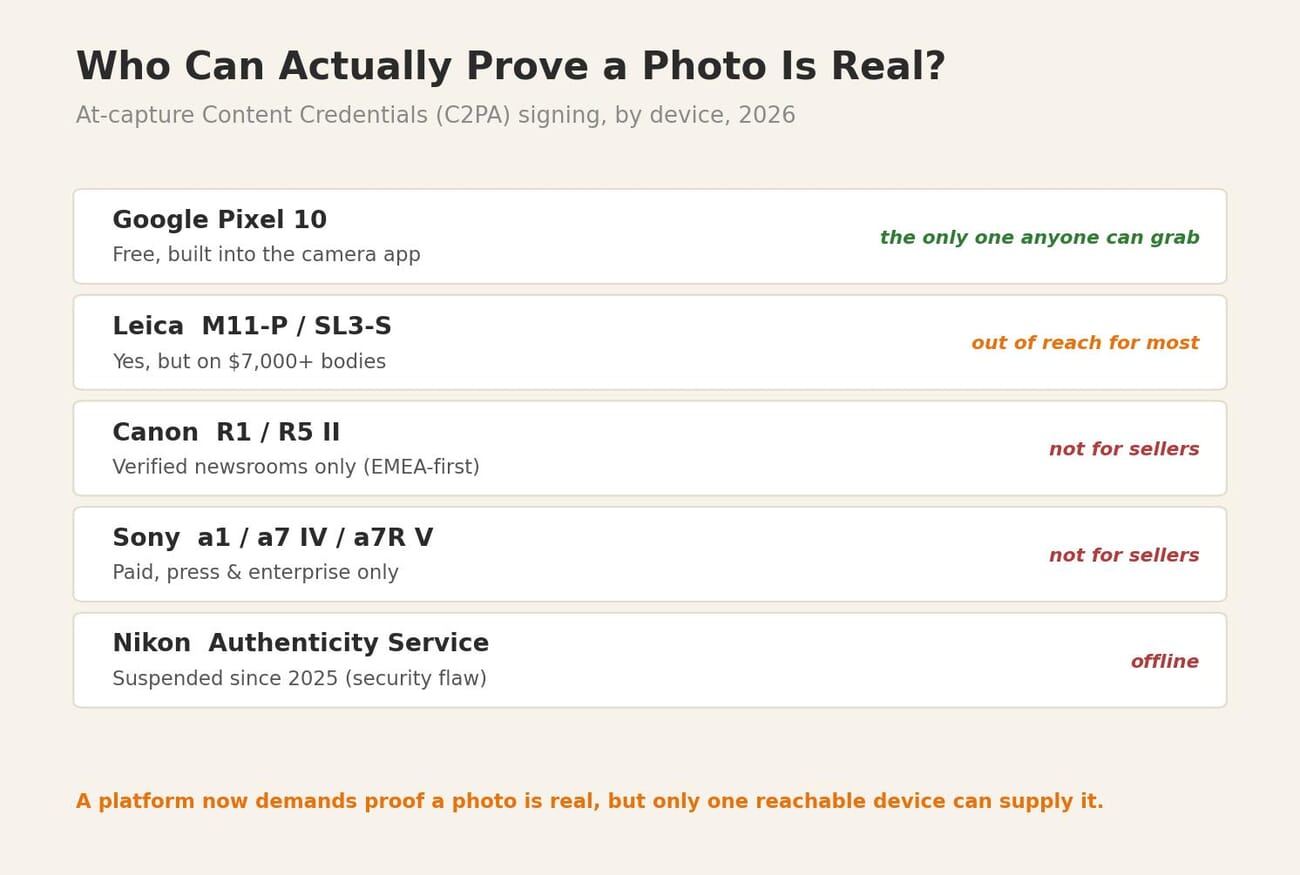
Etsy demands proof, but names no way to verify it
This is where the policy gets interesting for photographers. “Include an unaltered photo” sounds simple, but “unaltered” is a technical claim, and proving it is genuinely hard. The entire point of photo-provenance systems like C2PA Content Credentials is to answer exactly this question with cryptography: a tamper-evident record, written at the moment of capture, that travels with the file and shows whether and how it was edited.
Etsy references none of it. No Content Credentials, no C2PA, no metadata standard, no “verified camera” program. That is not necessarily a failure, most sellers would struggle to produce any of those today, but it means the rule has no objective test behind it. A listing is “unaltered” because the seller says so and a reviewer agrees, not because anything in the image can prove it. And despite the tough language, Etsy has not claimed it can automatically tell an edited photo from an untouched one. Given how unreliable AI image detectors remain, with frequent false positives and no appeal, that caution is probably wise.
The proof layer exists, but it is gated, paywalled, or suspended
Here is the part that makes this an industry story rather than just an Etsy story. The tool Etsy is implicitly asking for already exists. For two years, camera makers have been building at-capture Content Credentials, hardware-level cryptographic signing that stamps a photo as authentic the instant the shutter fires. The problem is who can actually use it.
Run down the list and the gap is stark. Canon‘s at-capture signing on the R1 and R5 II is licensed to verified news organizations and rolled out EMEA-first, not something a hobby seller can switch on. Sony’s “Write Digital Signature” on the Alpha 1, a7 IV, and a7R V is a paid feature aimed at press and enterprise customers. Nikon’s cloud-based Authenticity Service has been suspended since 2025 after a security vulnerability. Leica was first to market and remains the most complete, but only on bodies that cost many thousands of dollars. In other words, the proof exists, and almost nobody selling handmade candles can get to it.
There is exactly one exception, and it is the device already in a lot of pockets: the Google Pixel 10. It bakes Content Credentials into the stock camera app for every photo, for free, at the highest assurance level currently defined. It is, right now, the only consumer camera that lets an ordinary person cryptographically prove a photo came straight off a real sensor. A phone is the one place the proof layer actually reached the public, and even then, Etsy is not checking for it.
So how does a seller actually prove a photo is real?
Honestly? For now, you mostly cannot, at least not cryptographically. But the practical bar is lower than the technical one, because Etsy is not verifying credentials anyway. The realistic playbook: shoot genuine photos of your real product, keep the untouched camera originals rather than screenshots or re-exported copies, and avoid apps and uploads that strip EXIF data, since intact capture metadata is the closest thing most people have to a provenance trail. If verifiable provenance genuinely matters to you, a Pixel 10 is the one reachable device that signs at capture.
The uncomfortable truth is that an honest seller and a dishonest one can produce an identically “unaltered”-looking listing today, and neither can prove it with technology the other cannot. Etsy’s rule raises the expectation; it does not yet give sellers the means to meet it on paper.
The bigger picture: everyone wants proof, nobody can supply it
Etsy is not an outlier, it is the pattern. Photo contests are disqualifying AI entries, newsrooms are adopting signed-capture workflows, Apple is building “this is real” provenance into iOS, and marketplaces are now writing proof-of-real into seller policy. The demand for authenticity is everywhere. The supply, a simple, free, universal way for a normal person to prove an image is genuine, is not.
That mismatch is the real headline. Until at-capture signing is free and built into the cameras and phones ordinary people already own, the way the Pixel 10 hints it could be, “prove your photo is real” will keep outrunning anyone’s ability to actually do it. Etsy just made that gap impossible to ignore for six million sellers at once.
Frequently Asked Questions
What did Etsy change about product photos?
As of October 22, 2026, every Etsy listing must include at least one unaltered photo of the actual item against a real background, and all images must accurately show the item’s true color, condition, scale, and material. AI-generated images may only supplement a real photo and must not misrepresent the item. Bot-generated listings are banned, and AI-generated patterns and recipes are barred unless the listing shows a real result.
Does Etsy use Content Credentials or C2PA to verify photos?
No. Etsy has not named any verification standard. It says it will “leverage technology to better identify misleading imagery,” but it references no Content Credentials, no C2PA, and no metadata test. In practice the rule is enforced by human review and unspecified tooling, not an automated authenticity check.
How can I prove my product photo is unaltered?
There is no consumer-reachable way to cryptographically prove it yet. The practical steps are to photograph your real item, keep the untouched camera originals (not screenshots or re-saved copies), and avoid tools that strip EXIF metadata. The only free consumer camera that signs photos at capture with Content Credentials is the Google Pixel 10.
When does the Etsy rule take effect?
Etsy announced the update on October 22, 2026. There is no hard effective date; the company says enforcement and listing removals will expand “in the coming months.”
The bottom line
Etsy’s new photo rule is a reasonable, buyer-friendly move, and most honest sellers already do what it asks. But by demanding proof a photo is real, Etsy spotlighted a gap the whole industry has been circling: the cryptographic proof that would actually settle the question exists, yet it is locked behind press credentials, premium price tags, suspended services, and firmware most people will never touch. One free phone aside, ordinary creators have no way to prove what a platform is now asking them to prove. Fix that, make honest provenance free and universal, and rules like Etsy’s become enforceable. Until then, “show us an unaltered photo” is a request nobody can fully answer.
Based on Etsy's October 22, 2026 announcement and seller-handbook update, corroborating industry reporting, and public information on camera Content Credentials. Verified as of October 26, 2026.
Primary Coverage
- Etsy – Creativity and Trust in the Age of AI (James Ossman) – The official announcement of the updated listing image requirements.
- Etsy Seller Handbook – Important updates to AI use on Etsy – The detailed image rules: unaltered photo requirement and AI limits.
- PPC Land – Etsy forces sellers to show one unaltered photo in every listing – Independent reporting on scope and enforcement.
- Mashable – Etsy is cracking down on AI slop – Coverage of the banned AI patterns and recipes.
- Lumethic – C2PA Cameras in 2026: every model that signs at capture – The current list of at-capture Content Credentials devices (Leica, Sony, Pixel 10).
Image Sources
- PhotoWorkout camera-signing scorecard and pin – Original PhotoWorkout data graphic and illustration.
- Featured conceptual illustration – Stylized PhotoWorkout illustration on photo authenticity.