

- Eastman Kodak has released six new professional films: three Ektacolor Pro color negatives (ISO 160, 400, 800) and three Ektapan black-and-white negatives (ISO 100, 400, P3200).
- The films are rebranded versions of the beloved Portra and T-Max lines, now sold directly by Eastman Kodak instead of Kodak Alaris.
- Pricing starts at $10.99 per roll for Ektapan B&W and $16.99 per roll for Ektacolor Pro color — with early signs of more competitive pricing than existing Portra stock.
- Available now in 35mm and 120 formats at major retailers including B&H Photo.
Eastman Kodak has announced its biggest batch of professional film releases yet — six new stocks across two brand-new product lines. The Kodak Ektacolor Pro color negative films and Kodak Ektapan black-and-white negative films hit retailers on March 24, completing Kodak’s long-running mission to bring all of its photographic film distribution back in-house.
For the film photography community, this is a landmark moment. These films represent the return of Kodak’s most iconic professional emulsions — Portra and T-Max — under new retro-inspired branding and direct-from-factory distribution.
Ektacolor Pro: The New Portra
The Ektacolor Pro line is Kodak’s new name for what film photographers have known and loved as Portra — arguably the world’s most popular professional color negative film. The emulsions are the same; the branding and distribution are what’s changed.
Three speeds are available, all daylight-balanced:
- Ektacolor Pro 160 — Ultra-fine grain with exceptionally natural skin tones and smooth highlights. The cleanest, most detailed option in the lineup.
- Ektacolor Pro 400 — Billed as “the world’s sharpest and finest-grain 400-speed color negative film.” Versatile from bright daylight to low light.
- Ektacolor Pro 800 — The low-light specialist, offering strong underexposure latitude while maintaining natural skin tones and balanced color.
All three Ektacolor Pro films are available in both 35mm (135) and 120 (medium format). Kodak promises “outstanding exposure latitude” across the range, making them reliable for both amateur and professional photographers working in portraits, weddings, and commercial shoots.
Ektapan: T-Max Reborn
The Ektapan name is a revival — Kodak originally used it for a professional B&W film that was discontinued nearly 25 years ago. The new Ektapan films are essentially the T-Max lineup under vintage branding, featuring Kodak’s signature T-Grain emulsion technology.
T-Grain emulsions use flat, tabular silver halide crystals rather than traditional cubic grains. The result: better light absorption, lower grain, higher resolution, and sharper images with a “clean” look and distinct edges.
Three speeds are available:
- Ektapan 100 — The finest grain and sharpest option. Ideal for detailed architectural, landscape, and commercial work where maximum clarity matters.
- Ektapan 400 — Kodak calls it “the world’s sharpest and finest-grain 400-speed B&W film.” A versatile all-rounder.
- Ektapan P3200 — A multi-speed film optimized for push processing to ISO 3200 and beyond. The go-to for low-light and street photography situations.
Ektapan 100 and 400 are available in both 35mm and 120 formats. The P3200 variant is 35mm only.
What’s Really Going On: The Kodak vs. Kodak Alaris Story
Here’s the backstory that makes this announcement more significant than a simple rebrand. For over a decade, Kodak Alaris — a separate company spun off from Kodak’s bankruptcy — handled the distribution of Kodak’s photographic films, including Portra, T-Max, Tri-X, and Ektar.
Starting in September 2025, Eastman Kodak (the Rochester-based parent company) began bringing film distribution back in-house. The rollout has been methodical:
- September 2025 — Kodacolor 100 and 200
- November 2025 — Kodak Gold and Ultramax
- January 2026 — Ektar and Tri-X
- February 2026 — Ektachrome slide film
- March 2026 — Ektacolor Pro and Ektapan (today’s release)
With today’s release, every Kodak Professional film is now distributed directly by Eastman Kodak. The company has consistently said this direct-to-retailer model will improve both pricing and availability for photographers.
Why New Names? The Branding Strategy
Rather than simply slapping an Eastman Kodak label on the existing Portra and T-Max names, Kodak chose to revive vintage brand names — a move that’s generated plenty of discussion in the film community.
The Ektapan name has genuine historical roots in Kodak’s film catalog, though the original Ektapan was a different emulsion. Ektacolor, meanwhile, was historically associated with Kodak’s darkroom papers and chemicals rather than film — which has caused some confusion among photographers. It’s also phonetically close to Ektachrome, Ektar, and Ektapan, adding to the “Ekta-lot” naming complexity.
All six new films feature Eastman Kodak’s updated yellow, red, and black packaging — a retro-modern design that’s been a consistent thread across the entire Eastman Kodak film relaunch.
Old vs. New: The Complete Film Name Comparison
If you’re confused about which new Kodak film replaces which, this visual guide breaks it down. The emulsions are identical – only the names and packaging have changed:
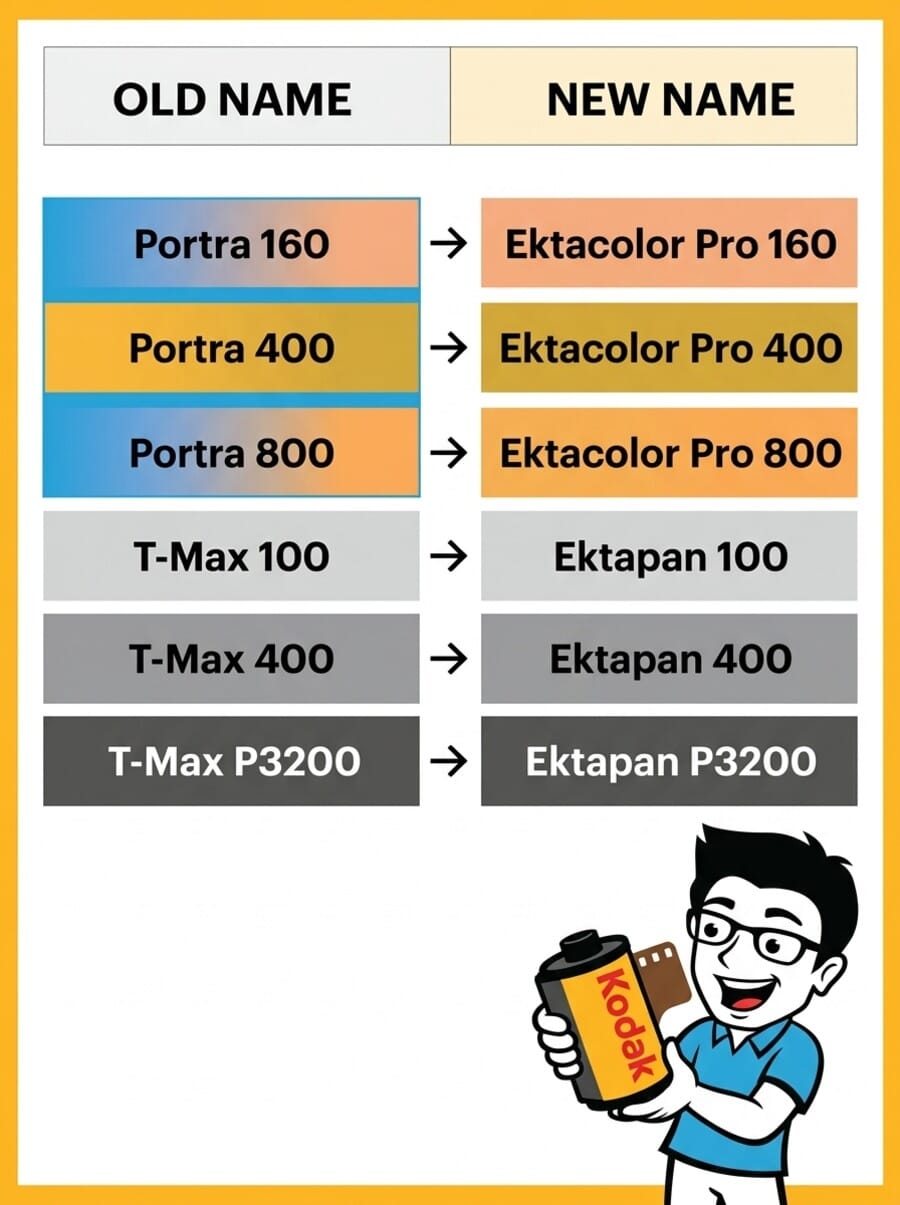
The History Behind the Names: Ektacolor and Ektapan Heritage
Kodak’s choice of “Ektacolor” and “Ektapan” isn’t arbitrary – both names have deep roots in the company’s 130+ year history, even if they weren’t originally used for the same products.
Ektacolor: From Darkroom Paper to Film
The Ektacolor name dates back to the 1950s, when Kodak introduced Ektacolor Paper – the company’s professional color printing paper for making high-quality prints directly from color negatives. Throughout the decades that followed, Ektacolor became synonymous with professional darkroom work. Variants like Ektacolor Portra, Ektacolor Supra, Ektacolor Ultra, and Ektacolor Edge were the papers of choice in commercial photo labs worldwide through the 1990s and 2000s.
Notably, Ektacolor was never a film brand until now. It lived exclusively in the printing and chemicals side of Kodak’s product line. The crossover from paper to film has raised eyebrows among photography historians, and it’s part of why some find the name confusing – especially given its phonetic similarity to Ektachrome (slide film) and Ektar (another color negative film that retained its original name).
Ektapan: A True Film Revival
The original Kodak Ektapan Film (4162) was a medium-speed ISO 100 panchromatic black-and-white film introduced for professional and commercial photography. According to Kodak’s own technical data sheet (Publication F-10), it featured “very fine grain” and was “well suited for portraiture and close-up work with electronic flash” as well as commercial, industrial, and scientific applications.
Kodak discontinued the original Ektapan around 2002 and officially recommended photographers switch to T-Max 100 as a replacement. Now, in a full-circle moment, the T-Max films themselves are being rebranded as Ektapan – a name that carries genuine heritage as a Kodak professional B&W film, even though the new Ektapan films use T-Grain emulsion technology rather than the original Ektapan’s conventional grain structure.
The “Ekta” prefix itself is one of Kodak’s most storied naming conventions, derived from the Eastman Kodak Trademark Archives. It has graced some of the company’s most iconic products: Ektachrome, Ektar, Ektagraphic, and now Ektacolor Pro and Ektapan. For longtime Kodak users, the prefix carries an immediate association with professional-grade imaging.
Pricing and Availability
All six films are available now at major retailers. Here’s the full pricing breakdown from B&H Photo:
Ektapan Black & White
| Film | 35mm (36 exp) | 120 (5-pack) |
|---|---|---|
| Ektapan 100 | $10.99 | $44.99 |
| Ektapan 400 | $10.99 | $48.95 |
| Ektapan P3200 | $13.95 | — (35mm only) |
Ektacolor Pro Color Negative
| Film | 35mm (36 exp) | 120 (5-pack) |
|---|---|---|
| Ektacolor Pro 160 | $16.99 | $64.95 |
| Ektacolor Pro 400 | $16.99 | $64.95 |
| Ektacolor Pro 800 | $19.95 | $89.95 |
Early pricing signals are encouraging — Portra has seen significant price increases over the past few years, and PetaPixel notes that the Ektacolor Pro rebrand appears to come with “a reverse of that trend.” Whether Eastman Kodak can maintain lower prices long-term remains to be seen.
Community Reaction: What Film Photographers Are Saying
The announcement sparked immediate discussion across the film photography community, with reactions ranging from enthusiasm to mild confusion.
On Reddit’s r/AnalogCommunity, the dominant sentiment was cautiously positive. “I’m happy to see Kodak flourish,” wrote one commenter, while another noted the competitive implications: “We need them to stay healthy if Fuji is going to continue to quiet quit.” The hope is that once Eastman Kodak fully reacquires all manufacturing and distribution rights, the company can invest more in expanding production capacity and even developing genuinely new emulsions.
The naming choice generated the most debate. Many photographers immediately recognized the films for what they are – “Yup, Ektacolor Pro is Portra and Ektapan is T-Max” was a common refrain. Some welcomed the retro branding as a nod to Kodak’s heritage, while others found the proliferation of “Ekta-” names (Ektachrome, Ektar, Ektacolor, Ektapan) unnecessarily confusing for newcomers to film photography.
Perhaps the most interesting community observation concerns pricing. While the Ektapan B&W films launched at essentially the same prices as the T-Max equivalents at B&H, the Ektacolor Pro color films arrived with prices that suggest a potential reversal of Portra’s recent price increases. Portra has seen steady price hikes over the past two years, and the Ektacolor Pro 160 and 400 launching at $16.99 per roll represents a more stable baseline. Photographers are hopeful that direct distribution will keep prices in check going forward.
Portra vs. Ektacolor Pro: Price Comparison
Here’s how the new Ektacolor Pro pricing compares to recent Portra prices (B&H Photo, March 2026):
| Film Stock | Portra (Kodak Alaris) | Ektacolor Pro (Eastman Kodak) |
|---|---|---|
| ISO 160 (35mm) | $17.99 | $16.99 |
| ISO 400 (35mm) | $17.99 | $16.99 |
| ISO 800 (35mm) | $20.99 | $19.95 |
The savings are modest per roll ($1-1.04), but they add up for regular shooters buying bricks of 5-10 rolls. More importantly, the trend matters: Eastman Kodak is pricing below the Kodak Alaris equivalent, signaling that direct distribution may indeed deliver on the promise of more competitive pricing.
What This Means for Film Photographers
The good news: the emulsions you love aren’t going anywhere. Whether you call it Portra or Ektacolor Pro, the same chemistry is producing the same beautiful results. The direct distribution model could mean better stock availability and potentially lower prices over time.
The broader significance is what this represents for the analog photography renaissance. Kodak isn’t just maintaining film production — it’s actively investing in bringing all of its film brands under one roof, streamlining distribution, and designing attractive new packaging. That’s a strong vote of confidence in the future of film photography.
If you’re a film shooter eyeing the new stocks, the practical advice is simple: they’re the same films you already know. Ektacolor Pro shoots like Portra. Ektapan shoots like T-Max. The chemistry hasn’t changed — just the box it comes in and who’s selling it to you.
For the broader analog photography ecosystem, this completes a transition that’s been years in the making. Every major Kodak professional film stock – from the consumer-oriented Gold and Ultramax to the professional Ektachrome, Tri-X, Ektar, and now Ektacolor Pro and Ektapan – flows through a single distribution pipeline controlled by the company that manufactures them. That vertical integration should make supply chains more efficient and responsive to the demand spikes that have plagued film availability in recent years.
It’s also worth noting the psychological significance. Kodak filing for bankruptcy in 2012 felt like a death knell for film. Fourteen years later, the same company is releasing six professional film stocks simultaneously, with fresh packaging, competitive pricing, and a clearly articulated long-term vision. Whether you call it Portra or Ektacolor Pro, that’s a remarkable turnaround story for analog photography.
Frequently Asked Questions
Is Kodak Ektacolor Pro the same as Portra?
Essentially, yes. Ektacolor Pro 160, 400, and 800 appear to be the same emulsions as Portra 160, 400, and 800, now rebranded under a new name and distributed directly by Eastman Kodak rather than Kodak Alaris. The speeds, formats, and image quality characteristics are identical.
Is Kodak Ektapan the same as T-Max?
Yes — Ektapan 100, 400, and P3200 match the T-Max lineup in speed, emulsion technology (T-Grain), and format availability. The Ektapan name is a revival of a classic Kodak brand that was discontinued about 25 years ago.
Will Portra and T-Max still be available?
Kodak Alaris may continue to sell existing Portra and T-Max stock, but Eastman Kodak’s direct distribution of the same emulsions under the Ektacolor Pro and Ektapan names is the path forward. It’s unclear how long both branded versions will coexist on store shelves.
Are the new films cheaper than Portra and T-Max?
Early pricing from B&H Photo suggests comparable or slightly lower pricing. PetaPixel reports that the rebrand appears to come with a reversal of Portra’s recent price increases, though long-term pricing will depend on market conditions and Eastman Kodak’s distribution costs.
Sources used for this article:
Featured image: Photo by Arturo Añez on Unsplash.


Get the Weekly Photography News Digest
Join photographers who get our top stories delivered every Monday morning. No spam, unsubscribe anytime.