


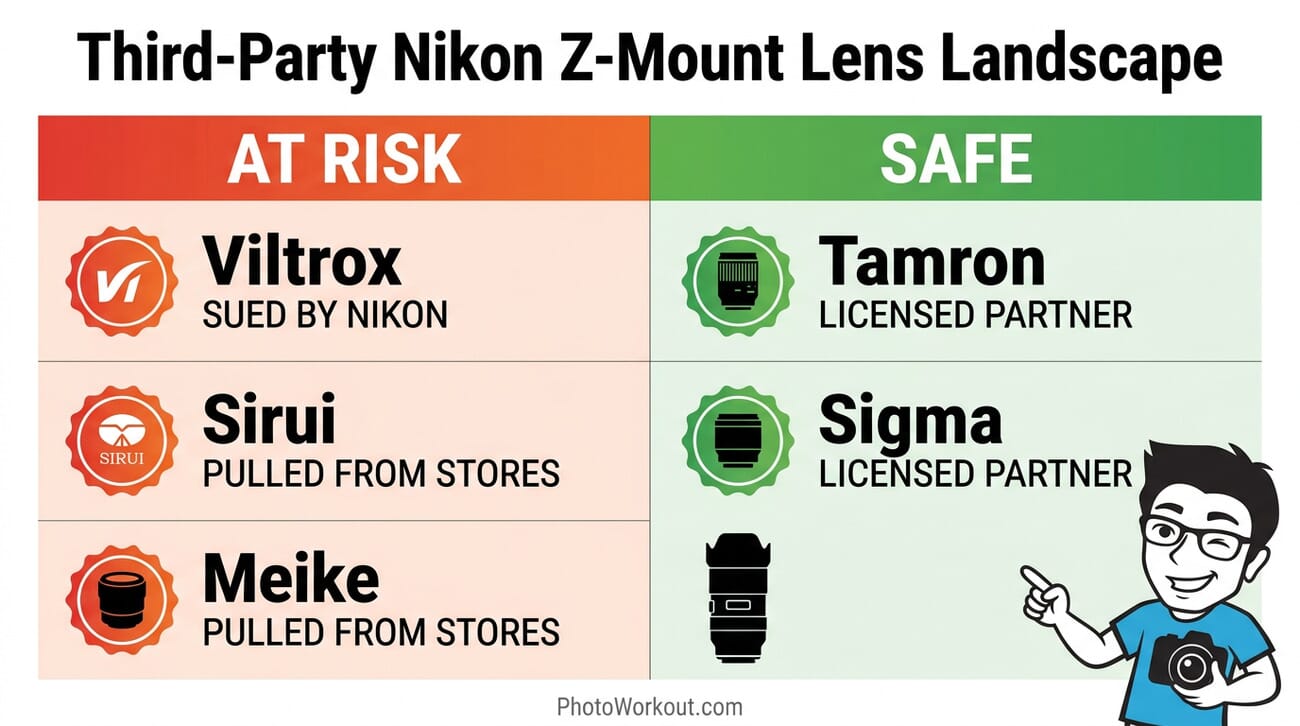
- Nikon has filed a patent infringement lawsuit against Viltrox in the Shanghai Intellectual Property Court, targeting Z-mount electronic communication protocols.
- Sirui and Meike have preemptively pulled Z-mount lenses from Chinese retail platforms, likely fearing similar legal action.
- Tamron and Sigma make Z-mount lenses under official Nikon license agreements and appear completely unaffected.
- Budget-conscious Nikon Z shooters face fewer affordable third-party lens options in the short term — but existing lenses should continue working.
The affordable third-party lens market for Nikon Z-mount shooters is in turmoil. In January 2026, Nikon filed a patent infringement lawsuit against Chinese lens manufacturer Viltrox — and the ripple effects are already forcing other brands off store shelves.
Sirui and Meike have quietly removed their Z-mount lenses from major Chinese retail platforms. While neither company has been directly sued, the move appears preemptive — a sign that Nikon’s legal offensive is reshaping who gets to make lenses for its mirrorless cameras.
Nikon vs. Viltrox: The Lawsuit
The case was filed in the Shanghai Intellectual Property Court under case number (2025) Hu73 Zhi Min Chu No. 182. Nikon is suing Shenzhen Viltrox Technology Co., Ltd. along with its parent company Shenzhen Jueying Technology Co., Ltd. and local distributor Shanghai Qiuhong Photographic Equipment Co., Ltd.
The lawsuit centers on what Chinese patent law calls the “provisional protection period” — the window between when a patent application is published and when it’s formally granted. Nikon alleges that Viltrox manufactured and sold Z-mount lenses using Nikon’s patented technology during this period. Now that the patent has been approved, Nikon is seeking retroactive royalties for those sales.
The hearing was scheduled for March 2, 2026. Nikon has neither confirmed nor denied the lawsuit publicly but told PetaPixel: “Nikon has always worked with officially licensed partner companies to expand the Z-mount ecosystem.”
The Patents at Stake
According to patent attorney Dr. Bernard Dippenaar and analysis by Professor Bob Newman in Amateur Photographer, there isn’t a single “Z-mount patent.” Instead, the dispute likely involves electronic communication protocols — specifically, the electrical contact points and autofocus communication between a lens and the camera body.
While any manufacturer can physically build a lens that fits the Z-mount, enabling autofocus, image stabilization data exchange, and EXIF metadata requires interfacing with Nikon’s proprietary electronic systems. That’s where the patent protection kicks in — and where unlicensed manufacturers run into trouble.
Sirui and Meike Pull Z-Mount Lenses
In early March 2026, reports emerged that Sirui had removed all Z-mount lenses from its official Taobao stores and most Chinese distributors. The move was reported by Nikon Rumors and Chinese photography forum Camera Beta.
Shortly after, Meike followed suit. In a statement, Meike described the removal as temporary, attributing it to “inventory optimization” and claiming the company was “re-inspecting quality and coordinating distribution channels.” Meike stated that Z-mount lenses would return by the end of March.
It’s worth noting that at the time of writing, both Sirui and Meike Z-mount lenses remain available through US retailers like B&H Photo and Adorama. The pullback appears concentrated in the Chinese market, where Nikon’s lawsuit was filed.
Licensed vs. Unlicensed: Who’s Safe?
Not all third-party lens makers are in the same boat. Tamron and Sigma both produce Z-mount lenses under official licensing agreements with Nikon. These companies pay royalties and have access to Nikon’s mount specifications, meaning their lenses are fully sanctioned.
Chinese manufacturers like Viltrox, Sirui, Meike, TTArtisan, and 7Artisans appear to have reverse-engineered the Z-mount electronic protocols without formal licensing. While this was tolerated — or at least not actively challenged — for years, Nikon’s lawsuit against Viltrox signals a shift in enforcement posture.
The situation mirrors what Canon did with its RF mount. Canon took legal action against Viltrox over RF-mount lenses, and has maintained a relatively closed ecosystem. However, Nikon’s approach differs: rather than an outright ban, reports suggest Nikon is primarily pursuing royalties, potentially opening the door to future licensing agreements rather than shutting manufacturers out entirely.
What This Means for Buyers
If Nikon Z-mount is the current system — or one under consideration — here’s the practical impact:
Existing lenses should keep working. Even if Sirui or Meike stop selling Z-mount lenses permanently, lenses already purchased will continue to function. The main risk flagged by Chinese photography forums is that a future Nikon firmware update could potentially break compatibility, though this would be an aggressive and unusual move.
Budget options are shrinking — for now. Nikon Z shooters who relied on affordable Chinese-made alternatives (often priced at $200–$500, compared to $800+ for Nikon-branded equivalents) face fewer choices in the near term. Viltrox, Sirui, and Meike together represented the bulk of the budget Nikon Z lens market.
Licensed third-party lenses remain unaffected. Tamron’s and Sigma’s Z-mount lineups are safe bets. Both companies have been expanding their portrait and zoom offerings for Z-mount, and their licensed status means zero legal risk.
The used market may heat up. As supply tightens for unlicensed Z-mount lenses, used lens marketplaces could see increased demand and pricing for Viltrox, Sirui, and Meike Z-mount optics.
The Bigger Picture
Nikon has historically been more restrictive about third-party mount access than Sony (which opened up the E-mount specifications). The Viltrox lawsuit — combined with the Sirui and Meike withdrawals — suggests Nikon is tightening control over its Z-mount ecosystem at a time when third-party lenses had been flourishing.
The outcome of the Viltrox case will likely set the precedent. If Nikon secures a favorable ruling, expect more Chinese manufacturers to either seek formal licensing agreements or exit the Z-mount market. If the dispute results in a licensing framework, it could actually benefit consumers by legitimizing third-party lenses while giving Nikon royalty revenue.
For Nikon Z shooters, the Nikon Z lens roadmap and licensed third-party options from Tamron and Sigma remain the safest long-term investments. The era of unregulated budget Z-mount lenses may be coming to an end — but a more structured, licensed ecosystem could emerge in its place.
Will my existing Viltrox, Sirui, or Meike Z-mount lens stop working?
There is no indication that existing lenses will stop functioning. The lawsuit targets past royalties, not a product ban. The main theoretical risk is a future Nikon firmware update breaking compatibility, but this would be highly unusual.
Are Tamron and Sigma Z-mount lenses affected by this legal dispute?
No. Both Tamron and Sigma produce Z-mount lenses under official licensing agreements with Nikon. They are completely unaffected by the Viltrox lawsuit or the Sirui/Meike pullbacks.
Can I still buy Sirui and Meike Z-mount lenses in the US?
As of early March 2026, Sirui and Meike Z-mount lenses are still available through US retailers like B&H Photo and Adorama. The removal has been concentrated on Chinese retail platforms like Taobao.
How does this compare to Canon’s RF mount restrictions?
Canon also took legal action against Viltrox over RF-mount lenses and has maintained a closed mount ecosystem. Nikon’s approach appears slightly different — reports suggest Nikon is primarily seeking royalties rather than an outright production ban, which could lead to future licensing deals.
What should budget-conscious Nikon Z shooters do now?
Consider licensed third-party options from Tamron and Sigma, which offer excellent quality with zero legal risk. If purchasing Viltrox, Sirui, or Meike lenses, buy from established retailers with good return policies in case availability becomes an issue.
Featured image: Photo by Çağlar Oskay on Unsplash.
Sources used for this article:
Related Posts
Get the Weekly Photography News Digest
Join photographers who get our top stories delivered every Monday morning. No spam, unsubscribe anytime.