


- The Bolt Hunter is an AI-powered lightning camera trigger that uses predictive algorithms to compensate for shutter lag in real time.
- Built by storm chasers at Motion Horizons LLC, it has been field-tested across multiple storm seasons with real lightning sample photos to prove it.
- The Kickstarter campaign closed at over $106,000, more than 20x its $5,000 goal, and the product has since shipped.
- Now shipping at $349, in stock, the weather-sealed device features 48-hour battery life, Bluetooth and hardwired connectivity, and a dedicated Night Mode.
Lightning photography has always been one of the most thrilling – and most frustrating – genres in the hobby. You set up your tripod, dial in your settings, point your camera at the sky, and then… wait. And miss. And miss again. The core problem is simple physics: lightning is faster than your camera’s shutter response.
A new device called Bolt Hunter claims to have cracked that problem. Launched on Kickstarter on March 3, 2026, this AI-powered lightning camera trigger blew past its modest $5,000 goal, and unlike so many crowdfunders, it actually delivered: the campaign closed at over $106,000 and Bolt Hunter now ships as a finished $349 product.
What Is Bolt Hunter?
Bolt Hunter is a purpose-built lightning camera trigger developed by Motion Horizons LLC, founded by photographer and product designer Jeff Boyce. Unlike general-purpose camera triggers that try to do everything, Bolt Hunter was designed with a singular obsession: capturing lightning strikes with maximum reliability.
“We designed Bolt Hunter to address the complaints and shortcomings of every trigger on the market,” Boyce says. “Instead of building a do-it-all device that’s marginal at many things, we built something exceptional at one thing: lightning photography.”
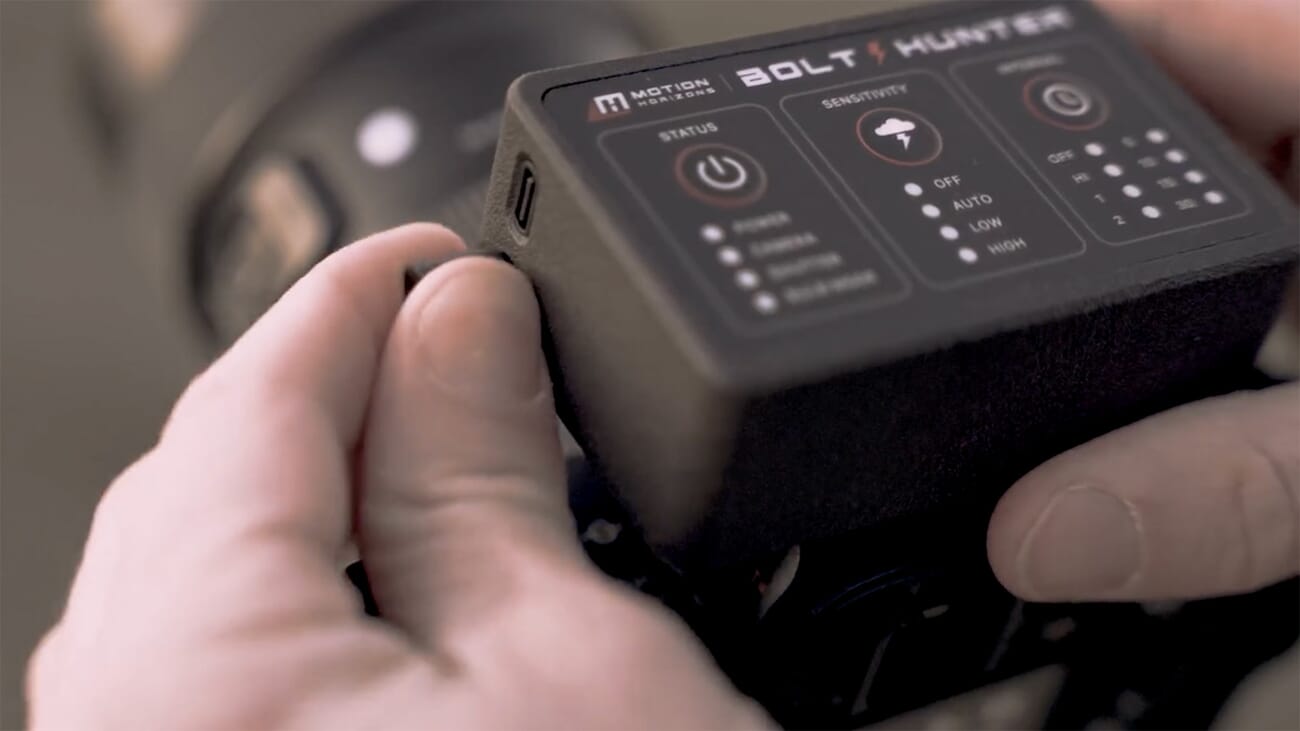
The device sits in your camera’s hot shoe and connects via a standard shutter release cable or wirelessly through Bluetooth. It’s compact enough to be portable, weather-sealed for obvious reasons (you’re literally pointing this thing at storms), and runs on an internal rechargeable battery rated for 48+ hours via USB-C.
How Bolt Hunter Works: Predictive AI vs. Traditional Triggers
This is where Bolt Hunter gets interesting. Traditional lightning triggers use simple optical sensors that detect sudden brightness spikes – essentially, they see the flash and fire the shutter. The problem? By the time a reactive trigger detects the light and your camera’s mechanical shutter actually opens, the best part of the lightning bolt is already gone.
Bolt Hunter takes a fundamentally different approach. According to Motion Horizons, the device detects faint intracloud precursor activity – the electrical signals that can precede visible lightning. It then does something no traditional trigger does: it measures your specific camera’s shutter lag and compensates for it in real time.
Here’s the clever part. The first detection in any lightning event is still reactive – there’s no way around that. But once a bolt begins, Bolt Hunter analyzes the return stroke timing and calculates when to fire subsequent exposures within milliseconds. The company calls this predictive triggering. It’s not predicting when lightning will strike a given location – it’s optimizing exposure timing once a lightning event is already underway.
For photographers who care about exposure settings and timing, this is a significant shift from “point the sensor at the sky and hope for the best.”
Night Mode and Key Features
Bolt Hunter operates differently depending on lighting conditions. During daytime storms, it fires the shutter in sync with lightning. But at night, it activates a dedicated Night Mode that works in reverse: it holds your shutter open in BULB mode and closes it when lightning strikes. This captures the earliest visible stages of a strike while limiting overexposure from repeated return strokes in the same frame – a common headache for anyone who has tried long exposure landscape photography during storms.
The device also automatically adjusts sensitivity as ambient light shifts, handling everything from bright sunset skies to complete darkness without requiring manual recalibration. Motion Horizons claims it can even trigger when pointed directly into the sun.
Other notable features include:
- Built-in intervalometer – Run a timelapse and trigger on lightning simultaneously, no extra accessories needed
- Lightning simulation mode – Test your camera configuration before the storm arrives
- Single-button operation – Works independently without the companion app for basic triggering
- Companion app via Bluetooth – Unlocks shutter lag measurement tools, predictive triggering controls, firmware updates, and connection monitoring
- Motion detection alerts – Notifies you if your camera tips or shifts position
- Auto-tightening cold shoe mount – With a sacrificial design that protects your camera body during falls (replaceable for about $15)
- 48+ hour battery life – Internal lithium battery, USB-C charging, no disposable 9V batteries
- Weather-sealed housing – Built to withstand heavy rain
Camera Compatibility
Bolt Hunter works with the vast majority of modern cameras, including models from Canon, Nikon, Sony, Fujifilm, Panasonic, OM System, Pentax, Leica, Hasselblad, and Sigma. It uses standard, non-proprietary shutter cables for hardwired connections.
For cameras without a dedicated shutter port (like the Canon R50), Bolt Hunter supports Bluetooth Low Energy triggering. It also supports USB-C shutter connectors on newer models. Whether you’re shooting with one of the best cameras for night photography or a more budget-friendly body, compatibility shouldn’t be an issue.
Field-Tested by Storm Chasers
What separates this Kickstarter from vaporware concepts is the field testing. Bolt Hunter has been used by named storm-chasing photographers across the 2023-2025 storm seasons, and the campaign features real-world sample images captured with pre-production units.
Veteran storm chaser John Sirlin, with over 30 years of experience, calls it “better than anything I’ve used before.” Connor Healey, a 1st place winner in the Siena International Photo Awards, says his “capture rate is absolutely insane.” Lori Grace Bailey, a professional photographer and lightning strike survivor (yes, really), describes it as her “go-to for its rock solid performance and durability.”
Those are strong endorsements, and the fact that they come from identifiable professionals with public portfolios – not anonymous testimonials – adds credibility. For anyone serious about improving their photography, this kind of specialized gear can make a real difference in niche genres like storm photography. For a broader look at settings and techniques for shooting after dark, see our complete night photography guide.
The Kickstarter Campaign
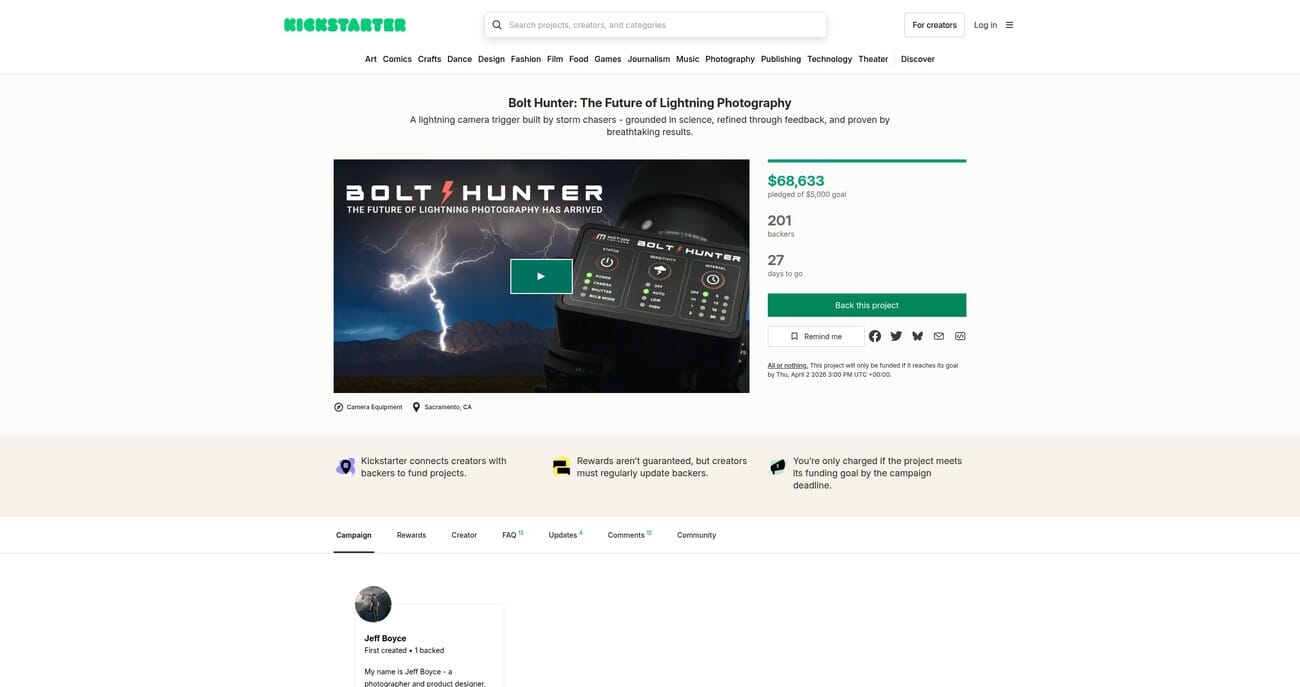
The numbers speak for themselves. Bolt Hunter launched on Kickstarter on March 3, 2026, with a humble $5,000 goal. The campaign closed having raised over $106,000 from more than 200 backers, over 20x the original goal, and Motion Horizons went on to deliver.
The overwhelming response suggests real demand for a purpose-built, high-performance lightning trigger – especially one that goes beyond simple light-sensor reactivity.
Pricing and Availability
Bolt Hunter delivered on its Kickstarter timeline and is now a finished product. It sells for $349 through the official store at bolthunter.io, where it is listed in stock and shipping within two business days. Each unit includes a matching camera cable, a USB charging cable, and a wall charger. Kickstarter backers paid $279 to $329, so retail is only a modest step up.
It is sold directly through the Bolt Hunter website rather than through major camera retailers, and independent reviews from lightning shooters have started to appear.
Crowdfunded hardware so often slips or never ships that it is worth stating plainly: Bolt Hunter is one that came through. Working prototypes and field results turned into a real, buyable product roughly on schedule, a track record that matters far more than any pre-launch promise.
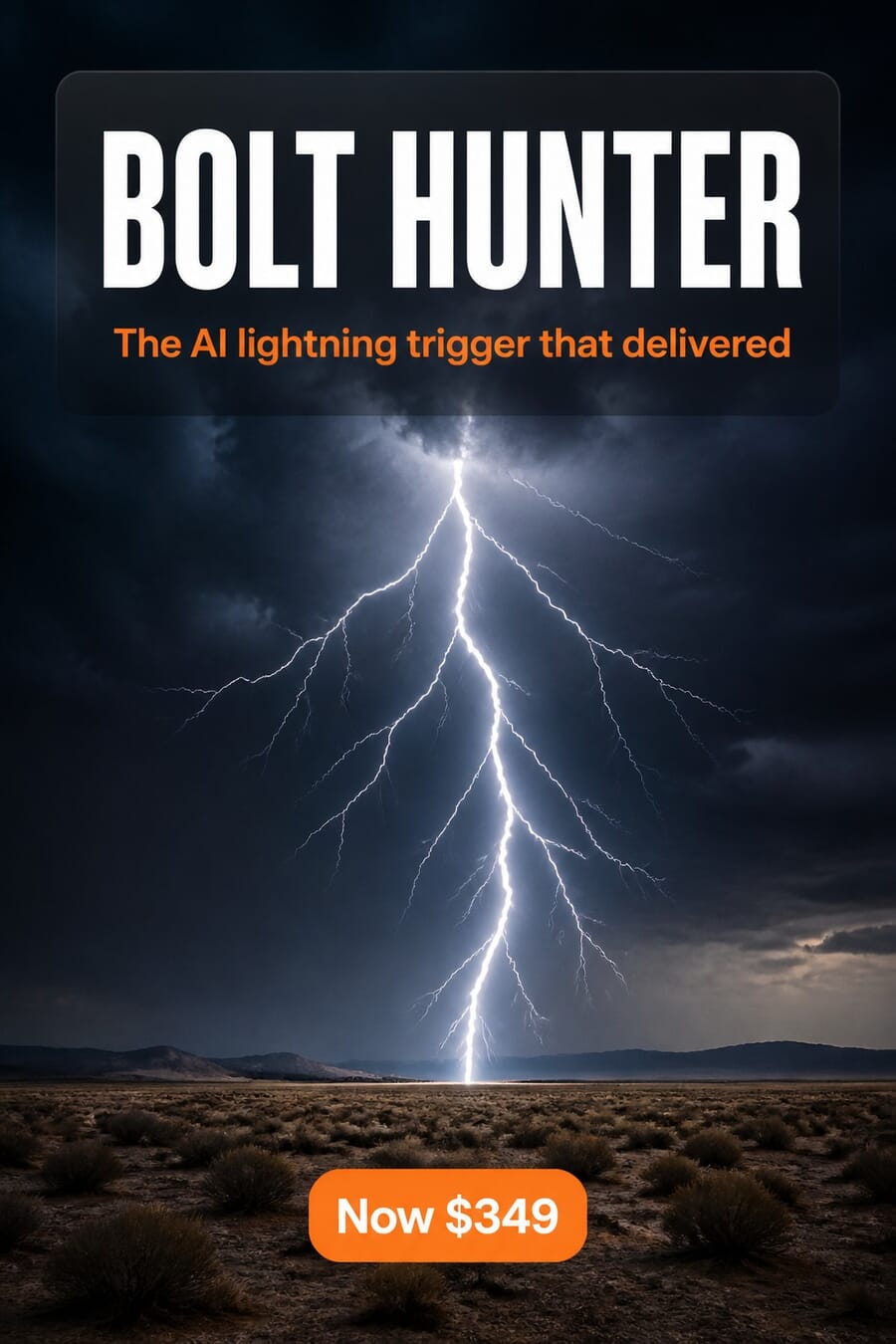
The Verdict: Now That It Has Shipped
Bolt Hunter is aimed squarely at a niche audience: storm chasers and lightning photographers who are frustrated with existing triggers. If you’ve ever set up a sturdy tripod, pointed your camera at a thunderstorm, and walked away with nothing but overexposed frames or empty skies, this device is speaking directly to you.
The predictive triggering approach is genuinely novel. Traditional triggers are purely reactive – they see light and fire. Bolt Hunter’s ability to measure individual camera shutter lag and time subsequent exposures within a lightning event is a meaningful technical advancement. Now that it has shipped and reached real buyers, early reviews from lightning shooters back up those field-tested claims.
For landscape photographers interested in adding storm photography to their repertoire, understanding your camera settings is essential. And if you’re already deep into long-exposure work with ND filters, a dedicated lightning trigger is the natural next step for storm season.
Featured image credit: Motion Horizons LLC / Bolt Hunter Kickstarter campaign.
Sources used for this article:
Reference
- Bolt Hunter camera trigger promises to solve the shutter lag struggle for lightning photographers – Digital Camera World
- Bolt Hunter Wants to Be the Storm Photographer's Best Friend – PetaPixel
- Bolt Hunter: The Future of Lightning Photography – Kickstarter Campaign – Kickstarter
- Bolt Hunter – Lightning Camera Trigger (Official Website) – Bolt Hunter
Image Sources
- Bolt Hunter product and field photographs – Courtesy Motion Horizons LLC / Bolt Hunter.
- Bolt Hunter promo pin – Stylized PhotoWorkout illustration.