


- Ricoh’s GR IV Monochrome is the first pocketable compact camera with a dedicated monochrome sensor, priced at $2,199.95 (as of February 2026).
- By removing the Bayer color filter, every pixel captures pure brightness data — delivering sharper detail, richer tonal gradation, and an extended ISO range up to 409,600.
- It shares the same body, 28mm f/2.8 lens, and 26MP resolution as the standard GR IV, but costs $700 more and shoots only black and white.
- Compared to the Leica Q3 Monochrom at $7,790, it offers a much more accessible entry point to dedicated monochrome photography.
- A built-in switchable red filter adds classic contrast effects — ideal for committed street and documentary photographers who think in black and white.
Ricoh GR IV Monochrome: A Dedicated B&W Sensor in a Pocket Camera
Ricoh has officially launched the GR IV Monochrome, a black-and-white-only version of its popular GR IV compact camera. Available since mid-February 2026 at a retail price of $2,199.95, the camera strips out the Bayer color filter array entirely, replacing it with a monochrome-dedicated APS-C CMOS sensor.
The result is a camera that cannot shoot color — ever. That sounds like a limitation, but for dedicated black-and-white shooters, it’s the point. Without the color filter, each pixel captures raw brightness information directly, eliminating the interpolation step that color sensors require. This translates to genuinely sharper images, finer tonal gradation, and significantly better high-ISO performance.
Until now, dedicated monochrome digital cameras have been exclusively the domain of Leica, with price tags starting well above $7,000. The GR IV Monochrome marks the first time a pocketable compact has offered this technology — and at roughly a third of what Leica charges.
What Makes a Monochrome Sensor Different
Every standard digital camera sensor uses a Bayer color filter array — a mosaic of red, green, and blue filters placed over individual pixels. Each pixel only sees one color of light, and the camera’s processor must interpolate (or “demosaic”) the missing color data to reconstruct a full-color image. This interpolation is remarkably effective, but it comes at a cost: some resolution is inherently lost in the process, and the color filter itself blocks roughly two-thirds of incoming light.
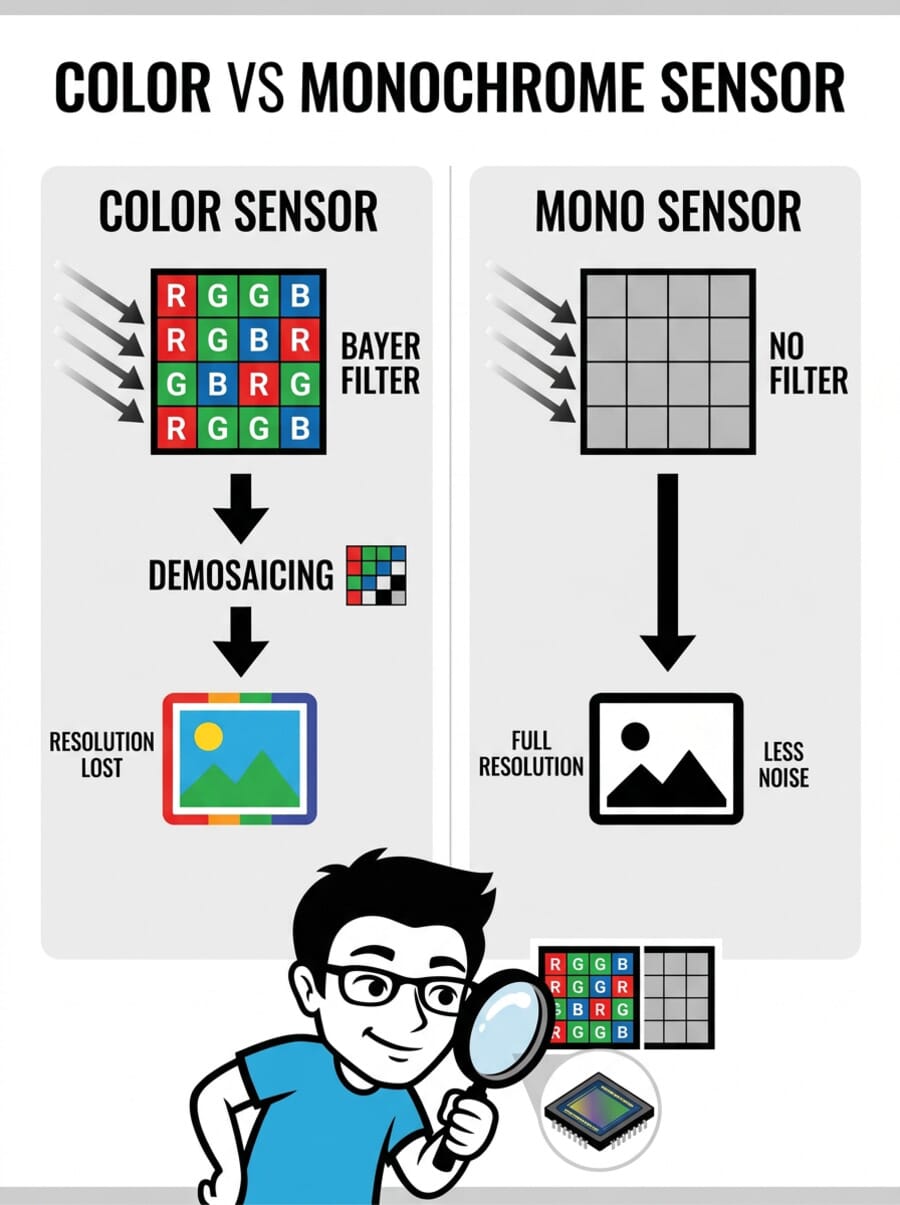
A monochrome sensor removes this filter entirely. Every pixel receives the full spectrum of light hitting it and records a single brightness value. No interpolation needed. The practical benefits are substantial:
- True per-pixel resolution — no demosaicing artifacts, no false color, no loss of fine detail
- Better light sensitivity — without the filter blocking light, the sensor captures more photons per pixel, resulting in cleaner high-ISO images
- Richer tonal gradation — smoother transitions from pure black to pure white, with more nuanced midtones
The difference is most visible in fine textures (fabric weave, architectural detail, skin pores) and in low-light shooting where a color sensor would produce noticeable noise. A monochrome sensor at ISO 6400 can look as clean as a color sensor at ISO 3200 — roughly one full stop of improvement.
GR IV vs GR IV Monochrome: What’s Different
The two cameras share the same body, lens, autofocus system, and processing engine. The differences are focused entirely on the sensor and the features built around monochrome shooting.
| Spec | Ricoh GR IV | Ricoh GR IV Monochrome |
|---|---|---|
| Sensor | APS-C BSI CMOS (color, Bayer filter) | APS-C CMOS (monochrome, no Bayer filter) |
| Resolution | 25.74 MP effective | 25.74 MP effective |
| ISO Range | 100–204,800 | 160–409,600 |
| Lens | 18.3mm f/2.8 (28mm equiv.) | 18.3mm f/2.8 (28mm equiv.) |
| Color Capability | Full color + B&W modes | Black and white only |
| Built-in ND Filter | Yes (2-stop) | No (replaced by red filter) |
| Built-in Red Filter | No | Yes (also acts as 2-stop ND) |
| Electronic Shutter | 1/4,000 max | 1/16,000 max |
| Image Stabilization | 5-axis sensor-shift | 5-axis sensor-shift |
| Storage | 53GB internal + microSD | 53GB internal + microSD |
| Weight | ~262g | ~272g |
| Body Finish | Standard with white GR logo | Matte black with semi-gloss black GR logo |
| Price (March 2026) | $1,499.95 | $2,199.95 |
The $700 premium buys the monochrome sensor, the built-in red filter, an electronic shutter that goes to 1/16,000 second, and six new monochrome-dedicated Image Control profiles (including “Solid” for crisp tonal curves and “Grainy” for a film-like finish). The body also gets a stealthier all-black aesthetic with a white power LED instead of the standard green.
How It Compares to the Leica Q3 Monochrom
Before the GR IV Monochrome, anyone wanting a dedicated monochrome digital camera had exactly one option: Leica. The Leica Q3 Monochrom retails for $7,790, and the M11 Monochrom costs $10,160 — before buying a lens.
The Ricoh undercuts the cheapest Leica monochrome by more than $5,500. Here’s what you trade:
- Sensor size: The Q3 Monochrom uses a full-frame 60MP sensor versus the GR IV’s APS-C 26MP. More resolution, more dynamic range, shallower depth of field.
- Lens: The Q3 has a Summilux 28mm f/1.7 — over a stop faster than the GR IV’s f/2.8. More light-gathering ability and background separation.
- Size: The Q3 Monochrom is a full-size camera weighing 743g. The GR IV Monochrome weighs 272g and fits in a coat pocket.
- EVF: The Q3 has a built-in electronic viewfinder. The GR IV relies on its rear LCD or an optional hot-shoe optical finder.
For street photography and travel — where pocketability matters more than ultimate image quality — the Ricoh makes a compelling case. The Leica delivers superior technical performance, but the GR IV Monochrome is the camera you’ll actually carry every day. At roughly 28% of the Leica’s price, it opens dedicated monochrome shooting to a much wider audience.
Early Reviews and Hands-On Impressions
PetaPixel’s hands-on review noted “less noise and better detail than with the standard GR IV with a black and white profile,” confirming the theoretical benefits of a dedicated monochrome sensor in practice. Reviewer Jaron Schneider praised the camera’s handling and the quality of the new monochrome Image Control profiles, while noting that the $2,200 price “is going to be hard to swallow.”
Fstoppers highlighted the practical benefits of the built-in red filter, which eliminates the need to carry and mount external filters — a significant convenience upgrade for street shooting. Their review also pointed out that the gap between JPEG and RAW quality narrows considerably on the monochrome sensor, making in-camera JPEGs a viable final output for many shooters.
The Verge described the GR IV Monochrome as “easily my most anticipated camera of 2026,” positioning it as a more attainable alternative to Leica’s monochrome lineup. Multiple reviewers noted the tighter, more tactile front command dial and the overall build quality improvements in the GR IV platform.
Ricoh GR IV Monochrome Sample Photos


Is the GR IV Monochrome Worth $2,200?
The honest answer: it depends entirely on how you shoot. Here’s a practical breakdown.
Consider the GR IV Monochrome if:
- The majority of finished work is already black and white
- Maximum tonal quality and detail in B&W is a priority
- Shooting in low light regularly and need cleaner high-ISO output
- Wanting a dedicated creative tool that forces commitment to the monochrome process
Stick with the standard GR IV ($1,499.95) if:
- Color photography is still needed — even occasionally
- B&W conversion in post-processing provides enough creative control
- The $700 savings matters more than the incremental quality gains
Converting a color photo to black and white in Lightroom or Capture One produces excellent results — good enough for the vast majority of photography. The monochrome sensor’s advantage is real but incremental. It shows up most clearly in high-ISO situations, fine detail rendering, and the purity of tonal transitions.
What the GR IV Monochrome offers beyond pixels is a creative commitment. Shooting with a camera that only sees in black and white changes how you see. Composition, light, and texture take priority over color, and that mental shift is something no software filter can replicate. For street photography, where the GR series has always excelled, this focus is a genuine advantage.
The GR series marks its 30th anniversary this year, tracing back to the film-era GR1 in 1996. The Monochrome variant represents Ricoh’s boldest addition to the lineup — and the most accessible dedicated monochrome camera ever made. Whether the $700 premium over the standard GR IV justifies the specialization is a personal call, but having the option at all is a win for photographers who think in black and white.
Featured image: Ricoh GR IV Monochrome product shot, AI-enhanced from official Ricoh press materials.
Sources used for this article:
Related Posts
Get the Weekly Photography News Digest
Join photographers who get our top stories delivered every Monday morning. No spam, unsubscribe anytime.