


- HSG (HongShan, the firm formerly known as Sequoia Capital China, with roughly $56B under management) is reported as the leading bidder to buy Leica Camera AG.
- The deal would start with Blackstone’s ~45% stake and could extend to the Kaufmann family’s ~55%, valuing Leica at about €1 billion, with a possible IPO down the line.
- The twist: Leica is the brand that pioneered camera-side photo authenticity. The M11-P (October 2023) was the world’s first camera to ship with C2PA Content Credentials built into the hardware.
- That raises a real question for a company whose entire proposition is trust and heritage: what happens to a provenance leader if a Chinese investment fund owns it?
- For photographers, the near-term product impact is likely small — but the symbolism, and whether Leica keeps leading on authenticity, is the story worth watching.
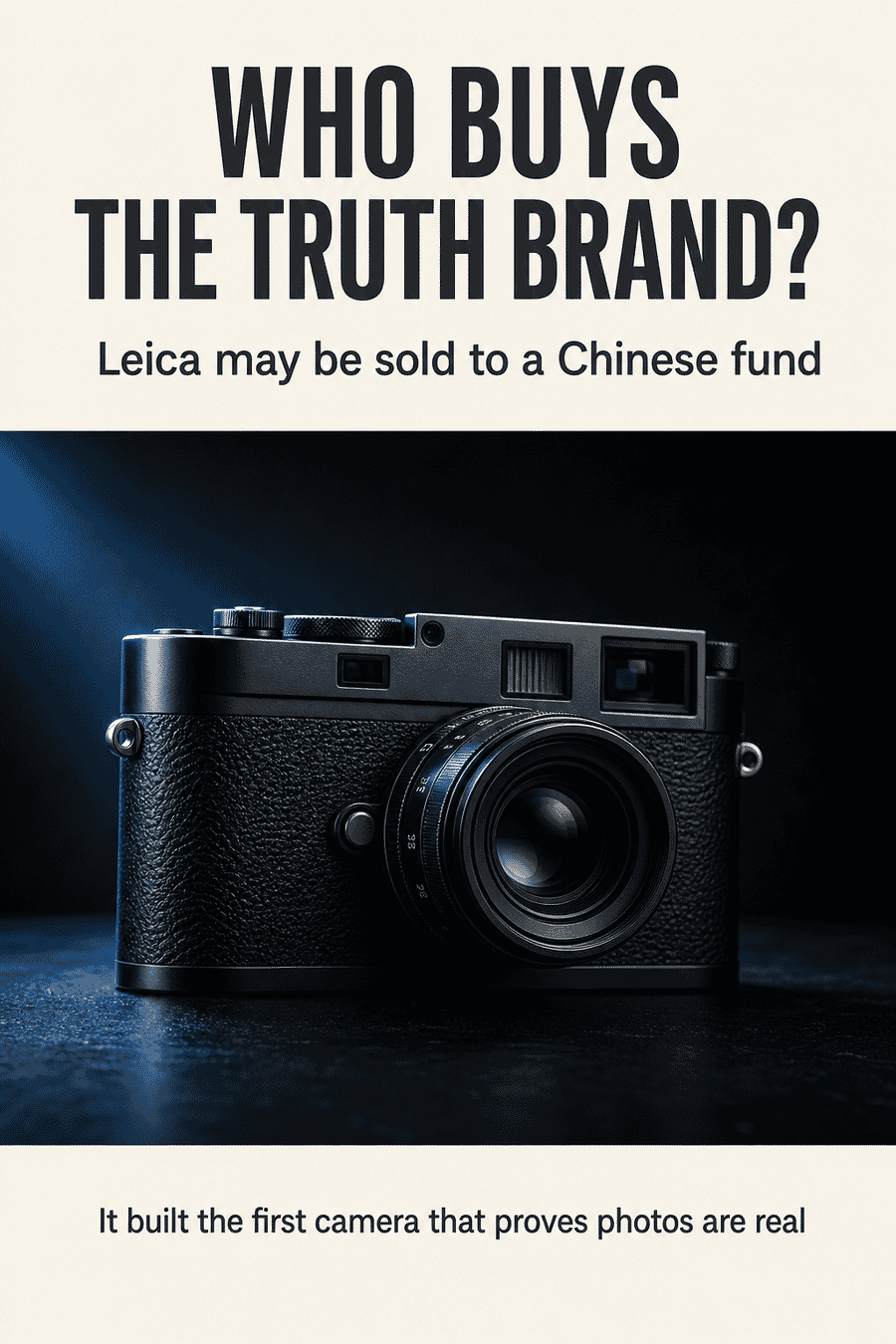
Leica is the brand that decided photographs should be able to prove they are real. In October 2023 its M11-P became the world’s first camera to ship with C2PA Content Credentials baked into the hardware — a cryptographic signature, captured at the moment of exposure, that travels with the file to show it came from a real camera and not an AI model. It was a genuine first, and a statement about what Leica stands for: trust, provenance, heritage.
Which is exactly why the latest news lands with some irony. Reporting now names a concrete buyer in advanced talks to acquire Leica: HSG, the Chinese investment firm formerly known as Sequoia Capital China. The generic “a Chinese giant might buy Leica” rumor has circulated for weeks. The specific, named deal — and what it means for a company built on authenticity — is the part worth slowing down for.
The Deal: HSG, Roughly €1 Billion, and a Possible IPO
According to Bloomberg’s reporting, HSG (HongShan) has emerged as the front-runner to buy Blackstone’s roughly 45% stake in Leica Camera AG — the holding the private-equity giant took as a strategic investor. People familiar with the talks say HSG may also pursue the remaining ~55% held by the Kaufmann family, led by Austrian billionaire Andreas Kaufmann, in a sale of control that would value Leica at around €1 billion. An eventual public listing has been floated as one endgame, and HSG is not reportedly the only suitor — Altor Equity Partners has also been linked to the process.
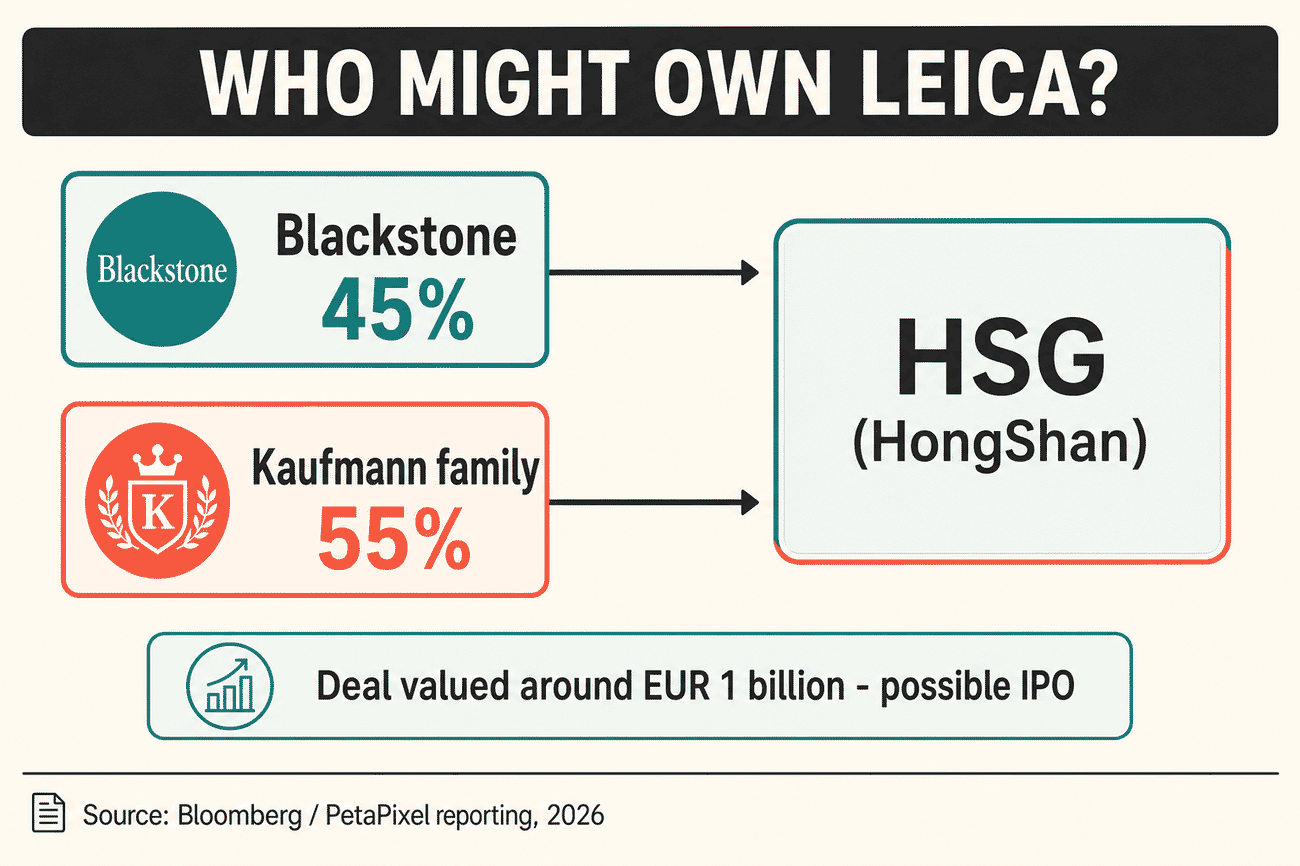
None of this is unprecedented for Leica. The company has been private-equity-backed for years through Blackstone’s minority stake, so a financial owner is not new. What is new is the specific identity of the lead bidder, and the prospect of a Chinese fund holding control of one of Germany’s most symbolically loaded brands.
What Leica Actually Pioneered: Cameras That Prove a Photo Is Real
To understand why the ownership question matters here more than it would for most camera makers, you have to understand what Leica chose to lead on. As part of the Content Authenticity Initiative, Leica shipped the M11-P in 2023 as the first production camera with C2PA Content Credentials, and then extended the feature by firmware to the SL3 and Q3. It put Leica at the front of an industry-wide effort to make images verifiable in an era when telling real from synthetic is getting genuinely hard.
That mission is more relevant by the month. We have written about how readers increasingly get accused of faking real photos, in our look at why your best shots get called AI and how to prove they are not, and about how AI detectors keep flagging genuine photographs as fake. Camera-side provenance — the thing Leica built first — is one of the few credible answers to that problem, which is what makes its stewardship worth caring about.
Why Ownership Matters for a Brand Built on Trust
Most acquisitions are judged on factories, margins and roadmaps. Leica’s most valuable asset is less tangible: a century of credibility, the Made-in-Germany promise, and now a leadership position in photo authenticity. Those are precisely the things an ownership change can complicate, fairly or not. The optics of a fund tied to China owning the brand that pioneered “prove your photo is real” write themselves, and Leica’s intensely loyal community will feel it even if the practical impact is minimal.
The sober read cuts the other way, though. HSG is a financial investor, not a competitor; its incentive is to protect and grow the brand value it is paying for, not dilute it. The C2PA standard itself is industry-led — driven by Adobe, the CAI and a broad coalition — so the technology does not live or die with Leica’s owner. And an IPO path could give Leica more capital to keep building, not less. The risk is less about sabotage and more about focus and signaling: does a new owner keep authenticity a priority, or quietly let Leica’s first-mover lead fade?
What It Actually Means for Photographers
In the near term, very little changes. Lenses keep coming, the cameras Leica just shipped keep working, and a sale of this kind plays out over quarters, not days — Leica even has fresh momentum, having just launched the SL3-P. Whoever ends up owning Leica has every reason to keep the things that make it valuable intact, including its provenance work.
The honest watch-item is direction, not disruption. Leica earned a unique position as the camera company that took authenticity seriously first. The question an HSG deal really raises is whether the next owner treats that as a core part of the brand worth defending and extending — or as a feature that quietly stops being a headline. For now, the cameras are unchanged and the deal is unsigned; the thing to track is who ends up holding the brand, and what they choose to do with its hard-won credibility.
Frequently Asked Questions
Who is trying to buy Leica?
HSG (HongShan), the investment firm formerly known as Sequoia Capital China, is reported as the leading bidder. It would buy Blackstone’s ~45% stake and may also pursue the Kaufmann family’s ~55%. Altor Equity Partners has also been linked to the process.
How much is Leica worth in the deal?
Reporting puts the valuation at around €1 billion for a sale of control, with a possible public listing floated as one eventual outcome.
Why does Leica’s role in photo authenticity matter here?
Leica’s M11-P was the world’s first camera to ship with C2PA Content Credentials (October 2023), later extended to the SL3 and Q3. It made Leica a leader in proving photos are real — so an ownership change raises questions about whether that leadership continues.
Will this change Leica’s cameras?
Not in the near term. The deal isn’t signed, and acquisitions like this play out over quarters. Existing cameras keep working, and a buyer has strong incentives to protect the brand’s heritage and its authenticity work.
The Bottom Line
A €1 billion deal that could put Leica in the hands of an ex-Sequoia China fund is a genuine business story, but the reason it resonates is symbolic: this is the company that decided cameras should prove a photo is real, and built the first one that does. The hardware won’t change overnight, and the C2PA standard outlives any single owner. The real test is whether Leica’s next chapter keeps authenticity at the center of the brand — or lets a first-mover lead quietly slip. Either way, who ends up owning Leica is worth watching.
The Deal
- Bloomberg — HSG said to lead bidding for Blackstone-backed Leica Camera – HSG as front-runner, Blackstone 45% stake, ~€1B valuation (May 29, 2026).
- PetaPixel — HSG is the leading bidder to acquire Leica – Summary of the reporting and IPO path.
Authenticity Legacy
- Content Authenticity Initiative — Leica launches world's first camera with Content Credentials – M11-P as the first C2PA camera (October 2023).
Image Sources
- Featured image — Leica M11-P product photo (staged via Photoroom) – Official Leica M11-P render composited into an editorial scene.
- Ownership infographic & Pinterest pin — stylized PhotoWorkout illustrations – Original PhotoWorkout editorial graphics.