


- Canon’s EOS R6 V, its $2,499 shutter-less, EVF-less, video-first full-frame body, shipped about two months ago with no flash capability at all, because with no mechanical shutter there was no conventional way to sync one.
- Firmware v1.1.0 (July 24, 2026) finally adds external Speedlite support: flash firing, E-TTL II metering, slow synchro, and full flash function and custom-function menus.
- The catch is the terms. Flash sync tops out at just 1/60s (very slow), and the R6 V has no traditional 5-pin hotshoe, so it only works with Speedlites built for Canon’s newer multi-function shoe, not older or third-party flashes.
- The wider lesson: as camera bodies drop the mechanical shutter, flash becomes the quiet casualty. A firmware update can restore the feature, but it cannot fully undo the physics of a slow sensor readout.
- The same week, Canon also shipped R6 Mark III firmware v1.1.0 (July 22) fixing FTP, USB, and interval-timer bugs, two R6-line firmware drops in three days.
When Canon launched the EOS R6 V, we flagged one glaring omission for a $2,499 full-frame camera: it could not use flash at all. Not a weak flash implementation, not a limited one, none. Now, about two months after the body reached buyers, Canon has addressed it in firmware. The fix is real, and for R6 V owners it is genuinely good news. But the fine print is the actual story, and it says a lot about where mirrorless design is heading.
Firmware version 1.1.0, released on July 24, 2026, adds external Speedlite support to the R6 V. It arrived alongside a separate firmware update for the R6 Mark III two days earlier, giving Canon’s R6 line two updates in three days. Here is exactly what the flash update fixes, the limitations it cannot escape, and why flash keeps turning into the quiet casualty of the shutter-less camera era. This is the sequel to our R6 V launch coverage: we told you the flash was missing, so here is what the firmware does and does not restore.
Why the R6 V Shipped With No Flash at All
The R6 V is a deliberately unusual camera. It is Canon’s video-first full-frame body: no mechanical shutter, no electronic viewfinder, active cooling for extended recording, and 7K RAW internal capture, all at $2,499. Stripping the mechanical shutter is central to that design. It cuts moving parts, enables silent capture, and suits a camera built around video first.
But the mechanical shutter is also what makes conventional flash sync work. A mechanical shutter can open the full sensor to a burst of light at a defined moment. An electronic shutter reads the sensor line by line instead, so a flash pulse only illuminates part of the frame unless the entire sensor is exposed at once, which only happens at slow speeds. With no mechanical shutter to fall back on, the R6 V simply had no way to fire a flash correctly at launch. It was not an oversight so much as a consequence of the sensor and the missing shutter.
What Firmware 1.1.0 Actually Adds
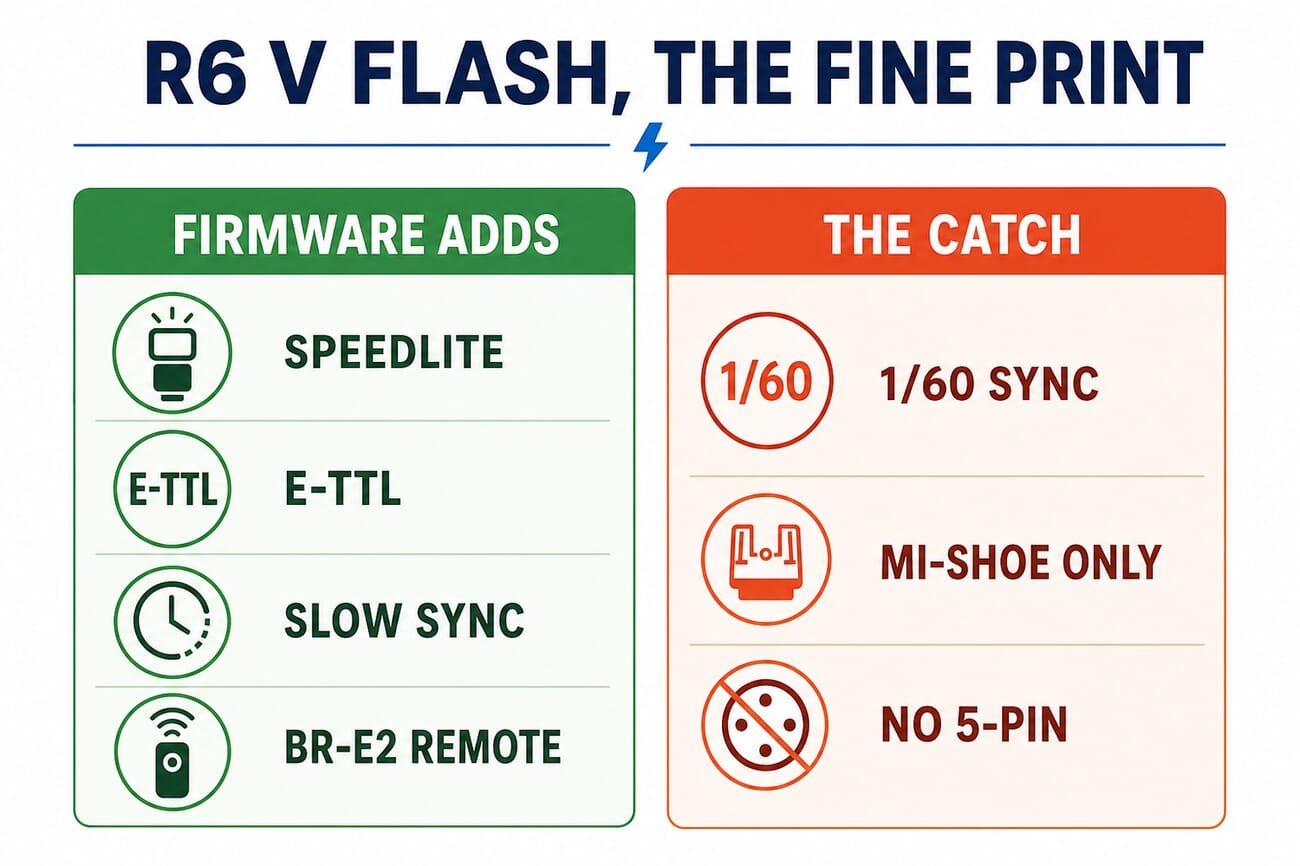
The update is more complete than a token fix. With v1.1.0 installed, the R6 V gains external Speedlite firing, E-TTL II metering with E-TTL balance control, slow synchro, and the full set of flash function settings and flash custom functions in the menu. In other words, once a compatible flash is attached, the camera behaves like a proper Canon flash system rather than a bolt-on.
Canon bundled other improvements in too: support for the new BR-E2 wireless remote controller, support for Canon’s software development kit for tethering and integration, and general bug fixes and stability improvements. It is a substantive firmware release, not just a flash patch.
The Catch: a 1/60s Sync Speed and No 5-Pin Hotshoe
Here is where the physics reasserts itself. Flash sync on the R6 V is capped at 1/60 of a second. By any modern standard that is very slow. A typical mirrorless body syncs around 1/200s to 1/250s, and high-speed sync pushes far beyond that. At 1/60s, you have almost no room to balance flash against bright ambient light. Daytime fill flash, freezing motion with flash, or overpowering the sun all become difficult or impossible without stacking on neutral-density filters and stopping down. For studio and low-light work at slow speeds it is fine; for anything involving daylight it is a real constraint.
The second limitation is physical. The R6 V does not have a traditional five-pin hotshoe. It relies on Canon’s newer multi-function shoe, so only Speedlites built for that interface will work. Older Canon flashes that depend on the classic center-pin hotshoe, and many third-party flashes and radio triggers that expect a standard hotshoe, are left out. If your lighting kit is built around older or third-party gear, the firmware does not bring it back.
Flash Is the Quiet Casualty of Dropping the Mechanical Shutter
Step back and the R6 V becomes a useful preview of a broader shift. Manufacturers are steadily moving toward electronic-only shutters for silent shooting, higher burst rates, and simpler, more durable bodies. The trade-offs are usually discussed in terms of rolling shutter distortion and banding under artificial light. Flash is the trade-off that gets talked about less, right up until you try to use one.
A fast, modern stacked sensor can read out quickly enough to support a usable flash sync speed even without a mechanical shutter. A sensor that reads out more slowly cannot, and no firmware can change the readout speed of the silicon. That is the real ceiling here. The R6 V story is a clean example of a pattern worth watching as more cameras go shutter-free: the feature can come back in software, but only within the limits the hardware allows. It is a different kind of consideration than the old worry about mechanical shutter wear on a used camera, and arguably a more important one for anyone who lights their work.
What This Means for R6 V Owners and Buyers
If you already own the R6 V, install v1.1.0. It is a clear upgrade that restores a capability the camera shipped without, and the added remote and stability fixes are worth having regardless. Just calibrate your expectations: this makes the R6 V usable with a compatible Speedlite for slow-sync and indoor or low-light lighting, not a daylight-flash workhorse.
If you are considering the R6 V and flash matters to your work, weigh the 1/60s ceiling and the multi-function-shoe requirement honestly. The R6 V remains a compelling video-first tool, and the 7K RAW and active-cooling package is genuinely strong for the price. But it is not built to be a flash-driven stills camera, and firmware has now defined exactly how far it will go. For hybrid shooters who need serious flash, a body with a mechanical shutter or a fast stacked sensor is still the safer pick.
Frequently Asked Questions
Does the Canon EOS R6 V support flash now?
Yes, as of firmware version 1.1.0 (July 24, 2026). It adds external Speedlite support including flash firing, E-TTL II metering, slow synchro, and full flash function and custom-function menus. The R6 V shipped about two months earlier with no flash capability at all.
Why did the R6 V launch without flash?
Because it has no mechanical shutter. Conventional flash sync relies on a mechanical shutter briefly exposing the whole sensor at once. An electronic shutter reads the sensor line by line, so at launch there was no supported way to fire a flash correctly. Firmware 1.1.0 enables flash within the limits the sensor readout allows.
What is the R6 V’s flash sync speed?
A maximum of 1/60 of a second, which is very slow compared with the 1/200s to 1/250s typical of most mirrorless cameras. That makes balancing flash against bright daylight difficult without neutral-density filters, though it is workable for indoor, studio, and low-light slow-sync shooting.
Which flashes work with the R6 V?
Only Speedlites built for Canon’s multi-function shoe. The R6 V has no traditional five-pin hotshoe, so older Canon flashes that rely on the classic center-pin connection, and many third-party flashes and radio triggers, are not supported.
Did Canon update the R6 Mark III too?
Yes. Canon released R6 Mark III firmware v1.1.0 on July 22, 2026, addressing FTP transfer (Err41), USB recognition, and interval-timer issues, and adding BR-E2 remote and SDK support. Combined with the R6 V update, that is two R6-line firmware releases in three days.
The Bottom Line
Canon deserves credit for restoring flash to the R6 V rather than leaving buyers stranded, and v1.1.0 is a proper implementation, not a token gesture. But the 1/60s sync ceiling and the multi-function-shoe requirement are the real headline, because they are set by hardware, not software. The R6 V is a reminder that as cameras shed the mechanical shutter, flash quietly moves from a given to a question you have to ask before you buy. Install the update if you own one, and read the fine print carefully if you are still deciding.
Featured image: Canon EOS R6 V product render (Canon), staged by PhotoWorkout. Infographic and pin: PhotoWorkout illustrations.
Firmware Coverage
- PetaPixel – Canon Adds Flash Support to the R6 V With New Firmware – Reports the v1.1.0 flash addition, the 1/60s sync cap, and the multi-function-shoe limitation.
- Canon Rumors – Canon has released firmware v1.1.0 for the EOS R6 V – Firmware breakdown and community context.
- Canon Australia – EOS R6 V Firmware Version 1.1.0 – Official firmware release notes.
Image Sources
- Canon EOS R6 V product render (Canon), staged by PhotoWorkout – Featured image.
- Flash fine-print infographic and vertical pin – created by PhotoWorkout – Editorial illustrations.