


- Leaked patent and prototype images show Insta360 developing its first pocket-sized selfie drone, with folding arms, ring-shaped ducted propeller guards, and a locking mechanism, aimed at effortless aerial selfies.
- The design lands squarely in the category DJI defined with the sub-$200 Neo, and the leaked look borrows from the DJI Flip’s fold and the Neo 2’s ducted guards (some analysts say it is actually closer to HoverAir’s fully folding form).
- So does Insta360 innovate or just copy DJI? The honest answer is both. It has a real record of category-creating ideas (consumer 360 cameras, the invisible selfie stick, and the world’s first 360 drone), but its recent expansion increasingly follows DJI into DJI’s own product categories.
- The fair verdict is fast follower with a 360 signature: Insta360 leads on its home turf of panoramic capture and follows DJI into adjacent categories, differentiating with 360. This is a patent, not a product, so treat it as a signal of intent, not a spec sheet.
A fresh batch of leaked patent images has Insta360 fans and drone watchers talking: the 360-camera giant appears to be building its first pocket-sized selfie drone. It is a small, folding flying camera clearly meant for grab-and-go aerial selfies, and it drops Insta360 straight into the fastest-growing corner of consumer drones, a corner DJI already owns.
Which raises a question worth asking honestly, and one a reader put to us directly: does Insta360 actually do its own product research, or does it just wait for DJI to invent a category and then follow? The patent is a perfect test case. Here is what it shows, how much it resembles a DJI Neo, and what Insta360’s track record says about whether this company innovates or imitates.
What the Patent Shows
The filing is real and public: it was published on February 3, 2026 as Chinese patent CN223865117U, assigned to Arashi Vision, Insta360’s corporate parent, and titled simply “a fuselage structure and a drone.” The images, drawn from that patent and prototyping documentation, depict an ultra-compact drone. The standout details are fully folding arms for pocketability, ring-shaped ducted propeller guards that protect the blades (and fingers), and a dedicated locking mechanism to keep it stowed. In short, a palm-sized flying selfie camera you can throw in a bag, built to follow the company’s Antigravity A1, its first drone.
Notably, the patent images show no sign of the protruding fisheye lens that defines Insta360’s panoramic cameras. That has fueled speculation: if the drone skips 360 capture, it competes head-on with DJI on price and features alone; if it adds panoramic shooting as a premium touch, cost control gets much harder in a drone supply chain Insta360 does not yet dominate.
It Looks a Lot Like a DJI Neo
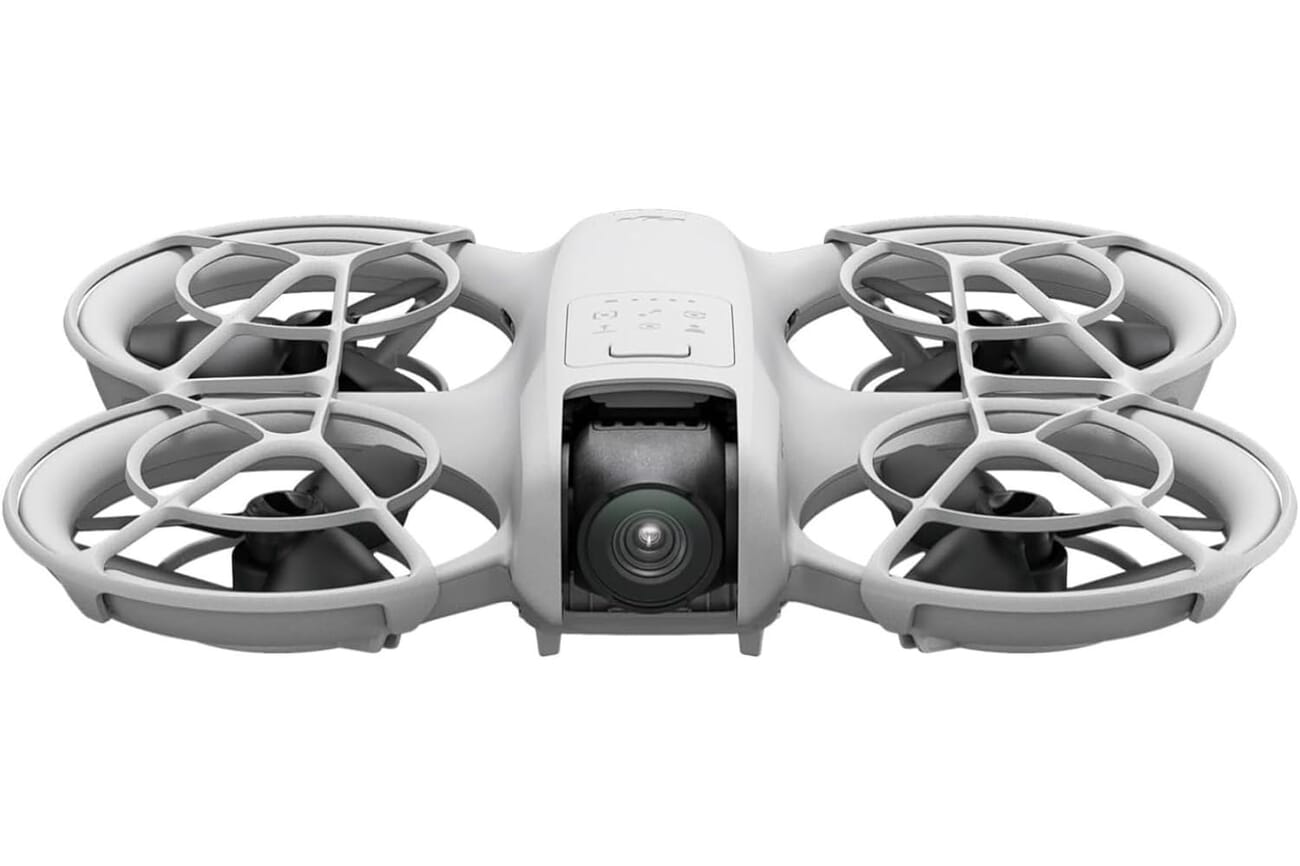
There is no getting around the resemblance. DJI’s Neo, launched in 2024 at roughly $200 (the Neo 2 followed at about $222), created the category this patent targets: a tiny, 135-to-151-gram drone with palm takeoff, intelligent subject tracking, and gesture control, no controller required. It has largely steamrolled the palm-sized tracking-camera niche that Zero Zero Robotics’ HoverAir pioneered.
The leaked Insta360 design reads as a blend of that lineage: the ducted propeller guards of the DJI Neo 2 and the folding form of the DJI Flip, though some analysts argue the fully folding storage design is actually closer to HoverAir than to DJI. Either way, Insta360 is not inventing this product type. It is arriving in a category others built, which is exactly what invites the copycat accusation.
So Does Insta360 Innovate, or Just Copy DJI?
This is the real question, and the fair answer is that Insta360 does both, in different arenas. Dismissing it as a pure copycat ignores a genuinely original track record; calling it a fearless innovator ignores how closely its recent roadmap shadows DJI.
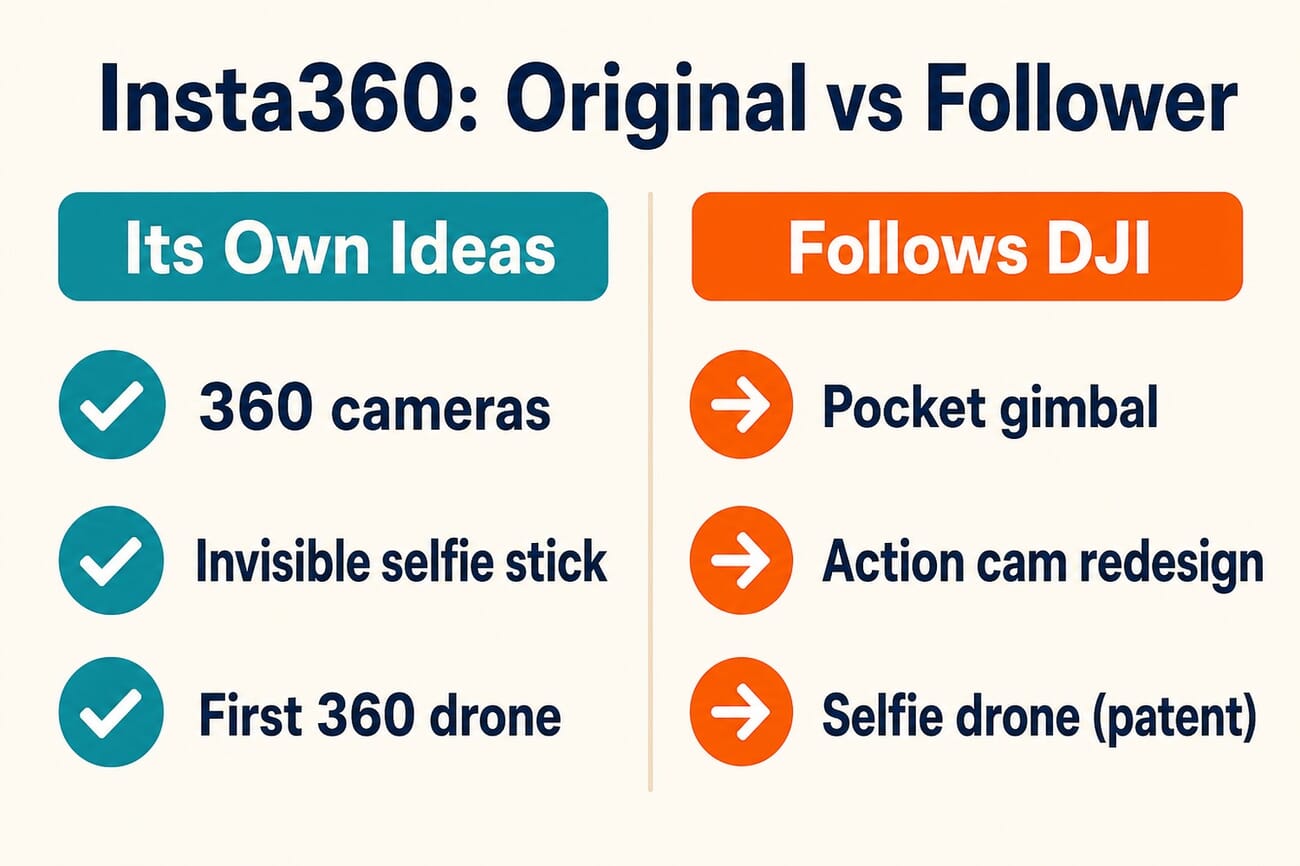
The innovation case is strong. Founded in 2015, Insta360 built the consumer 360-camera market and held roughly 67 percent of it by 2023. It popularized the “invisible” selfie stick that vanishes in 360 footage, pushed FlowState stabilization, and shipped genuinely novel products like the tiny magnetic Go series. Its Antigravity A1, launched under a dedicated sub-brand, is billed as the world’s first 360 drone, using advanced stitching to make the drone itself disappear from the shot. That is not imitation; DJI has no equivalent. The company’s 2025 IPO, which made founder JK Liu a billionaire, was built on real intellectual property.
The follower case is also real. Look at the recent roadmap and a pattern emerges. A leaked patent earlier this year pointed to a pocket gimbal camera aimed at DJI’s Osmo Pocket. The rumored Insta360 X6 redesign moves toward the streamlined look of the DJI Osmo 360. And now a selfie drone that lands in DJI’s Neo category. In each case, DJI defined the product type first and Insta360 followed, typically with a 360 or panoramic twist as the differentiator.
The honest verdict: Insta360 is a fast follower with a signature. It innovates hard inside its home discipline of 360 and panoramic imaging, then applies that lens to categories DJI opens up. That is a legitimate strategy, plenty of great companies win by refining rather than inventing, but it is fair to say the pocket drone is a case of following DJI into the water, not diving in first.
Why It Matters for Creators
For anyone who buys this gear, the copy-versus-innovate debate matters less than the result: more competition. The consumer drone space is shifting from a DJI-dominated duel with HoverAir into a three-way fight now that Insta360 is entering, and that pressure tends to push prices down and features up. A credible third player in the sub-$200 selfie-drone class is good news for creators, especially US buyers navigating a market where DJI faces import and certification hurdles.
Two caveats keep this grounded. First, it is a patent, a statement of where Insta360 is looking, not a product with a price or a release date. Companies patent designs they never ship. Second, matching DJI on cost in drones, a supply chain Insta360 does not yet command at scale, is a real challenge, especially if it wants to bolt on 360 capture. For the broader camera-brand shake-up this fits into, see our coverage of the Insta360 X6 clearing the FCC and GoPro fighting for survival.
Frequently Asked Questions
Is the Insta360 pocket drone a real product?
Not yet. So far it exists only in leaked patent and prototype images. There is no confirmed name, price, specs, or release date. A patent shows a company is exploring a design, not that it will ship it.
Does Insta360 copy DJI?
In part. Insta360 has real, original innovations, especially in 360 cameras, the invisible selfie stick, and the first 360 drone. But its recent expansion into pocket gimbals, action-cam redesigns, and now a selfie drone follows categories DJI created first. It is best described as a fast follower that differentiates with its 360 and panoramic technology.
How is it different from the DJI Neo?
Based on the patent, the hardware looks similar: a tiny folding drone with ducted propeller guards. Insta360’s likely differentiator would be panoramic or 360 capture, its core strength, though the leaked images do not show a 360 lens, so that remains unconfirmed.
What was Insta360’s first drone?
The Antigravity A1, launched under Insta360’s Antigravity sub-brand and billed as the world’s first 360 drone. It uses advanced stitching so the drone becomes invisible in the final 360 footage, a genuinely novel effect that has no direct DJI equivalent.
The Bottom Line
The Insta360 pocket drone patent is a neat snapshot of how this company actually operates. It is not a shameless clone, Insta360 has invented enough on its own to be taken seriously, and it is not a fearless pioneer here either. It is a fast follower with a real specialty, chasing DJI into a category DJI built while betting its 360 expertise can carve out a difference. For creators, the motive matters less than the outcome: a third serious drone brand pushing prices and features in the right direction. Whether this particular design ever leaves the patent office is the part still up in the air.
Primary Coverage
- CNIPA / Google Patents – CN223865117U, "A fuselage structure and a drone" (Arashi Vision / Insta360) – The verified patent filing, published February 3, 2026, filed January 27, 2025.
- Geeky Gadgets – Insta360 pocket drone patent – The patent report.
- FirstQuadcopter – Upcoming Insta360 products: Luna Pro, X6, and Pocket Drone – Patent design details and the DJI Flip/Neo comparison.
- BiggO Finance – From duopoly to three kingdoms: Insta360 vs DJI vs HoverAir – Folding design analysis, HoverAir comparison, and DJI Neo pricing.
- Antigravity – A1, the world's first 360 drone – Insta360's genuine drone innovation.
- Forbes – Insta360 founder becomes a billionaire upon IPO – Company history, 360 market share, and IPO context.
Image Sources
- DJI – Neo product image – The DJI Neo, the comparison drone.
- PhotoWorkout – concept drone image, comparison infographic, and pin – Editorial illustrations. The featured image is a generic concept drone, not the patented Insta360 design.