
Leica Just Quietly Killed Its Medium Format Mirrorless — What It Means for Fujifilm GFX

Key Takeaways
Leica Just Quietly Killed Its Medium Format Mirrorless — What It Means for Fujifilm GFX
  • Leica has dissolved the dedicated medium-format R&D structure that had been working on a new mirrorless MF camera since at least 2022. S-division staff have been reassigned to SL- and M-mount projects.
  • The cancellation lines up with Blackstone reportedly looking to sell its Leica share in a €1B deal — killing an unfinished high-cost program tightens the books before a sale.
  • Leica publicly confirmed and re-confirmed this MF camera was real for four years running. Dr. Andreas Kaufmann reaffirmed it as recently as May 2025. The quiet kill — no public statement — is the story.
  • Fujifilm GFX is now effectively unchallenged at the accessible end of medium format. Hasselblad (DJI-owned) and Phase One serve very different price tiers. The hoped-for three-horse race becomes a two-horse one — and one of those horses costs $40K.

For four years, Leica kept telling the photography world that a new mirrorless medium-format camera was coming. Stefan Daniel hinted at it in late 2022. The rumor was “confirmed” in 2023. It was “confirmed again” in 2024. In May 2025, Dr. Andreas Kaufmann personally went on the record — the camera is real, and is still being worked on.

This week, Leica Rumors reports the program has been quietly shut down. Multiple people familiar with Leica’s internal structure say the medium-format R&D activities have been “significantly reduced” — and that S-division development personnel have been progressively reassigned to SL- and M-mount projects. The dedicated medium format development structure itself, according to the report, has been dissolved.

Leica has not made any public statement. There is no press release announcing a cancellation, no roadmap update, no comment from Kaufmann or current management. The clearest signal that the camera is no longer coming is that the team that was building it no longer exists.

Why the Program Got Killed — and Why It’s Quiet

The most-cited reason inside the rumor chain is financial. Blackstone, the private-equity firm that holds the majority stake in Leica Camera, has reportedly been exploring a sale of its share in a deal valued at around €1 billion. The standard PE playbook before a sale is to clean up the income statement — kill experimental programs that are years from revenue, focus spend on the units that already print money, and present a tidy story to the next buyer. Leica’s SL mirrorless line and the M rangefinder system are both profitable established platforms. A medium-format mirrorless camera that hasn’t been announced, hasn’t been priced, and hasn’t shipped is exactly the line item that gets cut first.

That also explains the silence. Announcing a cancellation costs Leica credibility with the customers who were waiting and the camera press that has been writing about the project for four years. Letting the program disappear quietly, while reorganizing staff onto already-shipping product lines, achieves the cost-cutting goal without the PR hit. It is also harder to walk back if the next owner wants to revive it.

What This Camera Was Supposed to Be

The picture pieced together across years of leaks: a mirrorless successor to the Leica S system (which Leica officially discontinued with the S3 in 2022), built around a medium-format sensor, in a hybrid body that could shoot both stills and video. Leica had been describing it as a “large-format” hybrid in some 2023 communications — suggesting a sensor closer to 44 × 33 mm than full-frame, but also leaving room for something larger.

No mount system was ever confirmed publicly. The most-discussed possibilities were an extension of the L-Mount Alliance (which would have given the camera access to the Leica SL, Panasonic, and Sigma full-frame lens ecosystem with a crop) or a wholly new mount specific to the new format. Either route required years of native lens development. With the program now reassigned, neither will happen on Leica’s current timeline.

Fujifilm GFX Becomes the Default — Even More Than It Already Was

The current accessible-medium-format market is functionally a Fujifilm monopoly. The GFX 100S II body sits around $5,000, the 50S II under $4,000, and the lens range now includes pancakes, tilt-shifts, telephotos, and the rangefinder-styled GFX 100RF‘s fixed-lens variant. Fujifilm has been the only manufacturer aggressively expanding the format below $10,000.

Hasselblad — now owned by DJI — sells the X2D 100C at around $8,200 body-only, the smaller X1D successor lineage, and a beautiful but slim native lens range. Hasselblad has been doing one model release per generation, prioritizing build and color science over feature-list expansion. They are not positioned, financially or culturally, to chase Fujifilm into the GFX 50S II’s price tier. The DJI ownership has stabilized the brand, but not pushed it into volume.

Phase One sits at the other end entirely — the IQ4 150MP back system starts at around $40,000 and is a tech-camera digital back, not a body in the same category. Pentax 645Z, the last DSLR-style medium format body, was discontinued in spirit if not formally; Ricoh-Pentax has not announced a successor.

The hoped-for shape of the 2026-2027 medium-format market — Fujifilm, Hasselblad, Leica all pushing each other — collapses to one company doing volume and one company doing premium. There is no third player creating pricing pressure or feature pressure. Whatever Fujifilm decides to ship next at the affordable end of GFX, no competing manufacturer will undercut it.

Hand-drawn editorial sketch infographic: the 2026 medium format mirrorless market split into three price tiers, with Leica MF Mirrorless marked CANCELLED in an orange box pointing back to where it was intended to sit in the Premium Tier
The medium format mirrorless market at a glance — Fujifilm GFX dominates the accessible tier, Hasselblad anchors the premium slot, Phase One sits in its own ultra-premium category, and the Leica MF mirrorless slot now stays empty.

What This Means If You Were Waiting

Anyone holding off on a GFX or X2D purchase to see what Leica would do should stop waiting. There is no realistic timeline on which a new Leica medium-format mirrorless camera ships in the next three years. Even if a future Leica owner restarts the program tomorrow — which is possible — sensor sourcing, mount development, and lens roadmap make a 2029-or-later release the optimistic case.

For Leica system owners specifically, the news is mixed. The shift of S-division engineers onto SL and M-mount projects suggests both systems will see accelerated development — more cameras, more lenses, possibly the long-rumored M-mount autofocus body or an updated SL3 successor sooner than previously expected. SL and M shooters get the upside of the reorganization.

Photographers who actually wanted the camera Leica was supposed to ship — a body with the M-style ergonomics and color science applied to a medium-format sensor — have no direct replacement. The GFX 100RF is the closest analog in the market, with a fixed 35mm-equivalent lens and a deliberately rangefinder-styled body, but it is unambiguously a Fujifilm camera, not a Leica one.

Why the Format Itself Isn’t in Trouble

It is worth separating the Leica decision from the medium-format format. CIPA shipment data for 2025 shows the high-end mirrorless category — which includes both full-frame and medium format — held its share even as overall ILC volumes contracted. Fujifilm has had strong margin growth specifically off the GFX line. Demand is real and the format is profitable for the manufacturer that has scaled into it. Leica’s exit is a Leica decision driven by Leica economics; it is not a referendum on the format.

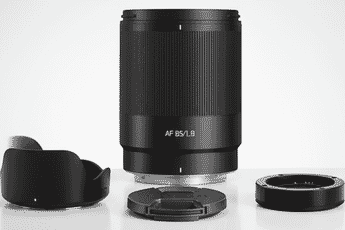
The same week Leica Rumors broke this story, Fuji Rumors published the first hands-on images of the upcoming Meike AF 85mm f/1.8 for Fujifilm GFX — the first viable third-party autofocus lens for the format. Third-party glass arriving in the GFX system right as Leica steps out of medium format is a clean tell: the manufacturers who think the format has a future are the ones still building infrastructure for it.

Frequently Asked Questions

Has Leica officially confirmed this cancellation?

No. The report comes from Leica Rumors citing multiple sources familiar with Leica’s internal organization. Leica itself has issued no statement. The clearest evidence is the staff reassignment — the engineers who were working on the project are now visibly working on other things.

Could the program restart under a new owner?

Possibly. Blackstone’s reported €1B sale process means a new owner could revive any program if the financial case lines up. But restarting a multi-year R&D project that has just been dismantled adds at least two-to-three years on top of any earlier timeline. The realistic earliest shipping date for a revived Leica medium-format mirrorless would be 2029-2030.

What about the existing Leica S system?

The Leica S system was officially discontinued with the Leica S3, last sold new in 2022. Existing S-mount lenses retain value in the used market for owners of S2/S006/S007/S3 bodies, but no new S-mount lenses or bodies are in development. The mirrorless project was supposed to be the format’s modernization. It now isn’t.

Should this change which GFX camera I buy?

No. The Fujifilm GFX 100S II, 50S II, and 100RF were already the best options at their respective price points. Leica’s exit reinforces that buying any of them is a safe long-term bet on the format — Fujifilm has no near-term competitor pressure that would force a sudden product-line reshuffle. If anything, the gap means Fujifilm gets to take more time between generations, which is good news for current owners.

PhotoWorkout pin: Leica Just Killed Its Medium Format Mirrorless — What It Means for GFX Buyers
Save this one — the medium-format market just got a lot less crowded.

Image credit: editorial composition by PhotoWorkout. Original reporting on the Leica medium format mirrorless program cancellation belongs to Leica Rumors; their post is cited in the sources section below.

Don’t miss this week’s photography news

Every Sunday: camera launches, lens announcements, and the photography moves that matter — curated before the big sites catch up.

By signing up you agree to receive our newsletter and accept our Privacy Policy. Your newsletter may contain affiliate links. Unsubscribe anytime.

Written by

Andreas De Rosi

Andreas De Rosi is the founder and editor of PhotoWorkout.com and an active photographer with over 20 years of experience shooting digital and film. He currently uses the Fujifilm X-S20 and DJI Mini 3 drone for real-world photography projects and personally reviews gear recommendations published on PhotoWorkout.