


- Researchers at Nagoya University built transparent gallium-doped zinc oxide (GZO) nanosheets that let a single pixel detect red, green, and blue light. The work was published in the journal ACS Nano.
- Today’s cameras use a Bayer color filter, where each pixel captures just one color and the rest is guessed from its neighbors. A pixel that sees all three colors at once could cut the total pixel count by up to 75%.
- Because the nanosheets are transparent, color-sensing layers can be stacked vertically. They are also ultrathin, lightweight, and heat-resistant to 400C, so early uses could include endoscopes, space hardware, and cars.
- This is lab-stage research, not a product. It is a promising path to smaller, sharper, more light-efficient sensors, but a camera or phone you can buy is years away.
The most important part of every digital camera and phone has barely changed in structure for about 50 years: the color filter that sits over the sensor and lets each pixel see only one color. A team at Nagoya University in Japan has just demonstrated a way around it, and if it scales, it could shrink the sensor in everything from a flagship mirrorless body to the phone in your pocket.
Their trick is a transparent nanosheet that lets a single pixel detect red, green, and blue light at once. The research, published in the peer-reviewed journal ACS Nano, is early and lab-stage. But it points at a genuinely different way to build an image sensor, one that could be smaller, higher-resolution, and better in low light all at the same time.
What Nagoya Actually Built
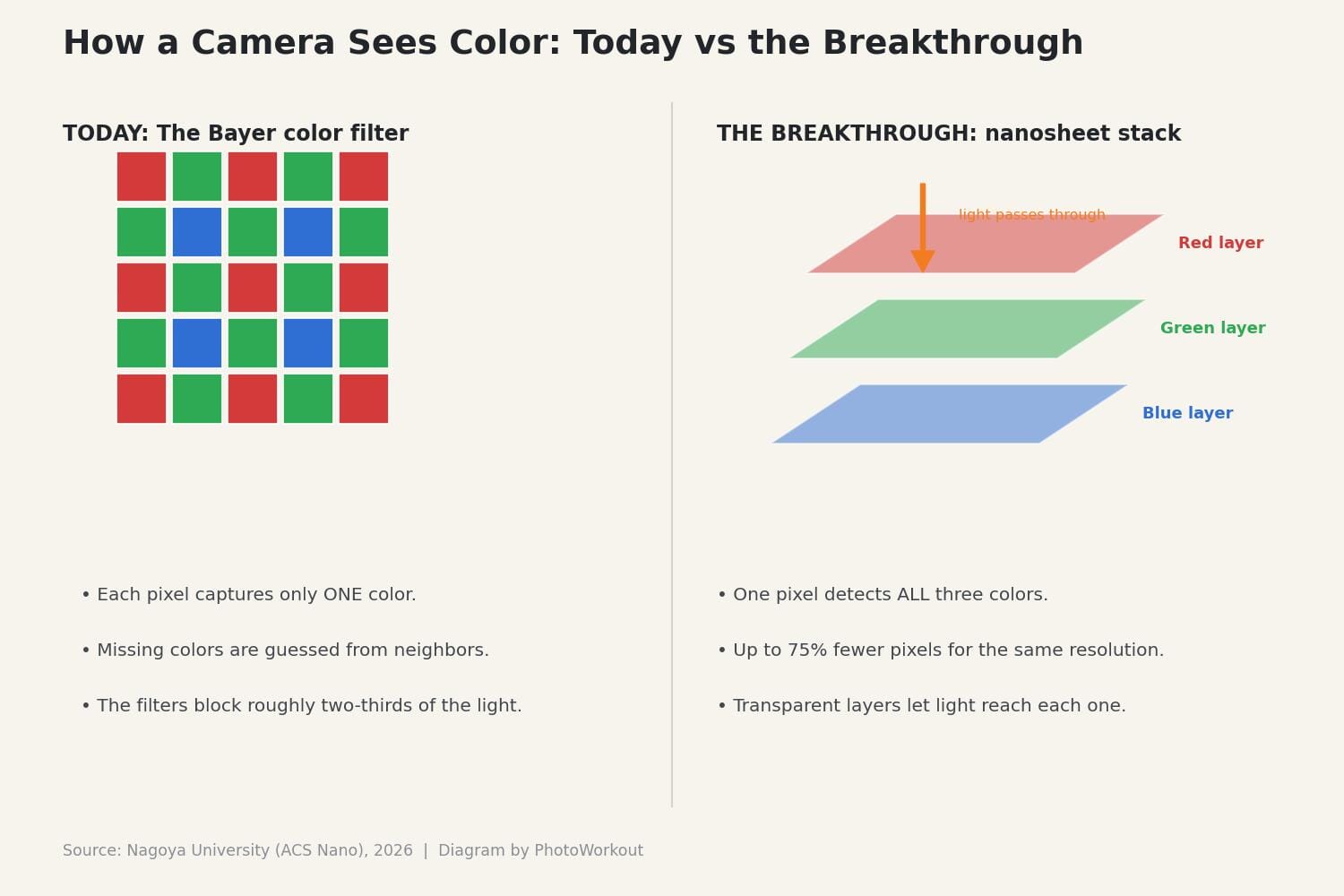
The breakthrough is a set of gallium-doped zinc oxide (GZO) nanosheets. In plain terms, they are ultrathin, nearly transparent sheets of material that can sense the intensity of red, green, and blue light in a single spot. They are also lightweight and can survive temperatures up to 400 degrees Celsius, which is why the team, led by Professor Minoru Osada at Nagoya University’s Institute of Materials and Systems for Sustainability, points to uses in harsh environments like space hardware, automotive systems, and medical endoscopes.
The headline is that one pixel can read full color. That does not sound dramatic until you understand how badly today’s sensors have to cheat to see color at all.
Why the Bayer Filter Has Held Cameras Back
An image sensor, on its own, is colorblind. It only measures how much light hits each pixel, not what color it is. To get color, almost every camera since the 1970s has used a Bayer array: a checkerboard of tiny red, green, and blue filters laid over the pixels, with twice as many green as red or blue because human eyes are most sensitive to green.
That design works, but it forces two big compromises. First, every pixel throws away roughly two-thirds of the light that reaches it, because its filter blocks the other two colors. Second, since each pixel records only one color, the camera has to reconstruct the missing colors for every pixel by guessing from its neighbors, a process called demosaicing. That interpolation is where a lot of fine detail, false color, and moire artifacts come from. It is the original sin of digital imaging, and it has quietly shaped how sharp, how noisy, and how large every sensor has to be.
How Transparent Layers Change the Math
This is where the nanosheets get clever. Because they are transparent, light passes straight through them, which means you can stack them vertically, with each layer tuned to detect a different color. A single point on the sensor then reads red, green, and blue in one place, no color-filter checkerboard and no guessing required.
The knock-on effects are significant. Nagoya estimates that if one pixel captures all three colors, the total pixel count could be cut by up to 75% while keeping the same image resolution. Fewer, smarter pixels means a physically smaller sensor, or the same size sensor packing far more effective resolution, and because no light is being blocked by color filters, better performance in low light. The approach also skips some of the complex semiconductor steps that conventional color sensors require, which could make them simpler and cheaper to produce.
If this sounds familiar, it echoes the idea behind Sigma’s old Foveon sensors, which also stacked color layers rather than using a Bayer filter. Foveon never won the mainstream because its silicon-based approach was slow and noisy. A transparent, simpler material could be the version that finally works, sitting alongside other sensor advances like Sony’s new LOFIC sensors and the LOFIC chip in DJI’s Pocket 4P that are pushing dynamic range from a different direction.
The Gallium Trick That Made It Work
The interesting engineering detail is how the team solved the material’s weak spot. Plain zinc oxide nanosheets are wonderfully transparent and chemically stable, but the researchers found they barely responded to visible light, which is useless for a camera. To fix that, they doped the zinc oxide with gallium, which created what physicists call trap states: tiny electronic pockets that capture electrons and convert incoming light into a measurable electrical signal. That one change turned a transparent-but-blind material into a transparent material that can actually see, which is the whole ballgame.
The Honest Caveats
None of this is shipping in a camera. This is a materials-science result in a research journal, demonstrating that the physics works, not a sensor you can put behind a lens tomorrow. The hard part of turning a lab result into a product is everything that comes next: reading data off the sensor fast enough for stills and video, manufacturing it at full sensor size without defects, keeping costs sane at scale, and proving the real-world image quality against decades of refined Bayer sensors. Any of those can stall a promising idea for years, or forever.
The heat resistance is a tell about where this lands first. A component that shrugs off 400 degrees is aimed at endoscopes, industrial and automotive cameras, and space hardware long before it reaches a consumer camera. That is usually how sensor technology arrives: in a niche where its specific strength matters most, then trickling toward the mainstream once the process matures.
Frequently Asked Questions
What did the Nagoya University researchers actually invent?
They created transparent gallium-doped zinc oxide (GZO) nanosheets that let a single pixel detect red, green, and blue light at once, instead of one color per pixel. The work was published in the journal ACS Nano.
How is this different from a normal camera sensor?
A normal sensor uses a Bayer color filter, so each pixel captures only one color and the camera guesses the rest from neighboring pixels. Because the nanosheets are transparent, color layers can be stacked so one pixel reads all three colors directly, with no color filter and no guessing.
Would this make cameras smaller or sharper?
Potentially both. Nagoya estimates the total pixel count could drop by up to 75% for the same resolution, which allows a smaller sensor or, at the same size, much higher effective resolution. Removing the color filters also means less light is wasted, which helps in low light.
Can I buy a camera with this sensor?
No. This is early lab research, not a product. Real cameras or phones using the technology are likely years away, if the approach clears the manufacturing and cost hurdles at all. The first uses are more likely in endoscopes, automotive, and space hardware, where the nanosheets’ heat resistance is valuable.
Is this related to the Foveon sensor?
Conceptually, yes. Sigma’s Foveon sensors also stacked color-sensing layers instead of using a Bayer filter. They never went mainstream because the silicon approach was slow and noisy. Transparent nanosheets are a different, potentially simpler material that could make the stacked-layer idea practical.
The Bottom Line
The Bayer filter has been the quiet compromise inside almost every digital camera for half a century, and most sensor progress has been about working around its limits rather than replacing it. Nagoya’s transparent nanosheets are one of the first credible hints at a genuine replacement: a pixel that sees full color, no filter, no guessing.
It is early, and the road from an ACS Nano paper to a camera you can hold is long and littered with promising ideas that never made it. But the direction is exciting, and it fits a broader moment where the fundamentals of imaging are being rethought, from sensor structure to how we prove a photo is real. If transparent sensors work, the camera in your next phone could be smaller, sharper, and better in the dark, all because someone made a sensor you can see through.
Primary Research
- Nagoya University: Transparent nanosheets open the door to smaller, higher-resolution optical sensors – Official announcement, mechanism, and the up-to-75% pixel-reduction estimate
- ACS Nano: peer-reviewed publication – The journal paper detailing the gallium-doped zinc oxide nanosheet sensor
- EurekAlert: research news release – Independent distribution of the Nagoya University findings
- Digital Trends: coverage of the transparent sensor – Accessible writeup framing what the breakthrough could mean for cameras
Image Sources
- Concept illustrations and Bayer-versus-nanosheet diagram: PhotoWorkout – Editorial concept renders and explanatory diagram created by PhotoWorkout; no consumer product exists to photograph