


- UK Prime Minister Keir Starmer has given tech companies three months to add on-device controls that stop children taking, sending or viewing explicit images — or face new legislation.
- Home Secretary Shabana Mahmood said enforcement “will include fines for companies and, as a last resort, we are exploring criminal liability for tech bosses who fail to comply.”
- It runs under the existing Online Safety Act, enforced by Ofcom, which already allows fines up to £18 million or 10% of global revenue.
- Separately, the UK’s Crime and Policing Act 2026 already made it a crime to create or possess AI tools designed to generate child sexual abuse material — the first law of its kind.
- For photographers, the direct hit is small but the direction is clear: AI image platforms face tighter input/output filters, age and identity checks, and more aggressive moderation that can snag legitimate work.
Regulators rarely talk about putting executives in prison. This week the UK did. At London Tech Week on June 8, Prime Minister Keir Starmer told tech companies they have three months to build controls that stop children from taking, sending and seeing explicit images on their devices — and his Home Secretary added that the government is “exploring criminal liability for tech bosses who fail to comply.” As PetaPixel and the BBC report, it is the bluntest enforcement signal any major market has aimed at the tech industry over child safety.
Most of the coverage has framed this as an Apple-and-Google story about phones. It is — but it also lands in a bigger UK push to police AI-generated imagery, and that is the part photographers and anyone who leans on AI image tools should actually track. Here is what was announced, what is real versus rhetoric, and where it touches the tools you use.
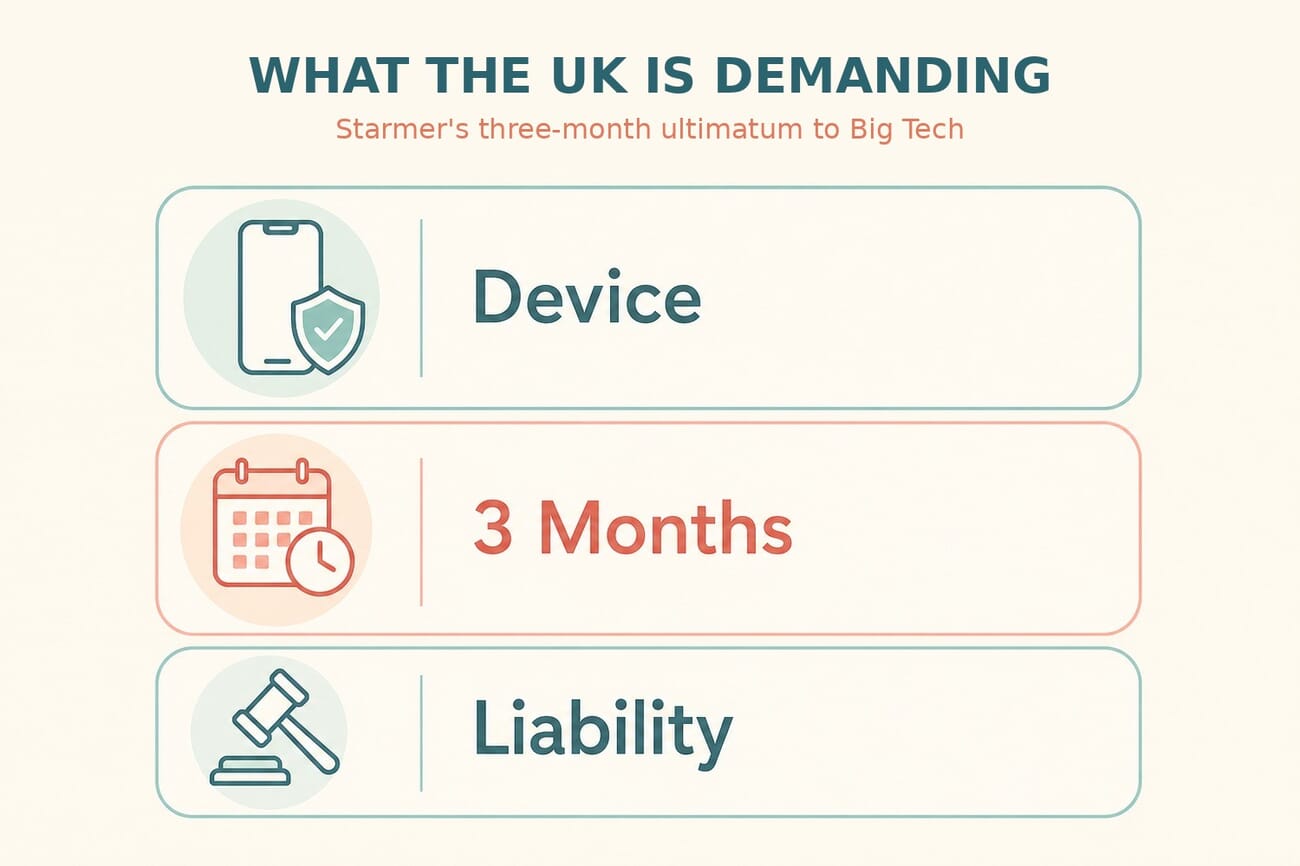
What the UK Actually Announced
The core demand is on-device: companies should block nudity across a phone or tablet by default, with only age-verified adults able to switch it off. The government singled out the gap in Apple’s current nudity detection, which doesn’t extend to the camera or to third-party messaging apps. Companies have three months to act voluntarily; if they don’t, Starmer said the government will “act and change the law”. The legal backstop is the Online Safety Act, already in force and enforced by Ofcom, which can levy fines of up to £18 million or 10% of global revenue — and which already carries senior-manager criminal liability provisions for serious, willful failures to protect children.
The urgency is grounded in hard numbers. The Internet Watch Foundation found that 91% of the child sexual abuse reports it assessed in 2024 involved self-generated content, out of more than 424,000 reports. Civil-liberties groups, however, have pushed back hard: the encrypted-messaging app Signal called default on-device scanning “dystopian,” echoing the backlash that forced Apple to abandon a similar client-side-scanning plan in 2021. That tension — child protection versus on-device surveillance — is the unresolved heart of the debate.
The Part That Hits AI Image Tools
The device controls are aimed at platform owners, not at the photo apps in your workflow. But this announcement sits on top of a law that does target AI image generation directly. The UK’s Crime and Policing Act 2026, enacted in April, made it a criminal offense — punishable by up to five years — to create, possess or distribute AI models “optimised” to generate child sexual abuse material. It also built in a testing regime so that approved bodies, including tech firms and the IWF, can probe AI models for that capability before release. The driver is grim: the IWF logged a 380% jump in AI-generated CSAM reports in 2024.
Put the two together and the message to every AI image platform operating in the UK is unambiguous: build robust safeguards into your generator or face real consequences, up to and including personal liability for whoever runs the company. That is already reshaping product behavior — stricter prompt filtering, output classifiers, mandatory provenance signals, and tighter age and identity checks. It is the same accountability pressure now visible in cases like the teenagers suing xAI over sexually explicit deepfakes its Grok tool generated.
What This Means for Photographers
For the vast majority of photographers, nothing breaks tomorrow. Your camera, your raw files and your editing apps are untouched. The friction shows up specifically when you use generative AI — text-to-image tools, generative fill, AI portrait and “virtual model” features. Expect three changes. First, more aggressive prompt blocking: tools will refuse a wider range of prompts and reject more outputs, which means more false positives. Art-nude, boudoir, fine-art and even some family or newborn work is most likely to get caught by a blunt filter that can’t tell context from intent — a real cost to legitimate photographers, already a sore point given how much work the industry has lost to AI.
Second, more identity and age verification. Platforms that let you generate or manipulate images of people will increasingly ask you to verify who you are, especially in regulated markets. Third, provenance becomes standard. Expect AI-assisted images to carry embedded content credentials by default — the C2PA authenticity signals that brands like OpenAI, Canon and Adobe have been rolling out. For working photographers that is mostly good news: it helps separate your real, camera-made work from synthetic imagery, a distinction that matters more every month as AI slips into contests and news feeds alike.
Should Photographers Outside the UK Care?
Yes — because of how global tech products get built. When a major market sets a strict rule, companies rarely ship a separate, looser version everywhere else; it is cheaper to build one compliant product and roll it out widely. The UK joins the EU’s AI Act and the US Take It Down Act in pushing the same direction: more verification, more filtering, more provenance on synthetic media. The pattern that began with privacy law under GDPR is repeating with AI imagery. Practically, that means the safeguards arriving for UK users are a preview of defaults most photographers will encounter, wherever they shoot. The sensible response isn’t alarm — it’s to keep AI-assisted work on reputable platforms with clear policies, expect to verify your identity, and keep provenance data intact rather than stripping it out.
Frequently Asked Questions
Will the UK actually jail tech CEOs?
Not imminently. The Home Secretary described criminal liability as a “last resort” being explored if companies ignore the request. The Online Safety Act already contains senior-manager liability provisions for serious child-safety failures; the new element is the government signaling it may use them to force compliance with on-device controls.
Does this affect the camera or editing apps I already use?
No. The device controls target nudity detection on phones and tablets, and the AI law targets tools built to generate illegal imagery. Standard cameras, raw files and conventional editors like Lightroom or Photoshop are not in scope.
Why would this make AI tools reject my legitimate photos?
To comply, platforms tighten automated filters on prompts and outputs. Those filters struggle to judge context, so legitimate genres like art-nude or boudoir can trigger false positives. It’s a known trade-off of stricter automated moderation.
What is the Crime and Policing Act 2026?
A UK law enacted in April 2026 that, among other things, made it a criminal offense to create, possess or distribute AI models specifically designed to generate child sexual abuse material — the first national law to target the tools themselves, with penalties up to five years.
What should photographers do now?
Nothing urgent. Keep AI-assisted work on reputable platforms, expect more identity and age verification, and preserve content-provenance data on your images rather than stripping it.
The Bottom Line
The headline — jail for tech bosses — is deliberately dramatic, and the immediate move is narrower than it sounds: device-level nudity blocking, aimed at Apple and Google, with criminal liability held in reserve. But read alongside the UK’s new law against AI tools built to generate abuse imagery, the trajectory is clear. AI image platforms are being pushed, hard, toward stricter filtering, verification and provenance — and because those changes get built once and shipped everywhere, photographers far from the UK will feel them too. The tools you use to make and manipulate images are entering a more regulated era. Knowing it’s coming is the first step to working around the friction without losing the plot.
Primary Coverage
- PetaPixel — UK threatens to jail tech CEOs over CSAM safeguards – The report framing the criminal-liability threat
- BBC News — Starmer calls on tech firms over child nude images – The June 8 announcement and IWF data
- Reuters — Big Tech must stop young people circulating nude images, says Starmer – Compliance deadline and legislative threat
- GOV.UK — Crime and Policing Bill: CSAM factsheet – The 2026 law criminalizing AI CSAM-generation tools
- Internet Watch Foundation — 2024 Reports Assessment – The 91% self-generated-content figure
Image Sources
- PhotoWorkout original illustrations – The featured image, infographic and pin are original PhotoWorkout illustrations (abstract concepts only)