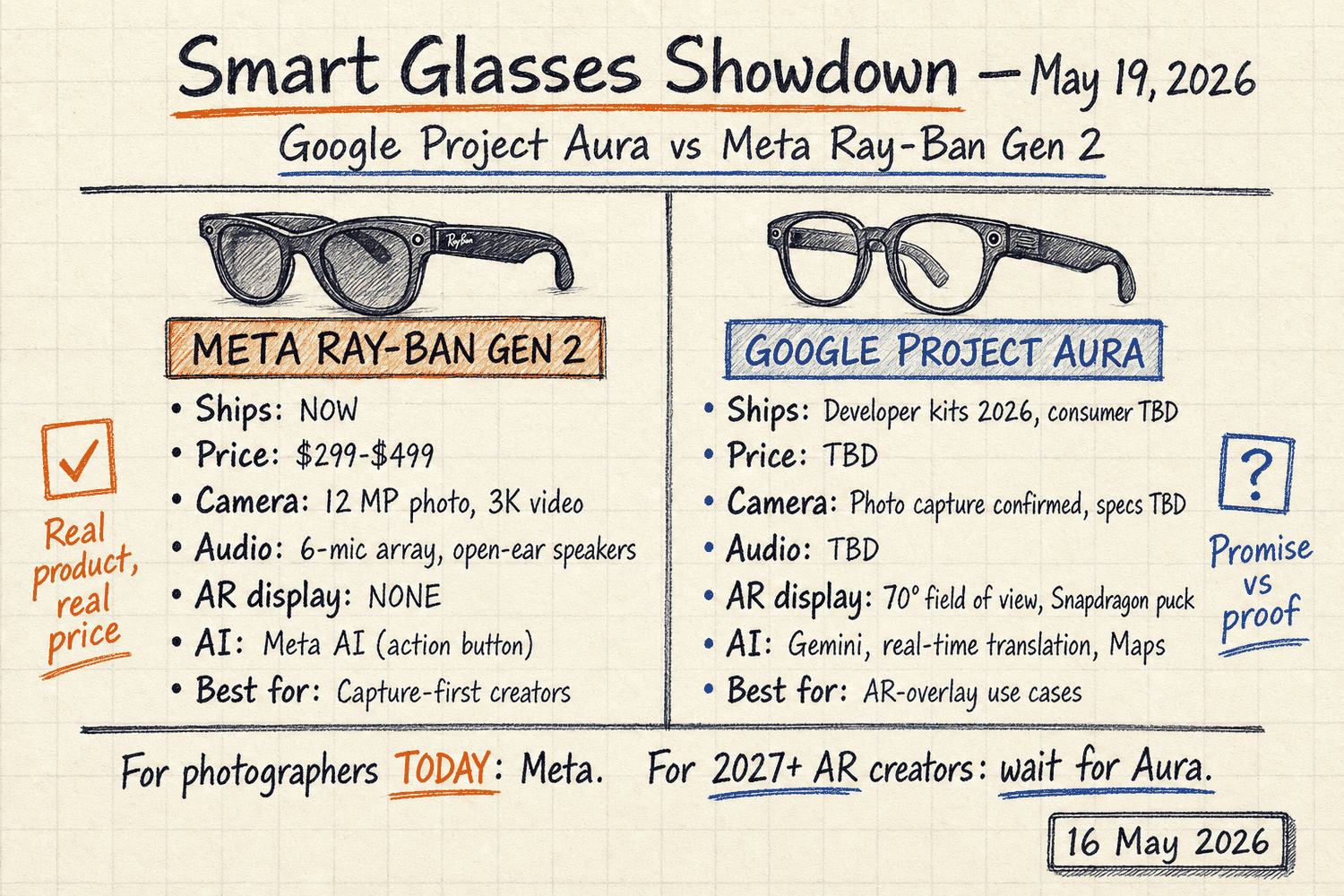


- Google is revealing its smart glasses at I/O on May 19, 2026 — the project is called Aura, built with Qualcomm, AR-display-first with a 70° field of view and an external Snapdragon processing puck. Developer kits ship this year; consumer release date is unannounced.
- Meta Ray-Ban Gen 2 is already on shelves at $299-$499 with a 12 MP camera, 3K video, six-microphone array, Wi-Fi 6 transfers, and the broadest frame lineup (Wayfarer, Headliner, Skyler, plus prescription-ready Blayzer and Scriber Optics). For pure capture-and-share workflows it is the only smart-glasses camera that ships today.
- For photographers and content creators, the buy/wait call is clearer than the comparison-piece headline suggests: Meta is a real product, Aura is a roadmap. If photo/video capture is what matters to you, buy now. If you specifically want AR-overlay tools for shooting (composition guides, real-time scene info), wait — but expect to wait into 2027 for consumer hardware.
- Privacy concerns apply to both. Meta is already in active litigation over Ray-Ban AI Glasses’ always-on capture model, and Google’s history with Glass (2014) plus Aura’s planned camera capture will reopen the same debate the moment Aura ships.
Google I/O 2026 lands on Monday, May 19. The keynote’s headline reveal — confirmed by CNET, Mashable, and a long string of pre-event leaks — is Google’s first proper consumer-targeted smart glasses since the Glass project quietly died in 2014. The new program is called Project Aura, built in partnership with Qualcomm, and it is explicitly positioned to take on Meta’s Ray-Ban Gen 2 line.
For photographers and content creators staring at the buying decision right now, the question isn’t really “which is better.” It’s “do I buy the camera glasses that exist, or wait for the ones that don’t yet?” Below is what’s actually known about Aura, what Meta Ray-Ban delivers today, and the honest verdict for capture-first creators.
When you buy through links on our site, we may earn a commission at no cost to you. We evaluate products independently. Commissions do not affect our evaluations.
What We Know About Google’s Project Aura
Google has been talking about a successor to Glass for years; what changed in 2026 is that the company finally has the hardware partners and the AI stack to make a credible second attempt. The leaks ahead of I/O converge on a consistent picture:
- Display: True AR overlay with a 70° field of view. This is the headline differentiator versus Meta — the glasses can actually project information into the wearer’s sightline, not just capture and assist via voice.
- Processing: An external Snapdragon “puck” that handles compute and battery, tethered to the glasses. This is what keeps the lenses themselves light enough to wear all day, at the cost of a second device in your pocket.
- AI: Native Gemini integration. Real-time translation. Maps directions painted onto the world in front of you. Live scene understanding.
- Camera: Photo capture is confirmed. Video, resolution, sensor specs — all unannounced.
- Frames: Reports point to partnerships with established eyewear brands. The “real fashion brands” CNET cited will be revealed Monday.
- Availability: Developer kits this year. Consumer release date not announced. Conservative read: late 2026 at the earliest, 2027 more likely.
The strategic posture is clear. Google isn’t trying to build a better camera-glasses; Google is trying to build the first mainstream consumer AR platform. Photo capture is a feature, not the headline.
What Meta Ray-Ban Gen 2 Already Delivers
The Ray-Ban Meta line — now in its second generation, available in the classic Wayfarer plus Headliner and Skyler shapes, and joined this spring by the prescription-ready Blayzer Optics and Scriber Optics — has been on store shelves for over a year. The hardware is mature and the specs are pinned down:
- Camera: 12 MP photo, 3K video. Not best-in-class compared to a flagship phone, but genuinely usable for casual capture, behind-the-scenes content, and POV documentation work.
- Audio: Six-microphone array (large upgrade over Gen 1) plus open-ear speakers. The mic quality is the unsung strength here — the glasses are surprisingly good as a hands-free recording device for vlog narration and field interviews.
- Transfer: Wi-Fi 6 UNII-4 for fast offload to the Meta View app and onward to Instagram, Facebook, WhatsApp.
- AI: Meta AI on a dedicated action button. Translation, scene description, hands-free search. No AR display — everything routes through audio.
- Frames: Widest selection in the category. Five base styles, two prescription-ready optical frames, dozens of lens-and-frame combinations.
- Price: $299 for base Gen 2 sunglasses, up to $499 for the new Blayzer Optics with prescription lenses.
- Availability: In stock now at Ray-Ban retail, EssilorLuxottica’s optical channels, and online.
For Photographers Specifically — What Matters
Camera glasses are not a replacement for a real camera. Anyone telling you otherwise hasn’t tried to compose a portrait with hardware glued to their face. What camera glasses are useful for: behind-the-scenes capture during a shoot, POV documentation of a location scout, hands-free recording when both hands are on the gear, and casual everyday capture where pulling out a phone would be slower or more obtrusive than tapping a temple.
For all of those use cases, Meta Ray-Ban already does the job. 12 MP stills and 3K video are not flagship specs in 2026, but they exceed what a documentary photographer needed in 2015 — and the form factor (real Wayfarer that looks like sunglasses, not a science project) is what actually lets the camera live on your face long enough to capture anything.
Google’s Aura would only become the better photographer’s pick if the AR overlay enables something Meta cannot — for example, a real-time composition grid projected through the lens, or live exposure-data hovering over the scene you’re framing on a separate camera body. Google has not signaled any of that. The capture story for Aura, based on what’s been confirmed, is straightforward photo capture without the AR features actively assisting it. That puts it behind Meta Ray-Ban on pure capture functionality, while still being more expensive (predicted), heavier (puck included), and shipping later.
For Content Creators — Video, Audio, Workflow
The audio story is what separates Meta Ray-Ban from every previous camera-glasses attempt. The six-mic array, combined with open-ear speakers, makes the glasses a viable hands-free production rig for short-form content — narrate a vlog while you shoot, record a walking interview, capture room tone for B-roll. The 3K video at 30 fps is enough for most social formats and the Wi-Fi 6 transfer means you can have footage on your phone seconds after you stop recording.
Google has not shared anything about Aura’s audio or recording workflow. The presence of an external puck suggests battery and processing headroom that could enable longer recording sessions than Meta’s all-in-glasses design — but suggests is not confirms. For a creator building a workflow around glasses-based capture, betting on unannounced Google hardware over already-shipping Meta hardware is a planning mistake.
The Privacy Problem — Both Have One
Meta is already in active litigation over Ray-Ban Meta’s privacy model. The always-on camera, the small recording indicator, and the question of whether AI features process subjects’ images without consent — all of those are live legal questions in 2026. If you’re a photographer, you’ve spent years thinking about consent and release-form etiquette. Wearing a camera on your face changes the dynamic in ways your established working habits don’t yet account for.
Google’s Aura will reopen the same debate the moment it ships. The 2014 backlash against Google Glass was largely a privacy backlash — “Glassholes,” restaurants banning the device, the legal grey area of recording in public. Google has had a decade to think through how to handle that better, and the AR display might actually help (subjects can see you’re using a device, not just wearing sunglasses) — but the company has not yet shared specifics. Privacy posture will be a watch-this-space at I/O.
Verdict — Buy Meta Now, or Wait for Aura?
Buy Meta Ray-Ban now if: you want camera glasses you can wear and use this week, your use case is capture-and-share workflows for social or BTS work, you want the form factor that actually looks like normal eyewear, you wear prescription lenses (the Blayzer/Scriber Optics are the first real solution), or you simply don’t want to bet a $500 purchase on hardware that hasn’t been revealed yet.
Wait for Google Aura if: you specifically want an AR overlay (real-time directions, language translation painted on the world, scene-aware information layered into your view), you’re a developer wanting to build for the Android XR ecosystem, you’re comfortable with the puck-plus-glasses two-device design, or your primary use case isn’t capture at all — it’s information-on-demand while moving through the world.
The honest answer for most working photographers and content creators is the first one. Meta Ray-Ban is the only camera glasses that exist as a product today, the price is reasonable, the camera is competent, and the audio is genuinely impressive. Aura’s bigger ambitions are interesting in a contracting camera market — but until Google ships consumer hardware with a real price, real review-unit access, and a real ship date, every comparison piece written this week (this one included) is comparing a roadmap against a product.
Frequently Asked Questions
When will Google’s smart glasses actually ship to consumers?
Google has confirmed only that developer kits ship in 2026. Consumer release date is unannounced. The realistic earliest timeline is late 2026 for a limited launch, with broader retail availability in 2027. Consumer prices have not been hinted at.
Can I take photos with Google’s Project Aura?
Yes — photo capture is confirmed. Megapixel count, video resolution, sensor type, and image-quality details have not been shared. Expect Google to disclose those at I/O on May 19.
How does Meta Ray-Ban Gen 2 compare to a phone camera for content?
Phones win on pure image quality — a flagship iPhone or Pixel uses a larger sensor, multi-frame computational processing, and a much faster image pipeline. Meta Ray-Ban wins on form factor and POV authenticity. For a behind-the-scenes shot at exactly your eye level while your hands are full, the glasses are the better tool. For a hero shot of your subject, a phone or real camera still wins.
Will Google Aura work with Apple devices?
Not confirmed, but unlikely as a first-class experience. Aura is built on the Android XR ecosystem and Google is positioning it as part of that platform. Cross-platform compatibility — pairing with an iPhone, for instance — may exist for basic features but the AR overlay and Gemini integration almost certainly require an Android pairing. Watch the I/O keynote for specifics.
Are there other smart glasses worth considering besides Meta and Google?
Yes — but they’re not yet competitive for general-purpose camera glasses. Samsung is launching a two-tier lineup (the entry-level Jinju at $380-$500 and the premium micro-LED Hayan at $600-$900 in 2027). XREAL is shipping AR-display glasses (One Pro, One S) but they’re tethered display devices, not standalone camera glasses. For a comparable always-wearable-with-camera product in 2026, Meta is currently alone.

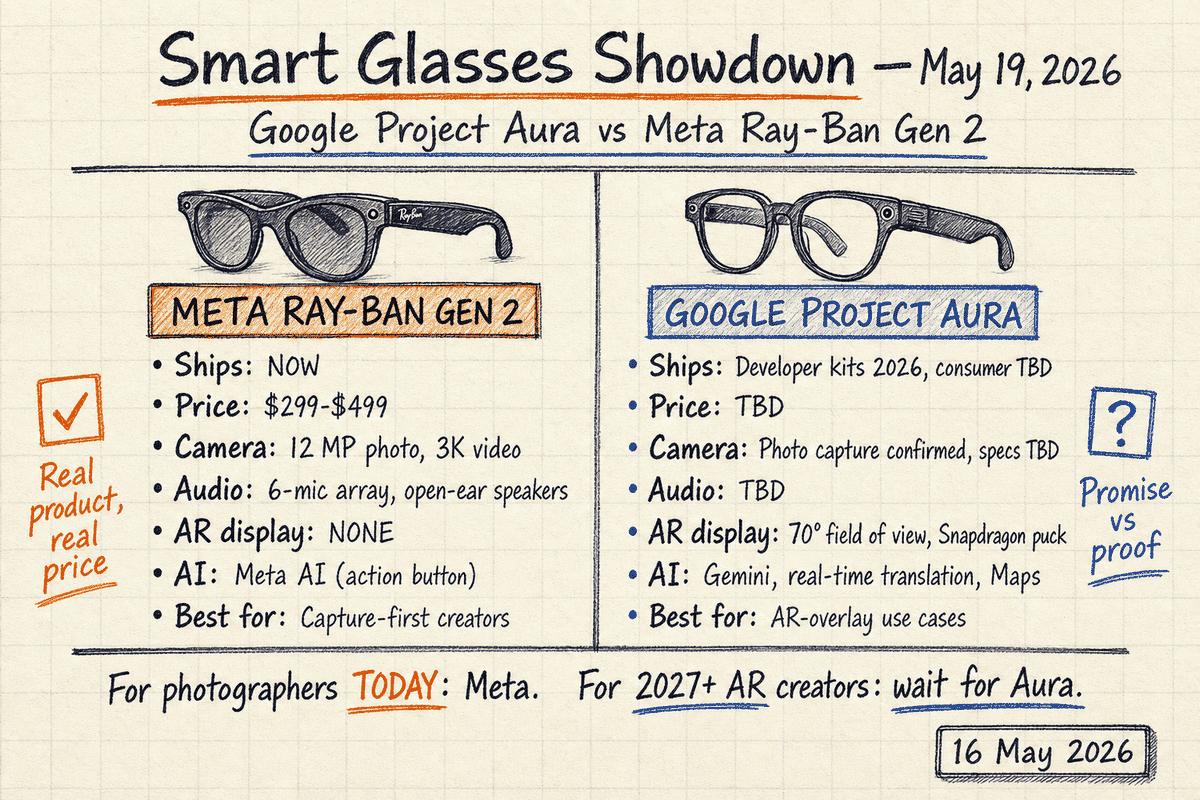
Image credit: editorial composition and sketch infographic by PhotoWorkout. Spec details for Project Aura sourced from CNET, Geeky-Gadgets, and Mashable pre-I/O reporting; Meta Ray-Ban specs sourced from EssilorLuxottica and Meta press materials. All sources cited in full below.
Reporting and prior coverage cited in this article:
Google Project Aura — Pre-I/O Reporting
- CNET — Google I/O 2026: New Gemini, Smart Glasses and a Whole New Laptop OS – CNET's I/O preview confirming smart-glasses reveal and fashion-brand partnerships.
- Geeky-Gadgets — Google I/O 2026: The Smart Glasses Reveals Everyone's Waiting For – Most detailed published spec breakdown for Project Aura: 70° FOV, Snapdragon puck, Qualcomm partnership, Gemini/Maps/Translate integration.
- Mashable — What to expect from Google I/O 2026: Gemini news, Android XR glasses – Android XR ecosystem context for Aura.
Meta Ray-Ban Gen 2
- PhotoWorkout — Ray-Ban Meta 'Blayzer' & 'Scriber' Optic Styles – Our March 2026 coverage of the prescription-ready Ray-Ban Meta optic styles with full Gen 2 spec details.
- PhotoWorkout — Meta Sued Over Ray-Ban AI Glasses Privacy – Our March 2026 reporting on the active privacy litigation.