


- Meta pulled the feature. Roughly three days after launch, on July 10, 2026, Meta removed the Muse Image capability that let anyone turn public Instagram photos into AI images, telling press the rollout “missed the mark.”
- While it was live, any public Instagram account could be @-mentioned in a Muse Image prompt to generate AI images from that account’s photos, opt-in by default with a buried opt-out. That specific capability is now gone.
- The reversal is a rare win for photographers. Pushback from creators, plus unions and agencies including SAG-AFTRA and CAA, moved Meta in days rather than months.
- The broader fight continues: Meta’s wider AI-content settings, the invisible Content Seal watermark, and the EU AI Act Article 50 labeling deadline on August 2, 2026 all still stand.
Update (July 2026): Meta has pulled this feature. About three days after launch, on July 10, 2026, Meta removed the Muse Image capability that let anyone turn public Instagram photos into AI images, following backlash from photographers and organizations including SAG-AFTRA and CAA. A Meta spokesperson said the rollout “missed the mark.” The opt-out steps below are no longer necessary, but the episode stands as a rare, fast win for creator pushback. Our original coverage follows, updated to reflect the reversal.
A week after PhotoWorkout covered Google Photos generating AI images from users’ libraries without meaningful consent, Meta pushed the pattern further. On July 7, 2026, the company launched Muse Image, its first in-house image generation model built by Meta Superintelligence Labs, and quietly enabled a feature that let any stranger on the internet @-mention a public Instagram account inside an AI prompt and generate new images of that person’s face. Meta pulled that feature three days later, on July 10, after a wave of backlash. This is the story of what it did, and how fast it fell apart.
There was no consent request and no notification. Meta’s own help page said the quiet part out loud: “You will not be notified about content created using AI features at Meta.” If your Instagram was public, you were opted in by default. The opt-out existed, but Meta buried it four menu levels deep, and it only stopped future generations. That design, opt-in by default with a hidden off switch, is exactly what lit the fuse.
What Muse Image Actually Does
Muse Image is the first output of Meta Superintelligence Labs, the AI research group Meta stood up under Alexandr Wang in 2025. In Meta’s own announcement, the model is described as agentic: it uses web search and coding tools during generation, self-refines its own drafts, and coordinates with Meta’s Muse Spark language model to plan and reason through a prompt before drawing. On a technical level, it is competent, current-generation stuff.
The feature that put it on the news wire is the Instagram integration. From The Verge’s coverage: users can @-mention any Instagram account inside a Muse Image prompt, and Meta AI will incorporate that account’s public photos as visual references to generate new images. This is not you generating an AI version of yourself. This is anyone in the world generating an AI version of you, using your public photos, without asking. That Instagram integration is the piece Meta removed on July 10; the underlying Muse Image model remains.
The Consent Design: Opt-In by Default, Buried Opt-Out
The design was the story. Public Instagram was opt-in for likeness reuse by default, and Instagram’s help center confirms it in almost the same phrasing: “people may be able to create content with your Instagram content using AI features at Meta.” Digital Trends pulled the two key quotes together in the first 24 hours: no notification, no visible watermark for the humans who might see the image, and no clarity on who owns or is liable for the output.
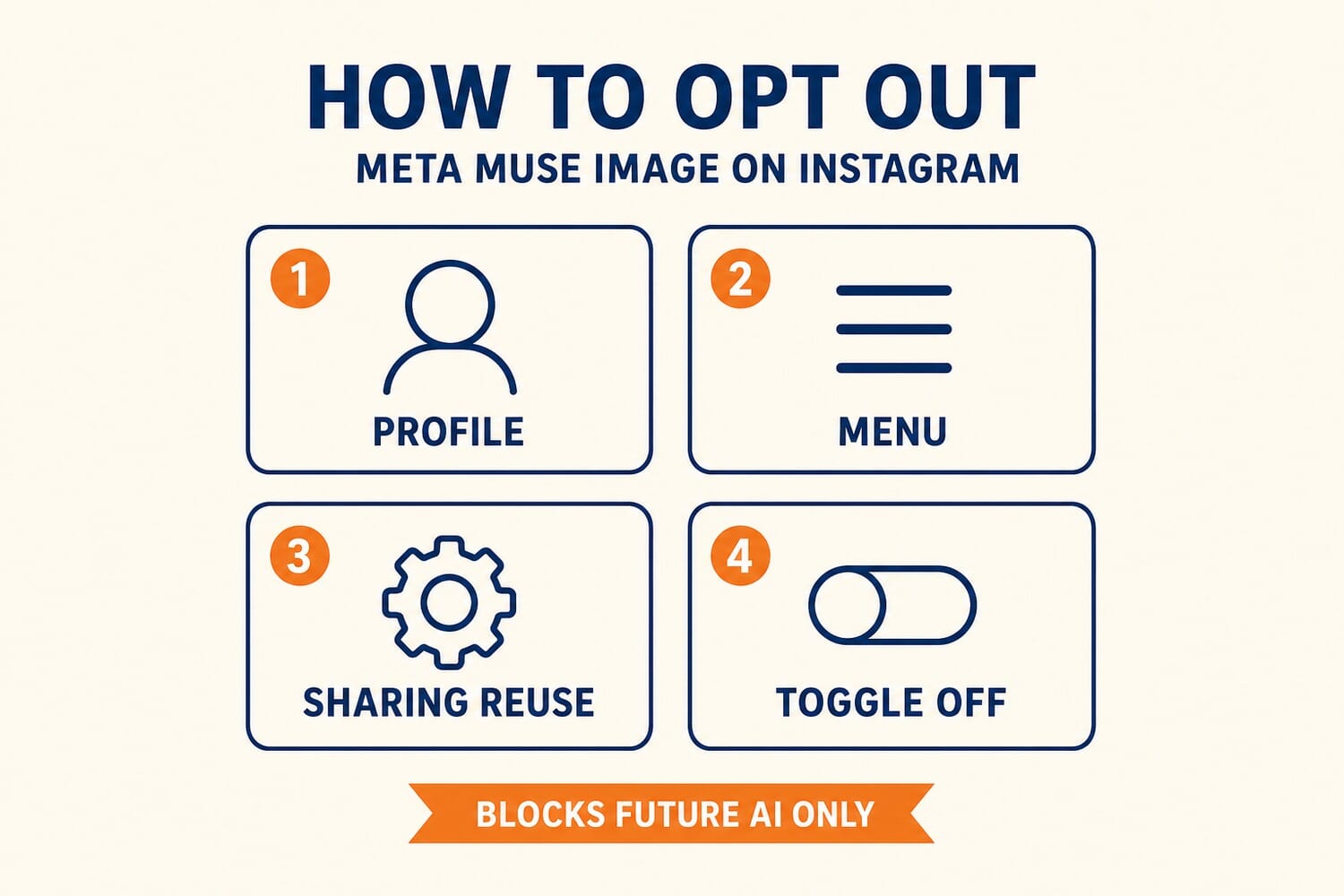
The good news is that the opt-out exists. The bad news is that it is a genuinely non-obvious menu path (the same path in the infographic above): Profile → three-lines menu in the top right → scroll to Sharing and reuse → toggle off both Posts and Reels under “Allow people to use your content on Instagram and with AI features on Meta.” It does not opt out of AI training on your content generally, only from this specific @-mention pull. And crucially, per Meta’s design, it only stops FUTURE generations. Anything anyone has already produced using your face stays live.
For a professional photographer or working creator, that language deserves reading twice. If your account is public and someone has already generated a hundred images of your face over the last 24 hours (a real possibility given the launch traffic), turning the toggle off today does nothing about those. It only closes the door forward.
The Content Seal Irony
The same July 7 announcement introduced Content Seal, an invisible watermark that Meta bakes into images generated by Muse Image. It survives cropping, compression, screenshotting, and most standard editing operations, and it can be verified through a public detector at facebookresearch.github.io/meta-seal. As image-provenance technology, the underlying Meta Seal framework is genuinely solid, and Meta released the reference implementation as open source, which is a meaningful contribution.
The irony is what it says about priorities. Meta built cryptographically robust provenance for the images it generates, so anyone can verify a fake AI photo came from Meta’s model, while removing consent and notification for the real photographs its users publish. The output is watermarked. The input is not credited. And unlike Content Credentials at capture on cameras like the Leica M11-P or the industry-wide OpenAI + Canon C2PA authenticity stack, Content Seal is invisible to viewers. An ordinary Instagram user scrolling their feed has no way of knowing whether the image they see is real, AI, or partially derived from a real photographer’s work.
The EU AI Act Wrinkle No One Is Talking About Yet
PhotoWorkout published Article 50 of the EU AI Act explainer yesterday. It is worth reading in conjunction with this one, because it points to a legal problem Meta has not addressed publicly. Starting August 2, 2026, anyone publishing AI-generated or AI-manipulated content in the EU market must visibly label it. Muse Image’s Content Seal is machine-readable but invisible to viewers, which is exactly the wrong side of the Article 50 line.
Practically, the deployer obligations under Article 50 fall on whoever publishes the AI content, not on Meta itself. So an EU-based Instagram user who @-mentions someone else and shares the result is technically the deployer, and technically on the hook for a visible label. Meta has not, at the time of writing, said whether Content Seal will surface as a visible on-image mark in EU territories. This is not a small compliance gap; it is a real one, and one that will shape whether the feature ships as-is in Europe on August 2.
What the Reversal Changes (and What It Does Not)
The immediate exposure is gone. With the @-mention feature pulled, strangers can no longer turn your public Instagram photos into AI images through Muse Image, and the buried opt-out is no longer something you need to hunt down. If you toggled it off in the last few days, there is nothing to undo.
What made this reversal fast is worth noting. The backlash was not just individual photographers. SAG-AFTRA urged members to disable the setting, and talent agency CAA issued a blunt statement that no one’s name, image, likeness, or creative work should be used by AI models without consent. Meta pulled the feature within about three days and told press it had “missed the mark.” Organized creator pushback moved a trillion-dollar platform in days, which almost never happens.
The broader problem has not gone away, though. Meta still treats a lot of public content as AI-training input under its general settings, so it is still worth deciding whether a professional Instagram presence needs to be public or whether a private account plus a portfolio site on your own domain is the safer default. Adding explicit AI-use terms to delivery contracts (“no AI training, no likeness reuse, no derivative generation”) is now standard practice. And where your hardware supports it, enabling Content Credentials on capture proves your originals came from a camera, using the same C2PA stack Meta chose not to interoperate with here.
Frequently Asked Questions
What is Meta Muse Image?
Muse Image is Meta’s first in-house AI image generation model, launched July 7, 2026 and developed by Meta Superintelligence Labs. It powers image tools across the Meta AI app, Instagram, and WhatsApp, with Facebook and Messenger integrations coming soon. Unlike Meta’s earlier Llama-based image work, Muse Image is designed as an agentic system that can search the web, write code, and self-refine during generation.
Can strangers really use my Instagram photos in AI images?
Not anymore. Meta removed the feature on July 10, 2026, about three days after launch. While it was live, anyone could @-mention a public account inside a Muse Image prompt and the model would pull that account’s public photos to generate new images of the person, with no permission request and no notification. That specific capability is now switched off.
Do I still need to opt out?
Not for this feature, since it has been pulled. If you want to lock down Meta’s broader AI-content settings anyway, the toggles still exist: open Instagram, go to your profile, tap the three lines in the top right, scroll to Sharing and reuse, and turn off both Posts and Reels under “Allow people to use your content on Instagram and with AI features on Meta.” Any images generated while the feature was live still exist.
Why did Meta pull the feature?
Backlash, and fast. Photographers, artists, SAG-AFTRA, and the talent agency CAA all condemned the opt-in-by-default design within days of launch. Meta removed the feature about three days in and told press the rollout “missed the mark.” It is a rare case of organized creator pressure reversing a major platform decision in days rather than months.
Does the Content Seal watermark protect me?
Not really. Content Seal is a robust invisible watermark on images Meta generates, verifiable through a public detector, and the underlying framework is open source. But it does not appear as a visible mark, so people who see the image cannot tell it is AI. And it does nothing to protect the real photographs that Meta pulled to make the derivative image in the first place.
Does the EU AI Act cover this?
Partially, starting August 2, 2026. Article 50’s deployer obligations require anyone publishing AI-generated content in the EU market to visibly label it. That obligation falls on whoever posts the derivative image, not on Meta itself. Whether Meta will make Content Seal a visible mark in EU territories has not been announced.
The Bottom Line
For one week, the trajectory looked grim. Google Photos had started generating AI images from private libraries by default, and Meta had just declared any public Instagram profile fair training input for anyone, without notice or meaningful consent. Then something unusual happened: the pushback worked, and Meta pulled its feature in about three days.
That is the rare good-news beat in this story, and it is worth sitting with. Organized creator pressure, from individual photographers up to SAG-AFTRA and CAA, moved Meta faster than most regulators ever could. But the underlying pattern has not changed: platforms keep testing how much user work they can convert into AI training material, and the default keeps landing on opt-in. The Content Seal watermark is still invisible to viewers, Meta’s broader AI-content settings still lean permissive, and Article 50 of the EU AI Act still takes effect on August 2, 2026. The win here is real, and it is also a reminder that photographers had to force it.
Primary Coverage
- PetaPixel: Meta Removes AI Image Generation Feature That Used Public Instagram Posts Following User Backlash – Confirmation that Meta pulled the feature on July 10, 2026 after backlash, including SAG-AFTRA's response
- Yahoo Tech: Meta Removes Muse Image AI Feature After Backlash – Meta's missed-the-mark statement, the three-day timeline, and CAA's condemnation
- Meta AI: Introducing Muse Image and Muse Video – Meta's official July 7, 2026 launch announcement from Superintelligence Labs
- The Verge: Meta's new Muse Image model can pull other Instagram users into AI photos – Independent confirmation of the @-mention mechanism and its scope
- Digital Trends: Meta's new AI can generate images of you from your Instagram, and you're opted in – Consent-by-default analysis with the exact opt-out menu path documented
- CNBC: Meta enters AI image model race with Muse Image – Business context on Meta's advertising and creator strategy behind Muse Image
- Meta Seal open-source framework (Content Seal reference) – Public detector and implementation reference for Meta's invisible watermarking on generated media
- Engadget: Meta built an AI detection tool to identify images and video created with its new models – Coverage of the Content Seal detector rollout alongside Muse Image
Image Sources
- Featured illustration, opt-out steps infographic, and vertical pin: PhotoWorkout illustrations – Editorial graphics created by PhotoWorkout