


- Reports (Bloomberg’s Mark Gurman, covered by CNET) say Apple is targeting late 2027 for its first camera-equipped AirPods, alongside camera smart glasses and a 20th-anniversary iPhone.
- Key nuance: the AirPods’ cameras are reportedly for AI “visual intelligence” — letting Siri see and answer questions about your surroundings — NOT for taking photos or video.
- The actual wearable camera for photographers is the smart glasses (code-named N50): speakers, mics and a high-resolution camera that can capture photos and video, aimed at Meta’s Ray-Ban frames.
- For casual shooters, the real shift is ambient, hands-free capture — grabbing candid moments without pulling out a phone — plus AI that helps you “see” a scene.
- It’s a 2027 roadmap, not a shipping product — and wearable cameras reignite the privacy and consent questions already swirling around smart glasses.
Apple’s next big bet reportedly isn’t a phone — it’s what you wear. According to reporting from Bloomberg’s Mark Gurman (picked up by CNET and others), Apple is lining up a 2027 wave of wearables that includes camera-equipped AirPods, smart glasses, and a 20th-anniversary iPhone. For photographers, the interesting part isn’t the hardware list — it’s what “ambient” capture could change about how everyday moments get photographed.
We covered the wearable-camera concept broadly when the rumors first stirred; this is the Apple-specific roadmap, and there’s an important catch in the details.
What Apple is reportedly planning
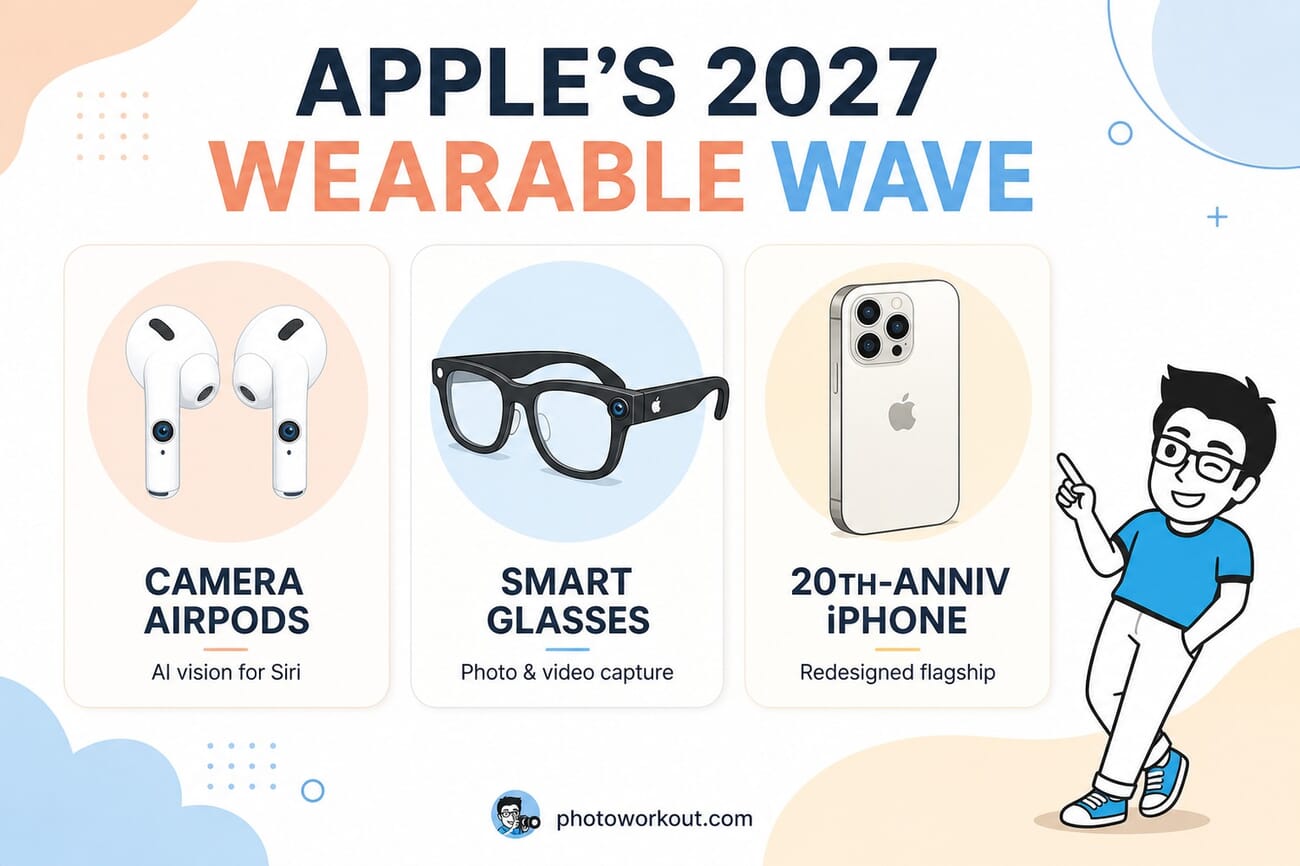
Three products anchor the reported 2027 wave:
- Camera AirPods — Apple’s first AI wearable. The cameras are reportedly there to give Siri “eyes”: visual intelligence so you can ask about objects and your surroundings. Crucially, the reports say these are not meant to capture photos or video — they’re sensors for AI, not a camera you shoot with.
- Smart glasses (code-named N50) — Apple’s answer to Meta’s Ray-Ban glasses, with speakers, microphones, and a high-resolution camera that can capture photos and video. This is the wearable camera photographers will actually care about.
- 20th-anniversary iPhone — 2027 marks 20 years since the original iPhone, and Apple is reportedly planning a milestone redesign to mark it.
So the headline “AirPods with cameras” is a little misleading for photographers: the AirPods are an AI-vision device, while the glasses are the part with a real capture camera. Both reportedly land around the same time in late 2027.
Ambient capture: a different kind of photography
The promise of a body-worn camera is hands-free, always-available capture. No reaching for a phone, no unlocking, no holding up a slab between you and the moment — you just look, and the camera is already there. For casual photographers, that mainly changes candid and first-person shooting: kids, pets, travel, cooking, anything that’s over by the time you’ve fished out your phone.
The AI-vision side matters too. If your earbuds (or glasses) can identify what you’re looking at, the line between “searching” and “shooting” blurs — point your attention at a flower, a landmark or a menu and get an answer, a translation, or a suggestion. It’s less about image quality and more about capture becoming ambient and assistive. The trade-off is the obvious one: a tiny worn camera will never match a real sensor and lens for deliberate photography — it’s for the moments you’d otherwise miss, not the ones you set up.
The privacy and consent question returns
Every wearable camera reignites the same debate: how do the people around you know they’re being recorded? It’s already a live issue — Meta is facing a class-action lawsuit over its Ray-Ban smart glasses, and lawmakers are pushing for hardware recording-indicator lights on camera glasses.
Apple tends to lead with privacy framing, and an AirPods camera that only feeds Siri (rather than saving footage) may be a deliberate way to sidestep some of that backlash. But once a high-res capture camera sits on your glasses, the consent question is unavoidable — and how Apple handles recording indicators and on-device processing will shape whether these are welcomed or resented in public.
How it stacks up — and our take
Apple is late here. Meta’s camera glasses are already on faces, and the Google–Meta smart-glasses race is well underway. Apple’s likely play is to arrive later but more polished, with tighter Siri/visual-intelligence integration and a stronger privacy story — the same pattern it ran with the smartwatch.
For now, this is a roadmap, not a product — 2027 is a long way off and Apple’s plans shift. But the direction is clear: capture is moving off the phone and onto the body, and “taking a photo” is starting to share space with “having a camera that’s always quietly seeing.” For casual photographers that’s genuinely exciting; for everyone standing in frame, it’s the part worth watching. In the meantime, your iPhone (and even your AirPods as a camera remote) is still where the real shooting happens.
Frequently Asked Questions
Will Apple’s camera AirPods take photos?
Reportedly no. The cameras in the AirPods are said to be for AI “visual intelligence” — helping Siri understand your surroundings — not for capturing photos or video. The wearable that’s expected to actually take pictures is Apple’s smart glasses.
When would these launch?
Reports point to late 2027 for both the camera AirPods and the smart glasses, alongside a 20th-anniversary iPhone. Nothing is official — these are roadmap reports, mainly from Bloomberg’s Mark Gurman.
What does this mean for everyday photography?
The shift is toward ambient, hands-free capture — grabbing candid moments without pulling out a phone — plus AI that can identify and answer questions about what you’re looking at. It won’t replace a real camera for deliberate work, but it could catch the moments you’d otherwise miss.
Are there privacy concerns?
Yes. Body-worn cameras raise consent questions for the people around you — Meta is already facing a lawsuit over its smart glasses, and there’s legislative pressure for recording-indicator lights. How Apple handles recording indicators and on-device processing will be pivotal.
The bottom line
Apple’s reported 2027 wearables are less about a new camera and more about a new posture: capture that lives on your body and an AI that sees alongside you. The camera AirPods are an AI-vision play; the smart glasses are the real camera. It’s exciting for casual, candid shooting — but it lands squarely in the middle of an unresolved privacy debate, and it’s still years and many rumors away.
Reporting and reference for this story:
Image Sources
- Featured image, “2027 wearable wave” infographic + pin — stylized PhotoWorkout illustrations – Created in-house (gpt-image-2); concept art, not depictions of real unreleased Apple products