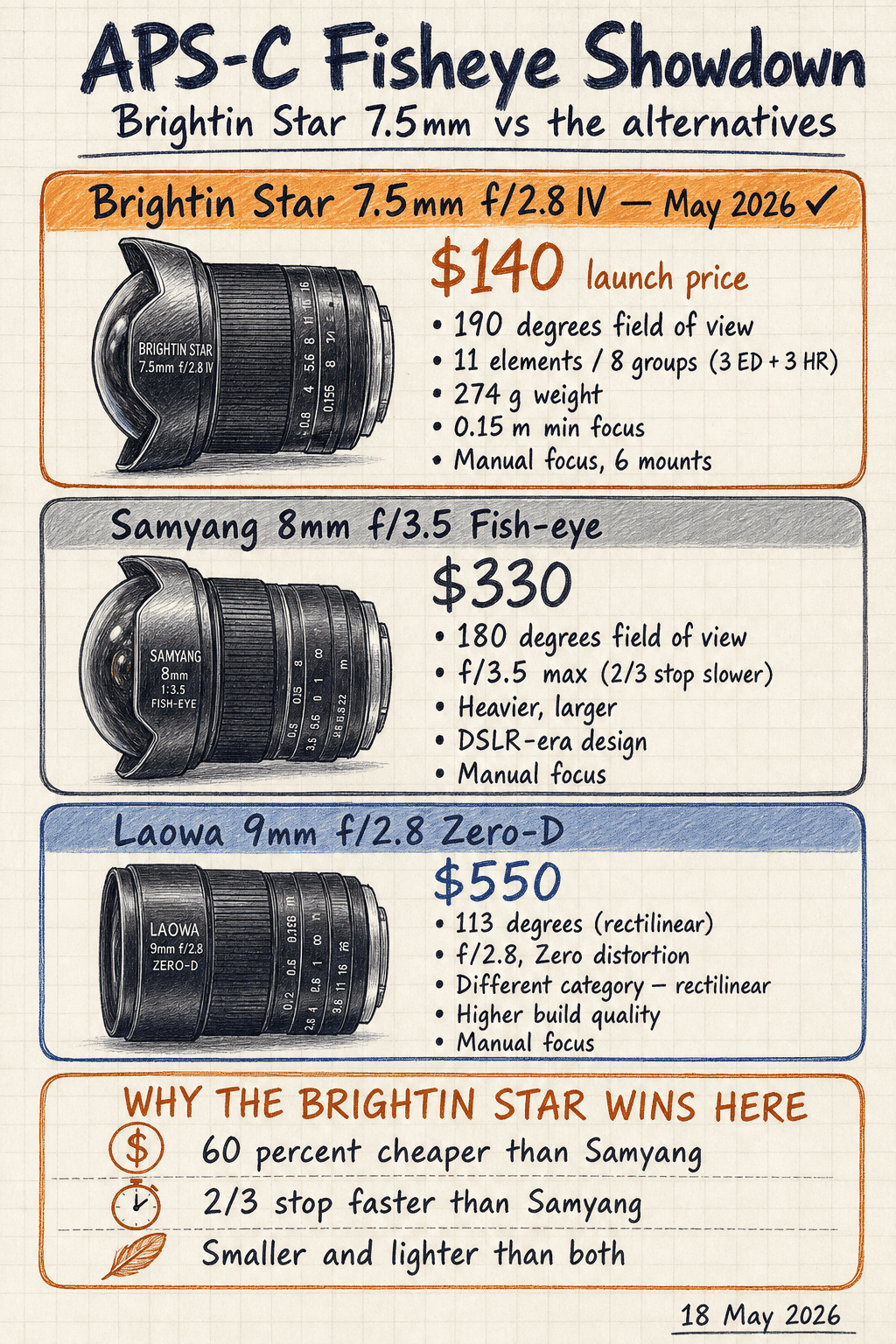


- Brightin Star announced the 7.5mm f/2.8 IV APS-C fisheye on May 11, 2026 with a $140 launch price (regular $160 after the intro window). Six mount options: Sony E, Nikon Z, Fujifilm X, Canon RF, Canon EF-M, and Micro Four Thirds. Available in both black and silver finishes. Listings are already live on Amazon.
- The optical formula is unusually serious for the price tier: 11 elements in 8 groups, with three extra-low dispersion (ED) elements and three high-refractive (HR) elements. A 5-blade aperture diaphragm produces 10-point starbursts around point light sources — particularly good for night cityscapes and astrophotography work.
- 190° field of view, 274g (9.7 oz) total weight, 0.15m close focus, manual focus only, rear filter slot. Aperture range f/2.8 to f/16. The compact body fits travel kits comfortably; the rear filter support is critical because the protruding front element makes traditional front-mounted filters impossible.
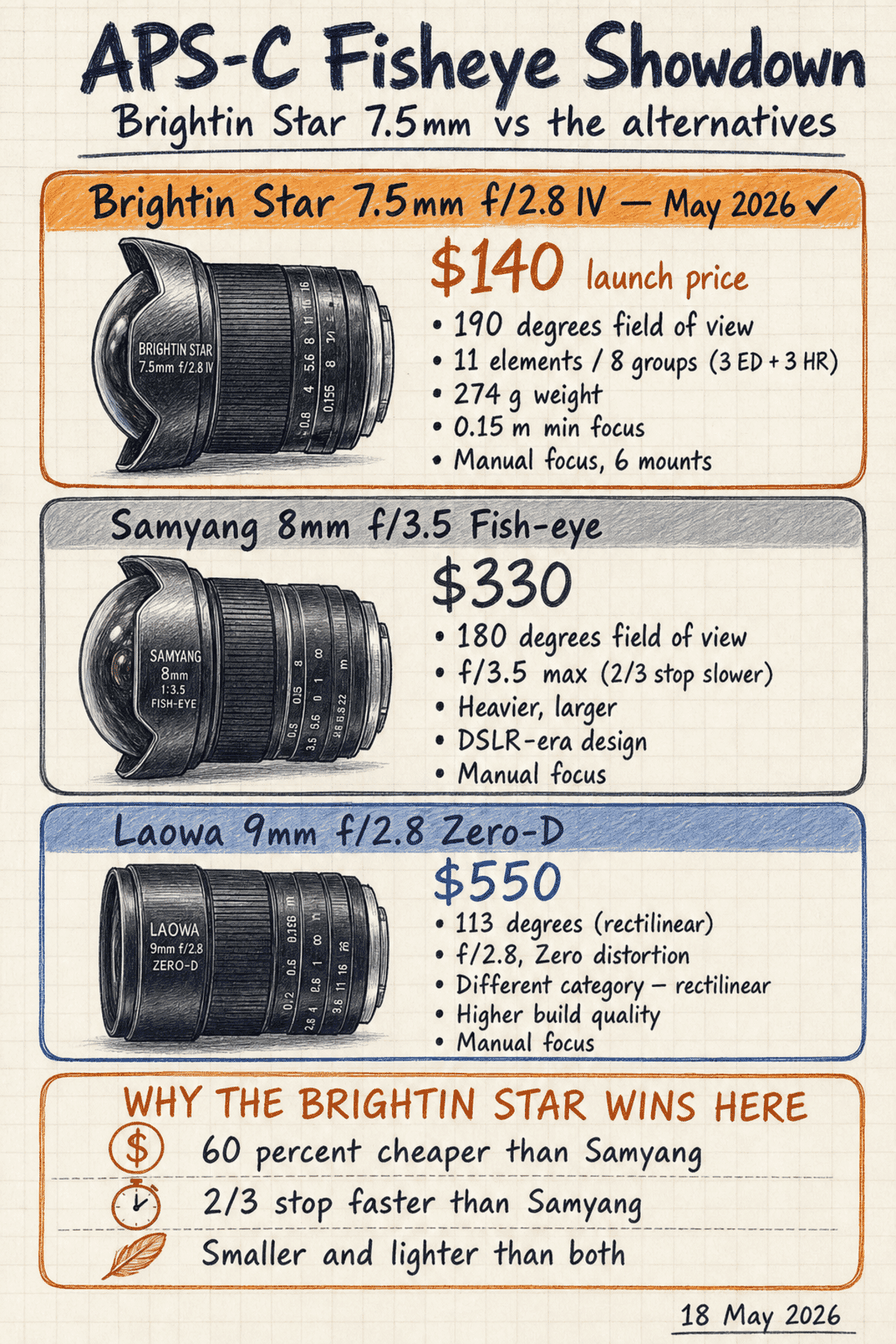
- At $140 the only real alternatives are the Samyang 8mm f/3.5 (~$330, slower, heavier, DSLR-era design) and the Laowa 9mm f/2.8 Zero-D (~$550, but that’s a rectilinear ultra-wide, not a fisheye — different category). For photographers who specifically want the fisheye distortion look, Brightin Star now owns the entry tier.
A 190° fisheye with ED glass for $140 is a genuine outlier in the ultra-wide manual lens market. Brightin Star announced the 7.5mm f/2.8 IV APS-C fisheye on May 11 — the company’s fourth-generation take on the 7.5mm focal length — and unlike the simultaneously-announced 10mm f/5.6 II at $66, this lens isn’t a stripped-down budget entry. The optical formula puts three ED elements and three HR elements in an 11-element / 8-group design, plus a rear filter slot and a 5-blade aperture engineered specifically for starburst character.
Six APS-C mounts ship from day one: Sony E, Nikon Z, Fujifilm X, Canon RF, Canon EF-M, and MFT. Both black and silver finishes are available. Amazon listings are live now at the $139.99 launch price (regular $160 after the intro window). Direct purchase from the manufacturer is also open.
When you buy through links on our site, we may earn a commission at no cost to you. We evaluate products independently. Commissions do not affect our evaluations.
The Optical Formula Punches Above the Price
Most $140 ultra-wides are six- or eight-element designs with no specialty glass. The 7.5mm f/2.8 IV ships with three ED (extra-low dispersion) elements and three HR (high-refractive) elements distributed across an 11-element / 8-group formula. ED glass specifically targets chromatic aberration — purple fringing on high-contrast edges, color separation in corner regions — which fisheye lenses traditionally struggle with because of the extreme angle of incoming light. HR elements help control distortion and improve corner sharpness.
None of this guarantees great real-world results. The optical formula is the recipe; manufacturing tolerances and quality control are what determine whether the recipe survives mass production. But the spec sheet signals intent — Brightin Star isn’t trying to ship the cheapest fisheye possible. They’re trying to ship the cheapest fisheye that actually performs at the level photographers expect from a credible lens.
Who Actually Uses a 7.5mm f/2.8 Fisheye
Four realistic buyer profiles for the Brightin Star 7.5mm f/2.8 IV:
- Astrophotographers who need maximum field of view and fast aperture for Milky Way and full-sky compositions. The combination of 190° FOV, f/2.8 aperture, and 274g weight is hard to find at any price — let alone $140. The 5-blade aperture’s starburst rendering on bright stars is editorial gold.
- Landscape photographers who want the fisheye look for tight stairwells, narrow canyons, dramatic interiors, and any composition where the curved-horizon aesthetic is a deliberate choice. The rear filter slot enables long-exposure work with ND filters that traditional fisheye optics block.
- Skate, surf, and action shooters who need the close-focus aesthetic — 0.15m minimum focus means you can practically touch the front element to the subject. Same “sacrificial lens” calculus as the 10mm budget option, but with meaningfully better optics for the times the shot is the keeper.
- Astrophotography and night-cityscape hybrid shooters using APS-C bodies (Nikon Zfc, Sony A6700, Fujifilm X-T5, OM System OM-3) who want one fisheye in the kit. The f/2.8 aperture handles low light, the ED glass keeps stars as points rather than smeared color, and the starburst aperture creates the streetlamp/star-cluster look that defines the genre.
What the Competition Costs
The honest competitive set for a serious-but-affordable APS-C fisheye is narrow:
- Samyang 8mm f/3.5 Fish-eye — around $330 street price. The default budget-tier fisheye for the last decade. 180° FOV (10° narrower than the Brightin Star), 2/3 stop slower at f/3.5, heavier and larger, DSLR-era design that pre-dates mirrorless. Still respected, but Brightin Star now does the same job for less than half the money.
- Laowa 9mm f/2.8 Zero-D — around $550. Different category entirely: this is a rectilinear ultra-wide, not a fisheye. The “Zero-D” designation means it corrects distortion to make straight lines stay straight. Useful for different work (architecture, interiors) and a premium build, but it doesn’t deliver the fisheye look at any setting. Not a direct comparison.
- Native first-party fisheye options on the same APS-C mounts — almost universally absent or expensive. Canon’s RF-S lineup has no fisheye. Sony has none for APS-C E-mount. Nikon Z has no native fisheye option for APS-C. Fujifilm shipped one early-X-mount fisheye that’s long discontinued.
That’s the gap Brightin Star is walking into. The major brands aren’t making fisheye lenses for crop-sensor mirrorless — Fujifilm shooters in particular have no current native fisheye in the X-mount lineup. The premium third-parties (Laowa, Voigtländer) ship rectilinear ultra-wides, not fisheyes. Samyang’s been the lone affordable fisheye option for a decade and is positioned 2.4× higher in price. This is the same gap third-party brands have been walking into across other major-brand-neglected segments. At $140 with f/2.8 and ED glass, the Brightin Star 7.5mm f/2.8 IV doesn’t just enter the segment — it effectively owns the entire entry-tier-fisheye slot.
The Limitations to Set Expectations Around
Set expectations honestly: this is still a manual-focus lens in a price tier where quality-control variation between copies is a real factor. Reviewer testing on early units of past Brightin Star lenses has shown sample-to-sample variation in centering, coatings, and aperture-blade smoothness. Some buyers get a great copy; others end up returning. That’s the third-party-budget-lens reality, not a Brightin Star-specific problem — TTArtisan, 7Artisans, and Meike all ship with similar variance.
The manual focus is genuinely manual — no electronic AF, no EXIF transmission to the camera body for some mount/body combinations, and you’ll need to set the aperture using the lens’s mechanical ring rather than the camera dial. For fisheye work at this focal length and f/2.8-to-f/8 working apertures, hyperfocal focusing handles 95% of compositions. But anyone expecting a one-trip-to-the-zoo no-think autofocus experience should look elsewhere.
Frequently Asked Questions
How is the 7.5mm f/2.8 IV different from the older Brightin Star 7.5mm f/2.8 III?
The IV designation appears to be primarily an updated optical formula and refreshed external design. Brightin Star has not published a side-by-side spec comparison, but the III version uses a different element count and was available in fewer mounts. The IV adds Canon RF and silver-finish options that weren’t available on the III. Real-world image-quality comparisons will need to wait for hands-on reviewer testing.
Can I use traditional screw-in filters?
No — the bulbous protruding front element makes front-threaded filters impossible. The 7.5mm f/2.8 IV uses a rear filter slot instead, which accepts thin gel or specialized rear-mount filter cuts. This is standard for fisheye optics and surprisingly useful for long-exposure landscape and astro work.
Will it work on a full-frame camera?
No. The image circle covers APS-C only. Mount it on a full-frame body and you’ll see heavy vignetting (black corners around an APS-C-sized image circle in the middle of the frame). Use APS-C crop mode if you need to shoot it on a full-frame body, but it’s purpose-built for crop sensors.
Is the 7.5mm f/2.8 IV better than the new Brightin Star 10mm f/5.6 II?
Different tools for different jobs. The 10mm f/5.6 II at $66 is the cheapest possible entry into fisheye optics — fine for occasional creative use and learning the look. The 7.5mm f/2.8 IV at $140 is the lens you buy when fisheye is a regular tool in your workflow, you need the f/2.8 aperture for astro or low-light work, and you want the better optical formula. If you can stretch from $66 to $140, the f/2.8 IV is the better lens. If $66 is the actual budget, the 10mm f/5.6 II is meaningfully better than nothing.

Image credit: editorial composition and competitive-comparison sketch infographic by PhotoWorkout. Launch details and spec confirmation sourced from PetaPixel and Brightin Star’s official product page — cited below.
Reporting and prior coverage cited in this article:
Primary Source
- PetaPixel — Brightin Star Launches New Fisheye Lens for APS-C Mirrorless Cameras – May 11, 2026 launch coverage with full spec breakdown and sample images.
- Brightin Star — Official 7.5mm f/2.8 IV product page – Manufacturer product page with full spec sheet, mount list, and direct ordering.
Affiliate
- Amazon — Brightin Star 7.5mm f/2.8 IV (ASIN B0GXR4DRSK) – Sony E-mount listing at the $139.99 launch price. Other mount variants also live on Amazon. PhotoWorkout earns a small commission on Amazon purchases through this link at no additional cost to you.
PhotoWorkout is a participant in the Amazon Services LLC Associates Program. We may earn a commission on qualifying purchases at no additional cost to you.