


- Three DJI stories landed in the same week, and together they widen the gap between what DJI sells globally and what a US buyer can legally or easily get. But they are three different problems, not one ban.
- The leaked DJI Neo 3 (spotted September 15) is legally blocked: DJI is on the FCC Covered List, so the drone cannot get the new US authorization it would need, even though its bundled RC Mini controller sneaked a grant in before the December 2025 cutoff.
- The Osmo 360 II went on global sale September 15 and skipped the US a second time, but this one is a choice. The camera holds a valid FCC grant and sits outside the drone tariff, so nothing in US law stopped it. DJI simply did not launch it here.
- The Section 232 drone tariff has been live since September 3: 25% on consumer models, 100% on heavy or thermal drones. It raises prices, it does not ban anything. The one thing that could reverse the access squeeze is DJI’s court fight with the FCC.
If you buy cameras and drones in the United States, this was another week of watching the rest of the world get gear you cannot. Three separate DJI stories landed within days of each other, and stacked together they make the same point: the distance between DJI’s global catalog and DJI’s US shelf keeps growing. A leaked Neo 3 beginner drone that cannot be certified here. A flagship 360 camera that shipped worldwide and skipped America again. And a drone tariff that quietly went live at the start of the month.
It is tempting to file all of this under one word, “banned,” and move on. That would be wrong, and the differences actually matter to what you can do about it. One of these is a legal wall, one is a business decision, and one is just a higher price. Here is the honest version of where US access stands this week.
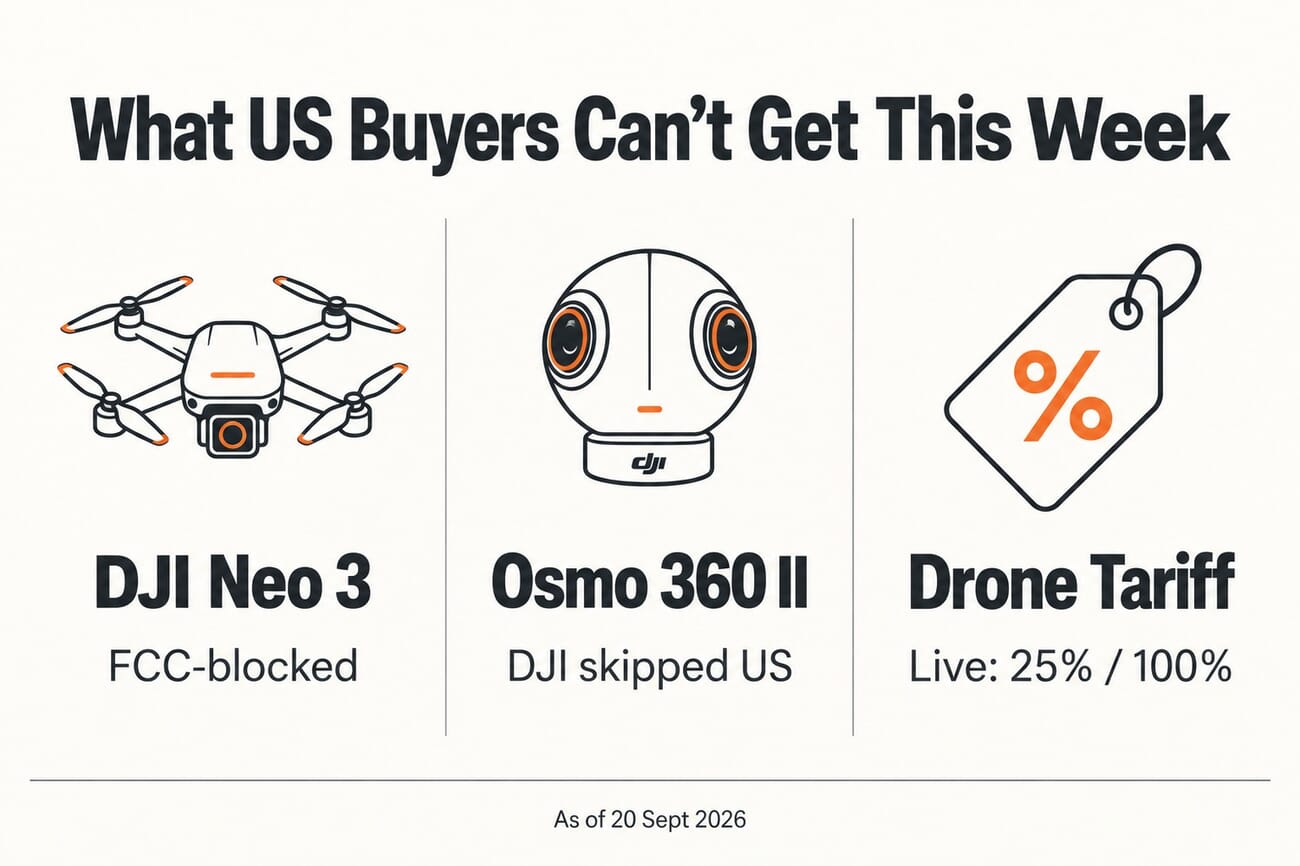
Three different walls, not one ban
The reason to separate these is simple: each one has a different cause, a different fix, and a different workaround. Lumping them into a single “DJI is banned in the US” headline is the kind of shortcut that gets shared widely and understood poorly. Below, each of the three, in plain terms.
The Neo 3: blocked, and not by DJI’s choice
A retail box for the DJI Neo 3 surfaced on September 15, showing a beginner drone wrapped in full hub-and-spoke propeller guards, a top-mounted sensor dome, and a nose gimbal much like the Neo 2. The most interesting thing on the box, though, was the controller: a new DJI RC Mini, the first Neo-class remote with a built-in screen.
Here is the catch. A DJI RC Mini received US FCC authorization on December 19, 2025, just three days before the FCC added DJI to its Covered List on December 22 and stopped issuing new authorizations for the company’s hardware. So the controller is cleared for US use. The drone is not. A controller grant is not an aircraft grant, and no Neo 3 made it through before the cutoff. Without its own pre-cutoff authorization, the Neo 3 cannot legally be sold in the States, which is exactly the mechanism we broke down when the FCC floated retroactively pulling authorizations for DJI drones you can still buy today. The likely outcome: American beginners get an FCC-approved remote and no approved drone to pair it with. The Neo 2 never got an official US launch either.
The Osmo 360 II: cleared, but DJI skipped the US anyway
The DJI Osmo 360 II is the uncomfortable one. DJI launched its 8K 360 flagship globally at IFA in Berlin, priced at €589 in the eurozone and £509 in the UK, with a September 15 on-sale date. The press release does not mention the United States once, no US price, no US date, and DJI’s American store still lists only the original 2025 Osmo 360. It is the second time this camera has passed over America, after the same thing happened at its August China launch.
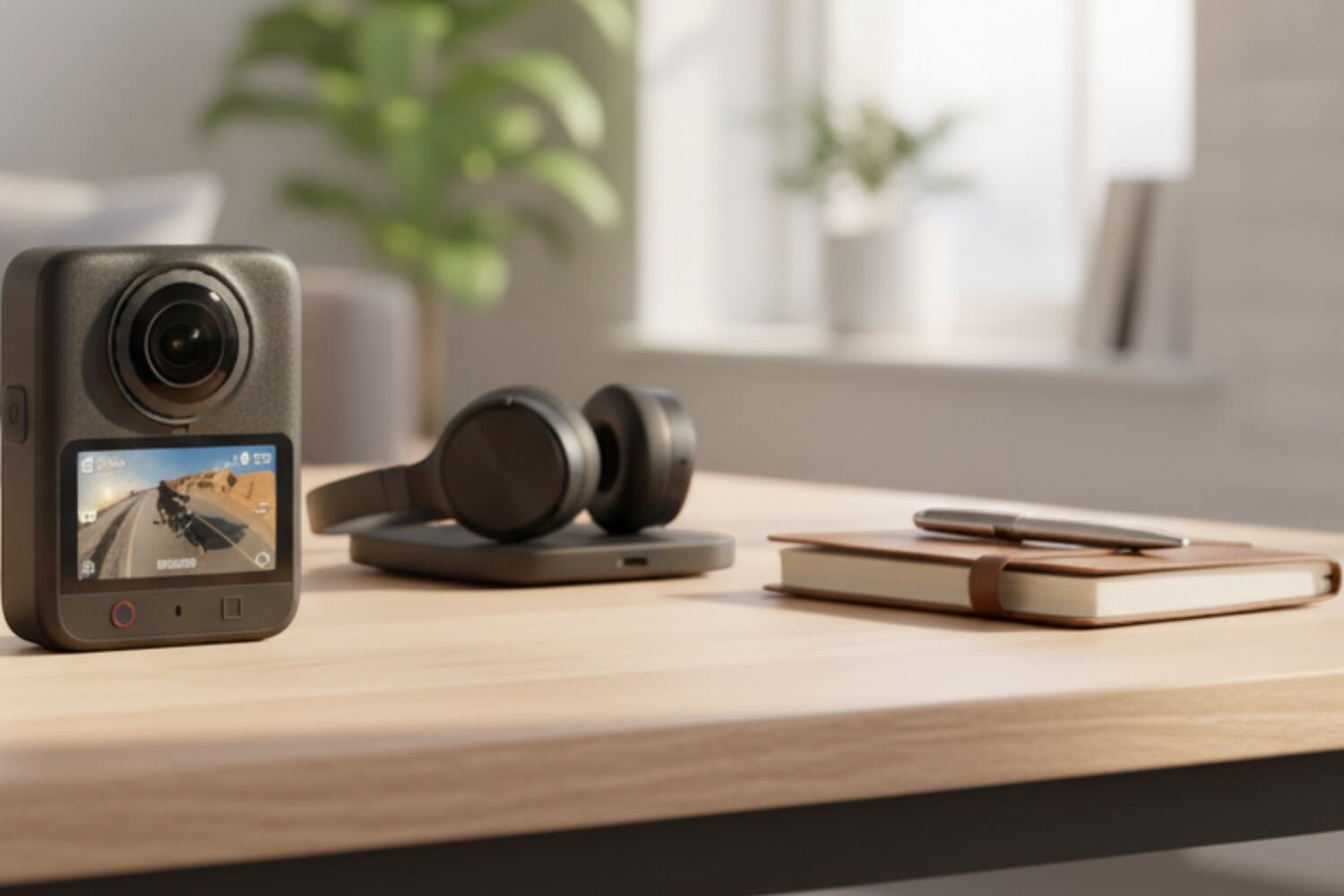
What makes this different from the Neo 3 is that nothing legal is stopping it. The Osmo 360 II holds a valid FCC equipment authorization granted December 21, 2025, one day before the cutoff, and a handheld 360 camera falls outside the drone tariff entirely. When the Pocket 4P skipped the US this summer, it was because the Covered List made a legal sale impossible. The Osmo 360 II has no such excuse. DJI is choosing not to launch a cleared product here, most plausibly because it is not interested in a US debut while its regulatory fight drags on. The practical result for creators: the Insta360 X6 is the only flagship 360 camera on US shelves, at $699.99, with no DJI alternative sitting beside it.
The tariff: live since September 3, and tiered
The third thread is the one people most often get wrong. The Section 232 drone tariff took effect at 12:01 a.m. Eastern on September 3, 2026, and it is not a flat 100%. It is tiered: 100% on heavy drones over 25 kg, thermal-imaging models, and certain critical components; and 25% on the consumer models most people actually buy, including DJI’s Mini, Air, Mavic and Neo lines. Allied nations sit lower, and a further component tranche is scheduled for February 2027. We laid out the full tier structure in our breakdown of the new drone tariffs.
The important framing: a tariff raises the price of a drone you can still buy. It does not remove it from the shelf. A DJI Mini or Air that was legally authorized before the cutoff stays on sale; it just costs about a quarter more than it did in August, and importers pass that straight to buyers. Conflating a 25% price bump with the Neo 3’s legal block, or the Osmo 360 II’s voluntary skip, muddies three very different situations.
What could actually reverse this: the courts
The single lever that could roll any of this back is DJI’s legal challenge. DJI filed a petition for review in the US Court of Appeals for the Ninth Circuit over the December 2025 Covered List addition, arguing the FCC failed to identify a specific national-security threat before listing its gear, exceeded its authority, and violated due process. The Pentagon has urged the FCC to reject DJI’s related reconsideration petition, and the FCC has reportedly begun quietly revoking some earlier DJI authorizations even as it insists existing grants remain valid. If the Covered List survives, the Neo 3 stays out and the pattern holds. If a court narrows or vacates it, the legal wall behind the Neo 3, the Pocket 4P and the Mic Mini 2S could come down. The tariff is a separate, trade-policy question that the courts here would not touch.
Frequently Asked Questions
Is DJI banned in the United States?
Not exactly. DJI gear authorized before December 22, 2025 can still be sold, so existing drones like the Mini and Air remain available. What changed is that DJI cannot get new US authorizations because it is on the FCC Covered List, which is why new models like the Neo 3 cannot launch here.
Why did the Osmo 360 II skip the US if it is legal to sell?
That appears to be DJI’s own decision. The Osmo 360 II holds a valid FCC authorization and is not covered by the drone tariff, so US law does not block it. DJI simply did not include the US in its global launch, likely a strategic choice while its regulatory case is unresolved.
How much is the new drone tariff on a consumer DJI?
25% for drones with a maximum takeoff weight of 25 kg or under, which covers essentially all consumer models. The 100% rate applies to heavier drones over 25 kg, thermal-imaging models, and certain components. Both tiers took effect September 3, 2026.
Can I still buy the Neo 3 by importing it?
You may be able to buy one through a third-party or gray-market seller, but it would not be an FCC-authorized device for US operation, and you would have no US warranty support. For most beginners, a currently-authorized DJI model or a US-available rival is the cleaner path.
The bottom line
This week did not “ban” anything new. It stacked three separate pressures on the same buyer: a beginner drone blocked by regulation, a flagship camera withheld by choice, and a tariff that quietly raised prices on the gear that is still here. The honest read is that the US is becoming a lower priority for DJI’s newest hardware, through a mix of rules DJI cannot control and decisions it can. Whether that trend reverses now rests less on DJI’s product calendar and more on a federal courtroom.
Primary Coverage
- DroneXL — DJI Neo 3 Box Leaks With an RC Mini the FCC Already Approved – Neo 3 retail-box leak, RC Mini FCC grant, and the aircraft-vs-controller distinction.
- DroneXL — DJI Osmo 360 II Goes Global at IFA, Skips America a Second Time – Osmo 360 II global pricing, valid FCC grant, and the absent US launch.
- DJI — Osmo 360 II launch (IFA 2026 press release) – Official global launch details and specifications.
- FCC — Covered List and DJI equipment authorization proceeding – The December 22, 2025 Covered List addition that blocks new DJI authorizations.
Image Sources
- DJI Osmo 360 II product image (DJI), staged via Photoroom – Official DJI product render composited into scene.
- Concept illustration, availability infographic and Pinterest pin — PhotoWorkout – Original PhotoWorkout editorial graphics.