


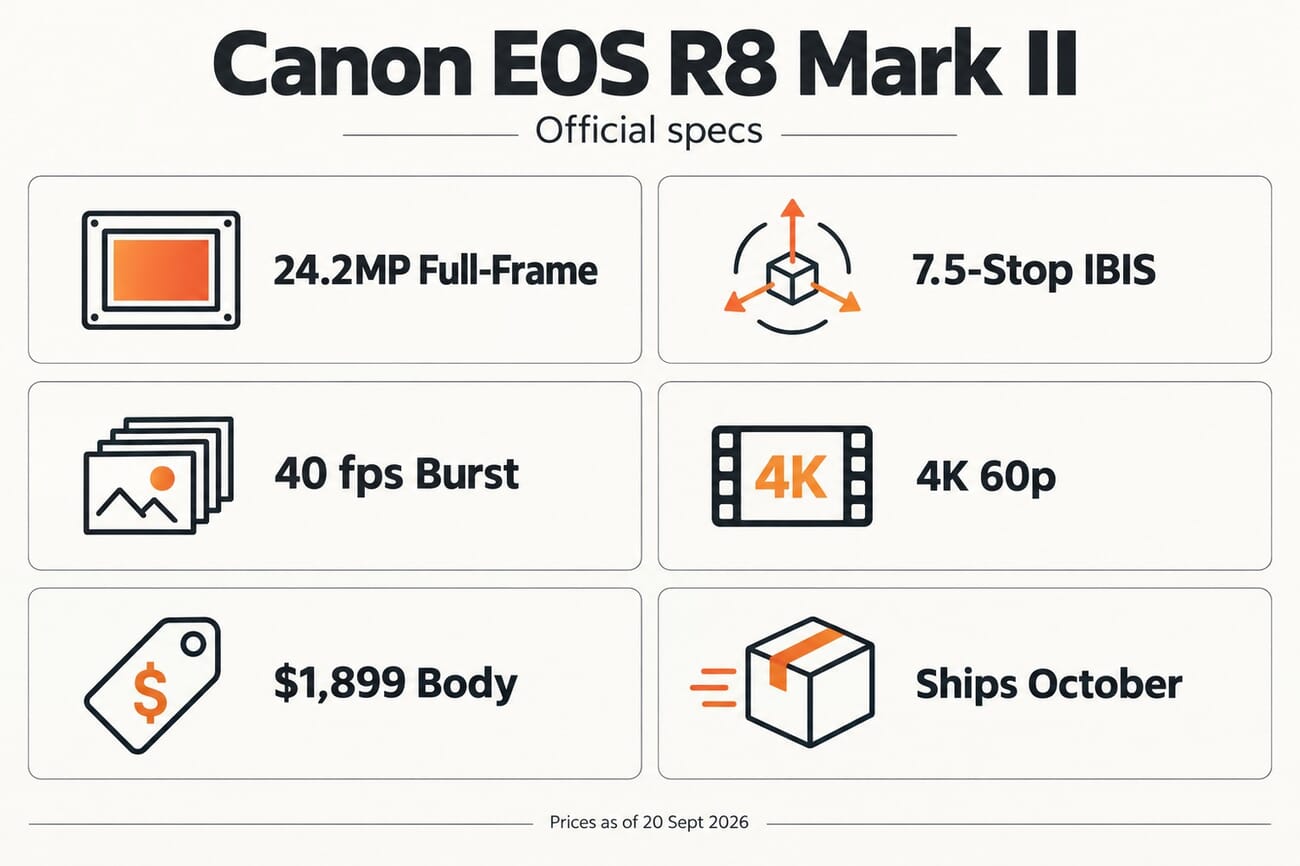
- Canon made the EOS R8 Mark II official on September 15, 2026. It keeps the 24.2MP full-frame sensor lineage of the R6 Mark II but finally adds the in-body stabilization the original R8 lacked.
- The marquee upgrade is a 5-axis IBIS system rated up to 7.5 stops at the center (7.0 at the edges), turning Canon’s smallest full-frame body into a genuine low-light and handheld-video tool.
- It is electronic-shutter only, hitting 40 fps with 20-frame pre-shooting, uncropped 4K/60p from 6K oversampling, and 180p Full HD, but that also caps flash sync at 1/200 second.
- Body-only price is $1,899 (or $2,099 with the RF24-50mm kit), shipping late October 2026. That is $400 above the original R8’s launch price, which reshapes the value case.
Canon has made it official. On September 15, 2026, Canon U.S.A. announced the EOS R8 Mark II, a full-frame mirrorless body that does the one thing owners of the original R8 spent two years asking for: it adds in-body image stabilization. Back in July, PhotoWorkout broke down the leaked spec sheet and argued the headline rumors were wrong, that this would be a 24-megapixel camera with real IBIS rather than a 32-megapixel retro throwback. The official announcement confirms almost exactly that reading. Here is what Canon actually shipped, what it costs, and why the price is the part worth arguing about.
If you want the pre-launch context, our earlier report on the leaked R8 Mark II specifications still holds up well against the final numbers. This piece covers the confirmed camera.
PhotoWorkout is reader-supported. If you preorder through links on this page we may earn a small commission, at no extra cost to you. It never affects our editorial take.
What Canon actually announced
The EOS R8 Mark II is built around a 24.2-megapixel full-frame CMOS sensor, the same effective resolution as the original R8 and drawn from the same family as the well-regarded Canon EOS R6 Mark II. Canon paired it with Dual Pixel CMOS AF II, deep-learning subject tracking for people, animals and vehicles across the full frame, and autofocus sensitivity down to -7.5 EV. Native ISO runs 100 to 102,400. None of that is a surprise, and none of it needed to be: the R6 Mark II sensor is fast, clean and proven, and reusing it keeps the R8 Mark II squarely in enthusiast-affordable territory instead of chasing resolution it does not need.
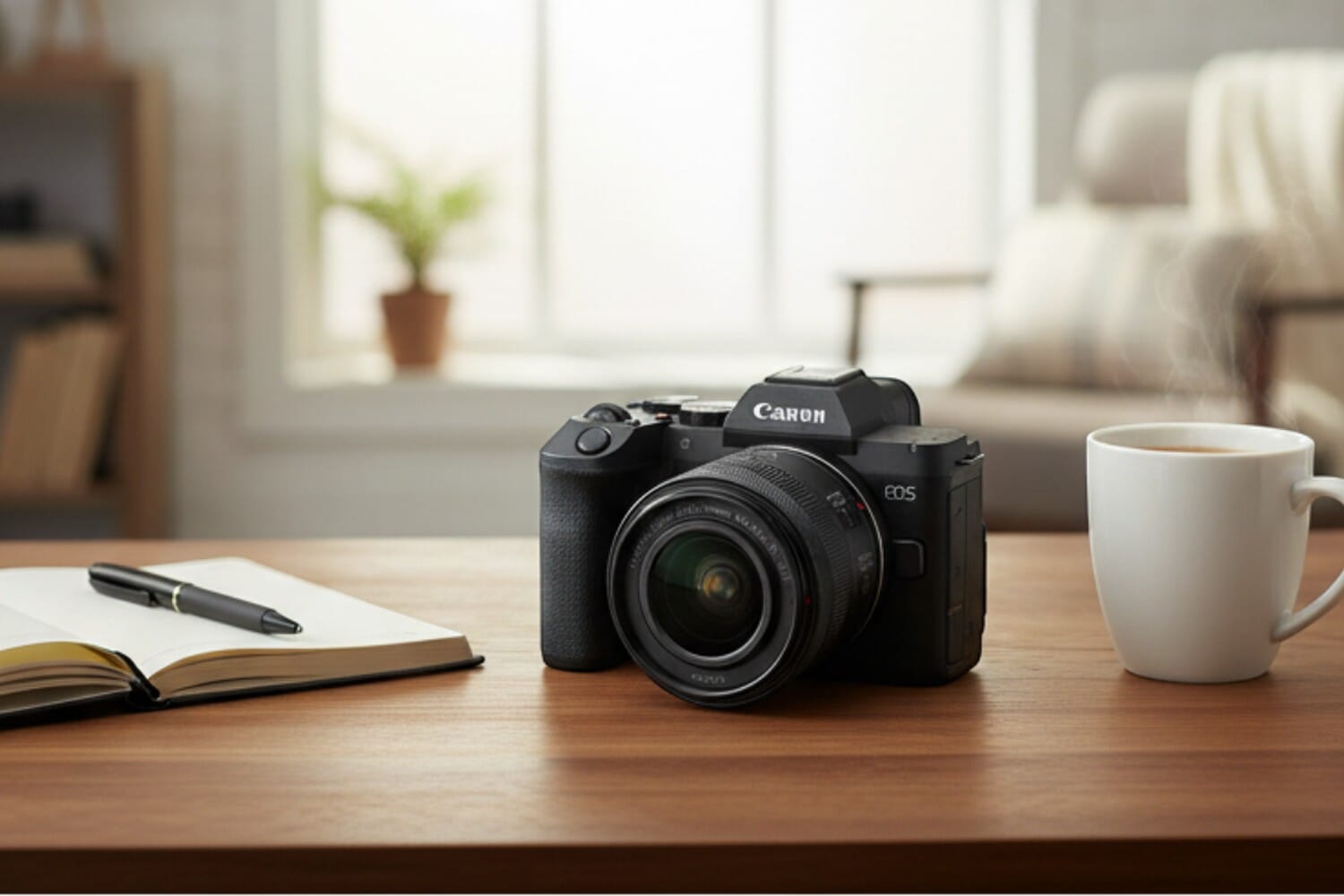
The body is where Canon spent its design effort. It calls the R8 Mark II the lightest EOS camera with IBIS to date, at roughly 546 grams with battery and card and 499 grams body-only. The look is new too: a flatter, more squared-off shell that Canon says nods to the angular heritage of the A-1, F-1 and T80 rather than the curvier recent EOS bodies. It is not the full AE-1 tribute the early rumor mill promised, but Canon clearly did reach back into its own history for the styling. A rear multi-controller joystick, absent on the original R8, is finally here, and the SD card moves to its own side door.
IBIS is the headline, and it changes what this camera is for
The original EOS R8 shipped in 2023 with no in-body stabilization at all, relying entirely on stabilized lenses. That single omission dominated every review. The Mark II fixes it with a 5-axis IBIS unit rated by Canon at up to 7.5 stops of correction at the center of the frame and 7.0 stops at the periphery. It adds Coordinated Control, which combines body and lens stabilization when you mount a stabilized RF lens, and Peripheral Coordinated Control, which Canon says specifically fights the edge wobble IBIS can introduce on ultra-wide lenses.
For everyday shooting, that is the difference between a keeper and a smeared frame in a dim restaurant, a museum, or at dusk. For video, it means usable handheld footage without a gimbal. Pairing 7.5-stop stabilization with a genuinely pocketable full-frame body is exactly the combination that made cameras like the R6 Mark II so popular, and it has now trickled down to Canon’s cheapest full-frame line. If you skipped the original R8 purely because it had no IBIS, this is the camera that erases your reason not to buy.
Electronic-only shutter: 40 fps, with strings attached
Speed is the other story, and it comes with a trade-off. The R8 Mark II drops the mechanical shutter entirely and relies on a fully electronic shutter. That unlocks a 40 fps burst rate, a silent 1/16,000-second top speed, and 20-frame pre-shooting that buffers the moment before you fully press the shutter. Canon quotes a 58 percent longer uninterrupted JPEG burst and a 30 percent longer RAW burst versus the original R8. For wildlife, kids and sport, on an affordable body, that is a real hit-rate boost.
The catch is the same one we flagged when Canon capped the R6 V’s electronic-shutter flash sync: going all-electronic limits you elsewhere. Flash sync tops out at 1/200 second at full frame (1/250 in 1.6x crop), and electronic shutters can still show rolling-shutter skew on fast pans and banding under some artificial light. How well Canon’s sensor readout tames those artifacts is the single biggest question reviewers will need to answer once retail units ship.
Video: uncropped 4K/60p and 180p slow motion
On the video side the R8 Mark II punches above its price. It records uncropped 4K up to 60p, oversampled from 6K for extra detail, plus uncropped Full HD at up to 180p for slow motion, with audio supported at every frame rate and a dedicated Slow & Fast recording mode. Canon Log 3, 10-bit capture, Wi-Fi 6 transfer, and wired or wireless live streaming over USB-C and HDMI round it out. The single SD card slot (UHS-II) and the compact LP-E17 battery carry over, and that battery is the one genuine weak spot: CIPA rates it at only about 150 to 220 shots per charge through the viewfinder, so spare batteries are not optional for a full day out.
The $400 question: is it still affordable full-frame?
Here is the part worth debating. The original EOS R8 launched at $1,499 body-only in 2023 (it sits at $1,599 today after tariff-driven adjustments). The R8 Mark II lands at $1,899 body-only, or $2,099 in a kit with the RF24-50mm F4.5-6.3 IS STM lens, shipping late October 2026. That is a $400 jump over the first model’s launch price, and it quietly repositions the camera. The R8 was the impulse-buy gateway to full frame; the Mark II is a considered purchase.
At $1,899, the R8 Mark II no longer undercuts everything in sight. It bumps up against Nikon’s Z5 II and lands within a couple hundred dollars of the frequently-discounted Nikon Z6 III, which offers a partially-stacked sensor and dual card slots. The IBIS, the 40 fps burst and the strong video spec absolutely justify the increase on paper. But buyers who remembered the R8 as the cheap way into Canon full-frame should recalibrate: this is a better camera at a higher tier, not a like-for-like successor at the old price.
Canon is also selling two accessories alongside it, both due late October: an EG-E2 Extension Grip ($99.99) that adds height and balance for larger hands and lenses, and the Speedlite EL-5 Ver.2 ($379) with longer wireless range. You can check current R8 Mark II preorder listings at B&H if you want to lock in a launch-window slot.
The odd one out: Dual Pixel 3D Converter
The strangest item on the spec sheet turned out to be real. Canon is releasing a free Windows application called the Dual Pixel 3D Converter, which generates 3D imagery from a single frame, either from Dual Pixel RAW files or from JPEGs the R8 Mark II captures with embedded distance data. It can output a 3D photo with a background, a background-isolated 3D model for interactive or web use, or a short 3D video clip. It is a niche, experimental feature rather than a headline reason to buy, and Canon has not said whether it stays free long-term, but it is a genuinely novel use of the Dual Pixel sensor most rivals cannot match.

Frequently Asked Questions
When does the Canon EOS R8 Mark II ship, and what does it cost?
Canon announced it on September 15, 2026, with availability expected in late October 2026. It is $1,899 body-only and $2,099 as a kit with the RF24-50mm F4.5-6.3 IS STM lens.
Does the R8 Mark II have in-body stabilization?
Yes. This is the big change over the original R8. It uses a 5-axis IBIS system rated up to 7.5 stops of correction at the center of the frame and 7.0 stops at the edges, with coordinated body-and-lens control.
Does it have a mechanical shutter?
No. The R8 Mark II is electronic-shutter only. That enables 40 fps bursts and a silent 1/16,000-second top speed, but it caps flash sync at 1/200 second and can show rolling-shutter effects on fast motion.
Is it worth upgrading from the original EOS R8?
If you were bothered by the lack of IBIS or wanted the joystick, faster burst and better video, yes. If you shoot mostly with stabilized lenses in good light, the original R8 still covers the same 24MP image quality for less money.
The bottom line
The EOS R8 Mark II is the camera the original R8 should probably have been: full-frame image quality in Canon’s lightest stabilized body, with fast, video-friendly specs that stretch well past its class. The only real friction is the $400 price climb, which moves it out of impulse-buy territory and into a genuine comparison against the Nikon Z5 II and Z6 III. For anyone who wanted the R8 but needed stabilization, though, the wait is over, and the answer is finally yes.
Primary Coverage
- Canon U.S.A. — EOS R8 Mark II launch press release – Official announcement, pricing, availability and the Dual Pixel 3D Converter.
- Newsshooter — Canon Announces EOS R8 Mark II – Full official specification table, burst and video figures.
- Canon Rumors — R8 Mark II announcement and pricing – Pricing breakdown and accessory details at launch.
Image Sources
- Canon EOS R8 Mark II product images (staged via Photoroom) – Featured and design images: official Canon product renders composited into scene.
- Specs infographic and Pinterest pin — PhotoWorkout – Original PhotoWorkout editorial graphics.