


- A roll of Kodak Portra 400 that cost around $9 in 2016 now runs $18 to $22, roughly triple, and about four times its mid-2000s price. Two same-day July 17 stories capture the squeeze and the counter-move.
- The Phoblographer resurfaced a 2005 film-price catalog showing how far costs have climbed. On the same day, the $35 Kodak EC35 launched as a deliberately cheap way into 35mm.
- The EC35 is a reusable point-and-shoot from Reto (the Kodak Charmera maker), not Eastman Kodak: 25mm f/10 acrylic lens, fixed 1/100s shutter, built-in flash, seven colors, 102 g.
- Bigger picture: Eastman Kodak brought stills-film distribution back in-house in March 2026, while Kodak Alaris raised distributed-film prices 1 to 39 percent on February 1 as silver costs surged.
Film photography is having a decade-long revival and a decade-long price problem at the same time. Two stories landed on the same day, July 17, that together tell the whole analog-economics tale: The Phoblographer dug up a 2005 film catalog to show just how much a roll now costs, and Kodak launched a $35 camera clearly designed as the cheapest possible way to start shooting it.
Here is the actual price curve, why film keeps getting more expensive, and where the new EC35 fits, plus the honest catch behind that low sticker price.
The 20-Year Price Climb, in One Chart
Kodak Portra 400 is the reference point most film shooters feel in their wallet, so it makes the clearest curve. In the mid-2000s a 35mm roll sat under $5. Through the 2010s it drifted up slowly, holding around $10 to $13 from roughly 2015 to 2020. Then it accelerated: past $13 in 2023, and today anywhere from $18 to $22 depending on the retailer.
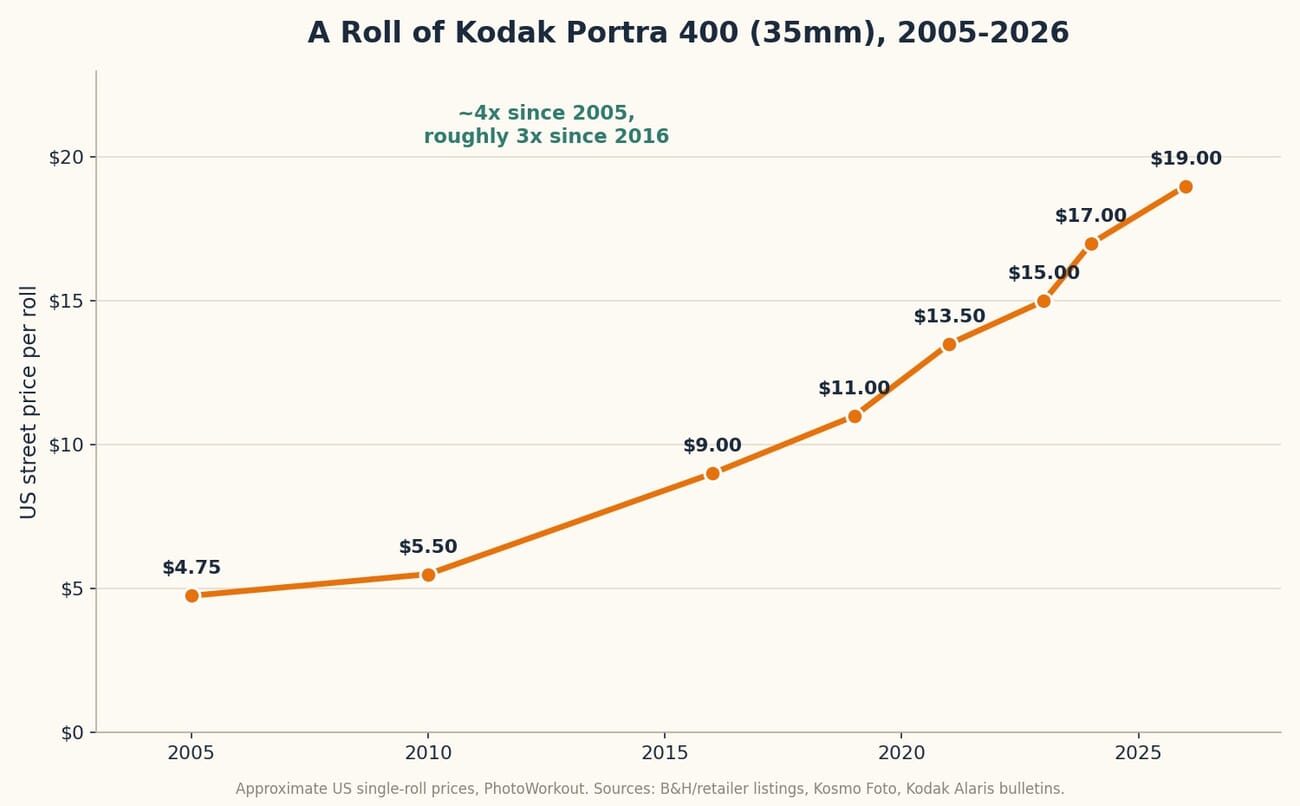
That is roughly a tripling since 2016 and about a fourfold rise from the mid-2000s, far outpacing general inflation over the same window. And Portra is not an outlier. Kodak Gold, once the value stock, now sits at $8 to $12. Ektachrome E100 slide film runs $18 to $22 before you add the pricier E-6 processing that pushes an all-in slide roll past $30. Every tier moved up together.
Why Film Keeps Getting More Expensive
The revival itself is part of the story. As demand returned, manufacturers who had spent the 2000s scaling down had to reverse course, and coating film is a capital-heavy, low-volume business with little room for the economies of scale that keep digital cheap. But three concrete forces drove the recent spikes.
- Silver. Photographic film is coated with light-sensitive silver halide crystals, so the silver commodity price feeds almost directly into a roll’s cost. Silver has climbed sharply, and manufacturers have cited it by name in price bulletins.
- Distributor price hikes. On February 1, 2026, Kodak Alaris raised prices on its distributed stocks by $1 to $3 per roll, a range that works out to anywhere from 1 to 39 percent depending on the film. Kodak has now raised prices multiple times since 2023.
- A thinning ecosystem. Fewer labs, discontinued stocks, and higher shipping and energy costs all compound. When a staple emulsion disappears, demand concentrates on what remains, pushing those prices up too.
There is one hopeful countercurrent. In March 2026, Eastman Kodak brought distribution of its stills films back in-house after more than a decade of outsourcing, a move it framed as bringing price stability and making new film stocks more likely. Whether that eventually bends the curve back down is the open question hanging over every shooter’s budget.
Kodak’s $35 Counter-Move: the EC35
Against that backdrop, the timing of the Kodak EC35 is no accident. Launched July 17 for $34.99 on Amazon, it is a reusable 35mm point-and-shoot built as the lowest-friction on-ramp into film. One clarification worth making up front: this is a Kodak-branded camera made by Reto, the licensee behind the viral Kodak Charmera, not a product engineered by Eastman Kodak, which today makes the film, not the cameras.
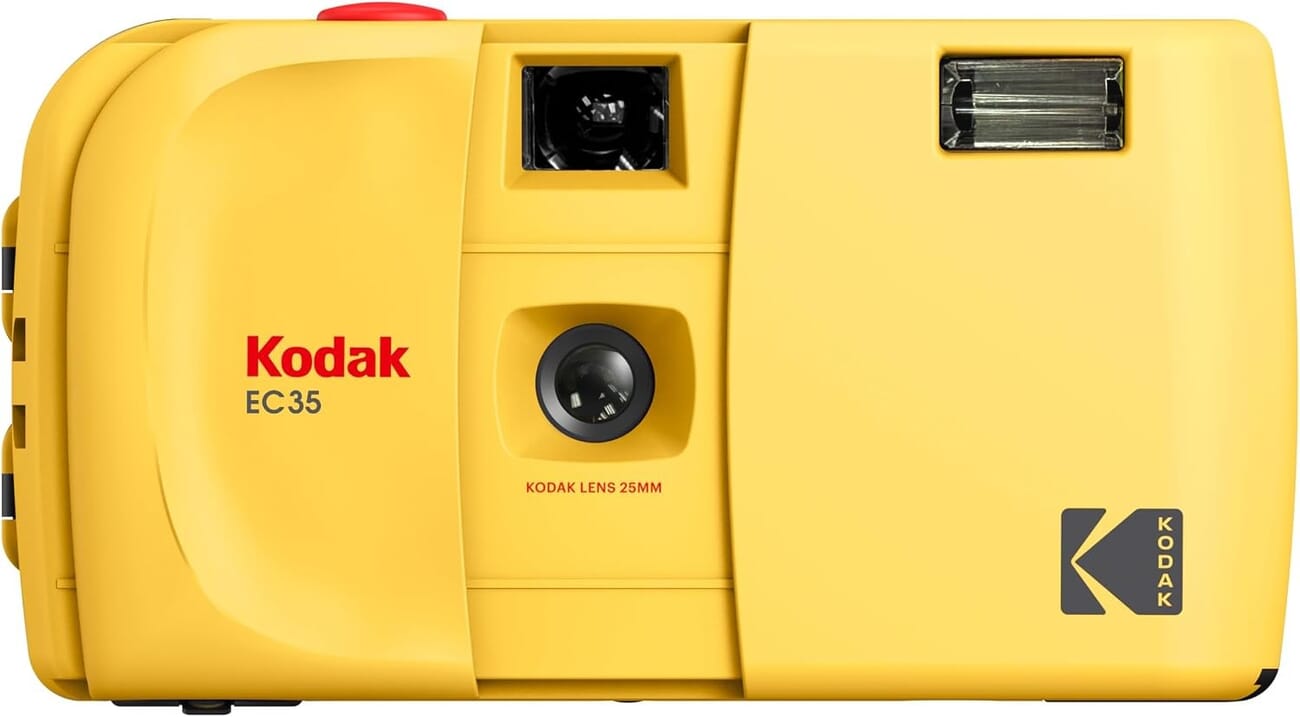
The spec sheet is deliberately minimal: a 25mm f/10 acrylic (plastic) lens, a single fixed 1/100 second shutter speed, fixed focus, and a built-in flash powered by one AA battery. It weighs just 102 grams, comes in seven colors from midnight black to avocado green, and revives the tactile sliding lens cover that once defined 1990s compacts like the Olympus Mju. Expect image quality much like a disposable: soft, grainy, flash-lit, and charming precisely because of it.
You can buy the camera alone for $35, or a $45 bundle that adds a strap and a 24-exposure roll of Kodak Ultramax 400. If a fixed-lens compact feels too limiting, the reloadable-but-simple category has grown fast; the roundup of best beginner film cameras covers the step-up options.
The Catch: a Cheap Camera Does Not Fix Expensive Film
Here is the part the launch marketing skips. The EC35 lowers the price of the camera, but the camera was never the expensive part. The recurring cost is film and developing, and that is exactly what has tripled.
Run the real math. A 24-exposure roll of Ultramax 400 is about $12 to $15, and lab development plus scanning adds roughly $12 to $18. Call it $28 all-in for 24 frames, or a little over a dollar per shot before you have printed anything. Shoot one roll a month for a year and you have spent $300-plus on consumables, on top of the camera. The $35 sticker is the cheapest part of a hobby that bills you every time you press the shutter.
That is not an argument against film, it is an argument for going in with clear eyes. The cheapest genuine way to shoot analog in 2026: buy the cheap reusable body, then economize on the recurring line by choosing budget color stock like Kodak Gold over Portra, bulk-buying film, and developing black-and-white at home. Shooters weighing the whole analog-versus-digital cost question often land on a hybrid like the retro-styled digital bodies we covered in the Canon EOS R8 Mark II report or the Fujifilm X100VI, which chase the film look without the per-frame bill.
Frequently Asked Questions
How much has film actually gone up?
A roll of Kodak Portra 400 has gone from roughly $9 in 2016 to $18 to $22 in 2026, about triple. Budget stocks like Kodak Gold and slide films like Ektachrome climbed on a similar curve. General inflation over that period was far lower, so film has gotten more expensive in real terms, not just nominal.
Is the Kodak EC35 actually made by Kodak?
It carries the Kodak brand under license but is made by Reto, the same company behind the viral Kodak Charmera and the Ektar H35. Eastman Kodak today manufactures film, not these consumer cameras. The film you load, such as Kodak Ultramax or Gold, is the genuine Eastman Kodak product.
Is the EC35 worth it, or should I buy a used film camera?
For the disposable-camera look with the ability to reload, the EC35 is a fair $35. For actual image quality, a used autofocus compact or an SLR with a real glass lens will run more but deliver sharper, more controllable results. The choice depends on whether you want the lo-fi aesthetic or the capability.
What is the cheapest way to shoot film in 2026?
Pair an inexpensive reusable body with budget color film (Kodak Gold rather than Portra), buy film in bulk, and develop black-and-white at home to cut the recurring lab cost. The camera is a one-time expense; film and developing are what add up, so that is where savings actually matter.
The Bottom Line
Film’s 20-year price climb is real, steep, and unlikely to reverse soon, even with Eastman Kodak taking distribution back in-house. The $35 EC35 is a smart, well-timed on-ramp that lowers the intimidation and the upfront cost, and it will introduce a lot of people to analog. Just go in understanding what the sticker does not cover: in film photography, the camera is cheap and the shooting is not. Budget for the rolls, not the body, and the hobby stays a joy instead of a surprise.
Primary Coverage
- The Phoblographer – How Film Prices Have Shot Up Over 20 Years – The July 17 cost-history piece built on a 2005 film catalog.
- PetaPixel – The Kodak EC35 35mm Film Camera Brings Back the Iconic Slide Cover – EC35 specs, pricing, and Reto attribution.
- Digital Camera World – Kodak just launched a compact film camera for the same price as the viral Charmera – EC35 full-frame vs half-frame detail and lineup context.
- Kosmo Foto – Eastman Kodak is distributing all its films again – March 2026 in-house distribution move and its implications.
- DPReview – Eastman Kodak has resumed direct sales of consumer film – Confirmation of direct distribution and the price-stability rationale.
- AnalogSpace – Kodak Alaris film price increase 2026 – The February 1 Alaris increase, varying 1 to 39 percent by stock.
Image Sources
- Kodak / Reto – EC35 product photography (featured and inline) – Manufacturer product images of the EC35, featured shot staged via Photoroom.
- PhotoWorkout – Portra price-history chart and pin illustration – Chart and stylized illustration created by PhotoWorkout from cited retail and bulletin data.