


- GoPro has agreed to be acquired by optical-photonics company Starman Optical in a definitive merger worth about $285 million, or $1.14 per share, announced September 1, 2026.
- GoPro says it will fully support existing consumer cameras, subscriptions, and cloud services, so your current gear and Quik plan are not going anywhere.
- The combined company’s stated future is defense, government, robotics, aerospace, and AI-infrastructure optics, not consumer action cameras, which changes GoPro’s long-term priorities.
- The deal ends a survival crisis that had GoPro warning it might not last the year. It stays listed on NASDAQ, clears roughly $92 million in debt, and existing shareholders keep about 10 percent.
The company behind the action camera in your backpack just changed hands. On September 1, 2026, GoPro announced it has entered a definitive merger agreement with Starman Optical, Inc., a privately held optical-photonics firm, in a deal valued at roughly $285 million. It closes a months-long scramble for a lifeline that, only weeks ago, had GoPro openly warning investors it might not survive the year.
The headline number matters, but the sentence buried in the announcement matters more for anyone who owns a GoPro: the combined company will “leverage its IP, optics, and imaging capabilities across defense, government, robotics and aerospace markets.” In other words, the brand survives, but its center of gravity is moving away from the consumer action cameras that made it famous. Here is what the acquisition actually is, and what it means for the camera you already own or just bought.
The deal: $285 million and a 10 percent stake
Under the agreement, GoPro shareholders receive an aggregate cash payment of about $285 million, which works out to roughly $1.14 per share. To put that in context, GoPro (NASDAQ: GPRO) was trading under 60 cents per share just last week, so the offer is a meaningful premium over where the stock had collapsed to. On the announcement the stock spiked hard, touching as high as $1.58 intraday.
A few structural details are worth knowing. GoPro’s existing shareholders will keep ownership of about 10 percent of the outstanding shares, so this is not a clean 100 percent buyout. GoPro’s roughly $92 million in debt will be repaid in full when the merger closes, which removes the balance-sheet pressure that had been threatening the company. GoPro will remain publicly listed on NASDAQ, and founder Nicholas Woodman stays on as CEO. Both boards have approved the deal, and it is expected to close by the end of 2026, subject to regulatory approvals.
This is the resolution of a story worth reading in full: a month ago GoPro told the market it might not be a going concern, a rare and serious admission. Our earlier report on GoPro warning it might not survive laid out how bad the numbers had gotten. The Starman merger is the answer to that cliffhanger. GoPro does not disappear, but it is rescued by being absorbed into a very different kind of company.
Who is Starman Optical, and why buy a camera brand?
If you have never heard of Starman Optical, you are not alone. It is a privately held optical-photonics company whose core business is optical transceivers used in AI data centers, the components that move enormous volumes of data using light rather than electrical signals. That is a booming, unglamorous corner of the AI buildout, and it is the opposite end of the imaging world from a waterproof helmet camera.
So why buy GoPro? The logic is optics and intellectual property. GoPro has spent two decades engineering compact, rugged lenses, image sensors, stabilization, and imaging pipelines. Starman’s pitch is that combining GoPro’s optical expertise and patent portfolio with its own U.S. manufacturing and transceiver technology creates something that can serve markets far larger than consumer cameras. Starman’s U.S.-made optical transceivers are expected to be folded into GoPro’s product lineup to reach markets like AI infrastructure.
“Advanced optics and imaging are essential to AI, national security, and the broader economy, yet much of the critical hardware supporting these technologies continues to be manufactured overseas,” said Charles Tebele, Chief Executive Officer of Starman Holding. The stated ambition is to “bring production of these critical components back to the United States.” Read plainly: GoPro is being bought less for its cameras and more for the imaging know-how behind them.
What actually happens to your GoPro
This is the part that matters if you own a Hero, a Max, or one of the newer models. The reassuring news, straight from GoPro: the company will continue to fully support its existing consumer products, subscriptions, and cloud product offerings. Your camera keeps working. Your GoPro subscription and the Quik app keep working. Cloud auto-upload keeps working. Nothing about the acquisition flips a switch that bricks hardware you already paid for.
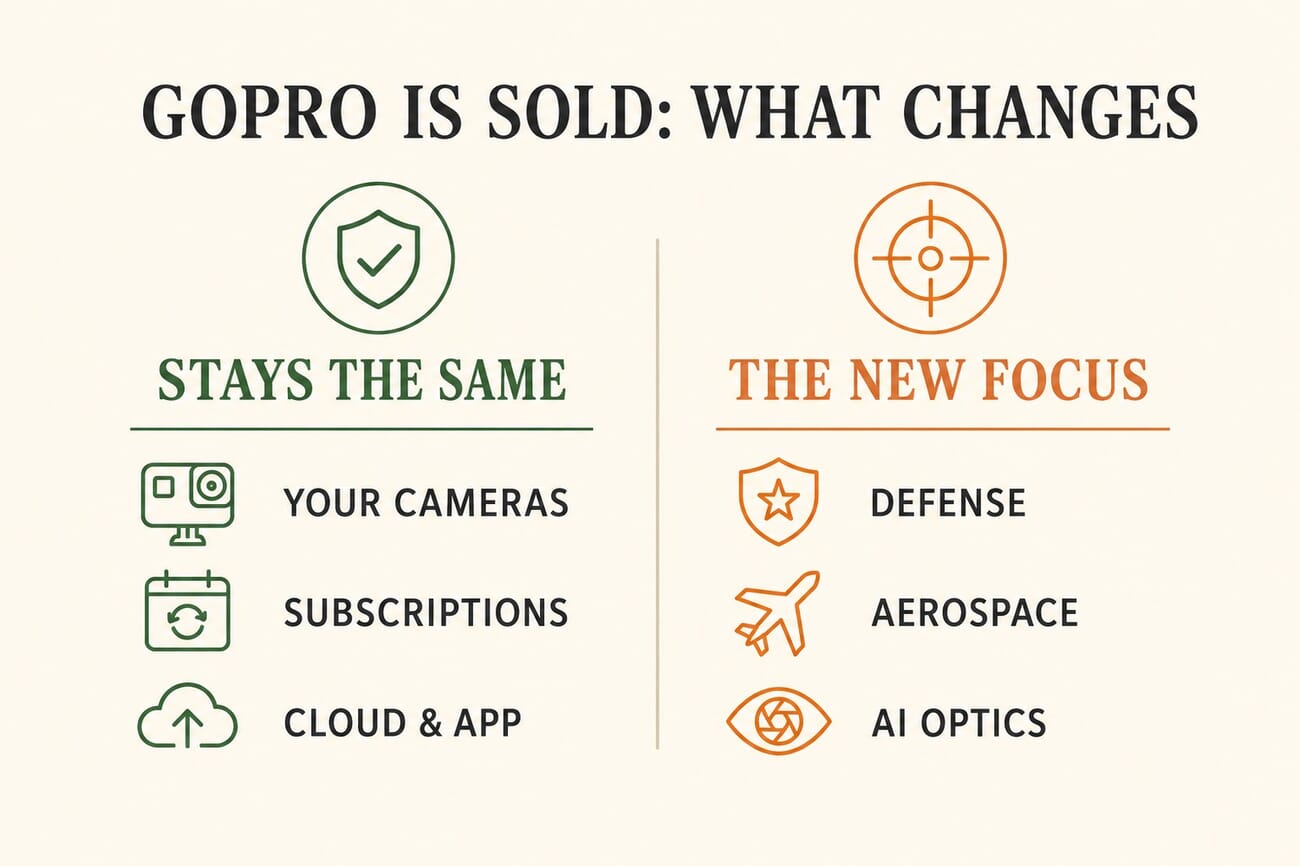
The caveat is about the future, not the present. When a company’s publicly stated strategy points at defense, aerospace, robotics, and AI infrastructure, consumer action cameras stop being the growth story and become a legacy line. That does not mean GoPro abandons them tomorrow. Woodman himself framed the merger as a way to “grow across consumer, commercial and defense markets.” But priorities show up in roadmaps and R&D budgets over time, and the honest read is that the pace and ambition of future consumer cameras is now an open question rather than a given.
Practical takeaway for owners: keep using your gear normally, and there is no need to panic-buy accessories or dump your subscription. Just temper expectations about how aggressively the consumer line gets pushed forward from here, and treat any big new consumer feature as a bonus rather than a promise.
The Mission 1 Pro question for anyone who just bought in
This acquisition lands with especially awkward timing for one group of buyers. Just days before the news, GoPro launched the Mission 1 Pro, its first interchangeable-lens camera, a roughly $700 swing at a more serious, modular imaging system. In our coverage of that launch, the open worry was blunt: an ambitious new platform is only as good as the company’s ability to support it, and GoPro’s survival was in doubt.
The merger answers half of that worry and sharpens the other half. On support, the picture improves: a debt-free GoPro inside a well-capitalized parent is far more likely to honor warranties, ship firmware, and keep the app running than a company staring down insolvency. On ambition, the picture is murkier. An interchangeable-lens system lives or dies on its lens ecosystem and sustained development, and that is precisely the kind of long-horizon consumer investment that competes with a new defense-and-optics mandate for attention. If you bought a Mission 1 Pro, it is not orphaned, but its future as a growing platform now depends on how seriously the merged company keeps investing in consumer imaging.
The Markiplier subplot
There is a genuinely strange side story here. The day before the merger was announced, YouTube star and filmmaker Mark Fischbach, better known as Markiplier, disclosed that he had become GoPro’s largest single shareholder, picking up about 8.5 percent of the company on the argument that it was badly undervalued. Roughly 24 hours later, the merger news validated that bet in dramatic fashion, with the stock jumping from under 60 cents toward the $1.14 deal price.
It is an unusually well-timed call, and it is a reminder of how far GoPro’s valuation had fallen that a single high-profile individual could accumulate that large a stake. What happens to Fischbach’s position as the deal closes is one of the more entertaining loose ends of an otherwise sober corporate story.
Why this fits a bigger “made in America” optics push
Zoom out and the deal fits a pattern we have been tracking across the imaging world. Washington has spent the past year tightening the screws on Chinese-made camera and drone technology, from tariff threats to proposed import restrictions. That backdrop is exactly why our reporting on the FCC’s proposed drone restrictions has stayed relevant, and it is the same current Starman is riding.
Starman is explicitly pitching U.S.-manufactured optics and transceivers as a national-security advantage, at a moment when the government wants critical imaging hardware built domestically rather than sourced overseas. Buying an American camera brand with deep optical IP is a fast way to plant a flag in that space. For the broader camera market, it is one more sign that geopolitics, not just image quality, is now shaping who makes your gear and where. If GoPro’s consumer future does slow, buyers looking for a rugged action camera will increasingly weigh alternatives like the Insta360 X6 or more budget-focused options such as the SJCAM SJ30.
Frequently Asked Questions
Is GoPro going out of business?
No. The Starman Optical merger is what keeps GoPro alive. The company had warned it might not survive the year, and this roughly $285 million acquisition clears its debt and keeps it listed on NASDAQ. The brand continues, though its long-term focus shifts toward defense and optics.
Will my existing GoPro camera still work?
Yes. GoPro has committed to fully supporting existing consumer products, subscriptions, and cloud services. Your camera, your GoPro subscription, and the Quik app are not affected by the acquisition.
Should I still buy a GoPro right now?
If you want a rugged action camera today, current GoPro models remain fully supported and are fine to buy. The open question is about future consumer cameras and how aggressively the merged company keeps developing them, not about whether today’s hardware works.
What is Starman Optical?
Starman is a privately held optical-photonics company best known for making optical transceivers used in AI data centers. It is buying GoPro largely for its optical expertise and intellectual property, which it plans to apply to defense, aerospace, robotics, and AI-infrastructure markets.
When does the deal close?
The merger is expected to close by the end of 2026, subject to regulatory approvals. Both GoPro’s and Starman’s boards have already approved it.
The bottom line
GoPro’s survival question has an answer, and it is not the one longtime fans might have hoped for. The brand lives, the debt clears, and your current cameras and subscriptions are safe. But the company that emerges is one whose ambitions point at defense contracts and AI-data-center optics, with consumer action cameras riding along rather than leading. For anyone invested in the GoPro ecosystem, the practical advice is simple: keep shooting, keep your subscription if you use it, and watch the roadmap closely. The cameras are fine. It is the company’s appetite for making new ones that just became the story to follow.
Reporting is based on GoPro's official merger announcement and coverage from established photography and business outlets. Figures verified as of September 3, 2026.
Image Sources
- GoPro action camera photo (featured) – Featured image: GoPro action camera, photo by Franco Salcedo on Unsplash.
- PhotoWorkout, "What Changes" infographic and share graphic – Stylized PhotoWorkout illustrations summarizing the deal.