


- GoPro just opened pre-orders for the Mission 1 Pro ILS, its first interchangeable-lens camera, at $699.99 ($599.99 for subscribers), shipping worldwide September 2.
- It uses a 50MP 1-inch sensor and a Micro Four Thirds mount, but with a huge caveat: there are no electronic contacts, so every lens is manual focus and manual (or fixed) aperture only, capped at f/4.5.
- The video spec is genuinely wild for a 197-gram body: 8K60, 4K240, 10-bit GP-Log2, and Open Gate up to 8K30, plus a free Mission Monitor app that turns an iPhone into an external monitor.
- Lens support is narrow. HyperSmooth is guaranteed with five profiled fisheyes and rectilinear MFT glass up to 50mm; anything longer is a gamble.
- The real risk is not the camera, it is the company. GoPro warned earlier this year it might not survive, so buying into a brand-new proprietary system is a bet on GoPro still being here to support it.
For two decades, a GoPro was a sealed box with a fixed lens. That just changed. GoPro has opened pre-orders for the Mission 1 Pro ILS, the first interchangeable-lens camera in the company’s history, and it is aiming it squarely at filmmakers rather than helmet-cam thrill-seekers. It pairs a 50-megapixel 1-inch sensor with a Micro Four Thirds mount in a body that weighs less than a candy bar. It is genuinely novel, genuinely capable, and comes with one very large asterisk.
What GoPro Actually Launched
The Mission 1 Pro ILS is the third camera in the Mission 1 Series, and the headline is right there in the name: ILS, for interchangeable-lens system. It is available to pre-order now on GoPro.com for $699.99, or $599.99 for existing GoPro subscribers, with shipping starting next week and retail availability worldwide on September 2. Micro Four Thirds lenses are sold separately, and that distinction matters more than usual here.
Inside is the same 50MP 1-inch sensor and GP3 processor as the fixed-lens Mission 1 Pro, in a body that weighs just 197 grams (6.95 ounces). GoPro is calling it the world’s smallest and most rugged cinema camera, and it already collected two awards at NAB 2026, including CineD’s Best-of-Show. Small, rugged, and lens-swappable is a combination no other camera really offers.
The Catch: It Is Fully Manual
Here is the asterisk. The Micro Four Thirds mount on the Mission 1 Pro ILS has no electronic contacts. None. That means there is no communication between the camera and the lens at all, so every lens you mount is manual focus and manual or fixed aperture, with a maximum aperture capped at f/4.5. Autofocus lenses will physically mount, but their focus and aperture motors simply will not work.
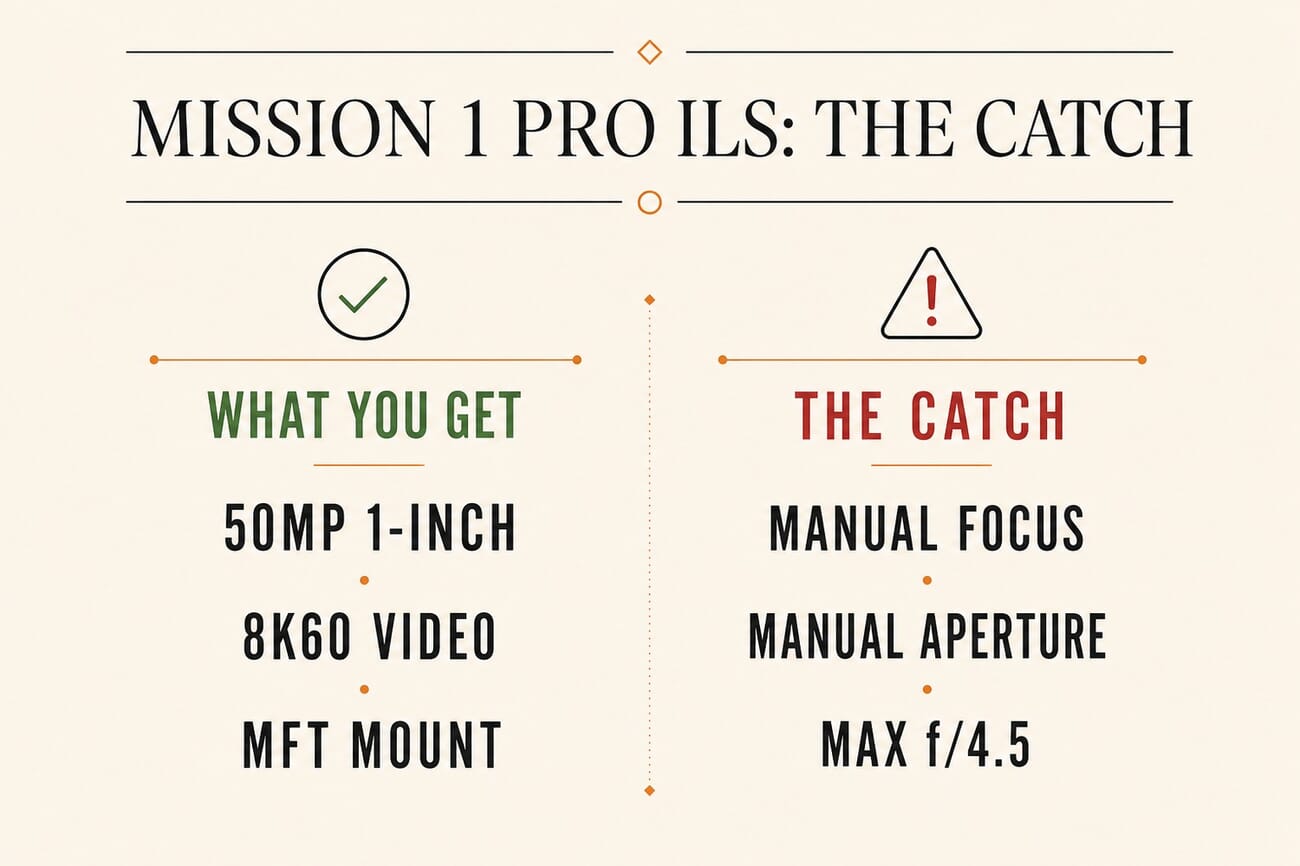
For a certain kind of shooter this is a feature, not a bug. Cinema and documentary work often lives in manual focus anyway, and GoPro leans into that with real filmmaking tools: focus assist with up to 8x magnification, focus peaking, and zebra exposure warnings. But if you were picturing a point-and-shoot action cam that happens to take any lens, reset that expectation now. This is a manual instrument.
Which Lenses Actually Work
Compatibility is narrower than “it takes MFT lenses” suggests. The lens has to cover the 1-inch sensor, be manual focus, and have a manual or fixed aperture no faster than f/4.5. GoPro’s in-body HyperSmooth stabilization is only guaranteed with five specifically profiled fisheye lenses, including the Brightin Star 7.5mm and a 7Artisans 6mm, plus rectilinear MFT lenses from 6mm to 50mm. Go longer than 50mm and performance is a gamble.
The upside is that this opens GoPro to creative looks it never had: true macro, telephoto compression, and circular fisheye effects. GoPro loaned reviewers a range of Venus Optics Laowa glass to show off the range at launch. The affordable-lens boom we have been tracking, from Brightin Star to 7Artisans, suddenly has a tiny new cinema body to play on.
The Video Specs Are Genuinely Wild
Whatever you make of the manual mount, the spec sheet is remarkable for a 197-gram camera. Video tops out at 8K60, 4K240, and 1440p480, with Open Gate modes up to 8K30 and 4K120 using the full sensor. It records 10-bit with GP-Log2 and HLG HDR, pulls 44MP frame grabs from 4:3 8K, and runs 3-plus hours of 4K30 on its Enduro 2 battery. Alongside it, GoPro released the free Mission Monitor app for iPhone and iPad, which adds focus peaking, zebra, real-time LUT preview, and remote start-stop on a bigger screen.
The Elephant in the Room: Can GoPro Survive to Support It?
This is where enthusiasm has to meet reality. Earlier this year GoPro filed a going-concern warning, telling investors it might not survive the year, and the Mission 1 line is the ambitious bet meant to turn that around. We covered what that actually means for buyers in our piece on whether you should still buy a GoPro that might not make it, and the calculus is sharper here. Buying a $700 body is one thing. Buying into a brand-new, proprietary, contact-free lens platform is a longer-term commitment, and it only pays off if GoPro is still around to build out the ecosystem, honor warranties, and ship firmware. That is a real risk to weigh, not a footnote.
Who Is This Actually For?
The Mission 1 Pro ILS is not an action camera and not a mirrorless replacement. It is a hyper-compact, rugged, manual cinema tool for creators who need to rig an 8K sensor into places a full camera cannot go: the inside of a car, a tight drone mount, a helmet, a gimbal. For that niche it is genuinely without equal. For everyone else, the fixed-lens Mission 1 Pro, an Insta360 X6, or a cheaper 8K action cam like the SJCAM SJ30 will be the more sensible buy.
Frequently Asked Questions
How much does the GoPro Mission 1 Pro ILS cost, and when does it ship?
It is $699.99, or $599.99 for existing GoPro subscribers, and it is available to pre-order now. Pre-orders begin shipping next week, with worldwide retail availability on September 2. Micro Four Thirds lenses are sold separately.
Does it have autofocus?
No. The mount has no electronic contacts, so every lens is manual focus and manual or fixed aperture, capped at f/4.5. GoPro adds focus assist and focus peaking to help, but autofocus lenses cannot drive their motors on this camera.
Which lenses work with it?
Manual Micro Four Thirds lenses that cover a 1-inch sensor, with a maximum aperture of f/4.5 or slower. HyperSmooth stabilization is guaranteed with five profiled fisheyes and rectilinear MFT lenses up to 50mm; longer lenses may vary.
What video resolutions does it shoot?
Up to 8K60, 4K240, and 1440p480, with Open Gate modes of 8K30 and 4K120 using the full sensor. It records 10-bit with GP-Log2 and HLG HDR, and can grab 44MP stills from 4:3 8K footage.
Is it a safe buy given GoPro’s financial trouble?
That is the key question. GoPro issued a going-concern warning this year, so buying into a new proprietary lens platform carries more risk than a standard camera. It is worth reading our coverage of GoPro’s situation before committing to the system long-term.
The Bottom Line
The Mission 1 Pro ILS is the most interesting thing GoPro has done in years: a 197-gram, 8K, interchangeable-lens cinema camera that genuinely has no direct rival. It is also a fully manual, contact-free system from a company fighting for survival. If you are a filmmaker who needs a tiny sensor you can rig anywhere and you are comfortable pulling focus by hand, it is a remarkable tool. Just go in with clear eyes about the manual workflow and the company risk behind it.
Sources and further reading:
Reference
Image Sources
- GoPro Mission 1 Pro ILS showing the exposed MFT mount and sensor (featured) – GoPro product image
- Mission 1 Pro ILS: what you get versus the catch (infographic) – PhotoWorkout illustration
- GoPro goes interchangeable (pin graphic) – Stylized PhotoWorkout illustration