


- Glyph’s new Atom EX80 is a USB4 portable SSD (up to 7,000 MB/s) with location tracking built in — it works with Apple Find My and Google Find My Device, so you can locate the drive itself if you lose it. No subscription, no separate tag.
- The catch: it’s a premium pro drive — $499.99 for 1TB, up to $2,199.99 for 8TB. The tracking is a bonus, not the reason to buy it.
- A $29 AirTag (or an Android Find My Device tag) clipped to any fast SSD gives you the same lost-and-found ability for a fraction of the price — with the downside that a tag can fall off.
- The honest limitation nobody mentions: Find My and AirTags both rely on other people’s phones being nearby. On a genuinely remote shoot with no one around, neither the EX80 nor an AirTag will find your drive.
- Where the EX80 actually wins over an AirTag: it can’t detach, and it supports both Apple AND Android networks (AirTags are Apple-only). For most US photographers, though, a cheaper drive plus a tag is the better-value lost-media insurance.
Losing a drive full of a client’s wedding or a once-in-a-lifetime shoot is the quiet nightmare of every working photographer. So a portable SSD that can find itself sounds close to magic. Digital Camera World reports that Glyph’s new Atom EX80 does exactly that — it has location tracking built into the drive. The real question for photographers isn’t whether it works, but whether built-in tracking is worth the premium over the dead-simple alternative: clipping a $29 AirTag to a normal drive. Here’s the honest answer.
What the Glyph Atom EX80 Actually Is
First, the drive itself is a serious piece of pro kit, tracking aside. The Atom EX80 is a USB4 (80Gbps) SSD rated up to 7,000 MB/s — fast enough to offload 1TB of 8K video or large-format RAW in under three minutes — and it’s compatible with Thunderbolt 5, 4 and 3. It has an integrated magnetic mount, is MagSafe-compatible for snapping onto an iPhone during mobile offloads, adds real-time drive-health monitoring, carries a MIL-STD-810F durability rating in an aluminum body, and ships with a 3-2-1 warranty (three years hardware, two years data recovery, one year replacement).
Capacities and US pricing: 1TB for $499.99, 2TB for $699.99, 4TB for $1,099.99, and 8TB for $2,199.99. It’s available to pre-order now, with shipping expected June 19, 2026.
The headline feature is the tracking. Crucially, it isn’t a cellular tracker with its own SIM and a monthly fee — it works with Apple Find My and Google Find My Device, the same crowd-sourced networks an AirTag uses. There’s no subscription and nothing to charge. In other words: Glyph baked AirTag-style tracking into the drive.
Here’s Glyph’s own walkthrough of the Atom EX80, including the tracking and magnetic mounting:
Why Losing Media Is a Real Photographer Problem
This isn’t a gimmick chasing a non-problem. Photographers move drives constantly — from camera bag to laptop to a producer’s hand on set, through airport security, between hotel rooms, in and out of a hundred pockets on a travel shoot. A drive is small, dark, and easy to leave on a café table or drop into the wrong bag. And unlike a lost camera body, a lost drive can mean lost work that no insurance payout brings back. Anything that raises the odds of getting a wandering drive back is worth taking seriously — which is exactly why it’s worth being clear-eyed about how well these tools really work.
Built-In Tracking vs. an AirTag: The Honest Comparison
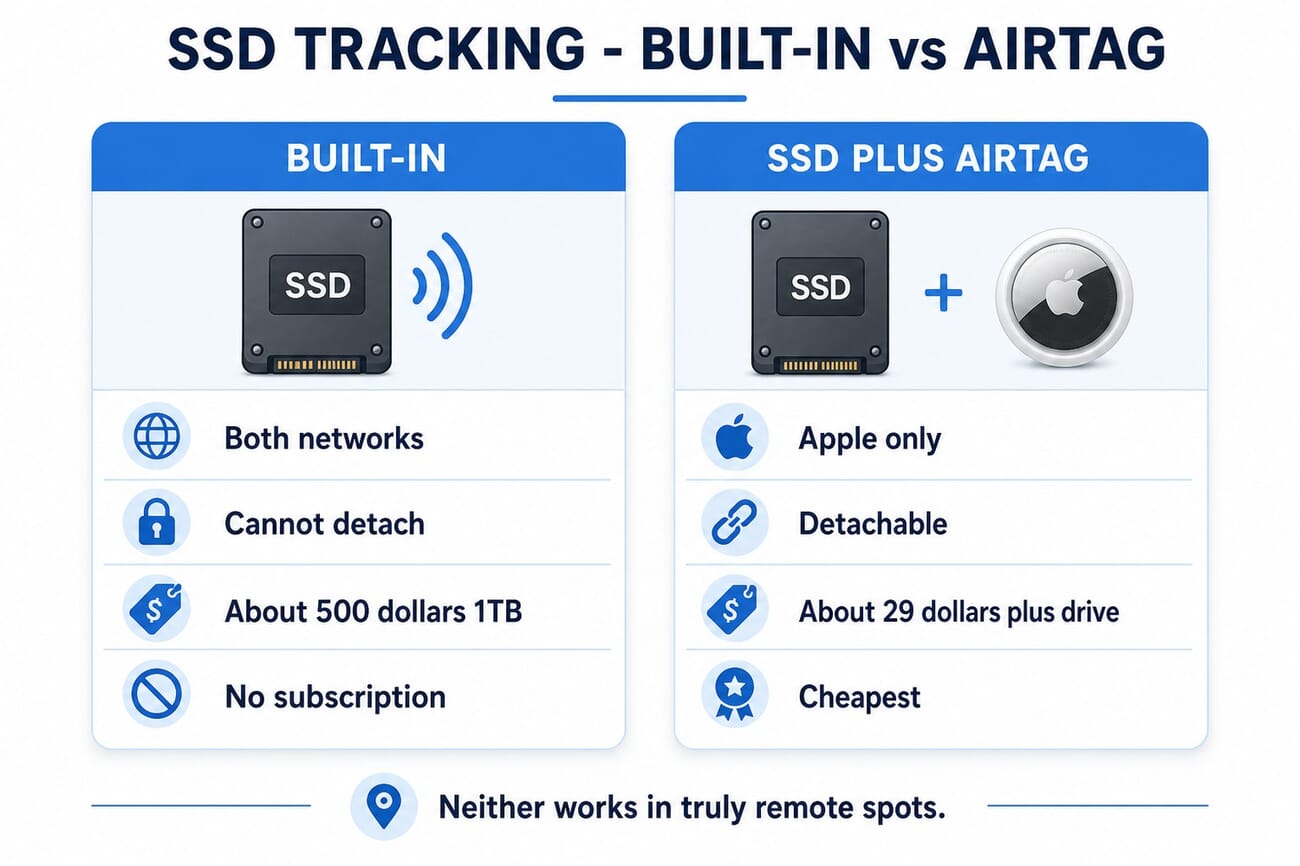
Because the EX80 uses the same Find My networks as an AirTag, this is a remarkably direct comparison. Here’s how the two stack up for a photographer.
Cost
This is the big one. The EX80 starts at $499.99 for 1TB — pro-drive money. A fast 1TB portable SSD from Samsung, Crucial or SanDisk runs roughly $90–$150, and an AirTag is about $29 (four-packs drop the per-tag cost further). So you can get a quick, rugged, trackable setup for well under half the price of the Glyph — the tracking premium is real. (See our take on the Lexar D70E 2TB for one fast, affordable offload option.)
Networks: Apple-only vs. both
Here the EX80 has a genuine edge. AirTags only work on Apple’s Find My network — useless if you’re an Android shooter. The EX80 supports both Apple Find My and Google’s Find My Device, so Android users get the same benefit. If you’re on Android, a built-in tracker (or an Android-compatible tag like a Chipolo or Pebblebee) matters more than it does for iPhone users.
It can’t fall off
An AirTag is one more thing to attach, and adhesive mounts and keychain loops do come loose — the most likely failure mode is the tag parting ways with the drive at the worst possible moment. Built-in tracking can’t detach. For some photographers that integration alone is worth something.
The Catch Nobody Mentions: Neither Works in Truly Remote Spots
Here’s the part the marketing glosses over, and it’s the most important thing for the “lose it on a remote shoot” pitch. Both Find My and Find My Device are crowd-sourced: your lost drive only reports its location when someone else’s phone passes within Bluetooth range and quietly relays it. In a dense city or a packed event venue, that happens constantly and tracking is near-instant. But on a genuinely remote shoot — a desert, a mountain trail, an empty stretch of coastline with no one around — there are no nearby phones to do the relaying, so neither the EX80 nor an AirTag will locate your drive. If your real fear is leaving a drive in the wilderness, the only tools that actually help are true GPS/cellular trackers with their own connectivity (and a subscription) — and the EX80 is not one of those. For events, airports, hotels and cities, though, Find My-based tracking genuinely works.
So Is It Worth It?
Don’t buy the Atom EX80 for the tracking. Buy it if you want a top-tier USB4 drive — 7,000 MB/s, MagSafe mounting, MIL-spec durability — and treat the built-in Find My as a nice integrated bonus. On its own merits it’s a legitimately great on-set offload and editing drive.
But if the tracking is the whole reason you’re tempted, save your money: a $90–$150 fast SSD plus a $29 AirTag (or an Android tag) gives you the same find-my-drive capability for a fraction of the price, with the only real downsides being a tag that could detach and Apple-only coverage. The clearest case for built-in tracking is an Android photographer who wants Find My Device support without hunting down a compatible tag. For everyone else, the humble AirTag-on-a-drive remains the smartest, cheapest lost-media insurance — just remember it, like the EX80, won’t save you where there’s no one around to help. Whatever you choose, the real protection is still a {inter(‘best-photo-cloud-2026′,’solid backup workflow’)}: track the drive, but never trust a single copy of an irreplaceable shoot.
Frequently Asked Questions
How does the Glyph Atom EX80’s tracking work?
It integrates with Apple Find My and Google Find My Device — the same crowd-sourced networks an AirTag uses — so you can locate the drive from your phone if you misplace it. There’s no cellular connection, SIM, or subscription involved.
Does it need a subscription or battery?
No subscription. Because it piggybacks on the Find My / Find My Device networks rather than using its own cellular link, there’s no monthly fee, and it doesn’t require a separate tracking battery to charge.
Is built-in tracking better than an AirTag?
It depends. Built-in tracking can’t fall off and works on both Apple and Android networks (AirTags are Apple-only). But a $29 AirTag on a cheaper drive does the same job for far less money. For most iPhone photographers, the AirTag route is better value; Android shooters benefit more from built-in support.
Will it help if I lose my drive in a remote location?
Probably not, and neither would an AirTag. Both rely on other people’s phones passing nearby to report a location. In a city or event they work well; in genuinely remote areas with no one around, only a true GPS/cellular tracker would help.
How much is the Glyph Atom EX80?
$499.99 for 1TB, $699.99 for 2TB, $1,099.99 for 4TB, and $2,199.99 for 8TB. It ships from June 19, 2026.
The Bottom Line
The Glyph Atom EX80 is a fast, rugged USB4 drive with a genuinely useful party trick: it tracks itself through Find My, no tag or subscription required. Just be honest about what that buys you. It’s a premium drive, the tracking is AirTag-equivalent rather than magic, and it won’t rescue a drive lost in the middle of nowhere. Buy it for the speed and build; if you only want peace of mind, a cheap drive and a $29 tag — backed by real backups — will protect your work for a lot less.
Primary Coverage
- Digital Camera World — This new portable SSD can be tracked if you lose it – Glyph Atom EX80 announcement
- PetaPixel — Glyph’s Atom EX80 SSD has built-in location tracking – Specs and details
- Glyph — Atom EX80 official product video – Manufacturer walkthrough
Image Sources
- PhotoWorkout illustrations – The featured image, comparison infographic, and pin are stylized PhotoWorkout illustrations (no real product render)