


- SJCAM has launched the SJ30, an 8K dual-lens action camera at $264 — the first action camera with two dedicated image sensors (a 1/2.0″ daylight sensor and a 1/1.8″ larger starlight sensor), which switch automatically to handle conditions from harsh midday sun to evening street scenes.
- Video specs include 8K at 20fps, 4K at 60fps, native vertical 5K capture, and SJCAM’s SteadyMotion 2.0 stabilisation with a 45-degree horizon lock. The body is IPX8 waterproof to 5 metres out of the box, 30 metres with the optional housing.
- At $264 the SJ30 lands at roughly half the price of the GoPro Hero 13 Black ($399) and well under the DJI Osmo Action 5 Pro ($349). The dual-sensor design is genuinely novel — neither GoPro nor DJI ships an action camera with switching sensors at any price.
- Launch timing matters: with GoPro’s ownership situation actively unresolved after the May sale/merger announcement, SJCAM is moving into a window where the dominant brand’s roadmap is paused. For buyers who don’t need the GoPro app ecosystem, the SJ30 is the most disruptive action-camera launch of 2026 so far.
Action camera competition has been on hold since GoPro put itself up for sale or merger earlier this month, leaving the segment’s dominant brand with a paused roadmap and no clear product direction. SJCAM didn’t wait. The Chinese action-camera maker just launched the SJCAM SJ30, an 8K dual-lens action camera that retails for around $264 — about half what a current-generation GoPro Hero costs, with hardware features GoPro hasn’t matched at any price.
The headline spec isn’t the 8K — most action shooters won’t use it. It’s the dual-sensor design: two physically separate image sensors that switch automatically based on lighting. That’s how SJCAM gets to launch into GoPro’s category without competing on brand.
When you buy through links on our site, we may earn a commission at no cost to you. We evaluate products independently. Commissions do not affect our evaluations.
What the Dual-Sensor Design Actually Does
The SJ30 pairs a 1/2.0-inch daylight sensor with a larger 1/1.8-inch starlight sensor inside a single body. The camera handles the switch between them automatically depending on ambient light. In bright outdoor scenes the smaller daylight sensor handles capture with cleaner detail and tighter color; in dim conditions — evening streets, indoor environments, dawn or dusk — the starlight sensor takes over with better low-light sensitivity.
Low light has historically been the segment’s weakest point. Action cameras chase small bodies and waterproof housings, which forces small sensors and bright fixed lenses, which struggle in anything that isn’t direct sunlight. Most current models — including the GoPro Hero 13 Black — handle low light through computational denoise, not a dedicated sensor. SJCAM’s approach trades a larger overall body for actual hardware solving the problem. Whether the auto-switching transitions smoothly in mixed lighting is the question real-world reviews will need to answer.
Full Spec Sheet
- Video: 8K at 20fps, 4K at 60fps, native vertical 5K (no awkward post-crop for social formats)
- Stabilisation: SteadyMotion 2.0 with six-axis gyroscope + 45-degree horizon lock
- Screen: 2.51-inch flip touchscreen with 180-degree rotation for self-framing
- Waterproofing: IPX8 to 5 metres out of the box; 30 metres with the optional housing
- Temperature range: Operates from -20°C to 60°C
- Battery: 2000mAh native; up to 7 hours of 4K recording with the optional power-handle accessory
- Audio: Detachable wind guard; supports the SJCAM M4 wireless microphone for clean voice capture outdoors
- Mounting: Magnetic quick-release system for fast accessory swaps
- Extras: Voice control, vertical-shooting mode, time-lapse, slow-motion
How It Stacks Up Against GoPro and DJI
The current top-of-line comparison set: the GoPro Hero 13 Black at $399, DJI’s Osmo Action 5 Pro at $349, and Insta360’s Ace Pro 2 at around $400. All three are well-reviewed, well-distributed, and built on much more mature accessory and software ecosystems than SJCAM offers. None of them ship a dual-sensor switching design.
The honest framing: if you already own a GoPro and rely on the Quik app for editing or have a closet of compatible mounts, switching brands for a $130 saving doesn’t make sense. If you’re buying an action camera for the first time, or coming from a phone, or want a dedicated B-camera for travel and vlogging that doesn’t double the cost of the trip, the SJ30 is a substantially more flexible piece of hardware than the price would suggest. The seven-hour battery with the power-handle accessory in particular is a meaningful gap versus the Hero 13’s roughly 90-minute native runtime at 4K.
The other gap-filler context: SJCAM is moving while GoPro’s ownership and product direction are visibly uncertain, while DJI continues facing US import friction, and while Insta360 has been chasing the dual-lens-but-360 segment with the GO 3S Retro and X5. The SJ30 walks into a window where the entrenched players are distracted.
Who Should Actually Buy It
The SJ30 makes most sense for travel shooters who want a single small camera that handles daytime and after-dark scenes without lugging a phone-plus-action-cam combo; solo vloggers who need the 180-degree flip screen and the M4 wireless mic option for clean audio outdoors; budget filmmakers who want a third or fourth angle that doesn’t break the kit budget; and anyone who wants a long-battery action camera for full-day shoots without juggling a stack of spares.
It’s a weaker fit for committed GoPro ecosystem users, pro extreme-sports shooters (where GoPro and DJI have the proven impact-survival track records), and 360-degree creators — the SJ30 is dual-sensor, not dual-lens-stitched, so it doesn’t shoot 360 video.
Frequently Asked Questions
Is 8K at 20fps actually useful?
Not really for video playback — 20fps is below the threshold for smooth motion. It’s useful for capturing maximum still-frame detail (8K stills extracted from video) or for slow, locked-off scenes like time-lapse. For everyday action footage, 4K at 60fps is the spec that actually matters.
Is the dual-sensor automatic switching seamless?
Unknown until real-world reviews land. Auto-exposure transitions between sensors in mixed lighting (a tunnel exit, a sunset shot, indoors-to-outdoors walking) are the make-or-break test. SJCAM’s marketing claims smooth handoff; expect early reviewers to specifically pressure-test this.
How does the SJ30 compare to GoPro for color science?
GoPro’s color profile is the segment standard — most editors and creators have years of habit calibrated to it. SJCAM’s color science is less established. For social-first content, either works; for cuts that drop into a multi-camera workflow with GoPro footage as the spine, expect to do more grading work to match.
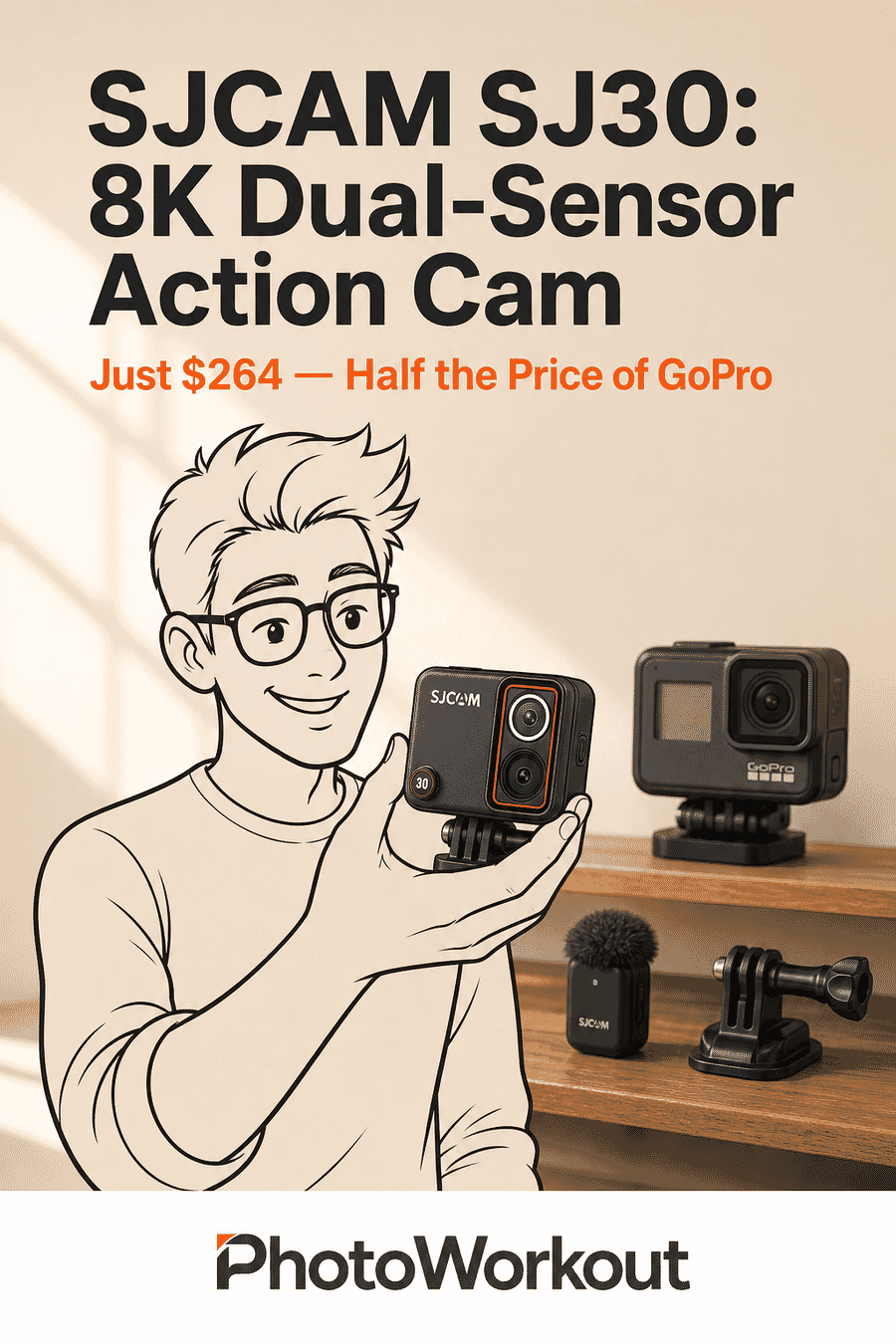
Image credit: editorial composition by PhotoWorkout. Reference product photography sourced from SJCAM’s Amazon listing. Spec details credit to Photofocus, cited below.
Reporting cited in this article:
Primary Source
- Photofocus — SJCAM SJ30 Announced, A New 8K Dual Lens Action Camera – Launch coverage with full spec breakdown and creator-positioning context.
- SJCAM — Official SJ30 product page – Manufacturer product page for the SJ30 with detailed spec sheet and accessory options.
Affiliate
- Amazon — SJCAM SJ30 listing – Current US retail availability and pricing. Note: PhotoWorkout earns a small commission on Amazon purchases made through this link.
PhotoWorkout is a participant in the Amazon Services LLC Associates Program. We may earn a commission on qualifying purchases at no additional cost to you.