


- GoPro’s board has launched a formal strategic review that could lead to a sale, merger, or other restructuring. Financial advisors are appointed.
- The trigger is brutal competitive pressure from DJI (Osmo Action and Pocket lines) and Insta360 (X4, GO Ultra, Ace Pro). Both have outshipped GoPro in key segments since 2024.
- For shoppers right now: current GoPro hardware (HERO 13, HERO 13 Black, Max 360) is still safe to buy short-term. Software updates and Quik subscription support are the longer-term question marks.
- Most likely outcomes from an acquisition: hardware lineup compressed to professional / industrial segments; consumer Hero line either sunsetted or shifted toward DJI-style integration with a parent ecosystem.
GoPro confirmed Tuesday that its board of directors has authorized a formal strategic review, appointing financial advisors to evaluate options that could include a sale of the company, a merger, or other restructuring. The announcement, first reported by DIY Photography, is the clearest signal yet that the company defining the action-camera category for nearly two decades may not survive as an independent entity.
The trigger isn’t a single bad quarter — it’s two years of accelerating competitive pressure. DJI’s Osmo Action 4 and Osmo Action 5 Pro have eaten the high-spec end of the market. Insta360’s X4 (360-degree), GO Ultra (POV first-person), and Ace Pro (traditional action-cam form factor) have segmented the rest. GoPro has responded with the HERO 13 line and Max 360, but the gap on AI-driven editing software and 360-degree capture keeps widening.
This isn’t a quiet hint. An authorized strategic review with appointed financial advisors is the exact language companies use when they expect to be sold within 6-18 months. The question now is who buys, and at what price.
What Forced the Decision
GoPro’s market position has eroded along three fronts simultaneously:
1. Smartphones absorbed the casual user. The original GoPro use case — capturing a vacation snorkel, a kid’s birthday party, a hiking trip — has moved to phones. iPhone 17 Pro and Pixel 10 Pro both shoot 4K 60p with HDR; Samsung S25 Ultra adds 200MP stills. For 80% of GoPro’s historic customer base, the phone is now adequate.
2. DJI swallowed the prosumer market. DJI’s Osmo Action 5 Pro (2024) added a 1/1.3-inch sensor, 120fps 4K, and seamless integration with the DJI Mimo editing app — features GoPro answered late or not at all. DJI’s hardware advantage (manufacturing scale across drones, gimbals, and action cams) lets them ship faster and price more aggressively.
3. Insta360 owned the categories GoPro didn’t enter. 360-degree capture (X4), first-person POV (GO Ultra), and AI-driven editing pipelines (FlashCut, the ReFrame tool) became table-stakes features. GoPro’s Max 360 is competent but doesn’t have the software ecosystem to match.
Add to that declining Quik subscription revenue — the recurring software revenue line GoPro pivoted toward after 2020 — and the financial picture clears up. The strategic review isn’t a surprise to anyone watching the quarterly earnings.
Who Could Buy GoPro (And Who Probably Won’t)
The shortlist of plausible acquirers comes down to three groups:
Adjacent imaging companies. Sony has a complementary lineup (a7 mirrorless + RX0 II / FX series cinema) but no real action-cam line and no obvious reason to add one. Canon and Nikon are even less likely — neither has shown interest in extending into action-cam categories. Fujifilm’s X-mount focus + Instax brand is a different consumer market entirely.
Chinese competitors. DJI absorbing GoPro would face severe regulatory pushback in the US (DJI is already on multiple federal restriction lists). Insta360 acquiring its primary US-market competitor is more plausible structurally but would consolidate the action-cam market to a near-duopoly with DJI.
Private equity. The most likely outcome. A PE firm buys GoPro, strips overhead, focuses the remaining hardware lineup on professional / industrial segments (mounted body cams, drone-mounted, industrial inspection), kills or licenses out the consumer Hero line, and harvests the software subscription revenue. This playbook has played out before — GoPro’s recent layoffs already match the pre-PE-acquisition signature.
A fourth dark-horse possibility: Apple. Apple’s Vision Pro spatial video push needs capture hardware beyond the iPhone. A GoPro acquisition gives Apple a wearable spatial-video capture device, professional-grade mounts, and an existing creator community. Unlikely but worth flagging — Apple has done weirder acquisitions for vertical capabilities (Beats, Drive.ai, Workflow).
Should You Buy a GoPro Right Now?
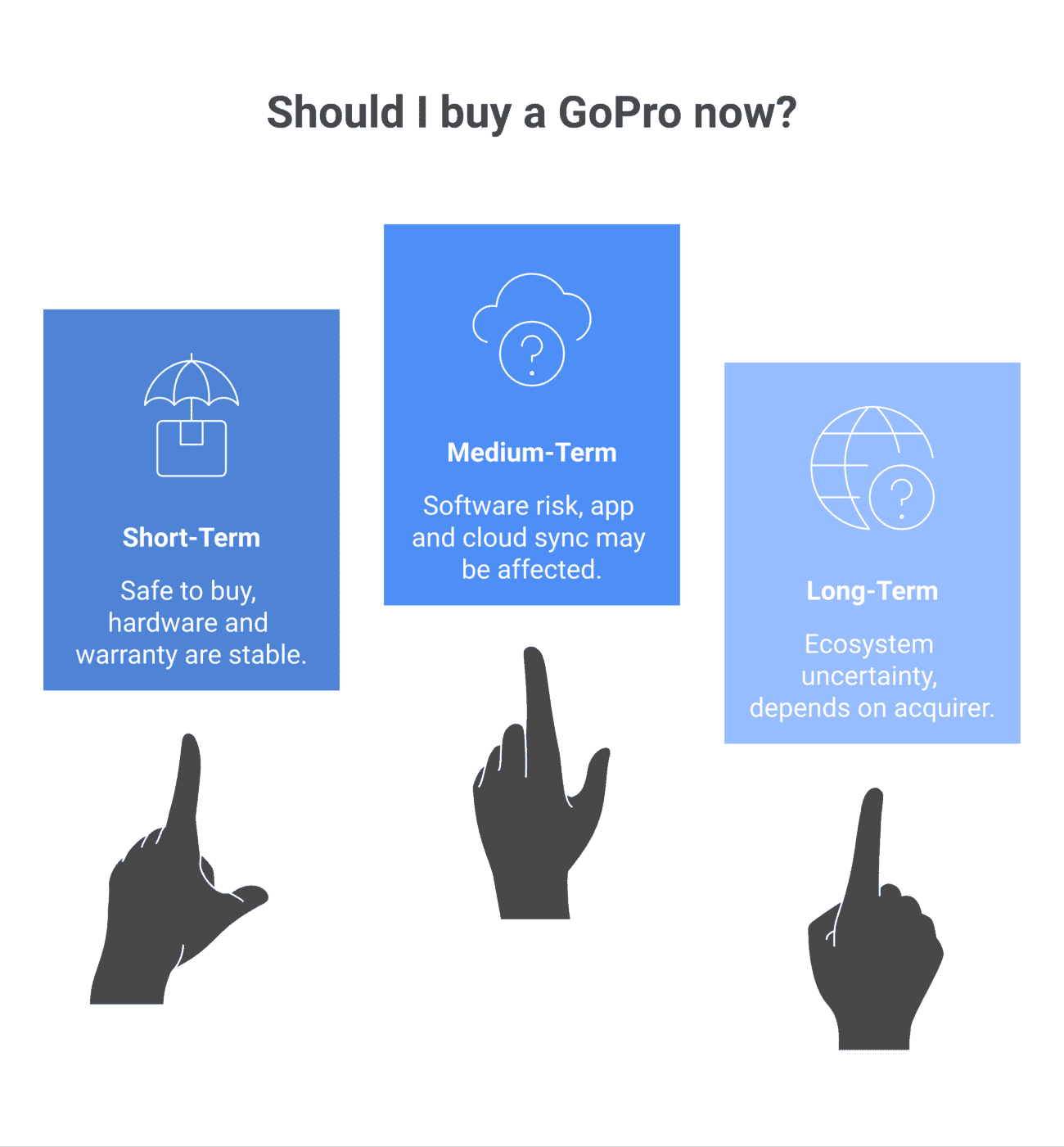
This is the real question for anyone shopping action cameras this month. The honest answer breaks into three timeframes:
Short-term (next 6 months): existing GoPro hardware is safe to buy. The HERO 13 Black, HERO 13, and Max 360 will continue to ship, be supported by warranty, and receive routine firmware updates. The strategic review doesn’t pause day-to-day operations.
Medium-term (6-18 months): software and subscription support become the question marks. The Quik app, cloud sync, and ongoing software features depend on GoPro maintaining engineering investment — and that’s exactly the line item PE acquirers typically cut first. If you depend on Quik for editing workflow, plan for it to potentially become a paid premium tier or get sunset entirely.
Long-term (18+ months): hardware ecosystem support — accessories, replacement batteries, repair availability — depends on who acquires. PE-driven consolidation typically means narrower hardware lineup but continued accessory support for existing products. A DJI / Insta360 acquisition would likely accelerate phasing out GoPro hardware in favor of the acquirer’s lineup.
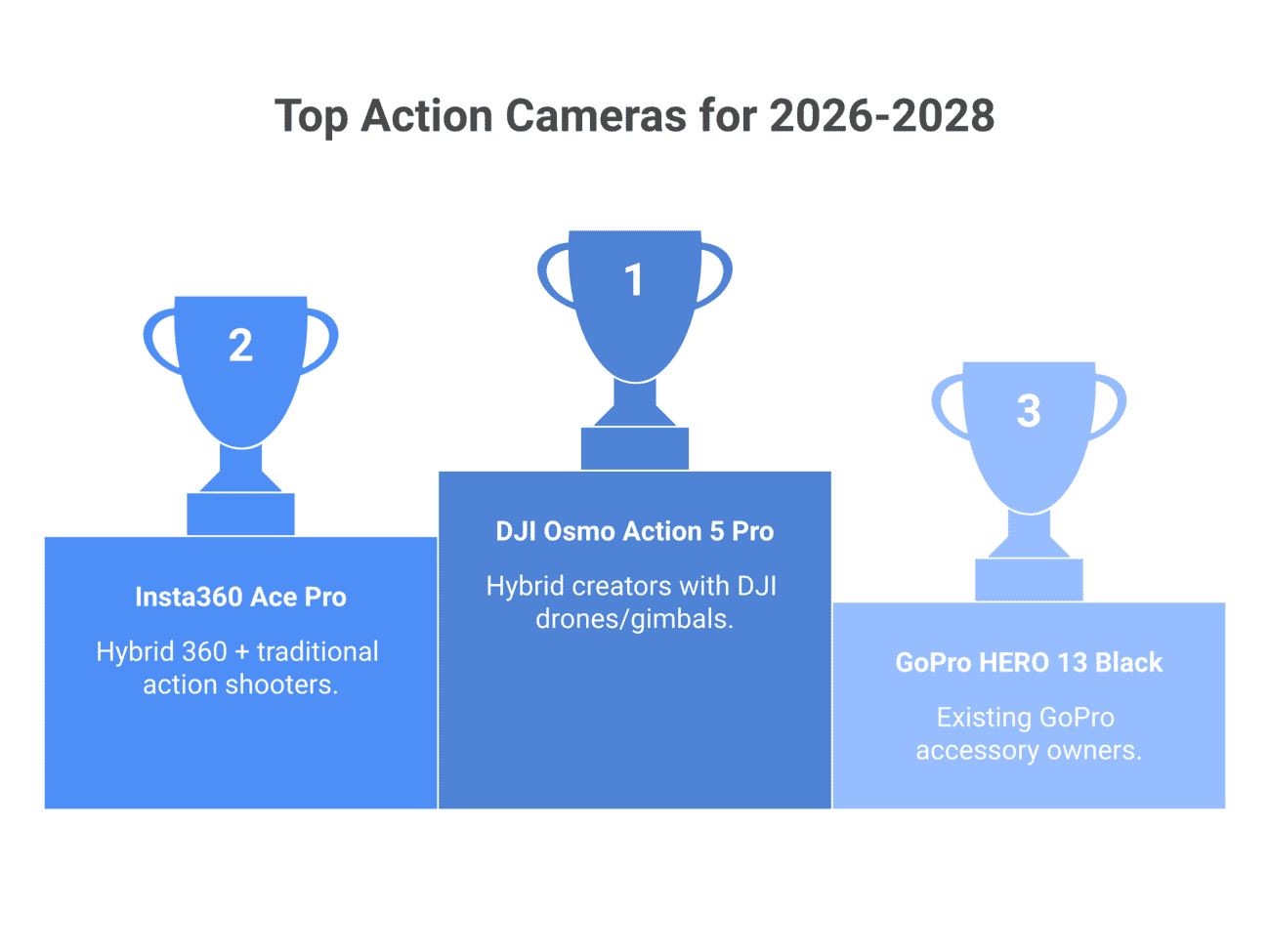
Recommendation: if you need an action camera right now, the DJI Osmo Action 5 Pro or Insta360 Ace Pro are safer multi-year bets than the GoPro HERO 13. Both have ecosystem stability that GoPro currently lacks. If you specifically need GoPro’s mount-compatibility ecosystem (existing accessories, third-party harnesses, dive housings), the HERO 13 still makes sense — but plan for software erosion.
What This Means for DJI and Insta360
Both DJI and Insta360 benefit massively from GoPro’s exit, but in different ways:
DJI gains pricing power in the prosumer action-cam tier. Currently DJI prices the Osmo Action 5 Pro aggressively against the GoPro HERO 13 — if that competition goes away, DJI can lift margins. The Osmo Pocket 3 line (handheld gimbal cam) also benefits indirectly as DJI’s broader brand positioning strengthens.
Insta360 gets clearer ownership of the 360-degree and POV categories. The X-series owns 360 capture; the GO Ultra owns first-person; the Ace Pro is the GoPro-shape competitor. Without GoPro fighting them in every category simultaneously, Insta360 can specialize without watching its flank.
Net effect on the market: action cameras get more expensive within 18-24 months regardless of who acquires GoPro. Three serious competitors became two; pricing pressure decreases.

Bottom Line
GoPro launching a formal strategic review is the clearest signal in two decades that the action-camera category leader may not survive as an independent company. The competitive pressure from DJI and Insta360 is real and accelerating; the financial trajectory has been heading this direction for several quarters.
For current GoPro owners and would-be buyers, the practical impact splits across timeframes. Hardware works now and will continue to. Software and subscription support is the deeper unknown — and that’s where the acquisition outcome matters most. If you depend on GoPro’s specific accessory ecosystem (dive housings, vehicle mounts, helmet rigs), the existing HERO 13 line is still a defensible buy. If you’re starting fresh and want long-term ecosystem stability, DJI’s Osmo Action 5 Pro or Insta360’s Ace Pro are the safer multi-year choices.
Expect resolution of the strategic review within 6-18 months. The outcome will reshape the action-camera market regardless of who ends up acquiring — and the ripple effects on accessory ecosystems, software subscriptions, and pricing pressure will be felt across every action-cam buyer’s decision for the rest of this decade.
Primary Coverage
- DIY Photography — Is GoPro for Sale? – Original reporting on the GoPro strategic review and the board's authorization of financial advisors.
Context and Competition
- DJI — Osmo Action 5 Pro – Reference for DJI's flagship action camera that has driven competitive pressure on GoPro.
- Insta360 — Action Camera Lineup – Reference for Insta360's full action-camera range including X4 (360), GO Ultra (POV), and Ace Pro.
Image Sources
- PhotoWorkout editorial illustration – Featured image is a PhotoWorkout editorial illustration.