


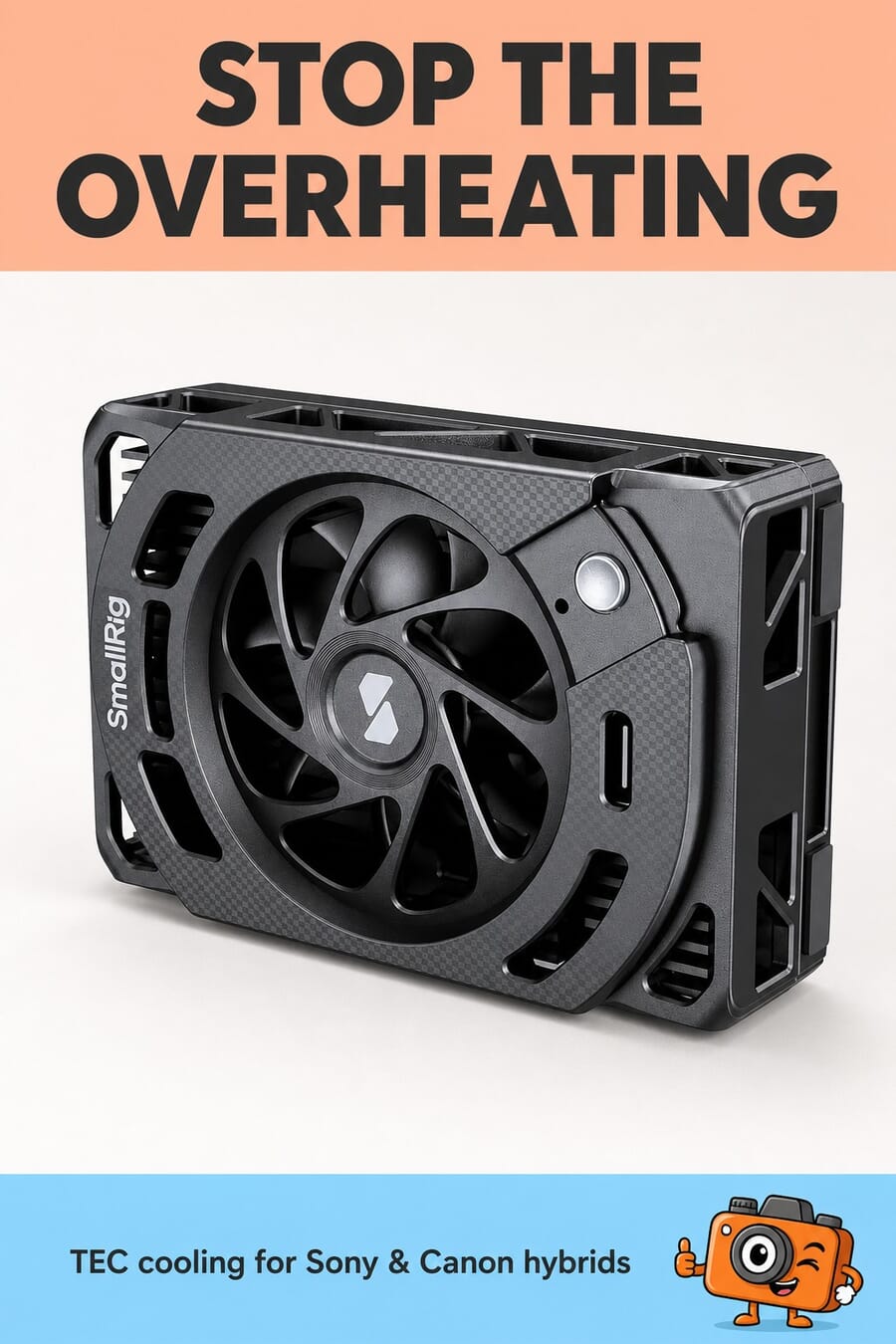
- SmallRig’s Hybrid Cooling fan pairs a 7,000 rpm fan with a TEC (thermoelectric) module — the key difference being it can pull the camera below ambient temperature, not just toward it.
- It targets the single biggest Sony hybrid complaint: overheating during long 4K/8K record sessions on bodies like the FX3, a7S III and a7 IV.
- Two versions: the Hybrid (TEC, ~$65, ~70 min runtime, 130g) and the Basic (fan-only, ~$44, ~180 min, 102g). The TEC’s power draw is why its battery life is shorter.
- Compatibility spans a wide Sony lineup plus Canon’s EOS R5, R5 II, R6 III and R7 — but it clips to specific bodies, so check your model before buying.
- For tripod, gimbal and cage rigs it’s an easy win; for true run-and-gun handheld work the added bulk, weight and recharge management are real trade-offs.
Overheating is the complaint that has shadowed Sony’s mirrorless hybrids for years. Push an FX3 or a7S III through a long 4K session in a warm room and the temperature warning eventually appears — sometimes mid-take. SmallRig’s answer is a snap-on cooling fan, and the headline version doesn’t just blow air: it uses a thermoelectric (TEC) module that can actively chill the camera below the surrounding air temperature.
That single detail is what separates this from the dozens of clip-on fans already on the market, and it’s why the run-and-gun crowd should understand exactly what they’re getting before clipping 130 grams onto the back of a camera they carry all day. Here’s how the TEC approach actually works, the two models and their trade-offs, the full compatibility list, and an honest read on who needs it.
PhotoWorkout is reader-supported. If you buy through links in this post we may earn a small commission at no extra cost to you.
Overheating is the #1 Sony hybrid complaint — and SmallRig aimed straight at it
Sony’s compact hybrid bodies pack full-frame sensors and high-bitrate codecs into magnesium shells that have very little room to shed heat. The result is a well-documented ceiling on recording time, especially in 4K 60p, 8K, or any sustained clip in summer conditions. Sony’s own thermal management helps, but it works by throttling and, eventually, shutting down — exactly when you don’t want it to.
External cooling has become a small industry because of this, and SmallRig — already a fixture in the Sony shooter’s rig ecosystem — has now built a two-tier system specifically to extend those record times. The interesting one is the Hybrid model, because of how it cools.
How TEC cooling actually differs from a fan
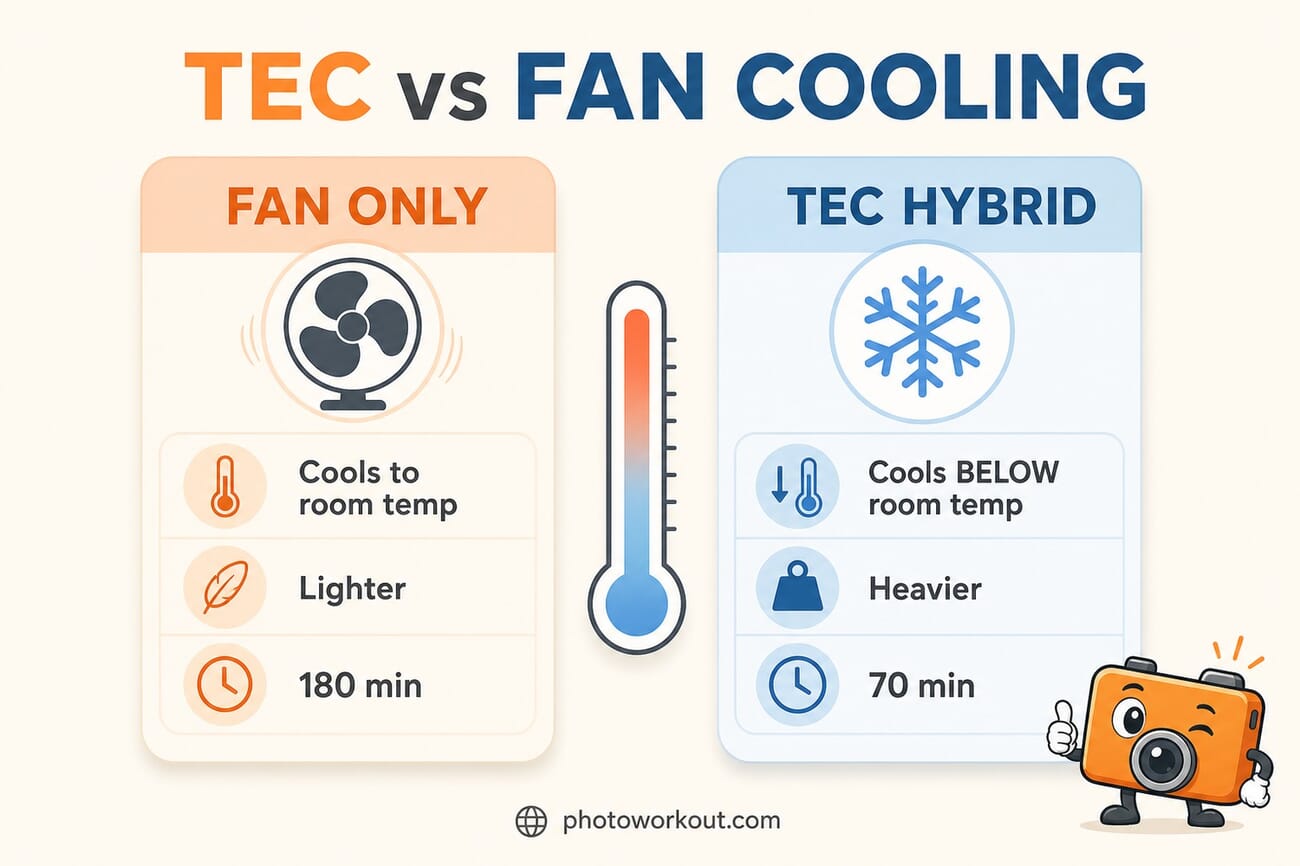
A conventional clip-on fan is a heatsink with a fan behind it. It moves air across the camera’s body to carry heat away faster than still air would. That helps — but a fan can only ever push the camera toward the temperature of the air around it. On a hot day, the air itself is the limit.
A TEC module — short for thermoelectric cooler, also called a Peltier device — works on a different principle. Run current through a junction of two semiconductors and one side gets cold while the other gets hot. Press the cold side against the camera and it actively pumps heat out, capable of driving the contact plate below ambient. The hot side still has to dump that heat somewhere, which is why the Hybrid unit also carries a 7,000 rpm fan to blow it away.
That extra capability isn’t free. The Peltier effect is power-hungry, which is why the Hybrid runs about 70 minutes on its battery versus roughly three hours for the fan-only model. And any time you chill a surface below the dew point, condensation becomes a theoretical risk — worth keeping in mind in humid environments, even if the contact area here is small and managed by the unit’s modes.
Hybrid vs Basic: which one, and what it costs
SmallRig sells two versions, and the right pick depends entirely on how hard you push the camera:
- Hybrid Cooling (~$65): the TEC model. Three modes (Auto, High, Low), 7,000 rpm fan on high / 4,500 rpm on low, ~70 minutes at full power, 85 × 50.8 × 32.8 mm, ~130 g. For sustained high-bitrate recording or hot conditions.
- Basic Cooling (~$44): fan-only, no TEC. Two modes, ~180 minutes of runtime, thinner at 25 mm and lighter at ~102 g. Plenty for milder use where you just want to buy back some extra minutes.
Both charge while in use and snap into caged or cage-free setups. The Sony TEC version currently runs around $59 on Amazon, a touch under the $65 list price. If your shooting rarely trips the thermal warning, the Basic model is the smarter buy; if overheating is actively costing you takes, the Hybrid is the one built for that fight.
Which cameras it fits
The cooling system clips to specific bodies, so compatibility matters more than usual. The confirmed lineup:
- Sony: FX3, FX30, a7 IV, a7S III, a7C II, a7C, a6700, ZV-E1, ZV-E10, ZV-E10 II, ZV-1, ZV-1F
- Canon: EOS R5, R5 Mark II, R6 Mark III, and the EOS R7
SmallRig sells body-specific mounts, so the exact fit and clip vary by camera — confirm your model is listed for the version you’re buying rather than assuming the universal claim covers it.
Bulk vs benefit for run-and-gun shooters
This is where the decision gets honest. On a tripod interview setup, a gimbal build, or a caged rig, an extra 130 grams and 33 mm of depth on the back of the camera disappears into the kit — and the payoff (uninterrupted recording) is exactly what those shooters need. Pair it with an external monitor and a proper cage and the cooler is just another module.
Handheld, run-and-gun work is the harder sell. The weight sits exactly where your thumb and the rear screen live, the 70-minute Hybrid battery means you’re managing recharge cycles during a shoot, and a fan spinning at 7,000 rpm is not silent — a consideration for run-and-gun audio captured on-camera. For that style, the lighter Basic model, or simply working within the camera’s native limits with smarter clip lengths, may be the better answer. The Hybrid earns its place when you’re locked off and rolling long.
Frequently Asked Questions
What is a TEC cooling module?
TEC stands for thermoelectric cooler, also known as a Peltier device. Passing current through a semiconductor junction makes one side cold and the other hot, so it can actively pump heat away from the camera and drive the contact surface below the surrounding air temperature — something a plain fan cannot do.
Why does the Hybrid model have shorter battery life than the Basic?
The thermoelectric module draws significant power. That’s the trade-off for active below-ambient cooling: roughly 70 minutes at full power on the Hybrid versus about 180 minutes on the fan-only Basic. Both can charge while running.
Will it fit my camera?
It mounts to specific bodies — a broad Sony lineup (FX3, FX30, a7 IV, a7S III, a7C II, a6700, the ZV series and more) plus Canon’s EOS R5, R5 Mark II, R6 Mark III and R7. Because SmallRig uses body-specific mounts, confirm your exact model is listed for the version you buy.
Is the cooling fan noisy?
At 7,000 rpm on high mode it is audible, which matters if you record audio on the camera itself. The lower 4,500 rpm mode is quieter, and external or off-camera audio sidesteps the issue entirely.
The bottom line
SmallRig’s Hybrid cooler is a genuinely smarter approach to a real problem: by adding a thermoelectric module to the usual fan, it can cool below ambient and meaningfully extend record times on Sony’s heat-limited hybrids. For locked-off, long-rolling work it’s an easy recommendation at around $59–$65. For handheld run-and-gun, weigh the weight, the 70-minute battery, and the fan noise against the lighter Basic model — and buy the one that matches how you actually shoot, not the spec sheet.
Reporting and reference for this story:
Image Sources
- SmallRig — product image (staged via Photoroom) – Featured image
- TEC vs fan comparison infographic — stylized PhotoWorkout illustration – Created in-house (gpt-image-2)
- Vertical pin graphic — stylized PhotoWorkout illustration – Created in-house (gpt-image-2)
This post contains affiliate links. If you buy through them, PhotoWorkout may earn a commission at no extra cost to you.