


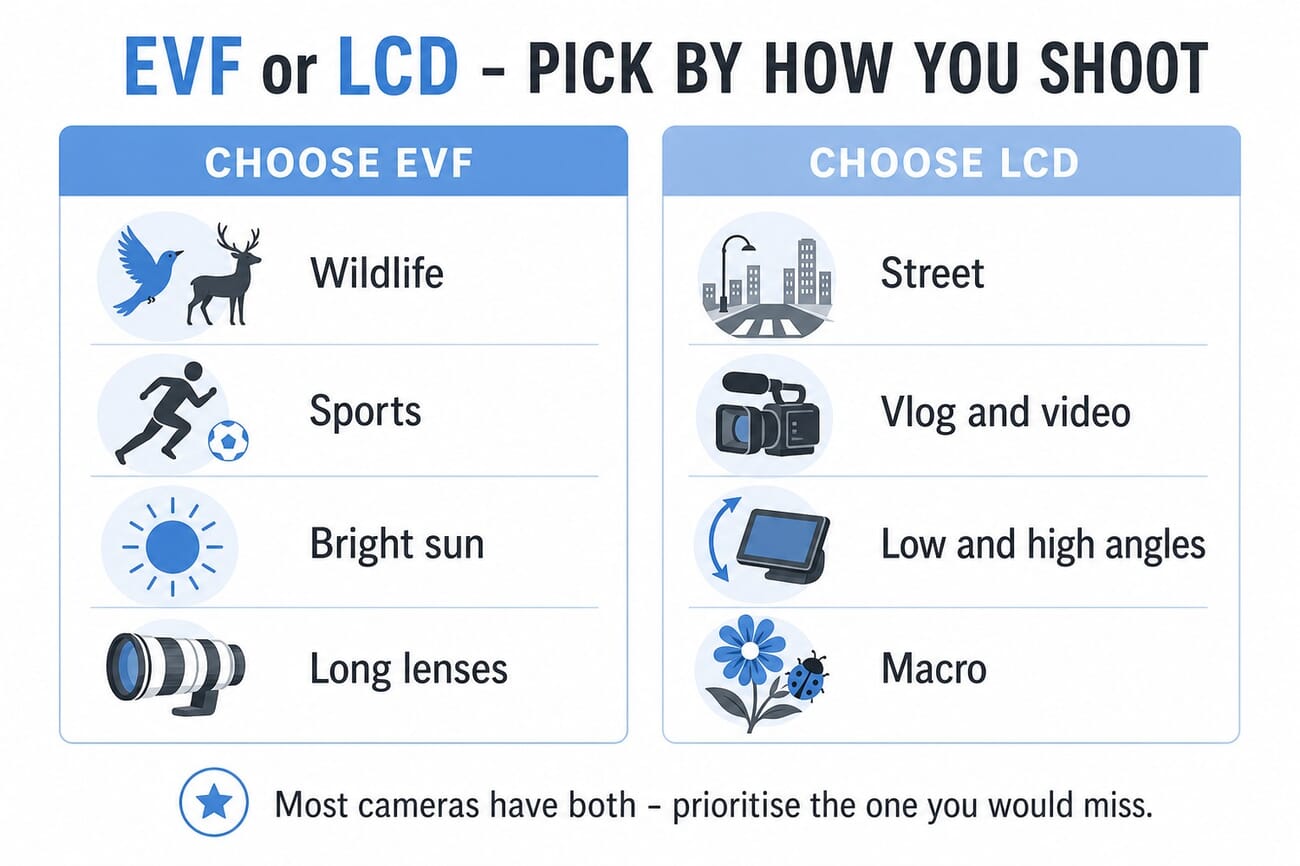
- Most cameras have both an EVF (eye-level electronic viewfinder) and a rear LCD — the real question is which one you’d miss if a camera dropped one, and that depends entirely on how you shoot.
- Choose the EVF if you shoot wildlife, sports, action, or anything in bright sun or with long lenses: eye-level shooting is steadier, glare-free, and better for tracking fast subjects.
- Choose the articulating LCD if you shoot street, video/vlog, low or high angles, or macro: a flip screen unlocks waist-level, overhead, and selfie framing that an EVF can’t.
- It only becomes a hard either/or with EVF-less creator cameras (like Sony’s ZV-E10 II) or rangefinder-style bodies — for those, match the missing piece to your genre before you buy.
- Quick rule: if you photograph moving subjects in daylight, never buy a camera without a good EVF. If you mostly shoot video or from creative angles, prioritise a fully-articulating screen.
It’s one of the most personal debates in cameras: if you had to give up your eye-level viewfinder or your rear screen, which would you keep? Digital Camera World just made the case for keeping the LCD. But framed as personal preference, the question isn’t very useful when you’re actually choosing between two cameras. So here’s the more practical version: the right answer isn’t about taste — it’s about how you shoot. Here’s a genre-by-genre breakdown so you can decide which display to prioritise.
When you buy through links on our site, we may earn a commission at no cost to you. We evaluate products independently. Commissions do not affect our evaluations.
First, What’s the Actual Question?
Here’s the thing most takes skip: nearly every interchangeable-lens camera has both an EVF and a rear LCD, so for most shooting you simply use whichever suits the moment. The decision only really bites in two situations. The first is when you’re choosing between two otherwise-similar cameras and one has a noticeably better viewfinder or a more flexible screen. The second — increasingly common — is when a camera drops one entirely: a wave of compact creator cameras now ditch the EVF to save size and cost, betting you’ll live on the screen. Knowing which display matters for your work is what keeps you from buying the wrong one.
Choose the EVF If You Shoot Action, Wildlife, or Bright Light
An electronic viewfinder isn’t nostalgia — it solves real problems the moment your subject moves or the sun comes out. Pressing the camera to your eye gives you a third point of contact, steadying long lenses and slow shutter speeds. The view stays perfectly visible in harsh daylight, where a rear LCD washes out to a useless mirror. And a modern EVF shows a live exposure and white-balance preview with blackout-free tracking, so you can follow a bird in flight or a sprinter without losing the frame.
If you shoot wildlife, birding, sports, fast street, or anything with a telephoto in daylight, an EVF is non-negotiable. Pro action bodies are built around superb finders — the Sony a9 III and a1, Nikon Z8 and Z9, Canon EOS R3 and R5, and the OM System OM-1 all pair high-resolution EVFs with subject-detection autofocus. For this kind of work, never buy a camera without a good viewfinder.
Choose the Articulating LCD If You Shoot Video, Street, or Creative Angles
The rear screen wins everywhere your eye can’t comfortably go. A flip-out or tilting LCD lets you shoot from the waist for candid street work, drop to ground level for a low macro angle, hold the camera overhead above a crowd, or flip it forward to frame yourself for video. It also makes touch-to-focus and quick image review effortless — exactly the points the Digital Camera World writer made for keeping it.

For street, video, vlogging, content creation, macro, and low/high-angle work, prioritise a fully-articulating (vari-angle) screen over a simple tilt screen — it’s the one that flips to face you. Creator-focused cameras lean into this: Sony’s ZV-E1 and {inter(‘sony-zv-e10-ii-japan-sales’,’ZV-E10 II’)}, Canon’s EOS R50 V, and similar bodies are built around the screen, not the finder.
The Cameras Where the Choice Is Forced
This is where the debate stops being academic. A growing class of compact, creator-first cameras leaves the EVF out altogether to stay small and affordable — the Sony ZV-E10 II is a poster child, and it recently topped Japan’s sales charts precisely because vloggers don’t miss a viewfinder. That’s fine if you shoot video and selfies; it’s a trap if you planned to photograph your kid’s soccer games in bright sun. On the flip side, some rangefinder-style and minimalist cameras lean the other way. Before you buy any camera that drops one display, picture your three most common shooting situations and ask which display each one needs — the answer is your buying decision.
How to Decide, in Three Questions
- Do you shoot moving subjects in daylight? If yes — wildlife, sports, kids, action — an EVF is essential. Rule out EVF-less cameras.
- Do you shoot video, vlog, or from creative angles? If yes, prioritise a fully-articulating screen that flips to face you; an EVF becomes a nice-to-have.
- Do you do both? Then get a camera with a high-resolution EVF AND a vari-angle LCD — most enthusiast and pro mirrorless bodies have exactly that, so you rarely have to choose.
Common Mistakes to Avoid
- Buying an EVF-less creator camera for action or wildlife. You’ll fight screen glare and instability every bright afternoon. The low price isn’t a deal if it can’t do the job.
- Ignoring screen type for video. A tilt-only screen doesn’t flip to face you — useless for vlogging. Check for “vari-angle” or “fully articulating.”
- Assuming a higher-megapixel EVF matters most. Refresh rate and lag matter more than raw resolution for tracking fast subjects.
- Forgetting battery life. Living on the rear LCD drains the battery faster than using the EVF — pack spares if you’re a screen shooter.
Frequently Asked Questions
Is an EVF or LCD better?
Neither — it depends on how you shoot. An EVF is better for action, wildlife, sports and bright-light shooting; an articulating LCD is better for video, vlogging, street and creative angles. Most cameras have both, so you only have to choose when one is missing or clearly better.
Do I need an EVF for wildlife or sports?
Yes. Eye-level shooting is steadier with long lenses, stays visible in bright sun where rear screens wash out, and tracks fast subjects better. Avoid EVF-less cameras for action photography.
What’s the best display for video and vlogging?
A fully-articulating (vari-angle) rear LCD that flips to face you. Many creator cameras, like the Sony ZV-E10 II, drop the EVF entirely and build around the screen for exactly this reason.
What’s the difference between a tilt screen and a vari-angle screen?
A tilt screen pivots up or down but stays behind the camera; a vari-angle screen swings out to the side and rotates, including all the way forward to face you. For video and selfies, you want vari-angle.
The Bottom Line
Stop arguing about which display is “better” in the abstract. If you photograph moving subjects in daylight, the EVF is the one you’d miss — so never buy a camera without a good one. If you shoot video or from creative angles, the articulating screen is your priority. And if you do a bit of everything, the easy answer is a camera with both, which is most of them. Match the display to the work, and the EVF-vs-LCD debate answers itself.
Further Reading
- Digital Camera World — EVF vs LCD: which one could I live without? – The opinion piece that prompted this guide
Image Sources
- Adil Ansari — photographer at eye-level (featured & pin) – via SampleShots
- Andrés — creator filming with a tripod-mounted camera – via SampleShots
- PhotoWorkout illustration – The EVF-vs-LCD decision chart is a stylized PhotoWorkout illustration