


- A lens mount is the bayonet + electronic interface that decides which lenses your camera can take — and switching mounts later usually means rebuying glass, so the mount you choose is a long-term commitment.
- The six mounts that matter in 2026: Sony E, Canon RF, Nikon Z, Fujifilm X (and medium-format G), Micro Four Thirds, and the Leica L-Mount alliance.
- Sony E has the largest lens ecosystem by far — the most native and third-party (Sigma, Tamron, Viltrox) options. It’s the safe pick if you want maximum choice.
- Micro Four Thirds (Panasonic + OM System) and Leica L (Leica + Panasonic + Sigma) are shared mounts — multiple brands’ bodies and lenses interchange, which is rare and valuable.
- Match the mount to the job: most lenses → Sony E; compact + video → Micro Four Thirds; APS-C with character → Fujifilm X; cross-brand full-frame → L-Mount; all-in on Canon or Nikon → RF or Z.
Buying a mirrorless camera isn’t really a decision about one camera — it’s a decision about a lens mount, and that choice follows you for years. The body you pick locks you into a specific bayonet, a specific lineup of native lenses, and a specific set of third-party options. Get it right and you can grow a kit for a decade; get it wrong and switching means selling glass at a loss. So before you compare megapixels and autofocus points, it’s worth understanding the mounts themselves.
This guide breaks down every major mirrorless mount in 2026 — who makes it, what it’s compatible with, how big its lens ecosystem is, and which one fits which kind of shooter. No jargon for its own sake; just what actually changes your buying decision.
When you buy through links on our site, we may earn a commission at no cost to you. We evaluate products independently. Commissions do not affect our evaluations.
What a Lens Mount Actually Is (and Why It Matters)
A lens mount is the mechanical and electronic connection between a lens and a camera body. Three things define it. The bayonet is the physical locking ring — its size and shape decide what physically attaches. The flange focal distance is the gap between the mount and the sensor; mirrorless cameras ditched the DSLR mirror box, so this distance is short, which has big consequences for lens design and adapting. And the electronic contacts carry autofocus, aperture and stabilization data — which is why a lens has to “speak the language” of the mount, not just fit it.
The practical upshot: a mount is an ecosystem, and ecosystems have momentum. The mount with the most lenses, the most third-party support and the most used-market depth is the one that keeps being easy and affordable to live with. That’s why “which mount” matters more than “which camera.”
The Major Mirrorless Mounts, Brand by Brand
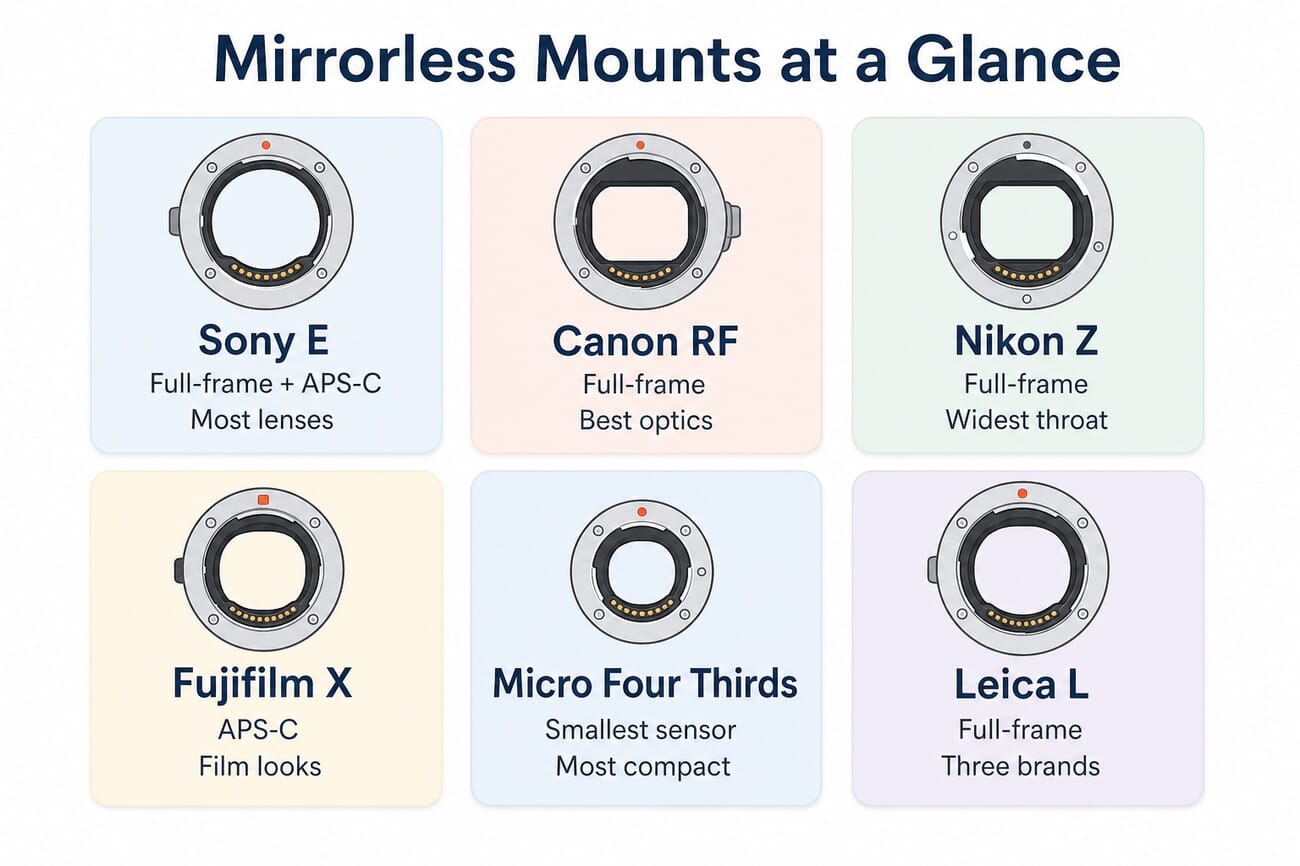
Sony E (FE and APS-C E) — the biggest ecosystem
Sony’s E mount launched in 2010 and got a head start on full-frame mirrorless, and it shows. The same mount covers both full-frame (Sony calls those lenses “FE”) and APS-C bodies, and Sony opened it to third parties early — so Sigma, Tamron, Viltrox and others all make native autofocus lenses for it. With an 18 mm flange distance, it’s also extremely adaptable. If your top priority is the widest possible choice of glass at every price point, E mount is the default answer. Browse the range in our lens database and Sony’s lead is obvious.
Canon RF (and RF-S) — superb optics, slowly opening up
Canon’s RF mount (full-frame) and RF-S (APS-C) pair a large 54 mm throat with a 20 mm flange, which lets Canon build some of the best — and most expensive — native optics around. The historic catch was third-party autofocus: Canon kept RF closed for years. That’s finally changing, with Sigma and Tamron now licensed to make RF lenses — but so far primarily for APS-C (RF-S), with full-frame third-party AF still limited. RF is a fantastic system if you’re committed to Canon’s (premium) lineup; just go in knowing the budget third-party options are thinner than Sony’s.
Nikon Z (and Z DX) — the widest throat
Nikon’s Z mount has the most extreme geometry of the full-frame mirrorless mounts: a huge 55 mm internal throat and a short 16 mm flange. That headroom is why Nikon’s Z glass — especially its fast primes and the S-Line zooms — is so highly regarded. After a slow start, Z is now opening to third parties too, with Sigma, Tamron and Viltrox shipping native autofocus lenses. It’s a strong, increasingly affordable full-frame choice, particularly for landscape and portrait shooters.
Fujifilm X (and medium-format G) — APS-C with character
Fujifilm went a different way: the X mount is APS-C only, with no full-frame option, paired with the film-simulation looks and retro handling that built Fuji’s cult following. The third-party scene is healthy (Sigma, Tamron and Viltrox all make X-mount autofocus lenses), and the native primes are excellent for street and travel. Separately, Fujifilm’s G mount powers its GFX medium-format mirrorless bodies — a different, larger sensor and lens system aimed at resolution-hungry pros.
Micro Four Thirds — small, shared, and video-friendly
Micro Four Thirds (MFT) is the outlier in two good ways. First, it’s a genuinely shared mount: Panasonic and OM System (formerly Olympus) bodies and lenses interchange freely, and many third parties build for it. Second, its smaller Four Thirds sensor (a 2× crop versus full-frame) keeps cameras and lenses remarkably compact, and the 2× crop gives wildlife shooters extra reach cheaply. It’s lost ground to full-frame, but for travel kits, run-and-gun video and budget telephoto reach, MFT is still hard to beat on size and value.
Leica L (the L-Mount Alliance) — three brands, one mount
The L-Mount is the other shared system, and the most ambitious: Leica, Panasonic and Sigma all build full-frame bodies and lenses to the same standard, so a Sigma or Panasonic lens mounts natively on a Leica, and vice versa. That means a Sigma fp or Panasonic S-series owner has access to Leica’s optics and Sigma’s value lenses on one mount. It’s a smaller ecosystem than Sony’s, but the cross-brand flexibility is unique — and growing, as our recent coverage of new L-mount lenses shows.
Mirrorless Mounts Compared
| Mount | Brand(s) | Sensor format | Flange distance | Third-party autofocus | Best for |
|---|---|---|---|---|---|
| Sony E (FE / E) | Sony | Full-frame + APS-C | 18 mm | Wide open (Sigma, Tamron, Viltrox) | The most lens choice; all-round |
| Canon RF (RF / RF-S) | Canon | Full-frame + APS-C | 20 mm | APS-C only so far (Sigma, Tamron) | Canon shooters wanting top native optics |
| Nikon Z (Z / DX) | Nikon | Full-frame + APS-C | 16 mm | Opening up (Sigma, Tamron, Viltrox) | Landscape, portrait, value full-frame |
| Fujifilm X | Fujifilm | APS-C only | 17.7 mm | Open (Sigma, Tamron, Viltrox) | Street, travel, film-look fans |
| Fujifilm G (GFX) | Fujifilm | Medium format | 26.7 mm | Limited | High-resolution studio & landscape |
| Micro Four Thirds | Panasonic, OM System | Four Thirds (2× crop) | 19.25 mm | Very open | Compact kits, video, wildlife reach |
| Leica L (L-Mount) | Leica, Panasonic, Sigma | Full-frame + APS-C | 20 mm | Native via Sigma (alliance member) | Cross-brand full-frame, hybrid video |
Flange distances are approximate and vary slightly by source; third-party support changes as licensing deals evolve, so treat the table as a 2026 snapshot rather than a permanent law.
Compatibility: Can You Adapt Lenses Across Mounts?
This is where mirrorless’s short flange distance pays off. Because there’s so little space between mount and sensor, you can slot an adapter in to mount older DSLR or legacy lenses — Canon EF glass on an RF body, Nikon F on Z, or decades-old manual lenses on almost anything. Native-brand adapters (Canon EF→RF, Nikon F→Z) generally keep full autofocus; third-party and dumb adapters may drop AF or aperture control, so check before you buy.
Two caveats. First, adapting only goes one way: you can put a DSLR lens on a mirrorless body, but not a mirrorless lens on a DSLR (there isn’t room). Second, “fits” isn’t “works” — a lens has to communicate electronically for autofocus and stabilization, which is exactly why the shared mounts (L-Mount, MFT) are special: lenses across those alliance brands work natively, no adapter required.
Which Mount Is the Most Popular?
By sheer lens count, Sony E leads — it’s the largest ecosystem of native and third-party glass, a lead that’s visible even in our own lens database, where E-mount options outnumber every other mirrorless mount. Canon RF and Nikon Z follow and are catching up fast, especially now that third parties are arriving. Micro Four Thirds still has one of the deepest lens catalogs of all thanks to its long history, even as the format contracts. And Fujifilm X dominates the dedicated APS-C enthusiast space. Popularity isn’t everything — but a bigger ecosystem means cheaper used lenses, more rentals and better long-term support.
Which Mount Is Best for You?
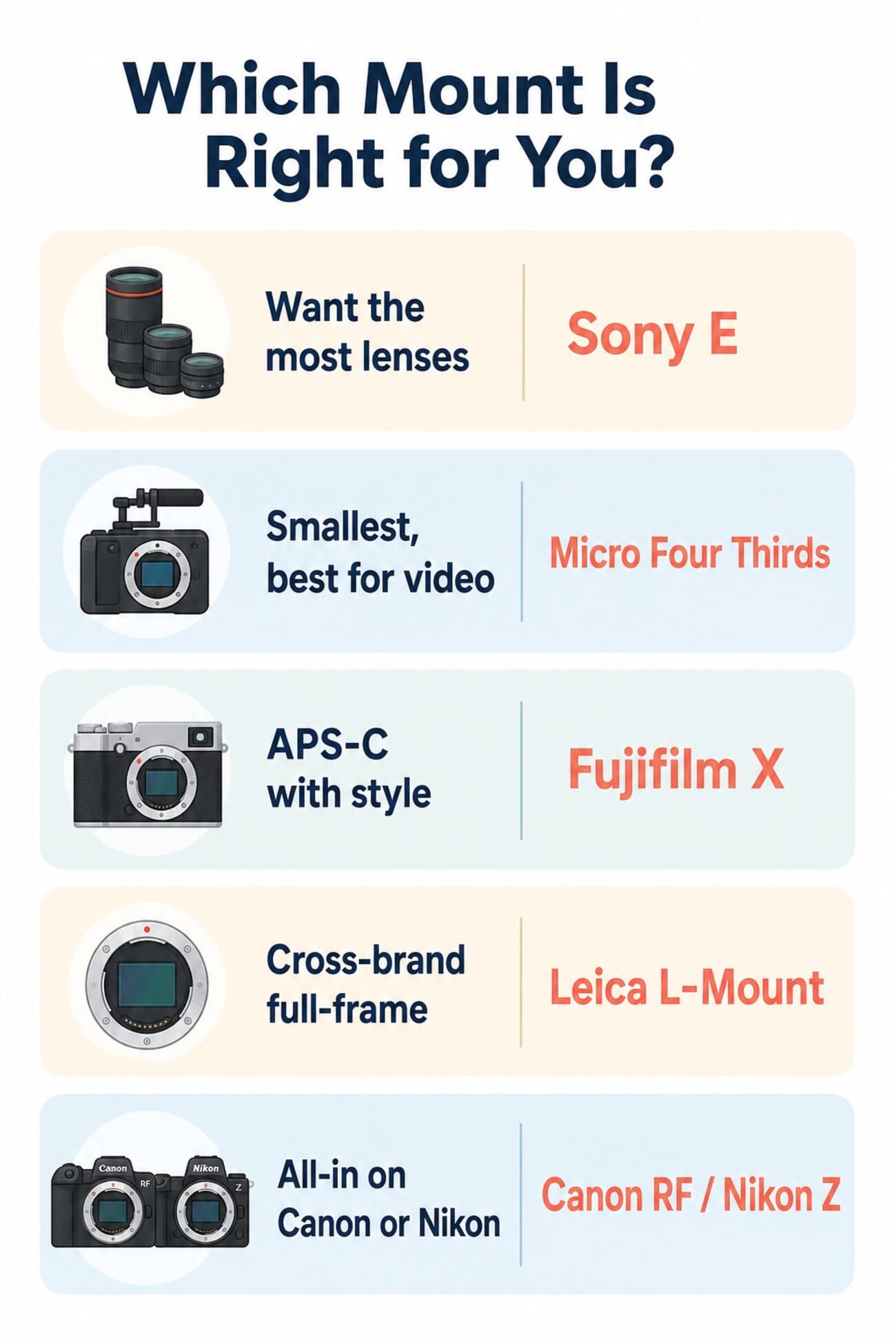
There is no universally “best” mount — there’s the best mount for your priorities. Want the widest, deepest, cheapest-to-grow lens selection? Sony E. Care most about size, weight and video on a budget, or want long telephoto reach cheaply? Micro Four Thirds. Love APS-C image character and tactile, retro cameras? Fujifilm X. Want full-frame with the freedom to mix lenses across three brands? Leica L-Mount. Already invested in Canon or Nikon, or set on their flagship optics? Canon RF or Nikon Z. Pick the priority first, and the mount follows.
Frequently Asked Questions
Can I use any lens on any mirrorless camera?
No. A lens must match your camera’s mount, either natively or through an adapter. Mirrorless bodies adapt older DSLR and legacy lenses well, but autofocus and aperture control depend on the adapter and lens — native-brand adapters keep the most functionality.
Which mirrorless mount has the most lenses?
Sony E, by a clear margin, thanks to its early start and open third-party policy. Micro Four Thirds also has a very deep catalog from its long history. Canon RF and Nikon Z are growing quickly as third parties join.
What’s special about Micro Four Thirds and the L-Mount?
Both are shared mounts. MFT lenses and bodies work across Panasonic and OM System; L-Mount works across Leica, Panasonic and Sigma. You can mix brands on one mount with no adapter — something no single-brand mount offers.
Can I put a third-party lens on a Canon RF camera?
Increasingly, yes. After years of restriction, Canon now licenses Sigma and Tamron for RF — but mostly APS-C (RF-S) lenses so far. Full-frame RF third-party autofocus options are still limited compared with Sony or Nikon.
Does the mount affect image quality?
Indirectly. The sensor and the specific lens drive image quality, but a mount’s geometry (throat and flange) influences how good and how fast lenses can be designed — which is why wide-throat mounts like Nikon Z enable standout optics.
The Bottom Line
Choosing a mirrorless camera is really choosing a mount — a long-term commitment to a lens ecosystem. Sony E gives you the most options, Micro Four Thirds the smallest and most affordable kit, Fujifilm X the most character, the L-Mount the most cross-brand freedom, and Canon RF and Nikon Z the strongest first-party optics. Decide what you value most, confirm the lenses you’ll want exist for that mount, and buy the body second. Do that and you’ll spend the next decade building a kit, not regretting one. For a head start, browse our camera database and lens database to see exactly what each mount offers.
Mount specifications and third-party support status were verified against the following sources (a 2026 snapshot).
Image Sources