


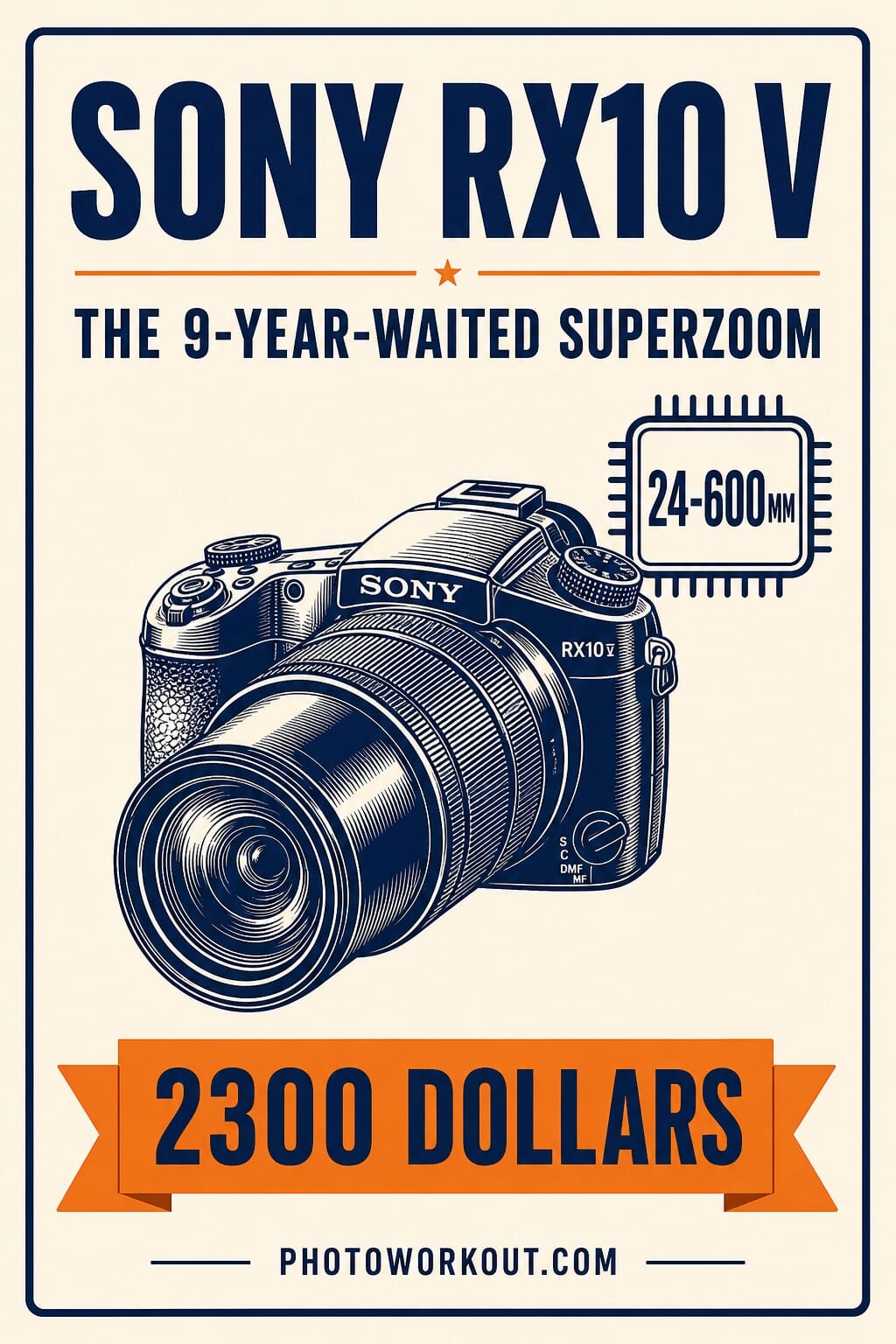
- Sony announced the RX10 V on July 9, 2026, the first update to its RX10 bridge-camera line in nearly nine years (since the RX10 IV in September 2017). Pre-orders opened today at $2,300 MSRP.
- The lens stays the same 24-600mm equivalent Zeiss Vario-Sonnar T* f/2.4-4.0 and the sensor stays at 20.1MP on a 1-inch stacked chip. Every meaningful upgrade sits around them: a new processor, redesigned body, tilting 3.69M-dot EVF and AI autofocus lifted from the A7 V.
- Video is where the RX10 V grows up: 4K 60p 10-bit All-Intra using the full sensor width, 4K 120p slow-mo with a crop, 1080p 240p, S-Log3, 16-LUT import, and 4K 30 live streaming over USB-C.
- The catches at $2,300: same 20.1MP sensor as the 2017 model, a rear screen that tilts but does not flip out (bad for vlogs at this price), and no built-in flash. For a hybrid shooter who needs 24-600mm reach in one body, though, it is the only game in town.
Sony finally unveiled the RX10 V today, and the headline number is a nine-year wait. The RX10 IV shipped in September 2017; there has been no bridge-camera successor from Sony since. That gap is unprecedented in a premium camera line, and it is why the launch specs matter beyond the usual generational bump: this is the model that has to justify Sony still making a fixed-lens 24-600mm superzoom in a mirrorless-plus-tele-zoom world.
MSRP is $2,300, pre-orders are live at B&H, and the answer to “did Sony do enough” depends on what you shoot. The lens and sensor did not change. The body, autofocus system, and video pipeline did. PhotoWorkout tracked the launch rumors in the June 26 preview; here is what actually shipped, and what it means at that price.
Sony’s own concept film for the RX10 V, published alongside the July 9 announcement, is the fastest way to see the design overhaul and the new dual top-dial control layout in motion before reading the spec breakdown:
What Actually Changed From the RX10 IV
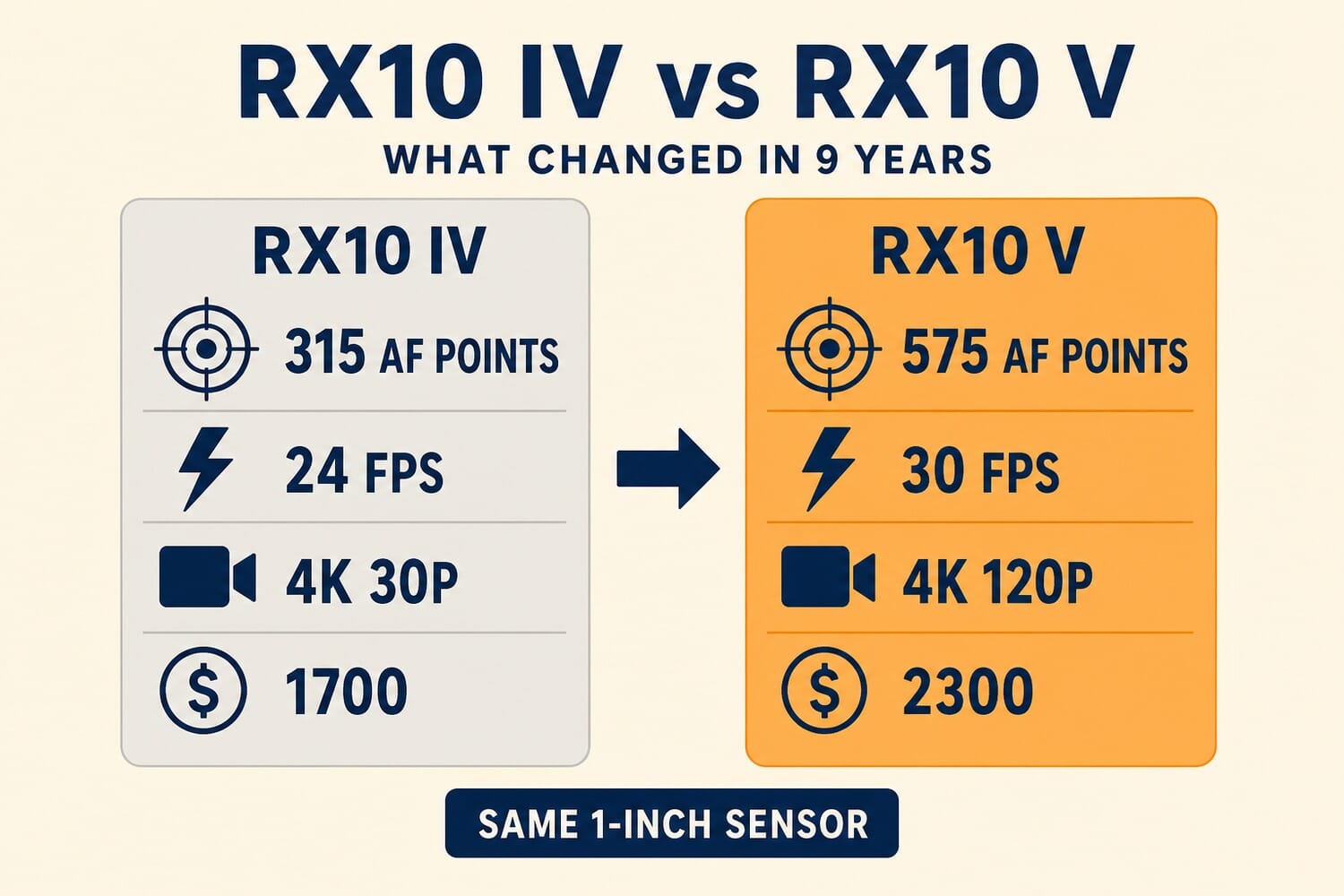
The autofocus overhaul is the change that will matter most in the field. Sony pulled the deep-AI processor and Real-Time Recognition system from the A7 V into the RX10 V, so the camera now identifies human faces, eyes, heads, and bodies, plus birds, animals, insects (both the head and the whole body), and vehicles including cars, trains, and airplanes. Numerically that is 575 AF points across 70 percent of the sensor, up from 315 points on the RX10 IV, and continuous AF/AE tracking doubles to 60 fps.
Burst goes from 24 fps to 30 fps in blackout-free electronic-shutter mode, and Sony carried over Continuous Shooting Speed Boost from its recent mirrorless bodies, a dedicated hardware jump straight to the maximum burst speed for decisive moments. That is genuinely useful for wildlife and sport where the priming lag on a normal half-press costs you the frame.
Video is arguably the bigger story. The RX10 V shoots 4K 60p 10-bit All-Intra (XAVC S and XAVC HS), reads the full sensor width for that resolution with no pixel binning, and can push to 4K 120p with a mild crop or 1080p at 240 fps. S-Log3 is in, up to 16 custom LUTs can be preloaded to preview finished looks on set, in-body stabilization has been tuned enough to smooth walking shots, and live streaming works up to 4K 30 over USB-C. That is a legitimate video machine, not a stills camera with reluctant video specs. Independent coverage in Engadget’s hands-on preview confirms every spec here.
What Sony Deliberately Did Not Upgrade
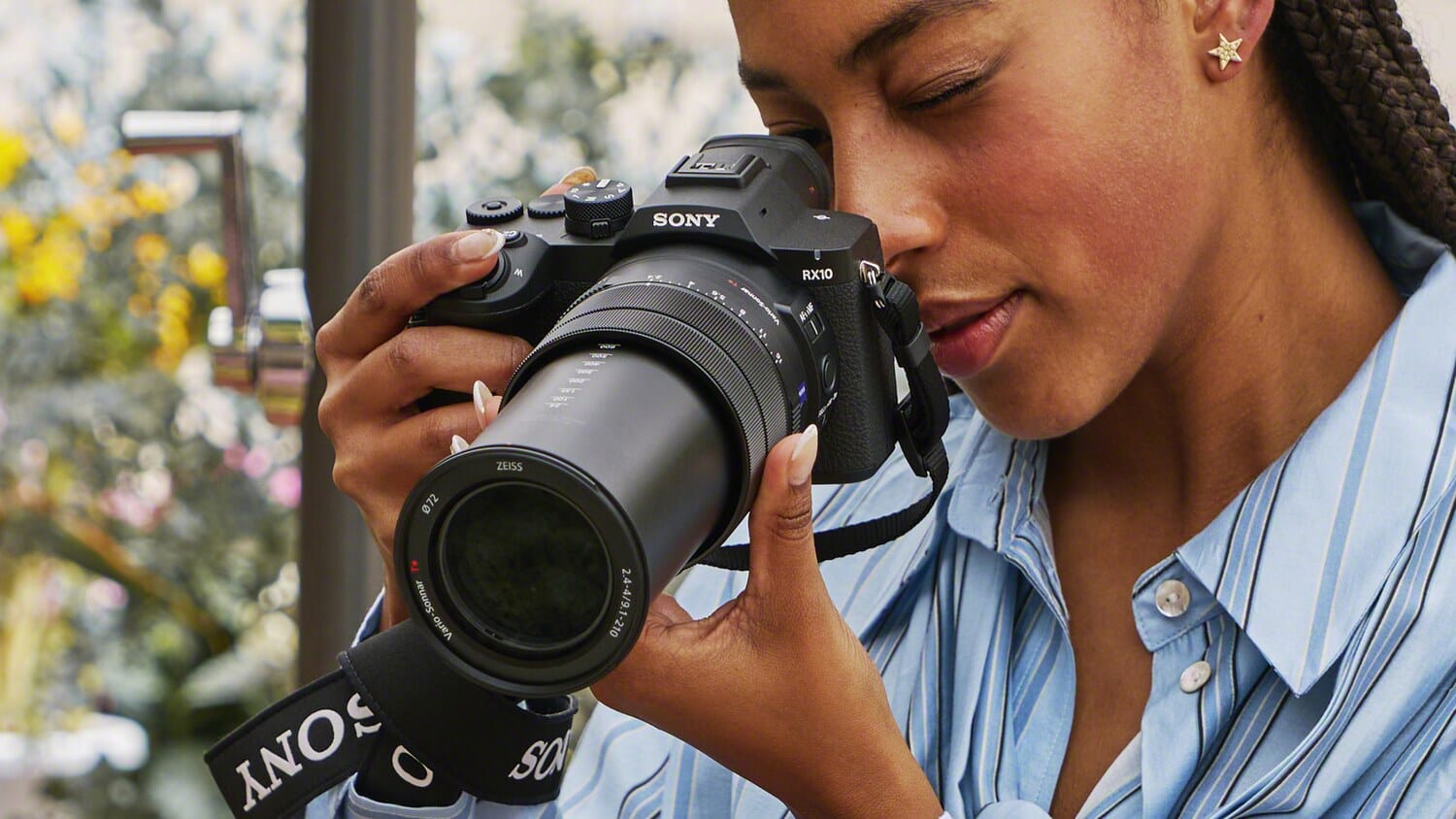
Two omissions are worth naming out loud. The rear display tilts but does not fully flip out, which is a real ergonomic miss on a $2,300 hybrid camera that Sony obviously wants vloggers to consider. Anyone shooting themselves regularly (talking-head reviews, walk-and-talks, food or product) will either learn to live with awkward framing or notice the ZV-1 II sitting there with a proper flip screen. The other omission is the built-in flash, which the RX10 IV had; the hot shoe still lets you mount a Sony flash unit, but the built-in pop-up is gone.
The bigger structural non-upgrade is the sensor. The RX10 V ships with the same 20.1MP 1-inch stacked chip as the RX10 IV. Sony leans on the argument that the sensor was the ceiling for the form factor, and that everything from processing to AF around it was the real bottleneck, and there is some truth to that. But at $2,300, the absence of a resolution bump is going to sit uncomfortably next to Sony’s own recently announced LYTIA L910 phone sensor hitting ~17 stops of dynamic range in a fraction of the size. For working photographers this is an argument about ergonomics, reach, and lens quality more than pixel count.
The Redesign Is Substantive
Sony’s press language calls the design a full overhaul, and the images bear it out. The RX10 IV was famously bulbous. The V is squared off, sleeker, with a much deeper grip and controls borrowed from the A7 V line: a joystick, three control dials, a control wheel, and a new dual top dial that includes a photo/video/S&Q selector plus an AF-ON button. The electronic viewfinder jumps to 3.69 million dots (from 2.4 million on the IV) and the rear display goes to 1.62 million dots, matching the sharpness bar current buyers now expect.
Ports are modernized: micro HDMI, 3.5mm mic and headphone jacks, a fast USB-C, and a single UHS-II SD card slot. The battery is a full-size NP-FZ100 rated for 630 shots per charge, the same battery used across Sony’s current A7 series bodies. That is a real convenience for hybrid shooters already inside the ecosystem, and a step up from the smaller battery in the previous RX10.
Who the RX10 V Is Actually For
The niche is narrower than the spec sheet suggests, and Sony knows it. This camera exists for the photographer who genuinely needs 24-600mm equivalent reach in one body without a lens change and cannot or will not carry a full-frame plus 200-600mm setup. That is a real customer: safari and birding travelers who value not swapping lenses, wildlife video shooters who need long-end reach with usable 4K frame rates, event photographers covering ceremonies from the back and pulling in tight from the same seat, and a growing subset of solo travel-video creators for whom the 24-600mm range replaces a two-lens kit.
For everyone else the calculus is harder. A used Sony A7 IV plus a Tamron 50-400mm zoom (roughly the same money) delivers a bigger sensor and better low-light performance, at the cost of weight and a lens swap for wide angle. Nikon’s COOLPIX P1100 gives you 24-3000mm equivalent for a fraction of the price if reach is all that matters. If pure video is the goal, Sony’s own ZV-1 II or a compact mirrorless with a compact zoom will handle vlogs better with a proper flip screen. The RX10 V is the answer to a specific question: one body, one lens, 24 to 600 millimeters, no compromises on either end of the zoom range. For that shopper, it is the only option in 2026.
For an early look with real sample footage from a wildlife-and-street shooter, AdoramaTV’s Seth Miranda ran the RX10 V through action and low-light tests on launch day. His review is worth the twelve minutes:
Contains affiliate links. If you buy through them, PhotoWorkout may earn a commission at no extra cost to you.
Pricing and Availability
MSRP is $2,300, pre-orders are open now, and Sony has not published US shipping dates yet. As of launch day, both major US retailers are priced identically at $2,298 (a small discount from Sony’s $2,300 MSRP): B&H and Adorama are both at that price. Amazon US will almost certainly follow in the next few days. That $2,300 sticker is a 35 percent bump on the RX10 IV’s $1,700 launch price in 2017, part inflation, part the ongoing NAND and premium-electronics pricing pressure PhotoWorkout tracked in the Q2 2026 memory-card piece, and part Sony pricing this into the “specialist reach” bracket rather than the mainstream premium compact bracket.
Frequently Asked Questions
How much does the Sony RX10 V cost?
$2,300 US MSRP for the body-and-lens (there are no separate lens variants; the 24-600mm is fixed). Pre-orders opened at B&H on July 9, 2026. That is up 35 percent from the RX10 IV’s 2017 launch price of $1,700.
Did Sony change the sensor?
No. The RX10 V uses the same 20.1MP 1-inch stacked sensor as the RX10 IV. Sony’s argument is that image quality was already at the practical ceiling for a 1-inch chip at this pixel count, and that AF, processing, and video around it were the real bottlenecks. Reasonable people will disagree at this price.
Is the RX10 V a good vlogging camera?
Video-wise, yes: 4K 60p 10-bit All-Intra, 4K 120p, S-Log3, 16 LUTs, and full-sensor readout put it in serious hybrid territory. Ergonomically, no: the rear display tilts but does not fully flip out, which makes talking-head framing awkward. The ZV-1 II or a proper mirrorless with a compact zoom will handle vlogs better.
What is the RX10 V’s zoom range?
24 to 600mm full-frame equivalent (9.1 to 210mm actual focal length), through the Zeiss Vario-Sonnar T* f/2.4 to f/4.0 lens carried over from the RX10 IV. That is 25x optical zoom range without swapping glass, which is the entire point of the RX10 line.
Should I upgrade from the RX10 IV?
If AF speed and video are what you shoot: yes, comfortably. The 575-point Real-Time Recognition system, 30 fps blackout-free bursts, and 4K 60p 10-bit All-Intra are all substantive upgrades. If you shoot mostly stills in decent light and rarely push the AF or the frame rate: probably not, because the sensor and lens are unchanged and the $2,300 is a lot for interface polish.
The Bottom Line
The RX10 V is a hard camera to review because it is a hard camera to place. On its own merits it is a legitimately capable modern hybrid: current Sony AF, current Sony video specs, current Sony body design, and a Zeiss zoom that still holds up at 600mm. Priced against its own market it is a $2,300 fixed-lens camera in a year when a bigger-sensor mirrorless body costs about the same, and Sony has left a working generation of RX10 IV bodies on the market as the “value” 1-inch superzoom pick.
For a specific kind of buyer (one-body one-lens 24-600mm reach, hybrid stills and video, no lens changes ever), it is the only camera on the market that does all of that in 2026, and Sony has priced it accordingly. For everyone else, the RX10 IV at a discount, a used mirrorless plus a Tamron long zoom, or Sony’s own ZV-1 II will all cover more ground for less money. The nine-year wait produced exactly the camera the niche asked for. It also produced a $2,300 answer that will not fit most shoppers looking at the RX10 line for the first time.
Primary Coverage
- Sony | Camera Channel: RX10 V concept film – Official Sony reveal video published alongside the July 9 announcement (embedded above)
- Engadget: Sony's RX10 V superzoom finally arrives with a new design and 4K 120p video – Independent launch-day breakdown of specs, price, and design changes
- B&H Photo: Sony RX10 V pre-order listing – Live pre-order product page with MSRP and shipping window
- Adorama: Sony DSC-RX10 V Digital Camera listing – Live launch-day listing at $2,298 (matched by B&H later the same day)
- AdoramaTV / Seth Miranda: Sony RX10 V Review — Was the 9-Year Wait Worth It? – Launch-day hands-on video with action and low-light samples (embedded above)
- Imaging Resource: Sony teases RX10 V announcement – Pre-launch teaser confirming design overhaul and timing
- The Phoblographer: First image of the Sony RX10 V shows a major design overhaul – Body redesign coverage ahead of the July 9 announcement
Image Sources
- Sony RX10 V product imagery (featured and inline): courtesy Sony – Official Sony press-kit renders from the July 9, 2026 launch
- RX10 IV vs V comparison infographic and vertical pin: PhotoWorkout illustrations – Editorial graphics created by PhotoWorkout