


- TrendForce pegs Q2 2026 NAND flash contract prices up 70 to 75 percent quarter-over-quarter, stacked on roughly 60 percent in Q1. Popular 1TB SSDs that sold near $45 late last year now list around $90.
- Memory cards are structurally the first products starved: SD, CFexpress, and microSD share the same NAND pool as enterprise SSDs, and AI datacenters with open-ended orders win every bidding round.
- Sony already blinked. On March 27 it suspended orders for nearly its entire card line (CFexpress Type A and B plus TOUGH SD) with no resume date, the first brand-level exit of the crunch.
- Analysts now expect tightness through late 2027 at minimum. The playbook: buy the cards and working SSDs you will need in the next year now, and let hard drives and cloud storage wait.
The flash-memory crunch stopped being an abstract industry story sometime this spring. It is now the reason a 128GB V90 card costs more than some lenses, and the reason Sony quietly stopped selling memory cards at all.
The Q2 numbers make it official: this is the steepest sustained flash-price escalation in the digital camera era, and every card slot in your bag sits at the very back of the queue for supply.
What Just Happened: Up 70 Percent in a Single Quarter
TrendForce’s contract-price tracking, reported by Tom’s Hardware, puts Q2 2026 NAND flash contract prices up 70 to 75 percent quarter-over-quarter. That is not the increase for the year; that is one quarter, stacked on top of roughly 60 percent in Q1. DRAM did the same dance at 58 to 63 percent.
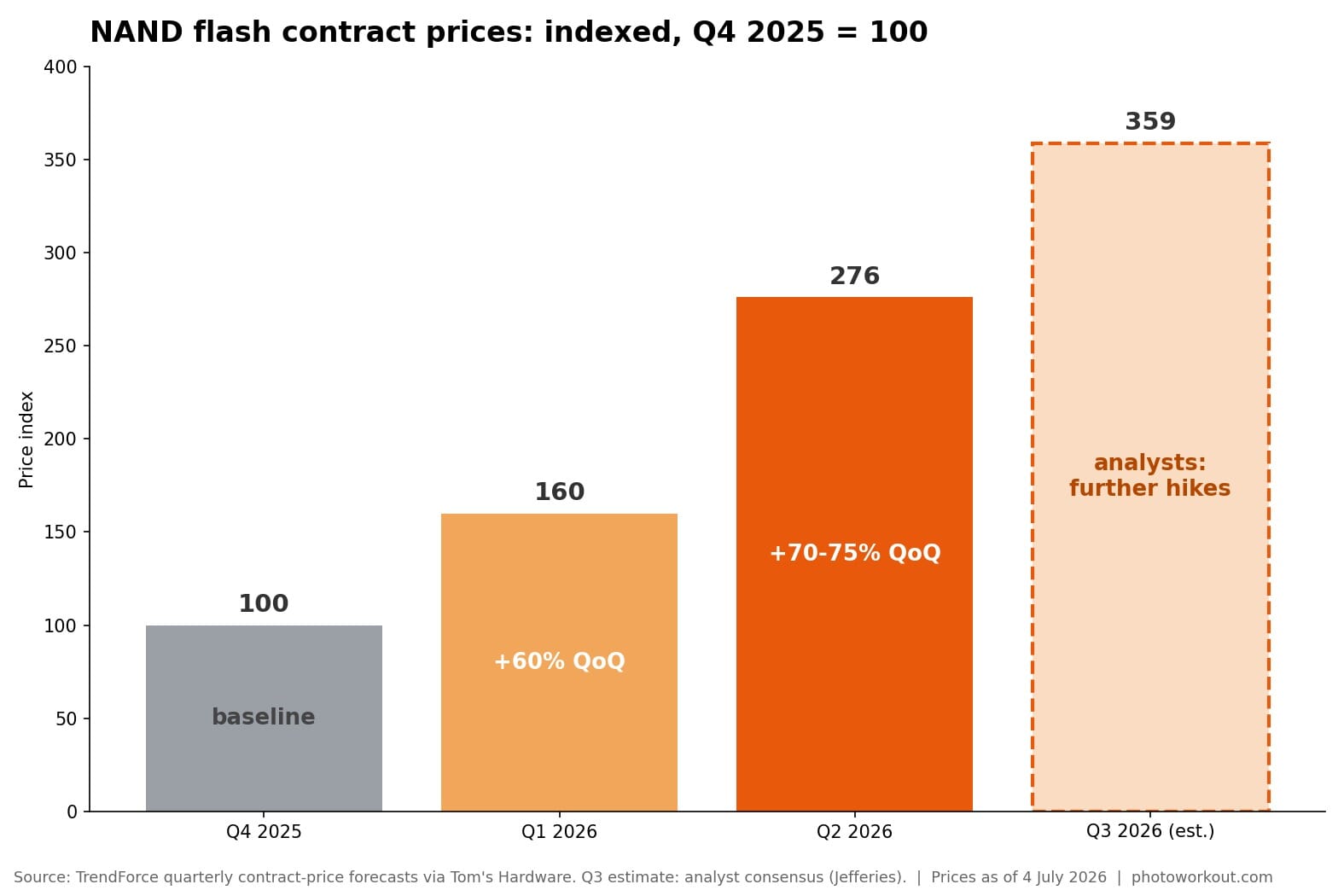
Compounded, NAND that cost 100 in December costs roughly 275 today. Retail follows contract prices with a short lag, which is why popular 1TB consumer SSDs that sold for about $45 late last year now list around $90, and why analysts at Jefferies warn of another 50 percent in Q3 and 40 percent in Q4, with genuine relief not expected before new fab capacity arrives in late 2027 to 2028.
Why Memory Cards Lose the Bidding War
The reason your card slot is exposed is structural, not incidental. There is one global pool of NAND flash, and an SD card, a CFexpress card, a phone, and a 60TB enterprise SSD all draw from it. When supply tightens, the chips flow to whoever pays the most per wafer, and that is never the consumer card market.
Google, Amazon, Meta, and OpenAI are placing what industry trackers describe as open-ended orders for AI-datacenter storage, effectively buying entire quarters of top-tier flash output in advance. Card makers, who buy NAND on the open market and sell into the lowest-margin consumer segment, are price takers at the very end of the allocation chain. They get what the hyperscalers leave behind, at whatever price remains.

That is why this squeeze hits cards harder and earlier than almost any other electronics category. A camera maker can absorb a pricier image processor; a card is nearly all NAND by cost, so its price tracks the crisis one-to-one.
The Canary: Sony Walked Away From Its Own Card Business
If the structural argument sounds theoretical, Sony made it concrete on March 27. The company suspended order fulfillment for nearly its entire memory card lineup: CFexpress Type A, CFexpress Type B, and the TOUGH SDXC/SDHC lines, citing the global semiconductor shortage. No resume date has been announced, and three months later the cards remain unavailable.
Read that decision the way the industry does. Sony sells CFexpress Type A cards that its own Alpha cameras depend on, and it still concluded that buying NAND at current prices to sell consumer cards was not worth doing. A brand exiting its own accessory ecosystem rather than selling at a loss is the clearest possible signal about where card economics sit right now.
For photographers the practical consequence is narrower choice on top of higher prices: Type A shooters lost the reference brand, and the remaining suppliers (Lexar, ProGrade, Delkin, Angelbird) inherited its demand. PhotoWorkout covered the first-order price moves as they landed, with ProGrade’s May 1 increase and Lexar’s 25 percent jump on June 1, both of which now look like early tremors rather than one-off corrections.
What It Already Costs You
Spot-checking live Amazon prices while writing this piece (July 4, 2026) tells the story faster than any index. The Lexar Professional 2000x 128GB V90, a workhorse UHS-II card that sat near $75 in PhotoWorkout’s X100VI card guide, currently lists at $233.93. The SanDisk 512GB Extreme PRO CFexpress Type B shows $449.99, with Amazon flagging just 14 units left in stock.
Scarcity flags like that matter as much as the sticker. Low stock on first-party listings is where marketplace sellers move in, and card counterfeiting historically spikes exactly when legitimate supply thins. Whatever you buy in the next year, buy it from the manufacturer’s official store or Amazon’s own inventory, not the cheapest third-party offer.
Buy Now or Wait? The Practical Playbook
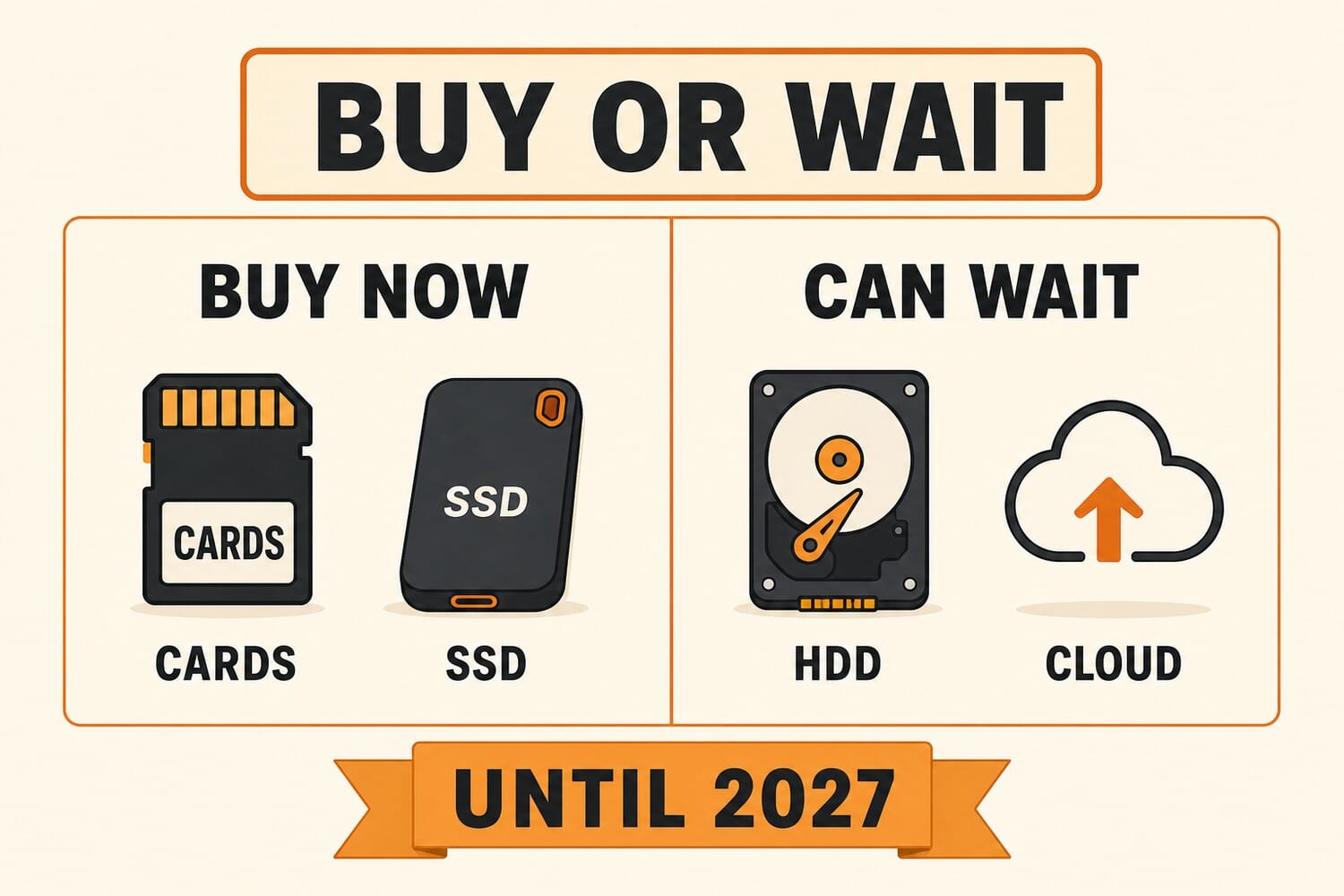
Buy now (prices rise from here)
Memory cards you will genuinely need in the next 12 months are the clearest case: analysts see two more quarters of double-digit increases before any plateau. Cover every slot in your working bodies plus one spare per slot. The 128GB and 256GB tiers are the sweet spot; ultra-high capacities carry the worst per-gigabyte premiums right now.
Working SSDs follow the same logic. If an editing or offload drive purchase was planned for the holidays, moving it forward will very likely beat the Q4 price. The picks in the external SSD roundup were priced before the Q2 jump fully landed at retail; treat listed prices as a floor.
Can wait (different supply chain)
Archive storage does not need panic. Spinning hard drives use magnetic platters, not NAND, and their pricing has been comparatively stable; a two-drive HDD archive plus cloud backup remains the cheapest insurance per terabyte. Cloud storage prices are contracted long-term and have not moved for consumers.
And do not stockpile beyond real need. Cards do not improve with age, warranties start at purchase, and if the 2027-2028 fab capacity lands as planned, hoarded inventory bought at peak prices becomes the most expensive shelf decoration in the studio.
Frequently Asked Questions
Why are memory card prices rising so fast in 2026?
Because cards are almost pure NAND flash by cost, and NAND contract prices rose roughly 60 percent in Q1 2026 and another 70 to 75 percent in Q2 (TrendForce). AI datacenter operators are buying flash output in open-ended contracts, and consumer cards sit last in the allocation queue, so card prices track the shortage almost one-to-one.
Will memory card prices come down in 2027?
Not early in the year, on current forecasts. Analysts expect further contract-price increases through late 2026 and supply tightness deep into 2027; meaningful relief depends on new fabrication capacity that is not expected online before late 2027 to 2028. Treat any plateau in 2027 as the optimistic case.
Should photographers stockpile memory cards?
Cover real, foreseeable need, not fear. A sensible target is every slot in your working cameras filled plus one spare per slot, in the capacities you actually shoot. Buying a year of cards now makes sense; buying five years of cards at peak prices does not.
Are hard drives and cloud storage affected too?
Far less. Hard drives store data on magnetic platters and are not part of the NAND supply crunch, and consumer cloud pricing is contracted and stable so far. That is exactly why the practical split is: buy NAND-based storage (cards, SSDs) ahead of need, and leave archive HDDs and cloud plans on your normal schedule.
The Bottom Line
The Q2 numbers turn a slow-burn supply story into a household one: flash prices are compounding quarter over quarter, the biggest buyers on earth have first claim on every wafer, and the first brand has already walked out of the card business rather than fight for allocation.
None of it is in a photographer’s control. What is: a 20-minute audit of your card wallet, one deliberate purchase at July prices instead of a forced one at December prices, and archives kept on platters and cloud where this crisis cannot reach them. The background on how the shortage started is in PhotoWorkout’s original explainer; this is the escalation nobody wanted confirmed.
Market Data and Coverage
- Tom's Hardware: DRAM prices predicted to jump 63% in Q2, NAND up to 75% – TrendForce Q2 2026 contract-price forecast: NAND up 70 to 75 percent QoQ
- TrendForce: AI server demand to drive memory contract activity in 2Q26 – Primary forecast: DRAM 58-63 percent, NAND 70-75 percent QoQ for Q2 2026
- PetaPixel: Sony shuts down nearly its entire memory card business – March 27, 2026 suspension of CFexpress Type A/B and TOUGH SD order fulfillment
- Wccftech: Jefferies warns memory prices will surge 50% in Q3 and 40% in Q4 – Analyst outlook: continued hikes through 2026, no relief until 2028
- TechSpot: RAM prices expected to rise another 40-50% in Q3 2026 – Corroborating H2 2026 memory-market forecasts
Image Sources
- Memory card organizer (featured image): photo by Samsung Memory – Via Unsplash, curated on SampleShots
- Photographer inserting SD card: photo by Samsung Memory – Via Unsplash, curated on SampleShots
- Camera field kit with memory cards: photo by Samsung Memory – Via Unsplash, curated on SampleShots
- NAND price chart and buy-or-wait infographic: PhotoWorkout illustrations – Editorial graphics created by PhotoWorkout from TrendForce and analyst data