


- DJI unveiled the EV50, its first VTOL fixed-wing cargo drone. It is a lift-and-cruise aircraft built for long-range heavy transport in tough terrain, not urban parcel delivery.
- On a 12-day Everest expedition it flew 32 times and reached 8,861 meters (29,072 feet), about 12 meters above the summit, a record for a VTOL drone, while carrying atmospheric research gear for Peking University.
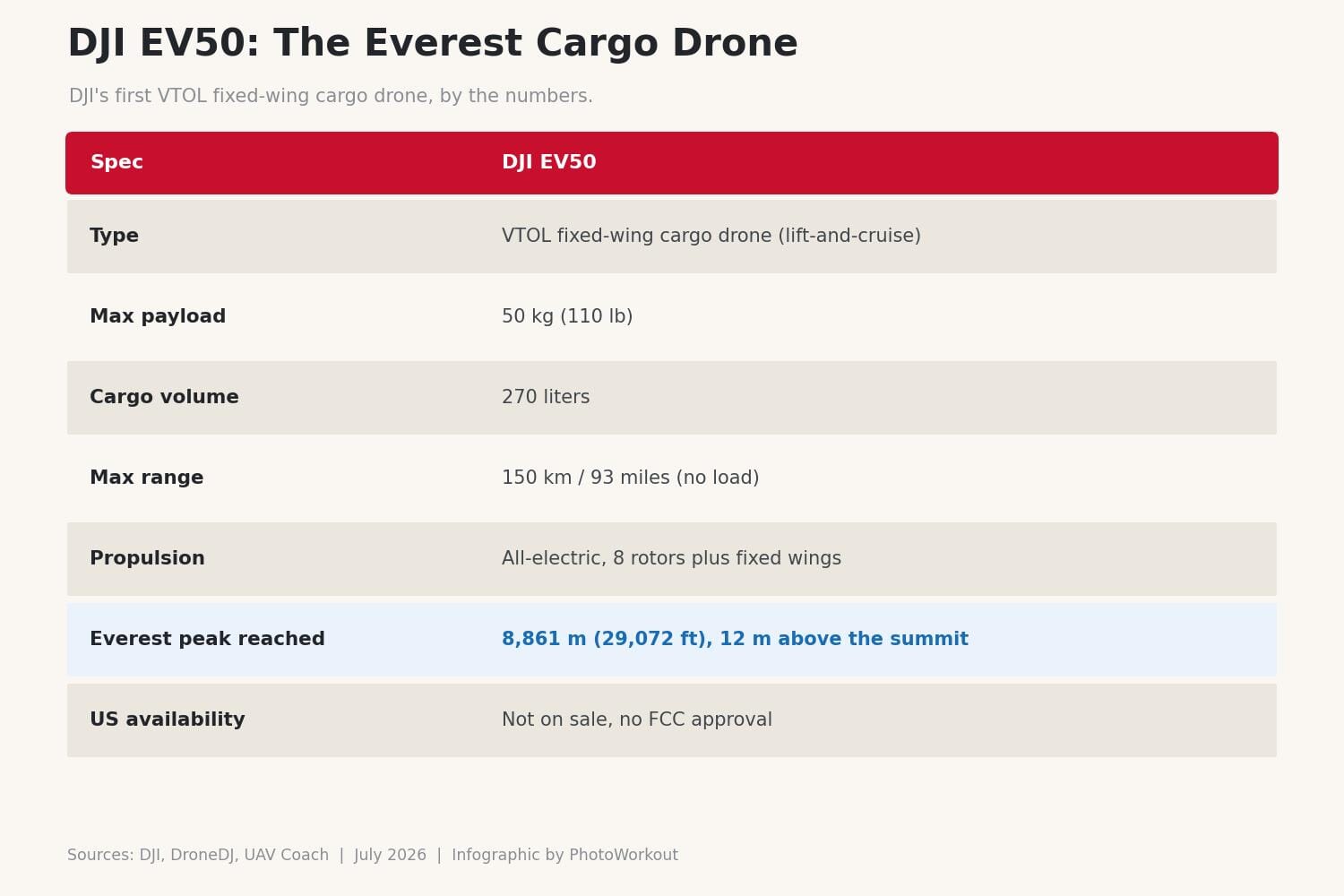
- Key specs: 50 kg (110 lb) payload, a 270-liter cargo bay, and roughly 150 km of range, all-electric with 8 rotors for vertical lift plus fixed wings for efficient cruise.
- It is not an aerial-photography drone and it is not coming to the US (no FCC approval). But it shows where DJI’s high-altitude, all-electric, autonomous flight engineering is heading.
DJI, the company behind most of the camera drones photographers actually fly, just did something very different. It unveiled the EV50, its first vertical-takeoff fixed-wing cargo drone, and it introduced the aircraft with a stunt few companies could pull off: flying it higher than the summit of Mount Everest.
The EV50 is not built for photographers, and it is not going on sale in the US. But the Everest feat, and what it signals about DJI’s engineering ambitions, is worth understanding for anyone who owns one of the company’s aircraft. Here is what was actually announced, verified against DJI’s own materials and independent coverage from DroneDJ and UAV Coach.
What the DJI EV50 Actually Is
The EV50 is a lift-and-cruise aircraft, sometimes called a hybrid VTOL. It takes off and lands vertically using a set of rotors, then transitions to fixed-wing flight and cruises like a small airplane. That combination is the whole point: vertical takeoff means it needs no runway, and fixed-wing cruise means it can carry heavy loads far more efficiently than a multirotor over long distances.
This is a real departure from DJI’s existing cargo drones. The FlyCart line uses a familiar multirotor layout, and DJI’s consumer drones are all quadcopters. The EV50 instead pairs eight rotors for vertical lift with a fixed wing for cruise, carries up to 50 kilograms (110 pounds) in a 270-liter cargo bay, and has a maximum no-load range of about 150 kilometers (93 miles). DJI positions it for emergency response, mountain logistics, island deliveries, and scientific expeditions, the kinds of missions where roads and runways do not exist.
The Everest Record, Explained
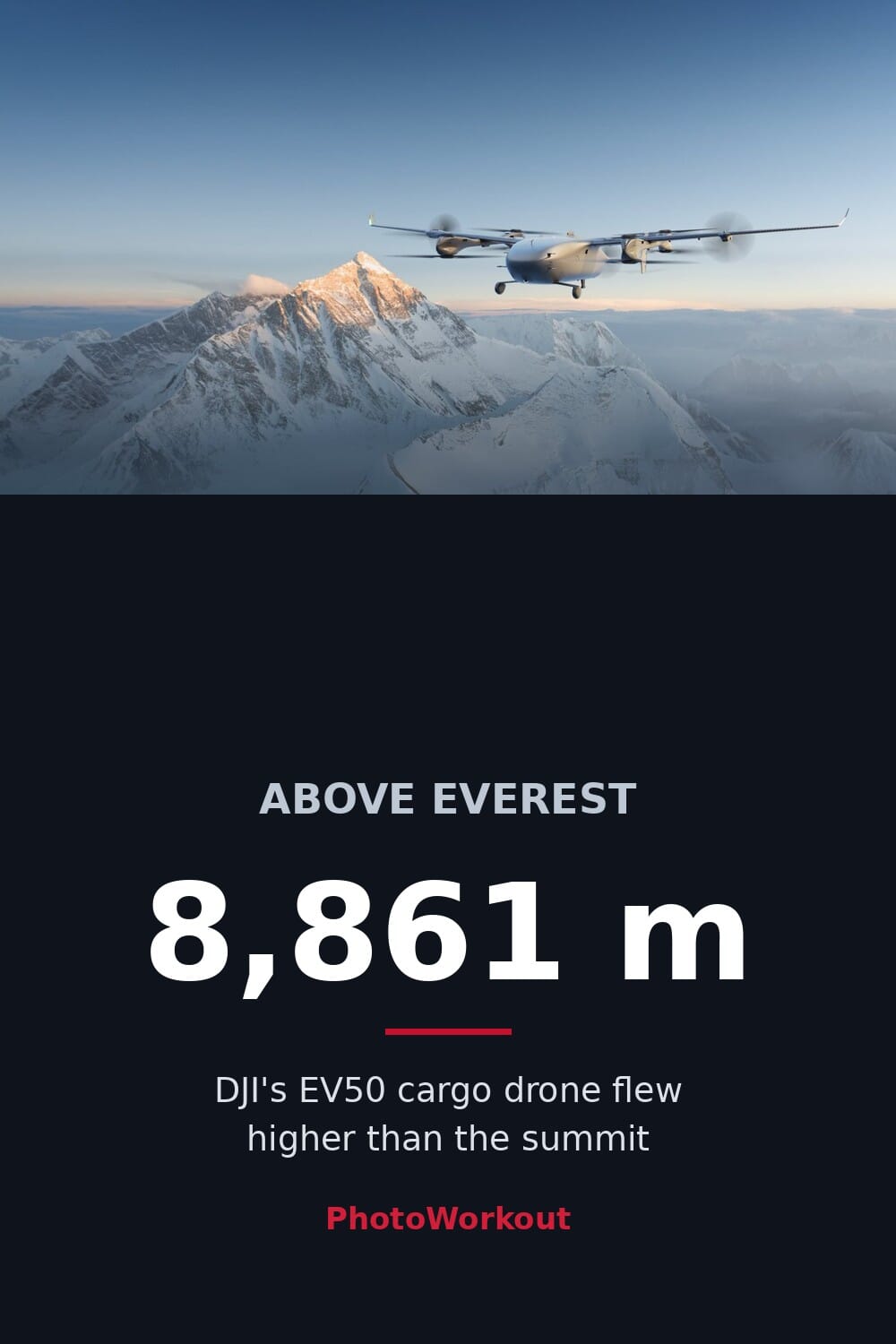
DJI did not just publish a spec sheet. It flew the EV50 to 8,861 meters (29,072 feet) during a scientific expedition in the Qomolangma National Nature Reserve, roughly 12 meters higher than Everest’s summit, which DJI says is a record altitude for a VTOL drone.
Over 12 days the aircraft completed 32 takeoffs and landings, including 12 research flights that carried ozone-measuring and atmospheric monitoring equipment for Peking University. Taking off from Everest Base Camp at 5,200 meters, it climbed as much as 3,730 meters in a single flight to sample the upper troposphere.
The reason an all-electric drone matters here is subtle but important. Scientists have long struggled to collect clean atmospheric samples above 8,000 meters: helicopter exhaust and rotor wash contaminate sensitive instruments, weather balloons cannot be steered, and conventional fixed-wing aircraft need runways that simply do not exist near Everest. Because the EV50 is fully electric, it produces no exhaust, and because it is a steerable VTOL, it needs no runway. According to expedition lead Professor Ye Chunxiang, that let the team observe glacier winds and gather data relevant to climate-change research on the Qinghai-Tibet Plateau.
Why It Is Not a Photography Drone, and Why It Still Matters
To be clear, the EV50 is not for aerial imaging. It has no gimbal camera for creative work, and DroneDJ describes it plainly as a logistics aircraft for emergency response and expeditions rather than photography. Photographers will keep reaching for a Mavic, an Air, or an Avata, not a 50-kilogram cargo hauler.
So why cover it here? Because the engineering underneath is the same well DJI draws from for its camera drones. High-altitude stability in thin air, all-electric endurance, efficient VTOL-to-cruise transitions, and autonomous flight in extreme conditions are exactly the capabilities that trickle down into better, longer-flying, more reliable consumer aircraft. The EV50 is also a clear signal that DJI is diversifying well beyond the camera drones that made its name, into enterprise logistics, agriculture, and now heavy-lift VTOL, a useful thing to understand about the company whose gear dominates most photographers’ kits.
The Catch: It Is Not Coming to the US
There is a familiar asterisk. The EV50 is not on sale in the US and has not received FCC approval. UAV Coach notes that unlike some DJI products that were FCC-approved but simply delayed, the EV50 is unlikely to launch in the US at all.
That fits the broader pattern American drone buyers have watched for two years, from the DJI Osmo Pocket 4’s stalled US launch to the ongoing scrutiny that prompted DJI’s independent security audit. For US pilots, the EV50 is a look at DJI’s cutting edge that they cannot legally buy, another data point in an increasingly split global drone market, where regulation as much as airspace rules now decides what you can fly.
Frequently Asked Questions
How high did the DJI EV50 fly on Everest?
It reached 8,861 meters (29,072 feet), about 12 meters above Everest’s summit, during a 12-day scientific expedition. DJI says that is a record operating altitude for a VTOL drone.
Is the DJI EV50 a photography drone?
No. The EV50 is a cargo and logistics aircraft built to carry payloads like research instruments or supplies, not a camera drone. It has no creative imaging gimbal, and it is aimed at missions such as emergency response, mountain logistics, and scientific work.
Can you buy the DJI EV50 in the US?
No. The EV50 is not on sale in the US and has not received FCC approval, and coverage suggests it is unlikely to launch there at all. Its first deployments are in China.
How much can the DJI EV50 carry, and how far?
It carries up to 50 kilograms (110 pounds) in a 270-liter cargo bay, with a maximum no-load range of about 150 kilometers (93 miles). Range drops as payload increases, as with any aircraft.
What is a VTOL fixed-wing drone?
It is a hybrid design that takes off and lands vertically like a multirotor, then flies forward on fixed wings like an airplane. That lets it operate without a runway while cruising far more efficiently over distance than a quadcopter can.
The Bottom Line
The EV50 will not end up in any photographer’s bag, and most US pilots will never legally own one. But flying a cargo drone above the summit of Everest, on battery power, while gathering climate data no manned aircraft could safely collect, is a genuine engineering milestone, not a marketing gimmick.
It also says something about DJI in 2026: a company still synonymous with camera drones is now building heavy-lift VTOL aircraft for science and logistics, and doing it at altitudes that push the limits of electric flight. That ambition is what eventually makes the drones photographers do buy better, even when the headline aircraft is one they never will.
Primary Coverage
- TechNode: DJI launches first VTOL fixed-wing cargo drone EV50, says it set Everest altitude record – Announcement details, expedition flight count, and the researcher's account
- DroneDJ: DJI's first eVTOL drone debuts where few aircraft can fly – Confirmed specs (payload, cargo volume, range) and the atmospheric-research context
- UAV Coach: DJI Unveils First eVTOL Cargo Drone in Dramatic Everest Debut – Payload and range in imperial units, plus the US availability and FCC status
Image Sources
- DJI EV50 press image (featured) – Official DJI promotional image of the EV50 in flight over the Everest massif
- Specs infographic and Everest-altitude pin: PhotoWorkout illustrations – Editorial graphics by PhotoWorkout, drone photo by DJI