


- The FTC granted early termination of the antitrust waiting period for Adobe’s acquisition of Topaz Labs, confirmed by Adobe on July 29, 2026. In plain terms, US regulators are not challenging the deal, and its biggest hurdle just cleared.
- This clears the path for the last major independent AI upscale, denoise, and restore house (Gigapixel, Photo AI, Video AI, DeNoise, Sharpen) to fold into Adobe’s Firefly and Creative Cloud. The deal was announced June 25 and is targeted to close in the second half of 2026.
- If you own a Topaz perpetual license, the software you paid for keeps working, and your upscaled or denoised files are yours with no lock-in. That part does not change.
- What is uncertain is the product’s independent future: continued standalone sales, new model updates, and long-term OS and GPU compatibility. Adobe’s incentive is to steer users toward Creative Cloud over time.
- Nothing changes overnight. If you have been eyeing Topaz, the choice is to buy now and lock a perpetual key, or wait for Adobe’s post-close roadmap. Either way, keep a backup of your current installers.
When Adobe announced it was buying Topaz Labs in June, plenty of photographers who had quietly built their editing around Topaz as an escape hatch from Creative Cloud felt the floor shift. The obvious question was whether regulators would let it happen. Now we have the answer, and it came fast.
On July 29, 2026, Adobe confirmed the US Federal Trade Commission granted early termination of the antitrust waiting period for the Topaz acquisition. That is regulator-speak for “we are not going to fight this,” and it removes the single biggest obstacle to the deal closing. We covered the acquisition itself when it was announced; this is the sequel that actually matters to you, because it turns a headline into a decision about the Topaz license sitting on your machine.
What the FTC Just Did
Under US law, deals above a certain size trigger a mandatory waiting period so the FTC and Department of Justice can review them for antitrust concerns. “Early termination” means the agency ended that waiting period ahead of schedule, with no second request for information and no move to block. It is the cleanest possible regulatory outcome for a buyer, and markets read it that way: Adobe stock jumped around 6% on the news, near two-month highs.
The timeline is quick. Adobe announced the definitive agreement to acquire Topaz on June 25, the FTC clearance landed just over a month later, and the deal is targeted to close in the second half of 2026. Regulatory approval is the hurdle that most often drags out or kills a tech acquisition, so clearing it this early strongly signals the deal is going through.
What Adobe Is Actually Buying
Topaz Labs is not just another plugin maker. It is a bootstrapped, Emmy-winning AI company whose tools, Gigapixel for upscaling, Photo AI for all-in-one enhancement, Video AI for footage, plus the older DeNoise and Sharpen apps, became the reference standard for AI image and video enhancement. Crucially, they sold largely as standalone software with perpetual licenses, which made Topaz the default answer for photographers who wanted best-in-class AI tools without another monthly subscription. We put its API through its paces in our hands-on Topaz testing, and the quality is the reason it built such a loyal base.
That is exactly why this deal lands the way it does. Topaz was, for a lot of people, the last major independent house in AI upscale, denoise, and restore. Adobe folding it into Firefly and Creative Cloud removes the most credible alternative to Adobe’s own AI stack. Topaz CEO Eric Yang is set to keep leading the team as a division inside Adobe, and Adobe has said standalone Topaz products remain accessible to current users. That reassurance is real, but it is also exactly the kind of language that tends to soften over the years after a close.
What Happens to Your Standalone Topaz License
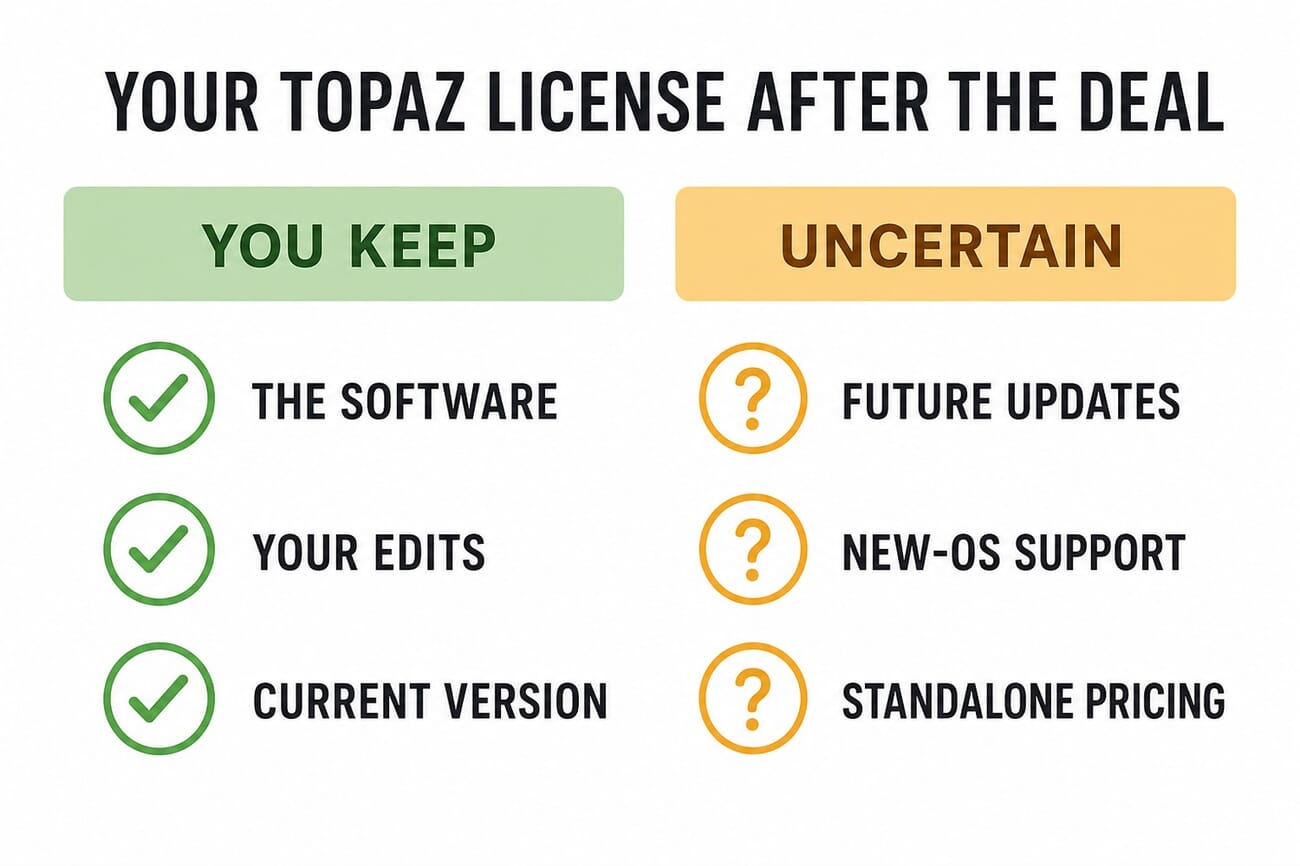
Here is the part no stock-market story will tell you, and the reason this is a PhotoWorkout piece. Topaz sells perpetual licenses: you pay once, you own that version forever, and you typically get a year of updates included. So the reassuring truth first: an acquisition does not switch off software you already bought. Your installed Gigapixel or Photo AI keeps running, your license key stays valid, and every file you have already upscaled or cleaned up is yours to keep with zero lock-in. Nobody can reach into your drive and take that away.
The honest caveats are about the future, not the present. A perpetual license guarantees the version you own, not a lifetime of improvement. After the close, the open questions are whether Adobe keeps selling Topaz as standalone software at all, whether new AI models and features keep flowing to the standalone apps or get reserved for Firefly and Creative Cloud, and whether the apps keep pace with new operating systems and GPUs over the next several years. Adobe’s commercial incentive is to move people into Creative Cloud, and history across the industry says standalone perpetual products usually get deprioritized once a subscription giant owns them. Your key will still open the last standalone build; it just may stop gaining ground.
Your Move: Buy, Hold, or Wait
If you already own Topaz licenses: do nothing urgent. They keep working. The one sensible bit of housekeeping is to download and archive the installers for your current versions, so a future Adobe decision to pull standalone downloads cannot strand you without a way to reinstall the software you paid for.
If you have been considering Topaz: there are two defensible plays. Buy now to lock in a perpetual key at today’s terms, before any pricing change or shift to subscription at close, which is the move if you want to own the tool outright. Or wait a few months to see Adobe’s roadmap, which is the move if you already pay for Creative Cloud and might get comparable enhancement baked in, making a separate purchase redundant.
If you were using Topaz to avoid Adobe entirely: this is the uncomfortable one. Your current tools still work, but your independent path just got narrower. It is worth knowing your alternatives, and we mapped a full one in our guide to the free stack that can replace Creative Cloud.
The Bigger Picture: One Fewer Exit Ramp
Step back and this is a consolidation story. The AI-enhancement space had a clear independent leader that a lot of photographers used precisely because it was not Adobe. With regulators standing aside, that leader is about to become part of Adobe. Less competition rarely means better pricing or more generous licensing for users, and it lands amid a running current of subscription fatigue that has photographers actively hunting for ways out of the Adobe ecosystem.
None of that is a reason to panic about the software on your machine today. It is a reason to be deliberate: know what your license actually guarantees, back up what you own, and make your buy-or-wait call with clear eyes rather than in reaction to a headline.
Frequently Asked Questions
Is the Adobe acquisition of Topaz Labs final?
Not yet closed, but very likely to complete. Adobe announced the definitive agreement on June 25, 2026, and the FTC granted early termination of the antitrust review on July 29, removing the biggest regulatory hurdle. The deal is targeted to close in the second half of 2026.
Will my Topaz perpetual license stop working after the deal?
No. A perpetual license means you own the version you bought, and an acquisition does not disable installed software. Your Topaz apps keep running and your existing edits are yours. What is not guaranteed is future updates, standalone availability, and long-term OS compatibility.
Should I buy Topaz now or wait?
Buy now if you want to own a perpetual license at today’s terms before any pricing or subscription changes at close. Wait if you already pay for Creative Cloud and expect comparable AI enhancement to be built in, which could make a separate purchase unnecessary. Either way, nothing changes immediately.
What is Adobe getting from Topaz?
Topaz’s AI enhancement models, including Gigapixel upscaling, Photo AI, and Video AI, which Adobe plans to bring into Firefly and Creative Cloud. Topaz was the leading independent AI upscale, denoise, and restore house, so the deal both adds strong technology and removes a key competitor.
The Bottom Line
The FTC stepping aside all but confirms Adobe will absorb the most important independent name in AI enhancement. For your wallet and your workflow, the takeaway is calm and specific: the Topaz software you already own keeps working and your files are safe, but the product’s independent future is now Adobe’s to decide. Back up your installers, know exactly what your perpetual license does and does not guarantee, and make any buy-or-wait decision on your own timeline. We will update this when the deal formally closes and Adobe details what happens to the standalone apps.
Featured image, license infographic, and pin: stylized illustrations created by PhotoWorkout. No Adobe or Topaz branding is used.
Reporting
- Seeking Alpha – Adobe receives early termination notice from FTC for Topaz acquisition – The July 29 FTC early-termination confirmation.
- Yahoo Finance – ADBE stock at near two-month highs after FTC grants early approval – Market reaction and deal context.
- US FTC – Early Termination Notices (HSR review) – What early termination of the antitrust waiting period means.
Image Sources
- Featured image, Topaz-license infographic, and vertical pin, created by PhotoWorkout – Editorial illustrations, no brand marks used.