


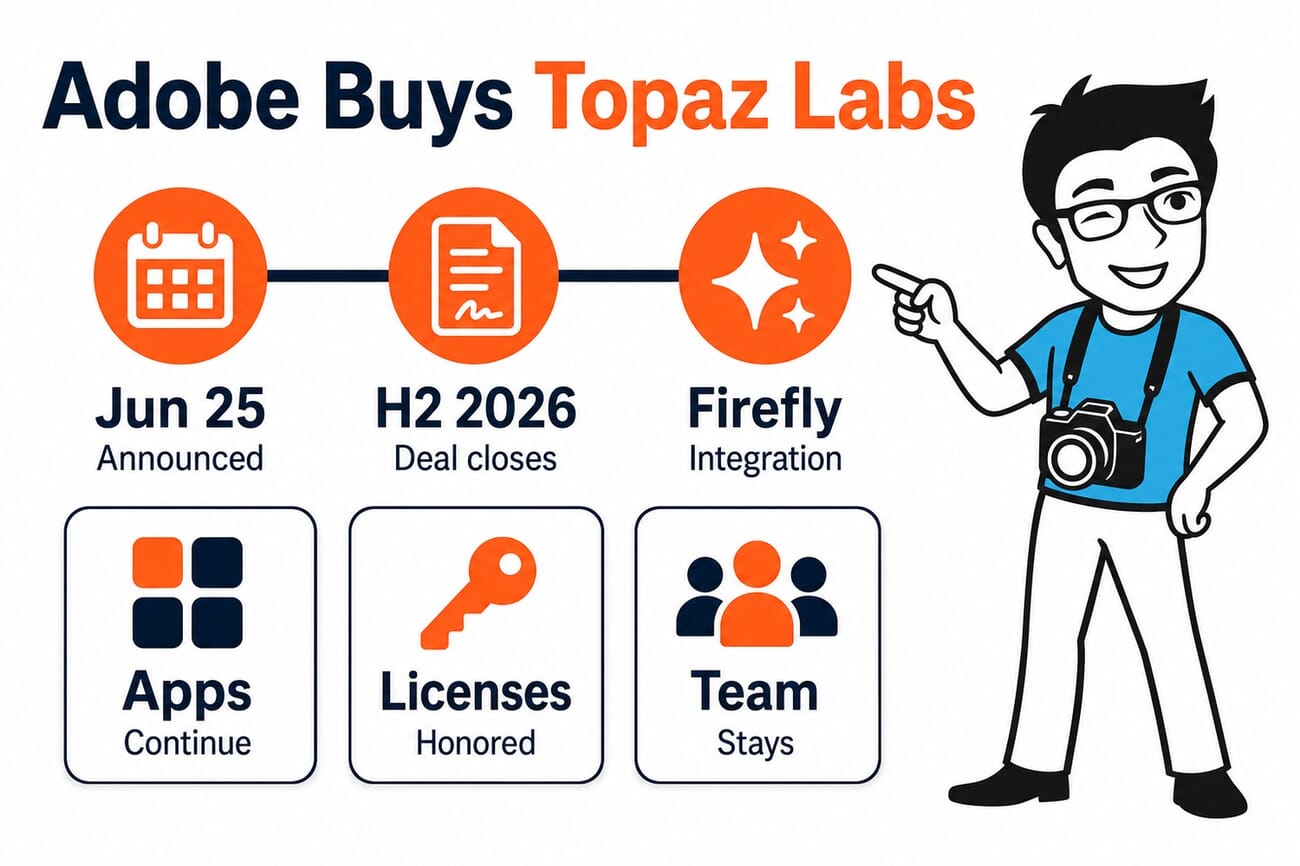
- Adobe signed a definitive agreement on June 25, 2026 to acquire Topaz Labs, the Dallas company behind Gigapixel, Topaz Photo, and Topaz Video. The deal is expected to close in the second half of 2026.
- Topaz apps will continue as standalone products, existing perpetual licenses stay valid, and CEO Eric Yang will keep leading the team inside Adobe.
- The real prize is the models: Topaz upscaling, denoising, sharpening, and restoration tech (plus NeuroStream) folds into Firefly, Firefly Services, and Creative Cloud apps.
- The buy-once escape hatch was already closing. Topaz moved to subscription-only pricing in October 2025. Independent alternatives now: DxO PureRAW, ON1, and the open-source Upscayl.
The biggest independent name in AI photo enhancement is independent no more. On June 25, 2026, Adobe announced a definitive agreement to acquire Topaz Labs, the Dallas-based company behind Gigapixel, Topaz Photo, and Topaz Video.
Most coverage has treated this as another line in Adobe’s AI shopping list. That undersells it. Topaz was the tool photographers bought specifically to stay outside the Creative Cloud subscription, and its upscaling and denoising models have been the benchmark that Lightroom and Photoshop features get measured against. Now those models are becoming Adobe features.
Here is what was actually announced, what happens to the apps and licenses you may already own, and where the independent alternatives stand.
The Deal: What Adobe Actually Bought
The core facts, straight from Adobe’s announcement: the agreement is signed but not closed, with completion expected in the second half of 2026. Financial terms were not disclosed. Topaz CEO Eric Yang will continue to lead the team, and the Topaz apps will remain available as standalone products on the Topaz Labs website.
What Adobe is really buying is the model portfolio. Topaz has spent two decades building AI models for upscaling, sharpening, stabilization, frame interpolation, noise removal, and footage restoration. That work won the company a Technology & Engineering Emmy in December 2025 for its TV catalog restoration technology. Adobe says those models will be integrated across Firefly, Firefly Services, and Creative Cloud apps including Photoshop, Lightroom, and Premiere.
Also along for the ride: NeuroStream, the VRAM-compression technology Topaz shipped in April that cuts GPU memory use by up to 95 percent. That tech matters more than it sounds. It is what lets heavyweight enhancement models run on ordinary consumer laptops, and it slots directly into Adobe’s recent push toward on-device AI. PhotoWorkout covered the six new models and NeuroStream in detail in the April Topaz release.
Why Adobe Wanted the Biggest Indie in AI Enhancement
Adobe’s stated logic is the hybrid workflow. Creators increasingly mix real captured photos and footage with AI-generated content, and everything has to be delivered at high quality across formats. Enhancement models that sharpen, denoise, and upscale are the glue in that pipeline, and Topaz makes the best ones on the market.
The quieter logic is that Adobe was already licensing the competition it just bought. The June Creative Cloud update added a Noise-Aware Sharpen feature to Lightroom that was powered by a Topaz model, something PhotoWorkout flagged in its June on-device AI coverage. Photoshop’s Generative Upscale, meanwhile, has spent the past year being unfavorably compared to Gigapixel in side-by-side tests. Buying Topaz turns Adobe’s most awkward comparison into a feature list.

There is also a defensive read. Enhancement quality has become a genuine battleground: Capture One shipped its own AI denoise this spring, DxO keeps iterating PureRAW, and AI-native editors keep undercutting on price. Owning the Emmy-winning model stack takes the strongest independent piece off the board before a competitor could grab it.
What Happens to Your Topaz Apps and Licenses
The short version for existing users: nothing changes today, and the paper trail is reassuring on the medium term. Adobe says the standalone apps continue after the close. Topaz has emailed customers confirming that existing perpetual licenses remain valid “throughout and after the transition,” and the apps keep getting updates in the meantime.
The uncomfortable context is that the one-time-purchase era at Topaz ended before Adobe ever showed up. In October 2025, Topaz consolidated its products into Topaz Studio and moved to subscription-only pricing. Owners of older perpetual licenses kept access to what they bought, with maintenance fixes but no new models. Anyone who joined after that date was already renting. PhotoWorkout’s Topaz Photo Pro review covers how the current tiers shake out.
So the honest framing is not “Adobe is taking away your buy-once software.” It is that the industry’s most prominent buy-once holdout had already switched sides, and the acquisition makes the move permanent. If a perpetual license mattered to you, the practical advice is unchanged since October: your existing license keeps working, but the upgrade path now runs through a subscription, and after the close it runs through a company whose entire business model is subscriptions.
Two open questions Adobe has not answered yet: whether Topaz subscriptions eventually merge into Creative Cloud plans, and whether the standalone apps survive long term or quietly wind down once the models live inside Photoshop, Lightroom, and Premiere. Adobe’s track record with acquired standalone products (Frame.io still exists, Fotolia did not) cuts both ways.
The Consolidation Problem, and Who Is Left Standing
Zoom out and the market-structure story is stark. Five years ago, a photographer who wanted best-in-class upscaling or denoising had a half-dozen credible independent options. The strongest of them is now Adobe. This is the same consolidation pattern playing out across creative software, and it lands on a community that was already restless: subscription fatigue is one of the most reliable applause lines in photography forums, and the grassroots momentum behind open-source editors like RapidRAW exists precisely because people want capable tools that nobody can acquire.
The good news is that the independent bench is deeper in enhancement than in most categories. For upscaling, DxO, ON1, and the free open-source Upscayl all remain independent; the full field is compared in PhotoWorkout’s photo enlargement software roundup. For noise reduction, DxO PureRAW and ON1 NoNoise AI headline the noise reduction guide, and Capture One’s new built-in Enhanced Denoise gets a three-way test against Lightroom and Topaz in this comparison.
None of those alternatives beats Topaz across the board. That is exactly why Adobe paid for it. But if the reason you ran Topaz was independence from Adobe rather than raw model quality, those are the names to evaluate before your next renewal.
What Topaz Users Should Do Before the Close
Nothing here is urgent, but a little housekeeping between now and the second half of 2026 costs five minutes and removes all the downside scenarios.
- Archive your installers and license keys. Download the current installers for every Topaz version you own and store them with your license emails. Perpetual licenses are being honored, but a downloaded installer answers to nobody.
- Check your renewal date against the deal timeline. If your Topaz subscription renews after the expected close, you will be renewing with Adobe. That is not automatically bad, but it should be a decision, not a default.
- Trial the independents before you need them. DxO PureRAW, ON1, and Upscayl all have free trials or are free outright. Knowing which one fits your workflow is cheap insurance.
- Watch for account-migration emails. Acquired products usually move to the buyer’s account system eventually. Real notices will come from Topaz or Adobe domains; acquisition windows are also prime time for phishing.
Frequently Asked Questions
Is Topaz Labs shutting down its apps?
No. Adobe says Gigapixel, Topaz Photo, and Topaz Video remain available as standalone products on the Topaz Labs website, and the Topaz team continues under CEO Eric Yang. Whether that remains true years after the close is an open question, but nothing is being discontinued now.
Will my perpetual Topaz license keep working?
Yes. Topaz has told customers directly that existing perpetual licenses remain valid throughout and after the transition. What you bought keeps working; it just stopped receiving new AI models when Topaz moved to subscriptions in October 2025.
Do you need a Creative Cloud subscription to use Topaz now?
No. Topaz subscriptions are still sold separately on the Topaz site, and Adobe has not announced any bundling. If the products do eventually merge into Creative Cloud plans, that would come after the deal closes in the second half of 2026.
When will Topaz features show up inside Photoshop and Lightroom?
Some already have: Lightroom’s June 2026 update shipped a Topaz-powered Noise-Aware Sharpen. Deeper integration into Firefly, Photoshop, Lightroom, and Premiere is planned after the acquisition closes, so expect the bigger wave of Topaz-branded quality inside Adobe apps from late 2026 into 2027.
The Bottom Line
For Adobe, this is a clean win: the best enhancement models in the business, an Emmy on the shelf, and NeuroStream’s on-device efficiency, all folded into Firefly right as hybrid AI workflows become the norm.
For photographers, it is more mixed. Topaz users get continuity now and probably better integration later. But the market just lost its strongest independent, and everyone who kept a Topaz license around as their exit ramp from Adobe now needs a new plan. The alternatives exist. There are simply fewer of them every year.
Primary Coverage
- Adobe Newsroom: Adobe to Acquire Topaz Labs – Official announcement, June 25, 2026, with deal structure and integration plans
- PetaPixel: Adobe Acquires AI Upscaling Specialists Topaz Labs – Coverage confirming standalone apps continue and Eric Yang stays on
- TechCrunch: Adobe acquires image and video enhancement tool maker Topaz Labs – Reports the expected H2 2026 close and Creative Cloud integration
License Background
- CG Channel: Topaz Labs to end perpetual licenses of its software – The October 2025 move to subscription-only pricing that predates the acquisition
Image Sources
- Adobe: official announcement graphic (featured image) – Adobe and Topaz Labs announcement artwork from the Adobe Newsroom
- Concert before/after: PhotoWorkout editorial test image – Denoising comparison produced during PhotoWorkout's hands-on Topaz Photo Pro review
- Deal timeline infographic: stylized PhotoWorkout illustration – Editorial infographic created by PhotoWorkout
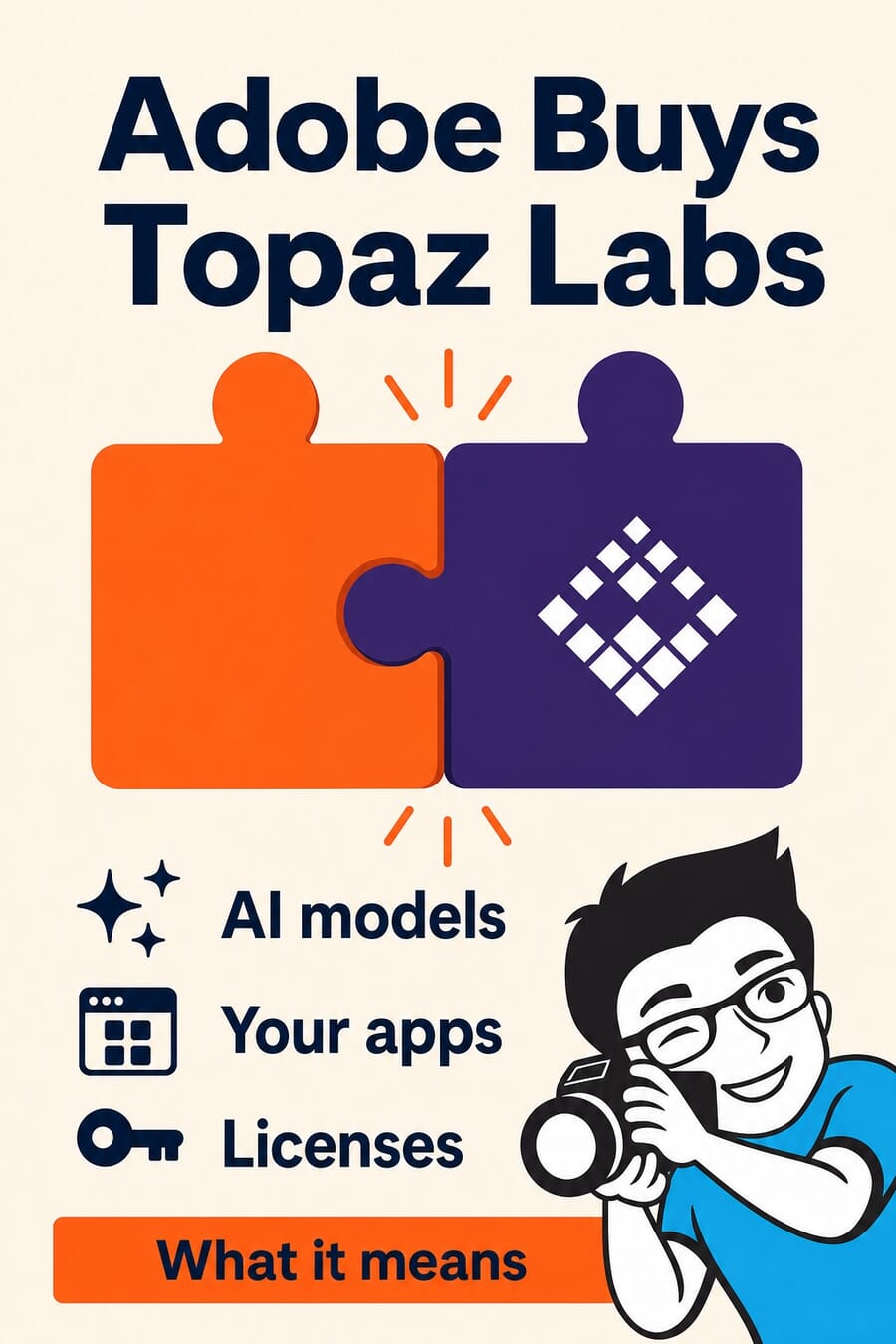
- Vertical pin graphic: stylized PhotoWorkout illustration – Editorial pin image created by PhotoWorkout