


- Most photography magazines now accept submissions through online portals — emailing JPEGs to editors is largely a thing of the past.
- Beyond print magazines, platforms like LensCulture, Feature Shoot, and 1x.com offer serious exposure and editorial credibility.
- Photography competitions (Sony World Photography Awards, WNPA) are an alternative path to recognition and publication.
- Prepare a tight, cohesive portfolio of 10–20 images rather than sending everything — editors reject scattershot submissions.
- If you used AI editing tools, disclose it — most competitions and an increasing number of publications now require transparency about AI-assisted work.
- Test your knowledge with the photo submission quiz at the end of this guide.
Why Getting Published Still Matters
Social media makes it easy to share photos with the world. Instagram, Flickr, and 500px give every photographer a global audience. So why bother submitting to magazines at all?
Because editorial publication carries weight that social media cannot replicate. A feature in a respected photography magazine signals that an editor — someone with professional standards and industry knowledge — selected your work from hundreds or thousands of submissions. That kind of third-party validation opens doors to gallery exhibitions, book deals, commercial assignments, and teaching opportunities.
Publication also builds a verifiable track record. When a client or gallery asks about your credentials, “published in LensCulture” or “featured in Outdoor Photographer” carries more weight than follower counts. And unlike social media posts that disappear into algorithmic feeds within hours, magazine features become permanent portfolio credits.
The submission landscape has shifted significantly in recent years. Many print magazines have moved online or adopted hybrid models. Online submission portals have replaced the old process of mailing prints or emailing ZIP files. And Instagram has become a discovery channel where editors actively scout new talent.
This guide covers the full spectrum of where and how to submit photos for publication — from traditional print magazines to online platforms, competitions, and social media discovery.
Where to Submit Your Photos
Traditional Print Magazines
Print magazines remain the gold standard for photography publication. While many have reduced their print runs or shifted to digital-first models, the editorial rigor hasn’t changed — getting accepted is still a mark of quality.
National Geographic accepts unsolicited submissions through its website and remains the most prestigious photography publication in the world. Competition is fierce — the magazine receives thousands of submissions monthly — but features in National Geographic are career-defining.
Outdoor Photographer focuses on landscape, wildlife, and adventure photography. Their submission guidelines are detailed and regularly updated on their website. Digital Camera World and Practical Photography accept reader submissions for featured galleries and technique showcases.
F-Stop Magazine is a fine art photography publication that runs themed open calls throughout the year. Submissions are free, and each issue focuses on a specific visual theme — making it approachable for emerging photographers with a focused body of work.
Other magazines worth researching: Black+White Photography, Aperture, British Journal of Photography, Lens Magazine, and PHmuseum.
Online Photography Platforms
Online platforms have become the most accessible route to editorial publication. Many of these operate like digital magazines — curated by editors, not algorithms — and carry genuine industry credibility.
LensCulture is one of the most influential online photography platforms. Their open calls cover everything from street photography to conceptual art. Submission fees typically range from $10–$60 depending on the call, but the exposure is significant — LensCulture features are frequently noticed by galleries, book publishers, and festival curators.
Feature Shoot highlights emerging and established photographers through daily editorial features. Submissions are free and reviewed by their editorial team. 1x.com operates as a curated photography gallery where every image is reviewed by a panel before publication.
Booooooom, Ignant, and Colossal feature photography alongside other visual arts. These platforms tend to favor conceptual, documentary, and fine art work over commercial or stock-style images.
Photo Contests and Competitions
Photography competitions offer another path to publication and recognition. Winners and finalists are typically published in catalogs, exhibited at galleries, and covered by photography media.
The Sony World Photography Awards is one of the largest and most prestigious competitions, drawing over 400,000 entries from 200+ countries annually. Categories span Professional, Open, Student, and Youth divisions. Entry is free for the Open and Youth categories.
The World Nature Photography Awards focuses on wildlife and environmental photography with themed categories. The International Photography Awards (IPA), Prix Pictet, and Taylor Wessing Photographic Portrait Prize are other major competitions worth tracking.
Be cautious about entry fees. Reputable competitions charge modest fees ($10–$50) or nothing at all. If a contest charges hundreds of dollars or retains rights to your images, that’s a red flag.
Social Media as a Discovery Channel
Instagram has become a primary discovery channel for photography editors and curators. Many magazine editors actively browse hashtags and follow emerging photographers. Being featured on editorial Instagram accounts like @natgeo, @magnumphotos, or @lensculture can lead directly to publication opportunities.
This doesn’t mean posting random images with popular hashtags. What works is building a cohesive, high-quality feed that demonstrates a clear visual storytelling approach. Editors look for photographers with a distinctive point of view, not just technically competent images.
Tag publications in relevant posts, use their submission hashtags (many magazines have specific tags for submissions), and engage genuinely with the photography community rather than using follow/unfollow tactics.
How to Prepare Your Submission
Curate Your Portfolio
The most common mistake in magazine submissions is sending too many images — or the wrong mix of images. Editors want to see a focused body of work, not a greatest-hits compilation spanning every genre.
Select 10–20 of your strongest images that share a cohesive theme, style, or narrative. A submission of 12 landscape photographs from the same region, shot with a consistent approach, is far more compelling than 30 unrelated images covering portraits, street, and wildlife.
Ask yourself: would these images work as a series hanging on a gallery wall? If not, keep editing down. Every image in the submission should be strong enough to stand on its own — one weak photo weakens the entire set.
Editing Standards
Magazine-quality photos need professional-level post-processing. That doesn’t mean heavy manipulation — it means careful attention to exposure, color accuracy, sharpening, and noise reduction. Photos should look polished but natural.
Process your images in a professional editor like Lightroom or Photoshop. Pay close attention to white balance, skin tones (for portraits), and shadow detail. Over-processed HDR effects, excessive saturation, and heavy vignetting will get your submission rejected immediately.
For a thorough walkthrough of professional editing techniques, see the complete guide to editing photos.
Technical Requirements
Most publications specify exact technical requirements. Common standards include:
- File format: TIFF or high-quality JPEG (quality 10–12 in Photoshop, 90–100% in Lightroom)
- Color space: sRGB for web publications, Adobe RGB for print
- Resolution: 300 DPI at the intended print size (minimum 3000px on the long edge for most magazines)
- File size: Typically 5–50 MB per image depending on the publication
- Naming convention: LastName_Title_01.jpg (or as specified in guidelines)
Always read the submission guidelines carefully. Sending files in the wrong format or size signals that you didn’t do your homework — and gives editors an easy reason to skip your work.
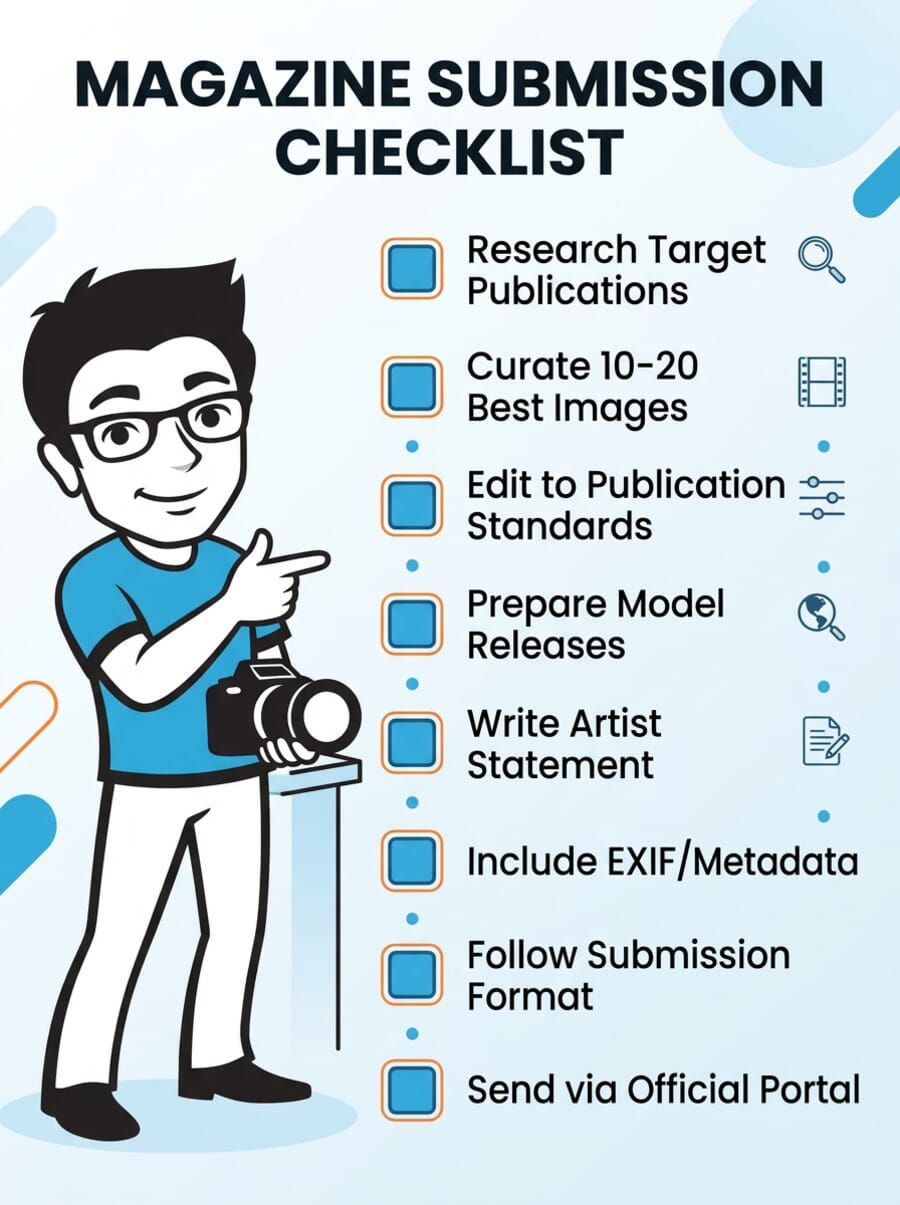
The Submission Process
Online Submission Portals
Most magazines and competitions now use dedicated submission platforms. Picter, Submittable, PhotoShelter, and WeTransfer are among the most commonly used. Some publications have their own custom portals.
Create accounts on these platforms early, well before your first submission. Fill out your profile completely — editors often check your profile and linked portfolio before reviewing images.
When uploading through portals, double-check that your images rendered correctly after upload. Some platforms compress files, which can introduce artifacts. If the platform supports it, include a brief project description or artist statement with your submission.
Model Releases and Legal Requirements
If your photos include recognizable people, magazines will ask about model releases. Editorial publications (news, documentary, fine art) generally don’t require releases for editorial use, but commercial publications do.
Best practice: get model releases whenever possible, even for editorial work. It expands the potential uses of your images and shows professionalism. Standard model release templates are available from organizations like the American Society of Media Photographers (ASMP).
Property releases may also be required for recognizable private buildings, branded products, or artwork visible in your images.
Metadata and EXIF Data
Embed proper metadata in your files before submitting. This includes your name, copyright notice, contact information, image title, and caption. Most photo editors (Lightroom, Capture One, Photo Mechanic) make this straightforward.
Some photographers strip EXIF data from submissions out of habit. Don’t — many editors appreciate seeing technical details, and some publications print EXIF data alongside featured images. For a deeper understanding of what metadata contains and how to manage it, read the guide on EXIF data and image metadata.
Writing an Artist Statement
Many submissions require a brief artist statement or project description. This is not a biography — it’s a concise explanation of what the project is about, what motivated the work, and what you hope the viewer takes away.
Keep it to 150–300 words. Avoid art-world jargon and pretentious language. The best artist statements are clear, specific, and honest. Explain the “why” behind the work — not a technical breakdown of how it was shot.
AI Editing Disclosure
AI-assisted editing has introduced new disclosure requirements across the photography industry. This is one of the most rapidly evolving areas of photo submission — and getting it wrong can end a career.
Photography competitions have the strictest policies. The Sony World Photography Awards, Wildlife Photographer of the Year, and most other major contests either ban AI-generated content entirely or require full disclosure of AI-assisted editing. The 2023 controversy — where Boris Eldagsen withdrew after winning with an AI-generated image — prompted most major competitions to update their rules.
What typically requires disclosure:
- AI-powered sky replacement or object removal (beyond basic clone/heal)
- Generative fill to extend or modify image content
- AI upscaling beyond the camera’s native resolution
- AI-generated composite elements added to photographs
What generally doesn’t require disclosure:
- Standard noise reduction (including AI-powered tools like DxO DeepPRIME)
- AI-assisted lens corrections and sharpening
- Auto white balance and exposure adjustments
- AI-powered culling and selection tools
The safest approach: when in doubt, disclose. Include a brief note about your editing workflow with any submission. Transparency builds trust, and editors respect photographers who are upfront about their process.
Some publications are now adopting the C2PA Content Credentials standard, which embeds a verifiable edit history into image files. This may become a standard requirement in the coming years.
Common Mistakes to Avoid
After reviewing thousands of submissions, photo editors consistently flag the same errors. Avoid these to improve your chances:
Ignoring submission guidelines. Every publication has specific requirements for file formats, image counts, and submission methods. Sending 50 images when the guidelines say 10–15 signals that you didn’t read the instructions. Editors often reject non-conforming submissions without looking at the images.
Submitting work that doesn’t fit the publication. Research the magazine before submitting. Look at recent issues. Understand their aesthetic, their audience, and the types of photography they publish. Sending wildlife images to a fashion magazine wastes everyone’s time.
Over-editing or heavy watermarking. Excessive HDR, oversaturated colors, and heavy-handed retouching are immediate disqualifiers for most editorial publications. Watermarks should never appear on submissions — they signal distrust and make images impossible to evaluate properly.
Sending simultaneous exclusives. If a magazine requests exclusive rights to publish certain images, don’t submit those same images elsewhere at the same time. This is a small industry — editors talk to each other.
No follow-up or excessive follow-up. If you don’t hear back within the stated review period, a single polite follow-up email is appropriate. Do not send weekly emails, message editors on social media, or call the office. Patience is part of the process — most magazines receive far more submissions than they can respond to.
Neglecting your online presence. Editors will search for you online after reviewing your submission. Make sure you have a professional photography portfolio website that showcases your best work, includes a bio, and provides clear contact information.
Test Your Knowledge: Photo Submission Quiz
Think you’re ready to submit your photos to a magazine? Take this quick quiz to test your understanding of the submission process, editorial standards, and common pitfalls.
Featured image: Photo by Alberto Bigoni on Unsplash.
Do photography magazines pay for published photos?
It varies widely. Some established print magazines pay per image or per feature — rates can range from $50 to $500+ depending on the publication and usage rights. Many online platforms and smaller magazines offer exposure rather than payment. Always clarify compensation terms before signing any agreement.
How long does it typically take to hear back after submitting?
Response times range from two weeks to six months, depending on the publication. Some magazines only respond to accepted submissions. If the guidelines state a specific review period, wait until that period has passed before following up with a single polite inquiry.
Can I submit the same photos to multiple magazines at once?
Generally yes, unless a publication specifically requests exclusive submissions. Most photographers submit to multiple outlets simultaneously. However, if a magazine accepts your work and requests first publication rights, withdraw the images from other submissions promptly.
Do I need a photography degree to get published in magazines?
No. Editors evaluate images on their merit, not the photographer’s credentials. Self-taught photographers are regularly published in major magazines and win international competitions. A strong, cohesive body of work matters far more than formal education.
Should I include EXIF data with my magazine submissions?
Yes, unless specifically told otherwise. Many editors appreciate seeing technical details like camera, lens, focal length, and exposure settings. Some publications print EXIF data alongside featured images. Embed your name, copyright, and contact info in the metadata as well.
Are there free ways to get my photography published?
Many reputable outlets accept free submissions. F-Stop Magazine, Feature Shoot, and the Open category of the Sony World Photography Awards are all free to enter. Social media platforms like Instagram also function as discovery channels where editors find new talent without any submission fees.