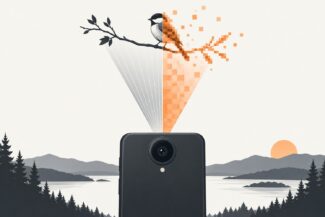

- Vivo’s X500 Pro Max went global on October 27 (open sales November 5) with the most optical-first zoom system on any phone: a 200MP ZEISS APO periscope telephoto with CIPA 7.0-rated stabilization, plus a clip-on ZEISS Telephoto Extender Gen 2 Ultra that reaches a real 400mm equivalent through glass, not algorithms.
- The timing makes it a statement. The 2026 memory crisis is pushing rivals to cut telephoto hardware and rebuild zoom with on-device AI. Vivo is spending its budget in the opposite direction: a Sony LOFIC main sensor with roughly 17 stops of dynamic range, bigger telephoto silicon, and bolt-on optics.
- It is not a US story: no US or UK launch. Europe gets it from 1,499 euros (about $1,740) for 12/256, with the 1TB photography-kit bundle at 2,199 euros; China starts at CNY 6,999 (about $1,040).
- One honest caveat: real glass does not mean untouched photos. Engadget’s hands-on still found AI-processing artifacts in text and faces at extreme zoom, and DXOMark has not scored the camera yet. The hardware direction is the news, not a quality verdict.
Three weeks ago, PhotoWorkout asked an uncomfortable question about where phone zoom is heading: as the memory crisis quietly reshapes your phone’s zoom, manufacturers are dropping optical telephoto hardware and reconstructing long-range shots with on-device AI. Is your 10x photo real photons, or invented detail?
On October 27, Vivo answered with hardware. The X500 Pro Max, now launching globally, bets the other way: a 200MP ZEISS APO periscope telephoto, a new Sony main sensor, stabilization rated to an unprecedented CIPA 7.0, and, the real statement piece, a clip-on ZEISS teleconverter that takes the phone to a 400mm equivalent with actual glass. For photographers tired of guessing which pixels their phone made up, this is the most interesting counter-move of 2026.
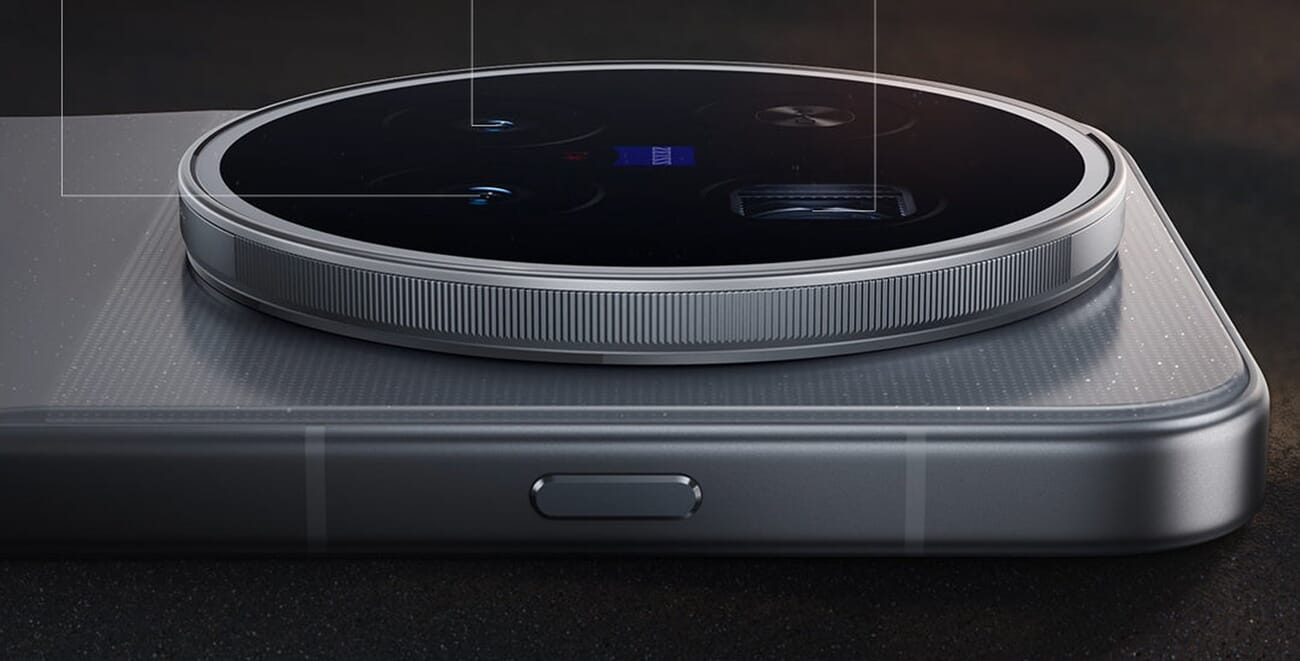
The spec sheet reads like a camera, not a phone
Strip away the phone parts (a 2nm Dimensity 9600 Pro, a 7,800mAh battery globally, trimmed to 6,750mAh in Vivo’s European listings) and what is left is a camera system with unusually serious numbers, all from Vivo’s own spec sheet:
- Main: 50MP Sony LOFIC sensor, 1/1.28-inch, f/1.57, 24mm equivalent, with gimbal-grade 3-degree OIS. This is the sensor generation PhotoWorkout covered when Sony’s first LOFIC chip promised about 17 stops of dynamic range, overflow capacitors on each pixel catch highlight charge that would otherwise clip.
- Telephoto: 200MP ZEISS APO periscope, 1/1.4-inch (physically larger than the main sensors in many midrange phones), f/2.67, 85mm equivalent, 15cm minimum focus for telephoto macro work.
- Ultrawide: 50MP, 15mm equivalent, f/2.0.
- Stabilization: the periscope carries CIPA 7.0-rated OIS, the highest rating yet published for a phone telephoto. CIPA ratings measure real shutter-speed gain, so this is the spec that decides whether 400mm handheld is usable or a blur lottery.
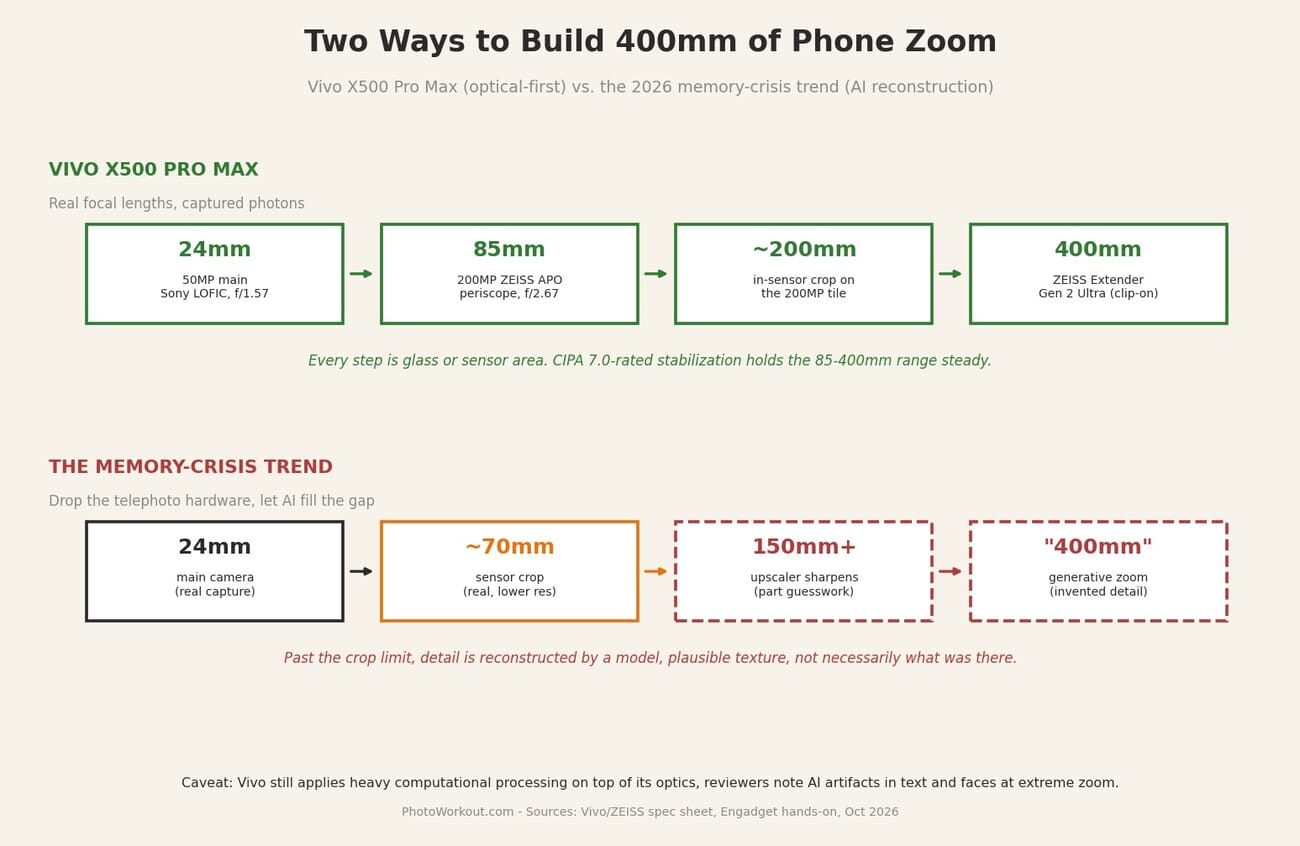
The 200MP telephoto tile is the quiet star. With four times the resolution of a typical 50MP periscope, Vivo can crop inside the sensor for intermediate focal lengths, roughly 85mm out to 200mm-plus, without leaning on an upscaler. That is the same “lossless crop” logic Apple is reportedly chasing for 2027-2028, as covered in PhotoWorkout’s look at the iPhone camera roadmap. Vivo is shipping it now.
The clip-on teleconverter: an honest answer to a dishonest trend
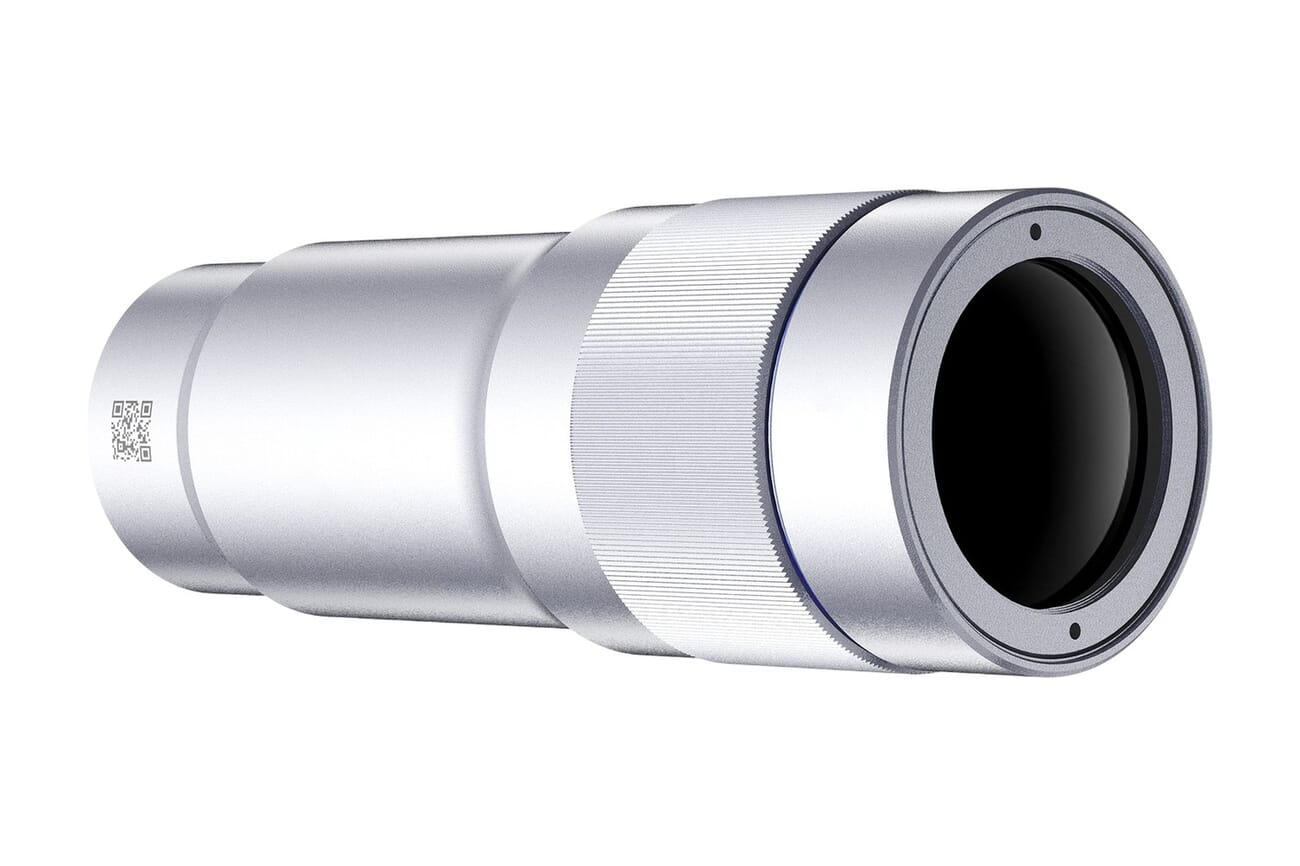
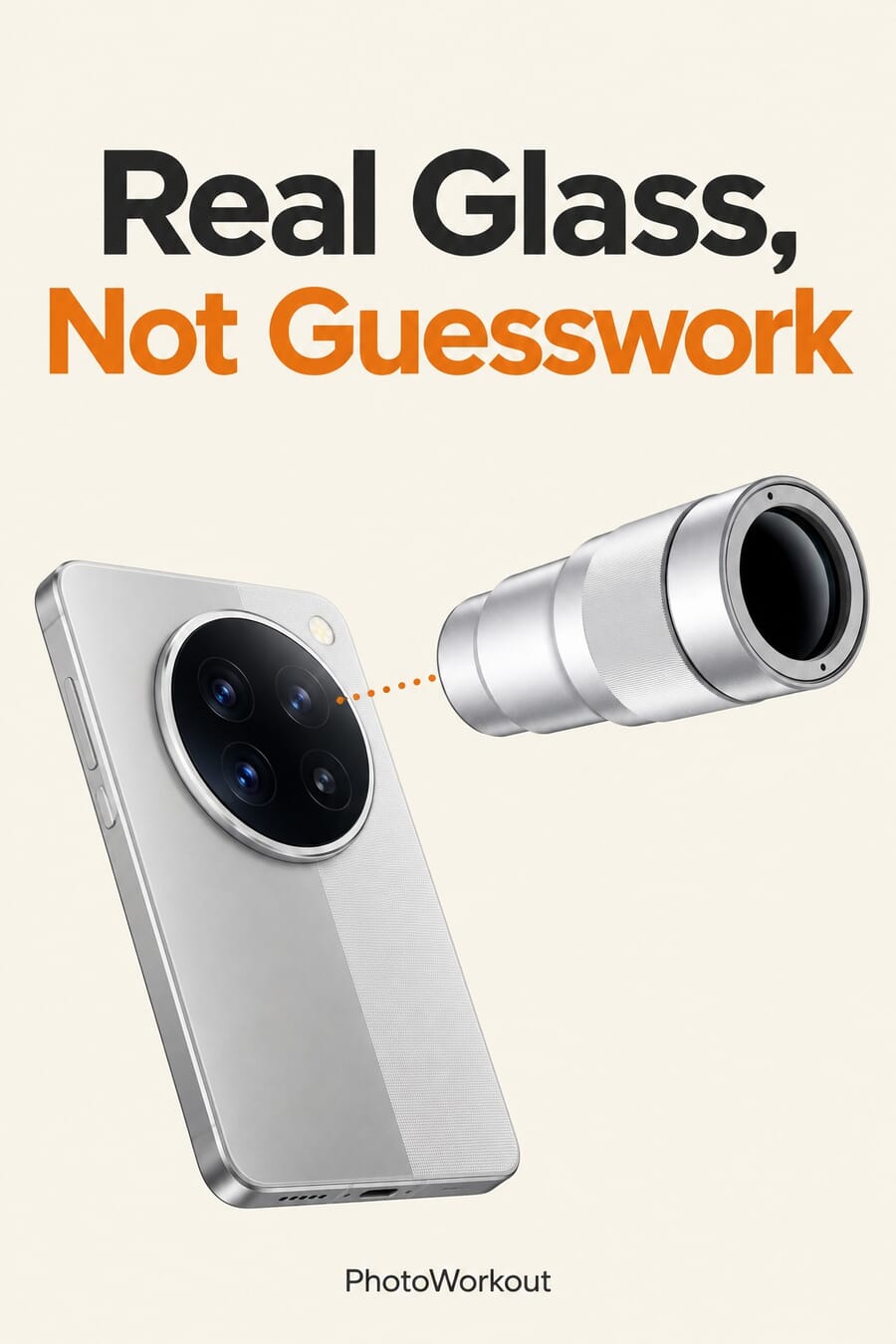
The X500 Pro Max supports two Gen 2 teleconverters co-engineered with ZEISS: a standard Telephoto Extender at 2.35x and the Gen 2 Ultra at 4.7x, which lands the periscope at a 400mm equivalent. These are real multi-element optical assemblies that thread over the camera module (via a case or the photography-kit grip), the smartphone equivalent of dropping a 2x converter on a 200mm lens.
For wildlife, field sports, airshows, or surf photography, the physics matter: a 400mm frame assembled from captured light can be verified, printed, and cropped with a clean conscience. A “400mm” frame synthesized by a generative upscaler cannot, which is precisely the worry PhotoWorkout flagged in the memory-crisis piece, and the reason detail that was never captured keeps becoming an authenticity problem, from contest screening to marketplace proof-of-real rules.
Why this cuts against the 2026 grain
Context makes the move sharper. Memory prices have roughly doubled through 2026, and PhotoWorkout has tracked the fallout as camera bodies reprice and phone makers quietly delete components. The zoom lens is the easiest casualty: drop the periscope, save the module cost and internal volume, and market “AI zoom” as a feature instead of an apology.
Vivo’s bill of materials goes the other way: a larger 1/1.4-inch 200MP telephoto sensor, LOFIC main silicon, ZEISS-branded glass, and an accessory optics program. Notebookcheck’s framing of the leaked pricing was blunt: ZEISS camera flagships are getting expensive too. True, and that is the trade on the table in 2026. You can pay for silicon and glass, or you can pay less and get a model’s best guess at a bird.
The caveats: processing, scores, and the missing US launch
Honesty requires three brakes on the enthusiasm. First, real glass does not mean untouched output. Engadget’s hands-on praised the hardware but found Vivo’s aggressive computational pipeline still smears fine text and faces at extreme zoom, including through the extenders, “a darker but more accurate image” would sometimes be preferable, the reviewer noted. Optical-first capture is a necessary condition for honest long-range photos; Vivo’s processing does not yet fully commit to it.
Second, DXOMark has not scored the X500 Pro Max as of publication, so camera-quality claims rest on launch-day hands-ons from DCW, Engadget, and PhoneArena, enthusiastic, but preliminary.
Third, the availability asterisk familiar from PhotoWorkout’s Xiaomi 17T coverage: there is no US or UK launch. The global rollout covers Spain, Italy, Austria, India, Brazil, Singapore, Hong Kong and more, with pre-orders from October 27 and open sales November 5. Europe pays 1,499 euros (about $1,740) for the 12/256 Pro Max, up to 2,199 euros for the 1TB photography-kit bundle; China starts at CNY 6,999 (about $1,040). US photographers can import, with the usual warranty and band caveats, but Vivo, like an increasing number of Chinese flagships, simply is not competing for the American buyer.
Frequently Asked Questions
What makes the Vivo X500 Pro Max zoom different from other 2026 flagships?
Reach comes from hardware at every step: an 85mm 200MP ZEISS APO periscope, in-sensor cropping on that 200MP tile for intermediate focal lengths, and an optional clip-on ZEISS Telephoto Extender Gen 2 Ultra (4.7x) for a 400mm equivalent. Most 2026 flagships cover long range by cropping a smaller sensor and reconstructing detail with on-device AI.
Is the ZEISS Telephoto Extender Gen 2 Ultra included?
No. It is an accessory, bundled in the photography kit (the 1TB kit bundle is 2,199 euros in Europe) or sold separately. It works on both the X500 Pro and Pro Max, and the smaller Gen 2 extender offers 2.35x.
Can you buy the Vivo X500 Pro Max in the US?
Not officially. There is no US or UK launch; availability covers much of Europe, India, Brazil and parts of Asia. Importing is possible but means warranty, banking-app, and 5G-band compromises. European pricing starts at 1,499 euros for the 12/256GB model.
What is CIPA 7.0 stabilization?
CIPA ratings measure how many stops of shutter-speed advantage a stabilization system delivers in standardized testing. A 7.0 rating, the highest yet claimed on a phone telephoto, means shots at 85-400mm equivalent remain sharp at shutter speeds that would otherwise demand a tripod. Vivo pairs it with gimbal-grade 3-degree OIS on the main camera.
Does the X500 Pro Max avoid AI processing entirely?
No, and that is the fine print. The capture chain is optical, but Vivo applies heavy computational processing, and early hands-ons still report AI artifacts in fine text and faces at extreme zoom. The difference is that the underlying detail is captured rather than invented, a better starting point, not a guarantee of fidelity.
The bottom line
The X500 Pro Max will not settle the real-vs-reconstructed debate by itself, Vivo’s own processing sees to that. But in a year when the economics push every manufacturer toward deleting lenses and synthesizing the difference, shipping a 200MP periscope, CIPA 7.0 stabilization, and a real 400mm teleconverter is a vote for photons over plausibility. Photographers should want this bet to pay off. If optical-first flagships sell, at 1,499 euros, the industry will notice, and the alternative future, where “zoom” quietly stops meaning “photograph,” gets a little less likely.
Based on Vivo's official launch materials and spec sheet, launch-day hands-on coverage, and PhotoWorkout's prior reporting. Pricing and availability verified October 28, 2026.
Primary Coverage
- Vivo – X500 series global launch pages and spec sheet – Official specs, pre-order window (Oct 27-Nov 4) and Nov 5 open-sales date.
- GSMArena – vivo X500, X500 Pro and X500 Pro Max go global – European and Malaysian pricing, global-variant battery change.
- Engadget – Vivo X500 Pro Max hands-on – Sensor details, stabilization explainer, AI-artifact criticism, availability.
- DPReview – Vivo's X500 Pro Max pairs a LOFIC main sensor with a 200MP telephoto – LOFIC sensor and extender compatibility.
- Vivo via PR Newswire – X500 series debut announcement – Official 400mm-equivalent extender claim.
Image Sources
- Vivo – X500 Pro Max official product imagery – Launch beauty shot and ZEISS Telephoto Extender Gen 2 Ultra render, via Vivo's official store.
- PhotoWorkout – zoom-chain comparison graphic – Original PhotoWorkout data graphic.
- PhotoWorkout – Real Glass pin graphic (based on Vivo product imagery) – Stylized PhotoWorkout illustration.