
- November 2026 stacks a supermoon, three meteor showers, a planetary close approach, a comet at perihelion, two oppositions, and Orion’s return into roughly three weeks. Treat each as its own shooting problem, not one “astro night.”
- The Nov 24 Beaver Supermoon is a compression problem, not a size story. It is only about 7% larger than an average full moon, so the giant moon you remember at the horizon is the moon illusion, not perigee. Shoot it at moonrise with a long lens and a distant foreground.
- Build the dark-sky half of the month around the New Moon on Nov 9 (the last Milky Way core of 2026) and the Leonids on Nov 17-18, which are best after midnight once the first-quarter moon has set.
- The planets deliver: Mars and Jupiter sit about 1.2 degrees apart on Nov 16, Venus reaches peak brightness around Nov 25, and Uranus hits opposition the same night.
- Each target wants different focal length, aperture, and shutter settings. Plan per-event and the whole month becomes a series of achievable shots instead of a vague wish list.
Most months hand astrophotographers a single headline event and a long wait for the next one. November 2026 hands over most of the catalog at once. Inside roughly three weeks the sky delivers a full supermoon, three separate meteor showers, a tight pairing of Mars and Jupiter, a comet reaching perihelion, two planets at opposition, Venus climbing to its brightest, and the slow return of Orion and the winter Milky Way to the evening sky.
The temptation is to read all of that as a calendar, nod, and keep scrolling. The better move is to treat each event as its own shooting problem, because the gear, framing, and exposure that nail a bright supermoon are almost the exact opposite of what catches a faint meteor. Below is the month laid out at a glance, followed by the one move that matters for each target. All dates and times are in UTC, so shift them to your own timezone before you commit to a shoot.
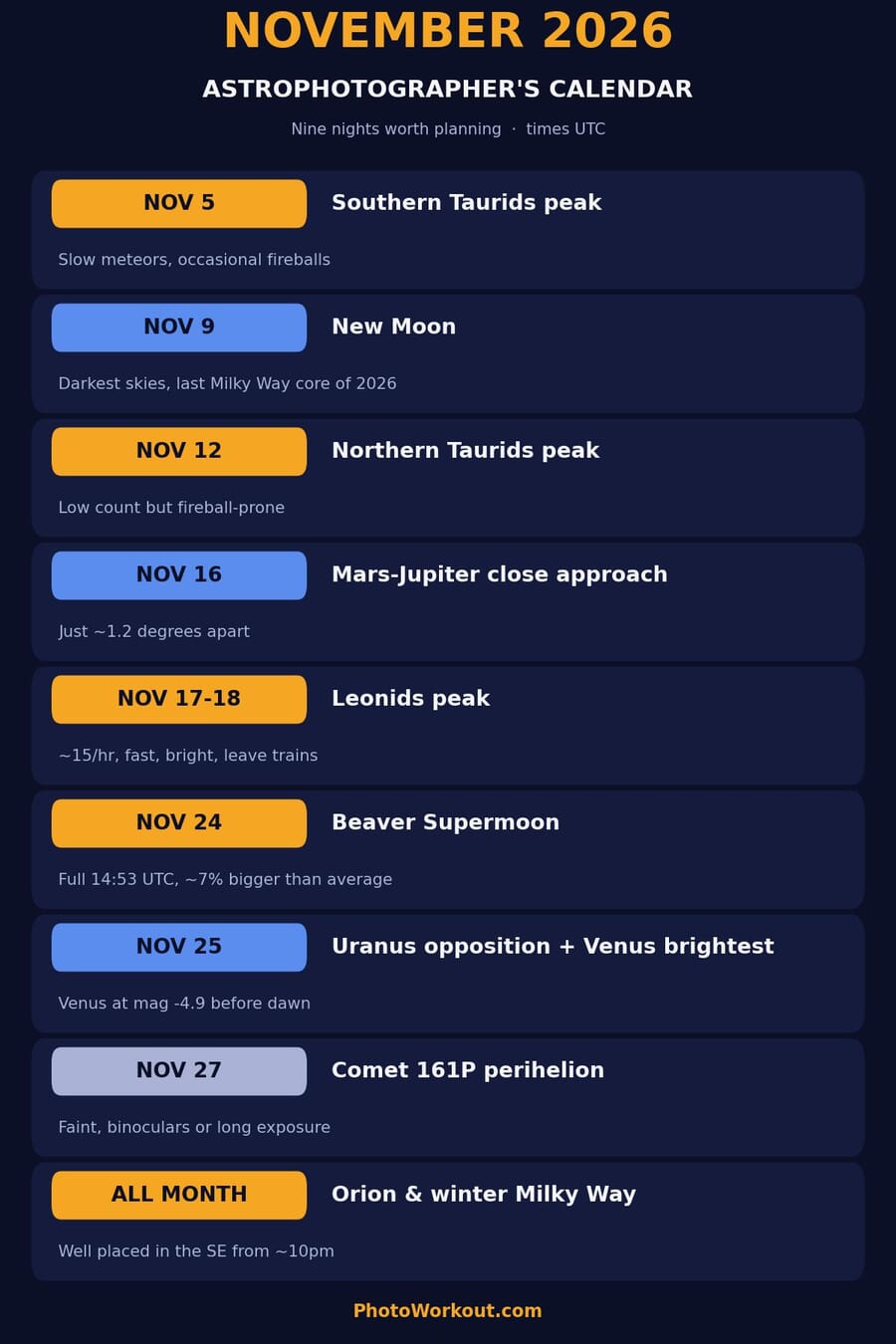
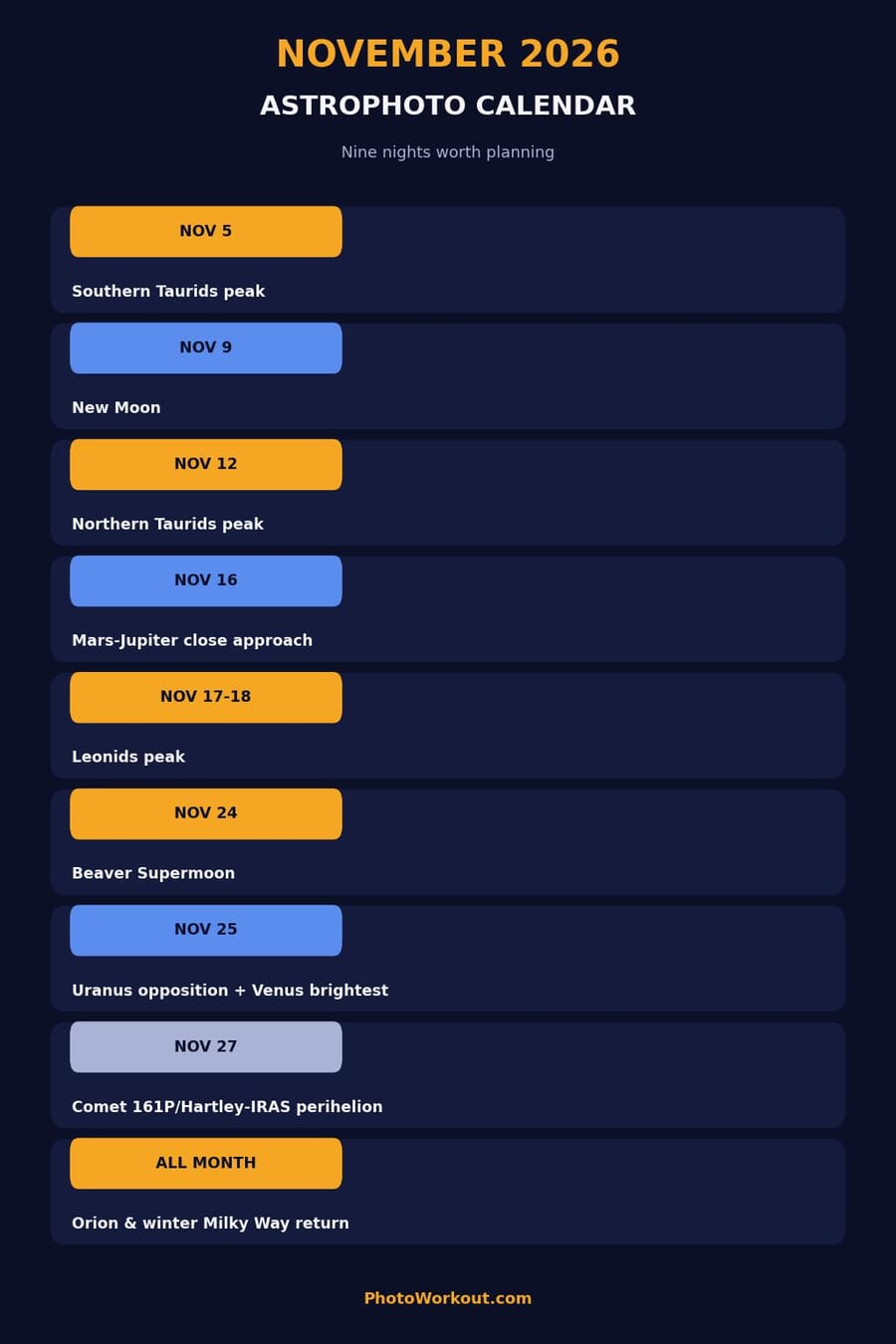
November 2026 at a glance
Nine events are worth putting on the calendar. Some overlap, which is good news and bad news: the week around the New Moon on Nov 9 is your best dark-sky window for faint targets, while the supermoon on Nov 24 washes out the sky for everything except itself. Plan the deep-sky work early in the month and the bright-object work late.
Nov 24 — the Beaver Supermoon is a compression problem
The Beaver Supermoon turns full at 14:53 UTC on Nov 24, and it will be the largest full moon of 2026 right up until the Cold Supermoon on Dec 24 edges past it by about one percent. That framing matters, because the honest numbers are smaller than the headlines suggest. A supermoon is roughly 7% larger in apparent diameter and about 15% brighter than an average full moon. The often-quoted “14% bigger, 30% brighter” figure compares the closest possible full moon against the smallest, not against a typical one, so it overstates what your eye and your sensor will actually register.
So why does the moon look enormous when it clears the horizon? That is the moon illusion, a perceptual trick in which nearby trees, rooftops, and ridgelines give your brain false scale cues. Its angular size has not changed at all. The practical consequence is that “it will look huge” is a promise the sky cannot keep in a photo. A bare supermoon high in a black frame looks small and disappointing every single time.
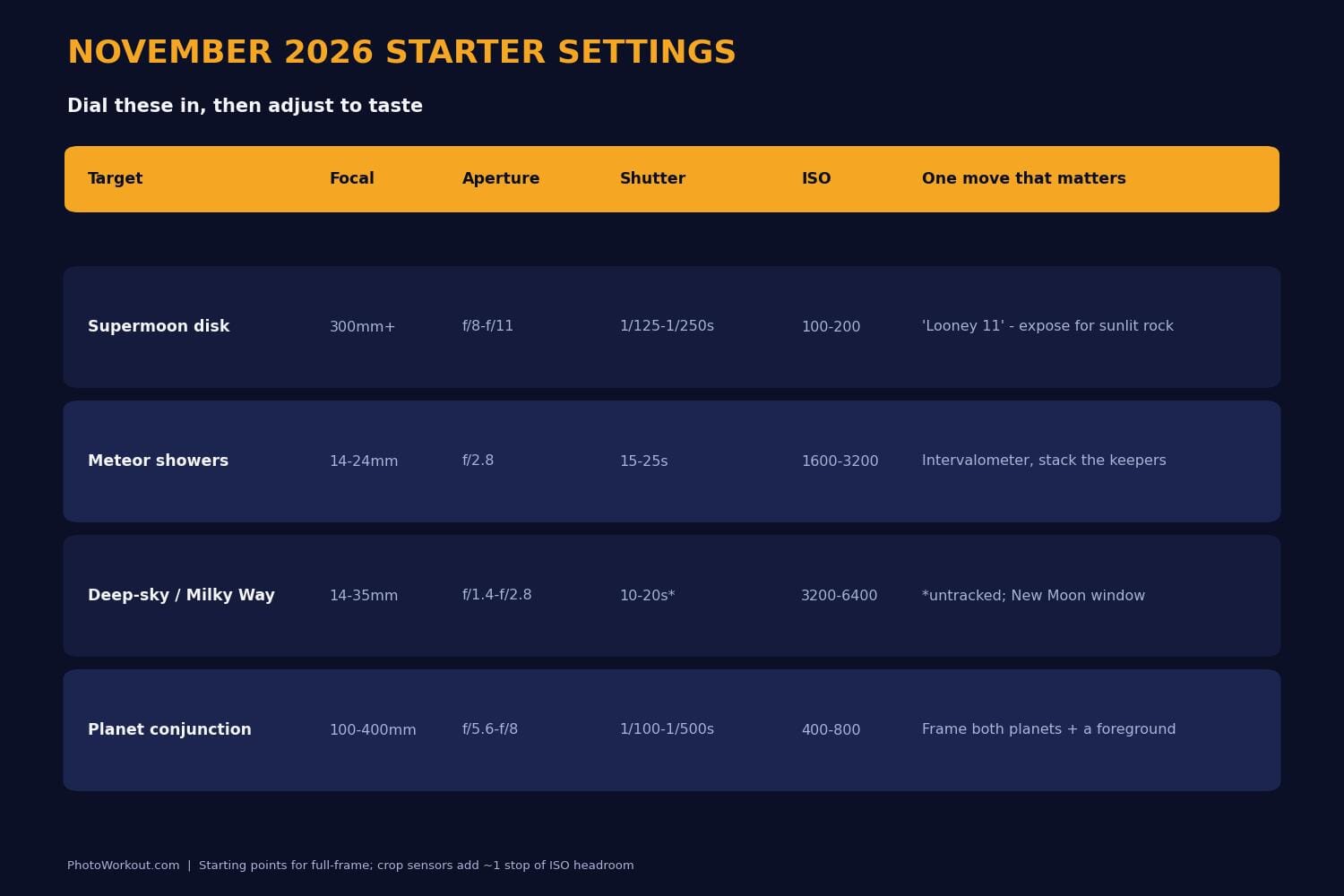
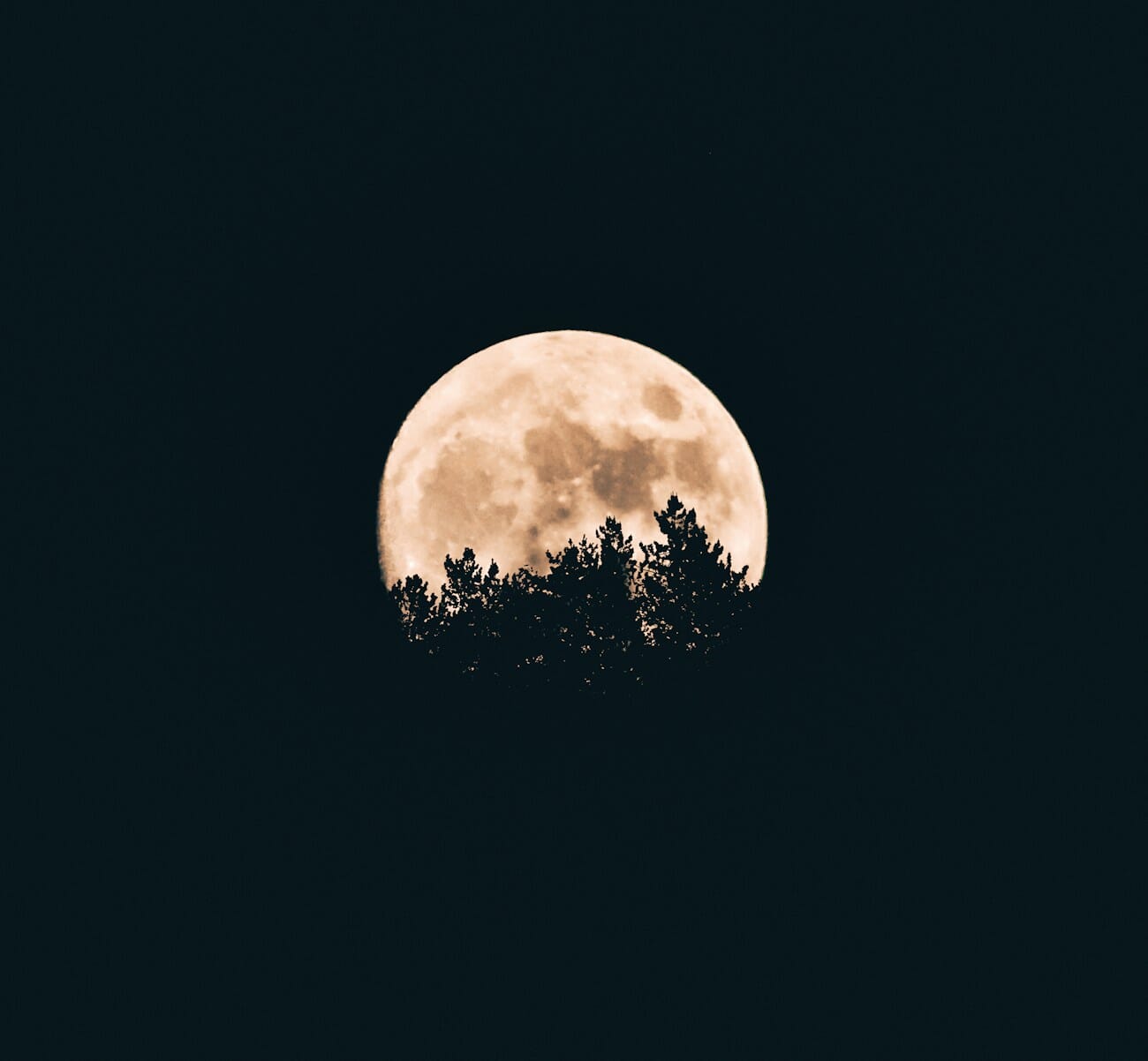
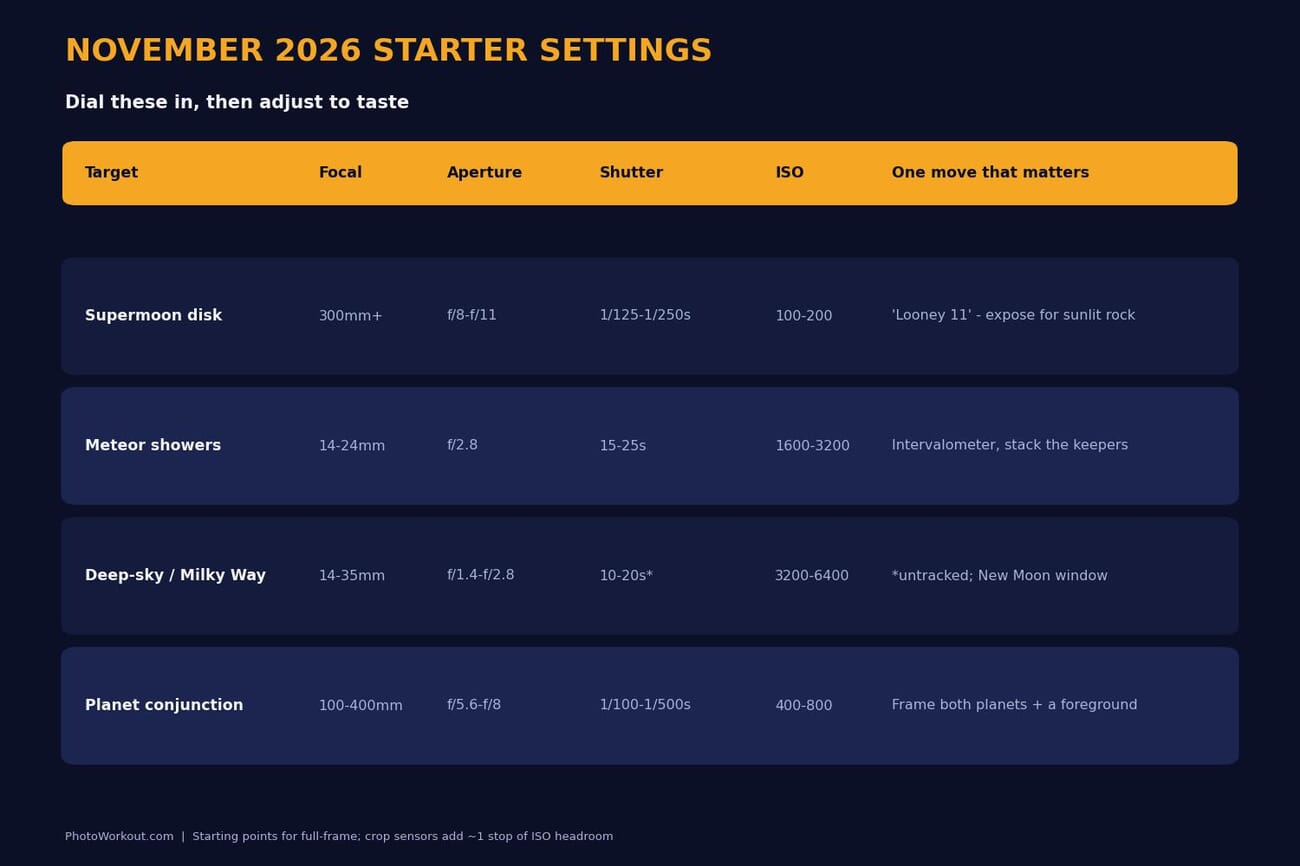
The one move that matters: shoot at moonrise with a long lens and a distant foreground. A 300mm or longer focal length aimed at a landmark a mile or more away compresses perspective so the moon looms behind it, which is the look people actually remember. Expose for the lit disk, not the dark sky. The moon is a sunlit rock, so the “Looney 11” rule (f/11, shutter near 1 over your ISO) is a reliable starting point before you bracket. Scout the exact rise azimuth with a planning app a day ahead so your foreground and the moon line up.
Nov 5 to 18 — three meteor showers in two weeks
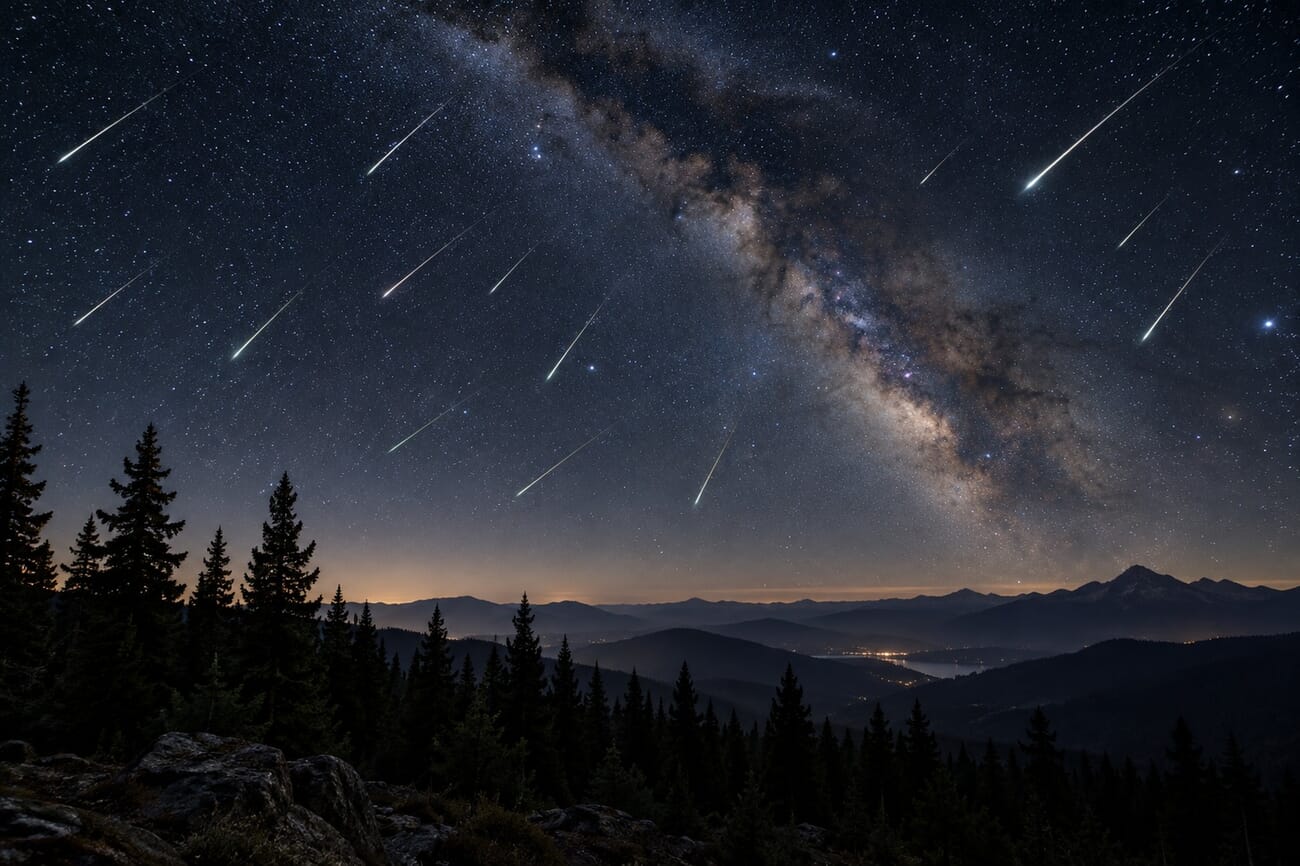
November runs three showers back to back. The Southern Taurids peak around Nov 5 and the Northern Taurids around Nov 12. Neither produces high numbers, maybe a handful per hour, but both are famous for slow, bright fireballs that can outshine anything else in the frame, and the Northern branch in particular is fireball-prone. The Leonids peak overnight on Nov 17-18. This is not a storm year, so expect ordinary rates near 15 meteors per hour under dark skies, but Leonids are fast and bright and often leave glowing trains that hang in the sky for a second or two.
Timing is on your side for the Leonids. The New Moon was on Nov 9, so by the 17th the Moon is only around first quarter and sets before the early morning hours, leaving the radiant high in a dark sky after midnight. That post-midnight window, when the shower’s radiant climbs highest, is when meteor rates roughly double.
The one move that matters: stop thinking single frame and start thinking sequence. Lock a fast wide lens (14-24mm at f/2.8) on a sturdy tripod, set an intervalometer to fire continuously at 15-25 second exposures around ISO 1600-3200, and let it run for an hour or more over a strong foreground. Meteors are random, so you are playing a numbers game: most frames catch nothing, and then you composite the handful of keepers onto one base exposure of the landscape. Frame about 40 to 60 degrees away from the radiant, not straight at it, so the trails have length.
Nov 9 — the dark-sky window: deep sky, planets, and a comet
The New Moon on Nov 9 (07:02 UTC) opens the darkest stretch of the month, and it carries a deadline: this is realistically your last chance to catch the bright galactic core of the Milky Way low in the evening sky before it drops out of reach for 2026. After this, the summer core is gone until next spring, and the sky transitions to the fainter winter Milky Way.
That same dark window sets up the month’s best planetary and deep-sky work. On Nov 16, Mars and Jupiter close to about 1.2 degrees apart, tight enough to frame both in a single telephoto shot with room for a foreground. Late in the month the lineup deepens: Venus reaches its greatest brilliancy around Nov 25 at roughly magnitude -4.9, blazing in the pre-dawn sky, and Uranus reaches opposition the same night, as close and as bright as the ice giant gets all year (though still a dim, small target that rewards a tracked long exposure). Comet 161P/Hartley-IRAS reaches perihelion on Nov 27. Set expectations honestly here: it is faint, a binoculars-or-long-exposure object, not a naked-eye spectacle, and anyone promising otherwise is overselling it.
The one move that matters: for the Mars-Jupiter pairing, use a 100-400mm lens at f/5.6-f/8 and keep shutter speeds short (1/100 to 1/500) so the planets stay as crisp points rather than smearing. Include a recognizable foreground, a ridgeline or a lone tree, to turn a technical conjunction into a photograph someone wants to look at. For the faint stuff (the comet, Uranus, the last of the Milky Way core), a star tracker changes everything, letting you expose for minutes instead of seconds without trailing.
All month — Orion and the winter Milky Way return
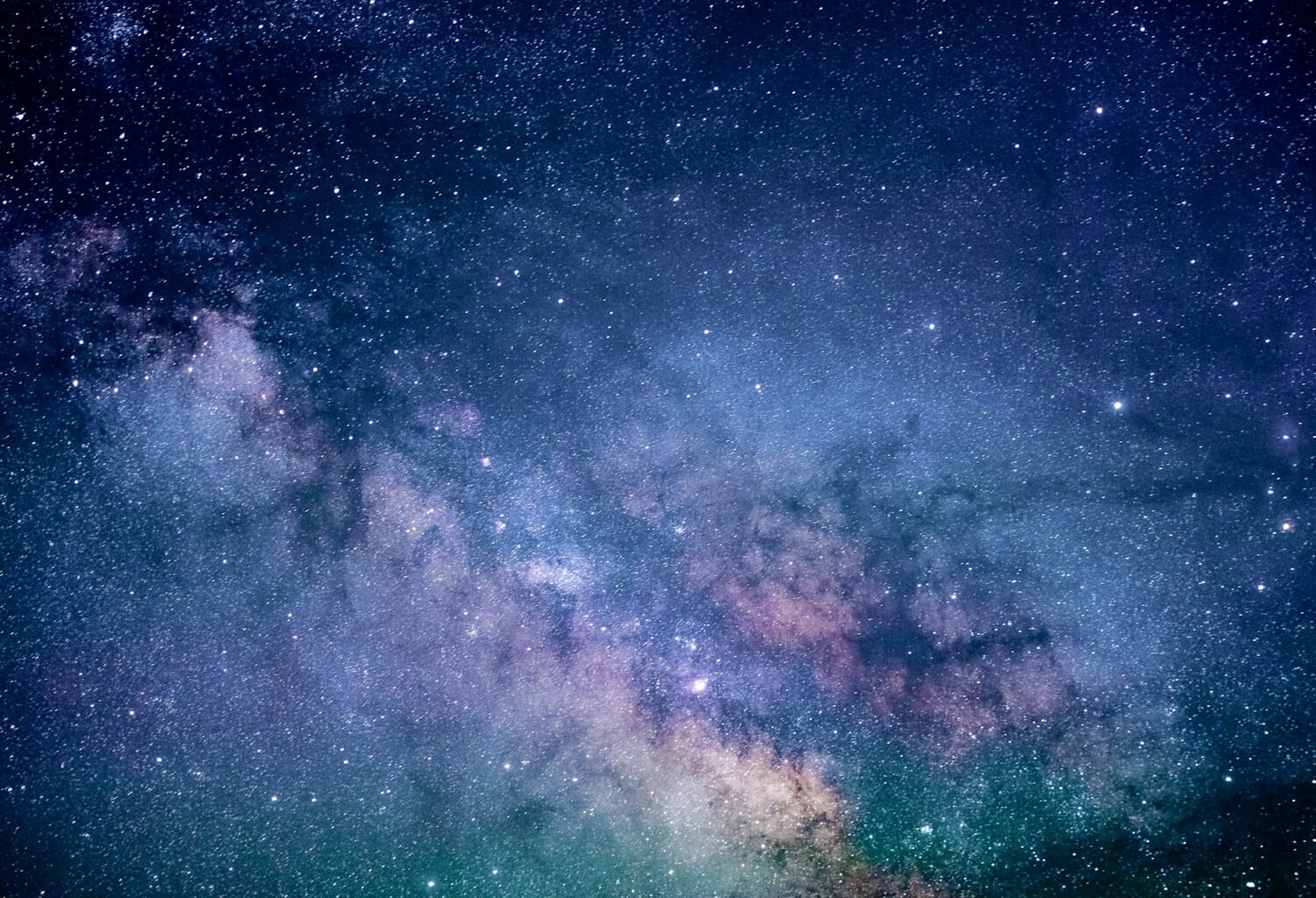
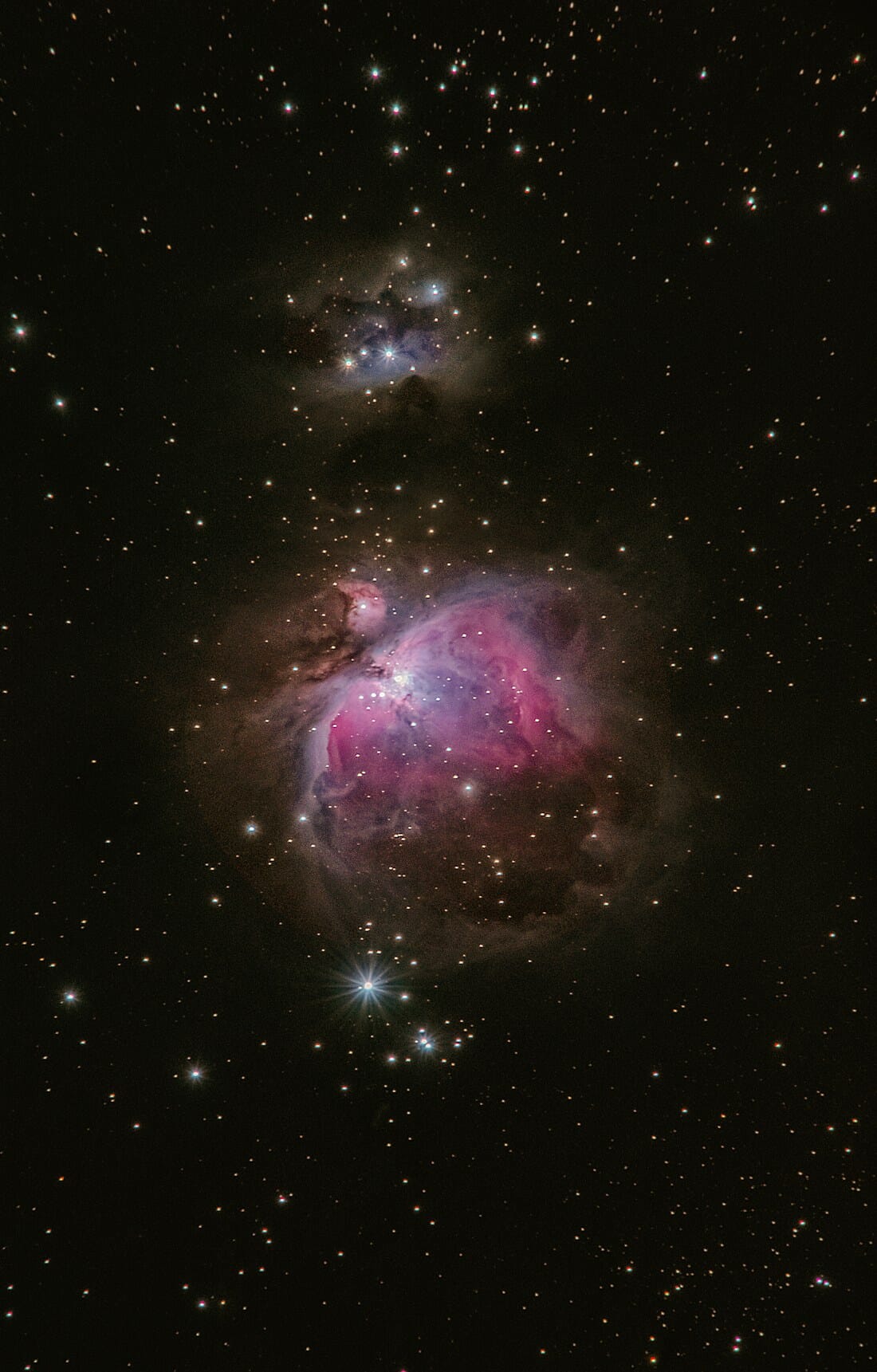
The quiet star of November is Orion. The constellation climbs back into the evening sky through the month, rising around 9 to 10 p.m. in early November and closer to 7 to 8 p.m. by the end, and it is well placed in the southeast from roughly 10 p.m. onward. For astrophotographers this is the gateway to the entire winter sky: the Orion Nebula (M42) is bright enough to register in a few seconds even without a tracker, and the broader region is dense with targets that stay available for months. The fainter winter Milky Way, the band running through Auriga, Gemini, and Canis Major, becomes a practical evening subject by mid-month too.
The one move that matters: this is the target to learn tracking on. Orion sits high enough and bright enough that even a budget star tracker turns a noisy 10-second grab into a clean two-minute exposure with real nebula color. If you are shooting untracked, a 14-35mm lens wide open at 10-20 seconds and ISO 3200-6400 still captures Orion rising over a landscape beautifully, and it is the easiest “wow” shot of the month for a beginner.
Starter settings for every target
The reason a single “astro mode” does not exist is that a supermoon and a meteor live at opposite ends of the exposure scale. One is a bright sunlit rock you expose like daylight; the other is a faint flash you have to collect over a long open shutter. Use the table below as a first pass, then adjust to your sensor and sky. Crop-sensor shooters can add roughly a stop of ISO to match full-frame light-gathering.
The gear story worth stealing: two telescopes, one cat
Just in time for Halloween, NASA released a striking composite of the Cat’s Head Nebula, a star-forming pillar 7,500 light-years away inside the Carina Nebula that really does resemble a cat seen from behind. What makes it a lesson rather than just a pretty picture is how it was made: it combines data from two different instruments, the James Webb Space Telescope’s near-infrared camera and the Hubble Space Telescope’s visible-light Wide Field Camera 3. Webb cuts through the dust to reveal structure that Hubble cannot see, while Hubble anchors the scene in the colors our eyes understand.
That multi-instrument, multi-wavelength approach is exactly what amateur astrophotographers scale down every clear night. Stacking frames shot through different filters, or blending a wide establishing shot with a tightly tracked close-up, is the same idea with a smaller budget. If November’s convergence is the excuse to finally try narrowband filters or a two-panel mosaic, the pros just published the blueprint. (For a sense of how far that compositing logic now scales, it is the same principle behind the world’s largest camera capturing 500,000 galaxies in a single frame.)
Whatever you point at the sky this month, the fundamentals carry across every target: a sturdy tripod, manual focus nailed on a bright star using live view at maximum magnification, raw capture, and a remote or intervalometer so you never touch the camera mid-exposure. If you want the deeper walkthroughs, our guides on photographing the Milky Way and the best lenses for astrophotography cover the gear and settings in full, and the best cameras for night photography roundup is a good place to start if you are still choosing a body.
Frequently Asked Questions
Is the November 2026 supermoon the biggest of the year?
No, but it is close. The Beaver Supermoon on Nov 24 is the largest full moon of 2026 until the Cold Supermoon on Dec 24 overtakes it by about one percent in apparent size. For a single photograph, that difference is invisible, so the November moon is every bit as worth shooting.
What is the best night to photograph the Milky Way in November 2026?
The nights around the New Moon on Nov 9 are the darkest and your last realistic window to capture the bright galactic core low in the evening sky this year. After that, the sky shifts to the fainter winter Milky Way, which is still photogenic but far less dramatic than the summer core.
Do I need a star tracker for any of these events?
Not for the supermoon, the meteor showers, or the Mars-Jupiter conjunction, which are all shot handheld-short or on a plain tripod. A tracker pays off for the faint targets: the comet, Uranus, and detailed shots of the Orion Nebula, where it lets you expose for minutes instead of seconds without the stars trailing.
Will I see the comet 161P/Hartley-IRAS with the naked eye?
Almost certainly not. The comet reaches perihelion on Nov 27 but stays faint, so it is a binoculars-and-long-exposure target rather than a naked-eye spectacle. Treat any photo of it as a bonus, not the night’s main event.
The bottom line
November 2026 is the rare month where the problem is not finding something to shoot but choosing what to prioritize. Anchor the plan on two dates: the New Moon on Nov 9 for everything faint, and the supermoon on Nov 24 for the one bright headline. Slot the meteor showers, the Mars-Jupiter conjunction, and Orion’s return around those two poles, match the settings to the target instead of hoping one setup covers them all, and you walk away from the month with four or five genuinely different images rather than one rushed attempt at all of them.
Event dates and times verified against the following sources ahead of publication.
Primary Coverage
- Digital Camera World: Astrophotography in November 2026 (supermoon, Orion, long winter nights) – Month overview and Orion framing
- PetaPixel: Two Telescopes Team Up To Photograph a Spooky Space Cat – Webb and Hubble composite of the Cat's Head Nebula
- NASA: Ghostly Cat's Head Nebula lurks within sight of Hubble and Webb – Primary source for the two-telescope image
Event Timing
- PhotoPills: Astronomical Events 2026 photography guide – New Moon, Leonids, and Milky Way core timing
Image Sources
- Featured photo: Stargazer under the Milky Way by Greg Rakozy – via SampleShots
- Full moon behind pines by Aron Visuals – via SampleShots
- Milky Way core by Jeremy Thomas – via SampleShots
- Orion Nebula (M42) by Alexander Andrews – via SampleShots
- Meteor-shower visual: AI-generated illustration by PhotoWorkout
- Sky calendar, starter-settings table and vertical pin: PhotoWorkout infographics