

- The third-party autofocus boom has a buried cost: most sub-$300 primes are engineered as disposable, with glued barrels, proprietary AF motors, and no channel for an owner to ever buy a spare part.
- The real right-to-repair gate is not labor cost. It is parts access. A shop can open almost anything; it cannot fix what no one will sell the part for.
- The failure decides the verdict more than the brand does. A dead AF motor or fried electronics on a cheap lens means replace; a loose filter ring, dust, or light fungus can be a DIY afternoon.
- Premium glass is worth fixing. A Sigma Art, a fast f/1.4, or any lens worth $400-plus usually justifies a repair bill, especially if it is in warranty and bought from an authorized seller.
- Buy with repairability in mind: favor makers with a real service presence, keep the warranty paperwork, and treat a $150 prime as a consumable, not an heirloom.
The cheap-autofocus flood is at full tide. This week alone, Meike started shipping its AF 58mm f/1.2 and the budget-AF pipeline kept gushing: TTArtisan, Viltrox, and 7Artisans now sell sharp, fast, autofocusing primes for a fraction of what the camera brands charge. It is genuinely great news for photographers, and sites like this one have celebrated every launch. But there is a cost nobody prints on the box.
These lenses are, by and large, built to be thrown away. When the autofocus motor dies or an element gets knocked loose, the repair quote, if a shop will even take the job, often costs more than simply buying another copy. That is not an accident of manufacturing. It is the design. So before the next $200 prime fails and the decision catches a reader off guard, here is the honest repair-vs-replace math, and the one factor that actually decides it.
The cheap-autofocus flood is real, and this week proves it
Five years ago, autofocus was the moat that kept third-party primes cheap and manual. That moat is gone. Meike’s AF 58mm f/1.2 began shipping around November 2 for Sony E, Nikon Z, and Fujifilm X at roughly $449. It lands in the same fortnight as a run of even cheaper glass: TTArtisan’s $99 autofocus 85mm f/1.8 Neo, Viltrox’s $299 pancake and first Micro Four Thirds autofocus primes, the $329 Viltrox 75mm f/1.8 EVO, and 7Artisans bringing autofocus to the full-frame fisheye.
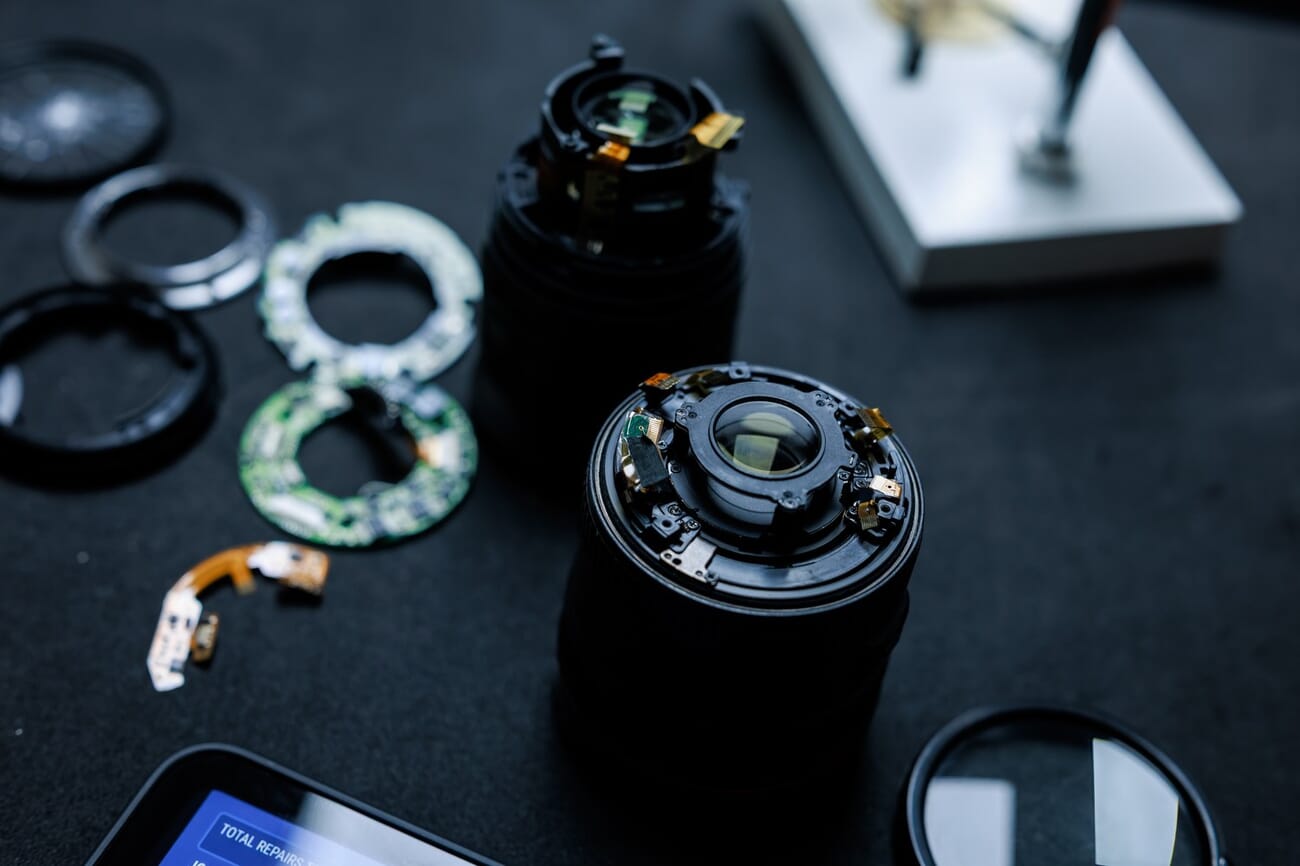
At $99 to $329 a lens, the math changes how people treat the gear. A native 85mm from Sony or Nikon costs enough that a repair is obviously worth considering. A $99 autofocus prime is in impulse-buy territory, and the quiet default becomes “if it breaks, I will just get another one.” That instinct is usually correct, and that is precisely the problem worth naming out loud. The industry has trained a generation of buyers to treat lenses, historically the most durable, resaleable thing in a kit bag, as consumables.
Why these lenses are built to be thrown away
Open a budget autofocus prime and the economics explain themselves. To hit those prices, the barrels are frequently glued or ultrasonically sealed rather than screwed, so getting inside means damaging the housing. The internals are mostly plastic. And the autofocus is driven by compact, proprietary voice-coil or stepping motors that the maker neither documents publicly nor sells as a spare.
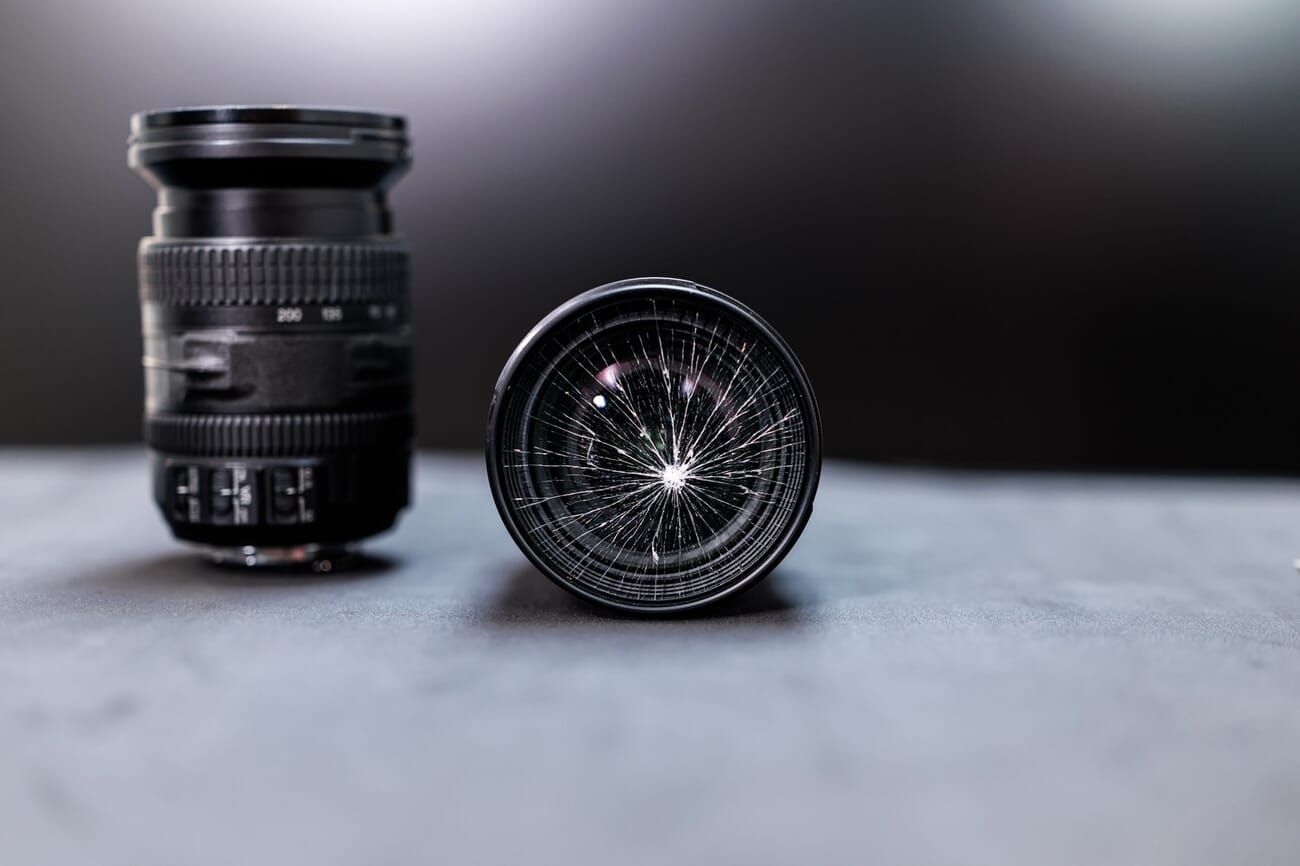
That last point is the whole story. A premium lens is also hard to service, but its maker runs a repair network that stocks the parts. A $150 prime from a fast-moving brand has no equivalent. There is no parts catalog, no module-level spares, no service bulletin. When the motor fails, even a skilled independent technician has nowhere to source a replacement except by cannibalizing another dead copy. The lens was not designed to be repaired, because at that price it was designed to be replaced.
What actually breaks, and whether you can fix it
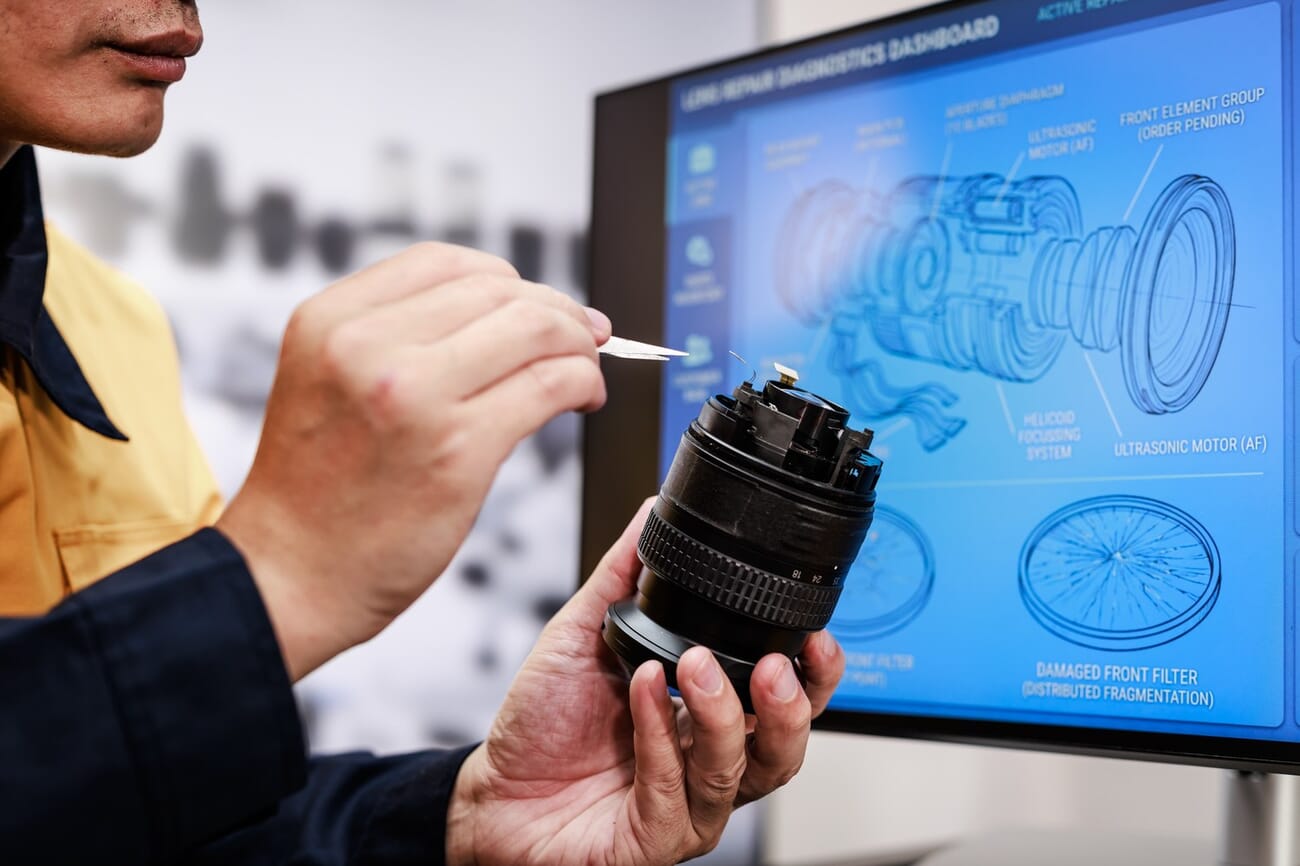
Not every failure is a death sentence, and the type of fault matters far more than the logo on the barrel. The rental house Lensrentals, whose technicians tear down and repair thousands of lenses a year, has published years of repair and failure data: autofocus systems, image stabilization, and zoom or focus mechanics are among the most common failure points, while cosmetic and front-element issues are comparatively routine fixes. The lesson is that where the fault sits on the lens decides your options.
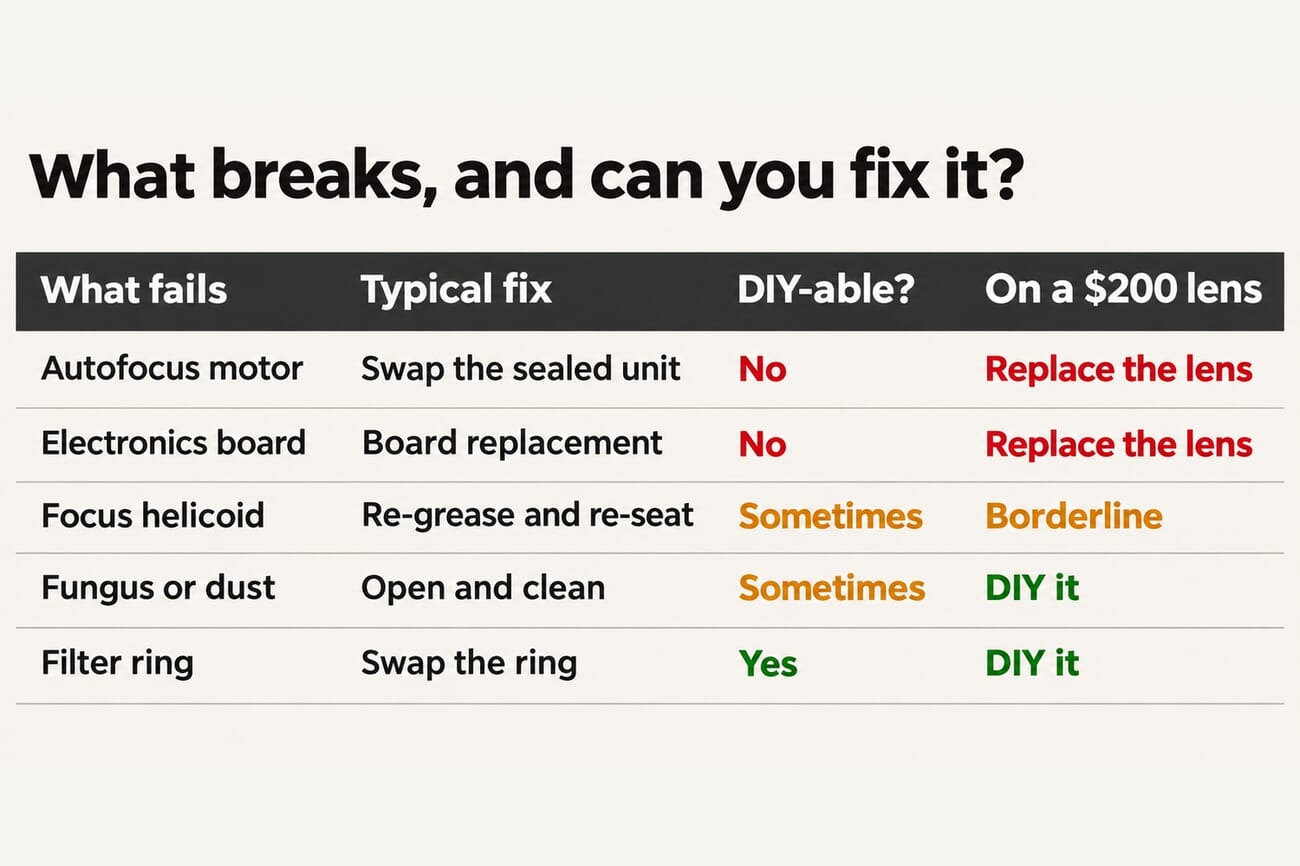
The top two rows are where cheap lenses go to die. A failed autofocus motor or a fried aperture or electronics board needs a part you cannot buy, so on a sub-$300 lens it is a replace. The bottom rows are where DIY lives: a loose filter ring, dust, or light fungus can often be cleaned or swapped with patience and a precision screwdriver set. The middle is the gamble. A re-grease of a stiff focus helicoid is doable; a decentered element you try to re-seat yourself can easily leave the lens worse than before.
This is also where the right-to-repair movement collides with reality. The difficulty of the teardown is real: iFixit’s guide for the Sigma 8-16mm, for instance, is rated “Difficult,” involving the mount, ribbon cables, and encoder components. But difficulty is not the true barrier. Parts are. Nikon proved the distinction in June 2024 when it launched a self-service repair program that actually sells owners both the manuals and the parts for select products. That is what meaningful repairability looks like, and it is exactly what budget third-party lens makers do not offer. Laws have not closed the gap either: New York’s Digital Fair Repair Act (signed in 2022, effective 2023) and California’s SB-244 (effective July 1, 2024) require makers of “digital electronic equipment” to provide parts and documentation, but neither statute clearly names interchangeable camera lenses, so camera gear sits in a gray zone.
Repair, DIY, or replace: the 60-second decision
Put the two factors together, lens value and fault type, and the decision almost makes itself. The split between premium and disposable is the decision tree.
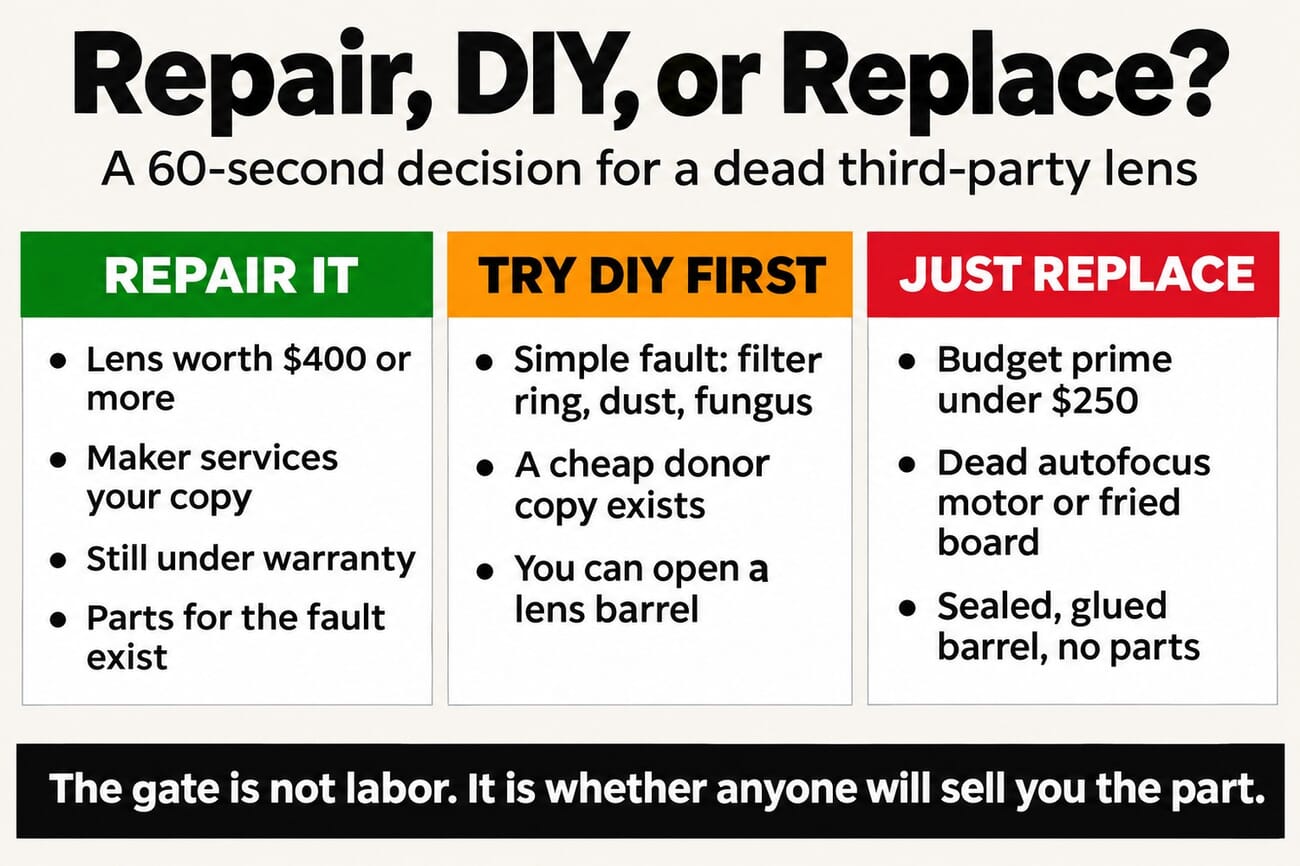
Repair it when the lens is genuinely worth the bill: a Sigma Art, a fast f/1.4, or anything in the $400-plus bracket, especially while it is still under warranty and was bought through an authorized seller. One caveat that catches people out: makers routinely refuse service on gray-market (parallel-import) copies, so a lens bought for a suspiciously low price from an unofficial channel may be unrepairable at any price.
Try DIY first when the fault is simple and the downside is low. This is where the cheap-lens era is quietly empowering: because the risk is small, experimentation is cheap. DIYPhotography documented a photographer who bought a broken $550 Sigma lens for $43.99 and fixed it at home, which is the whole case for DIY in one anecdote. If a cheap donor copy exists for salvage parts, and you are comfortable opening a barrel, a lens you were going to bin anyway is a free lesson.
Just replace it when the numbers say so: a budget prime under roughly $250 with a dead AF motor, fried electronics, or a sealed barrel and no parts channel. Paying a shop $120 to spend an hour failing to source a $200 lens’s motor is the worst of both worlds. Buy the replacement, and if it is any consolation, sell the dead copy to a DIY tinkerer as a donor.
How to buy so you are not left with a brick
Repairability is a buying decision, not just a breakage decision. None of this means avoiding third-party glass, which is often superb value. It means buying with clear eyes. Three habits help. First, when two lenses are close, favor the maker with a real service and warranty presence in your region over the absolute cheapest option; a slightly pricier lens that can be serviced is cheaper over five years than two disposable ones. Second, keep the purchase through an authorized seller and hold onto the paperwork, because that is what keeps warranty and gray-market exclusions from biting you later. Third, price in the disposability honestly: a $150 prime is a consumable, so insure it inside your general gear coverage rather than planning to repair it, and do not pay to fix what was never meant to be fixed.
The deeper backdrop is an industry in flux, with the majors circling the third-party players and the whole category being reshaped around price. That shift is mostly good for buyers. It just comes with a new rule of thumb that the old, built-like-a-tank lens world never needed: at the bottom of the market, a lens is only as repairable as its maker’s willingness to sell you a part.
Frequently Asked Questions
Can you even repair a Viltrox, Meike, or TTArtisan lens?
Sometimes, but rarely economically. Simple mechanical or cosmetic faults can be fixed by a skilled independent technician or a confident DIYer. Electronic and autofocus-motor failures are the problem, because these makers generally do not sell parts or publish service documentation, so a technician has no spare to fit except from another dead copy. On a sub-$300 lens, that usually tips the decision to replacement.
Does right-to-repair law cover camera lenses?
Not clearly. Laws like New York’s Digital Fair Repair Act and California’s SB-244 require makers of “digital electronic equipment” to provide parts and documentation, but they do not expressly name interchangeable lenses, and professional or specialized gear is often carved out. Cameras may fall under broad electronics definitions; standalone lenses are a gray area that has not been firmly settled.
What breaks first on a cheap autofocus lens?
The autofocus system and the electronics are the most common serious failures, alongside mechanical wear in the focus mechanism. Cosmetic damage, dust, and fungus are more frequent but far less serious. Rental-house repair data consistently shows AF, stabilization, and zoom or focus mechanics as leading failure points across brands.
Will a repair shop service a gray-market lens?
Often not under the manufacturer’s program. Makers commonly exclude gray-market, or parallel-import, copies from warranty and even paid service. An independent shop may still take the job for simple faults, but you lose the first-party parts channel entirely, which is already the weak link on budget lenses.
The bottom line
The cheap-autofocus boom is a win, and it is not slowing down. Just buy into it with the right mental model. A $150 to $300 prime is a brilliant tool and a disposable one, so when it dies, do not agonize: if the fault is cosmetic or mechanical, try a DIY fix for the fun of it; otherwise replace it and move on. Save the repair budget for the glass that earns it, the premium, serviceable lenses where a bill actually buys you years more life. And remember the one line that cuts through all of it: at this end of the market, the gate is not what a repair costs, but whether anyone will sell you the part.
Featured and in-body photos: Shutterstock. Decision guide and failure table: PhotoWorkout infographics.
Repair data, teardowns, and policy references consulted for this piece.
Repair Data & Teardowns
- iFixit – Repairing the Sigma 8-16mm lens (rated Difficult) – Difficulty of a real third-party lens repair.
- Lensrentals – lens repair and failure data (Roger Cicala) – Published repair rates and common failure modes across brands.
- DIYPhotography – I bought a broken $550 Sigma lens for $43.99 and fixed it myself – The case for DIY when a cheap donor exists.
Repairability & Policy
- Nikon – Self-Service Repair program (parts and manuals, June 2024) – A first-party maker selling owners parts: the counterexample.
- PetaPixel – Nikon Launches Self-Service Repair Program – Coverage of the Nikon self-service launch.
Image Sources
- Featured: lens repair bench – Shutterstock
- Shattered front element – Shutterstock
- Lens repair diagnostics bench – Shutterstock
- Disassembled lens internals – Shutterstock
- Decision guide, failure table, and vertical pin – PhotoWorkout infographics