

When you buy through links on our site, we may earn a commission at no cost to you. We evaluate products independently. Commissions do not affect our evaluations.
Key Takeaways
- Street photography captures candid, unposed moments of everyday life — and this challenge provides a structured plan to practice it
- Study 8 real-world street photos with full camera settings and technical analysis
- Learn key lessons from the examples: focal length variety, light awareness, and the decisive moment
- Follow the step-by-step Sunday challenge — from morning scouting to evening sharing
- Reference the recommended camera settings for four common street scenarios
Welcome to the very first Sunday Photo Challenge — a new weekly series designed to sharpen photography skills through focused practice and real-world inspiration. Each week features a specific genre, curated example photos with full EXIF data, and a hands-on shooting exercise to complete in a single day.
This week’s genre: street photography.
This Week’s Genre: Street Photography
Street photography is one of the oldest and most democratic forms of the craft. It requires no studio, no models, no expensive lighting rigs — just a camera, a public space, and the awareness to notice fleeting moments that most people walk right past. From Henri Cartier-Bresson’s “decisive moment” philosophy in 1930s Paris to Vivian Maier’s rediscovered archive of mid-century Chicago, the genre has produced some of photography’s most iconic and emotionally resonant images.
What makes street photography compelling is its honesty. These are unscripted, unrepeatable slices of life — a stranger’s expression, the geometry of shadows on a sidewalk, the chaos of a crowded market frozen at 1/500th of a second. The genre forces photographers to develop fast reflexes, sharp observation, and comfort with unpredictability. There is no “retake” button on the street.
Street photography also matters because it documents culture in real time. The best street photos become historical records — showing how people dressed, moved, interacted, and inhabited their cities. Whether shooting with a professional mirrorless body or a smartphone, anyone who walks out the front door with intention can make meaningful street photographs.
Inspiration: 8 Real-World Examples
The following eight photographs were selected from real uploads to demonstrate the range of approaches, gear, and techniques that work in street photography. Each image includes full camera settings — study them carefully before heading out for the challenge.
1. Urban Symphony in Red
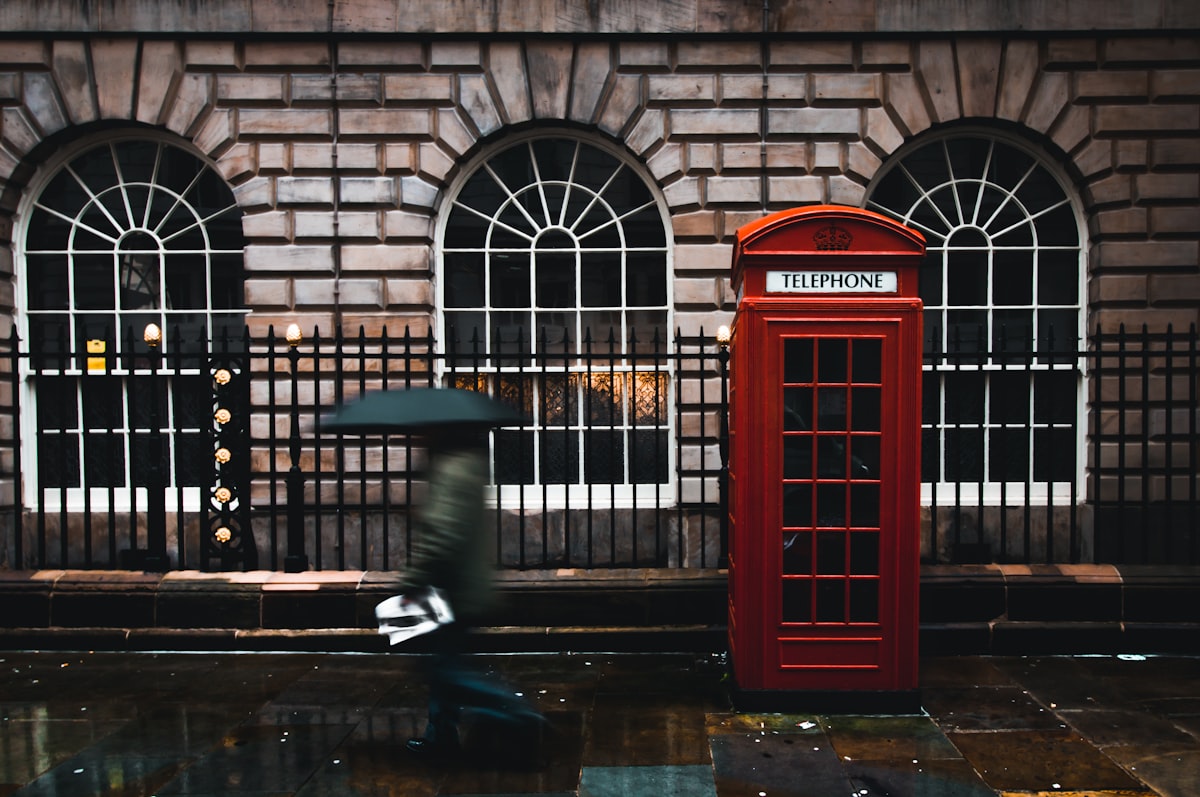
The extremely slow 1/8-second shutter speed at f/18 transforms walking pedestrians into ghostly streaks of motion, while the static architecture stays razor-sharp. This contrast between stillness and movement is the heartbeat of the image. The ultra-wide 13mm focal length pulls in the full scene and creates dramatic depth, making the viewer feel immersed in the energy of the street.
2. Urban Reflections: A Glimpse Through Glass
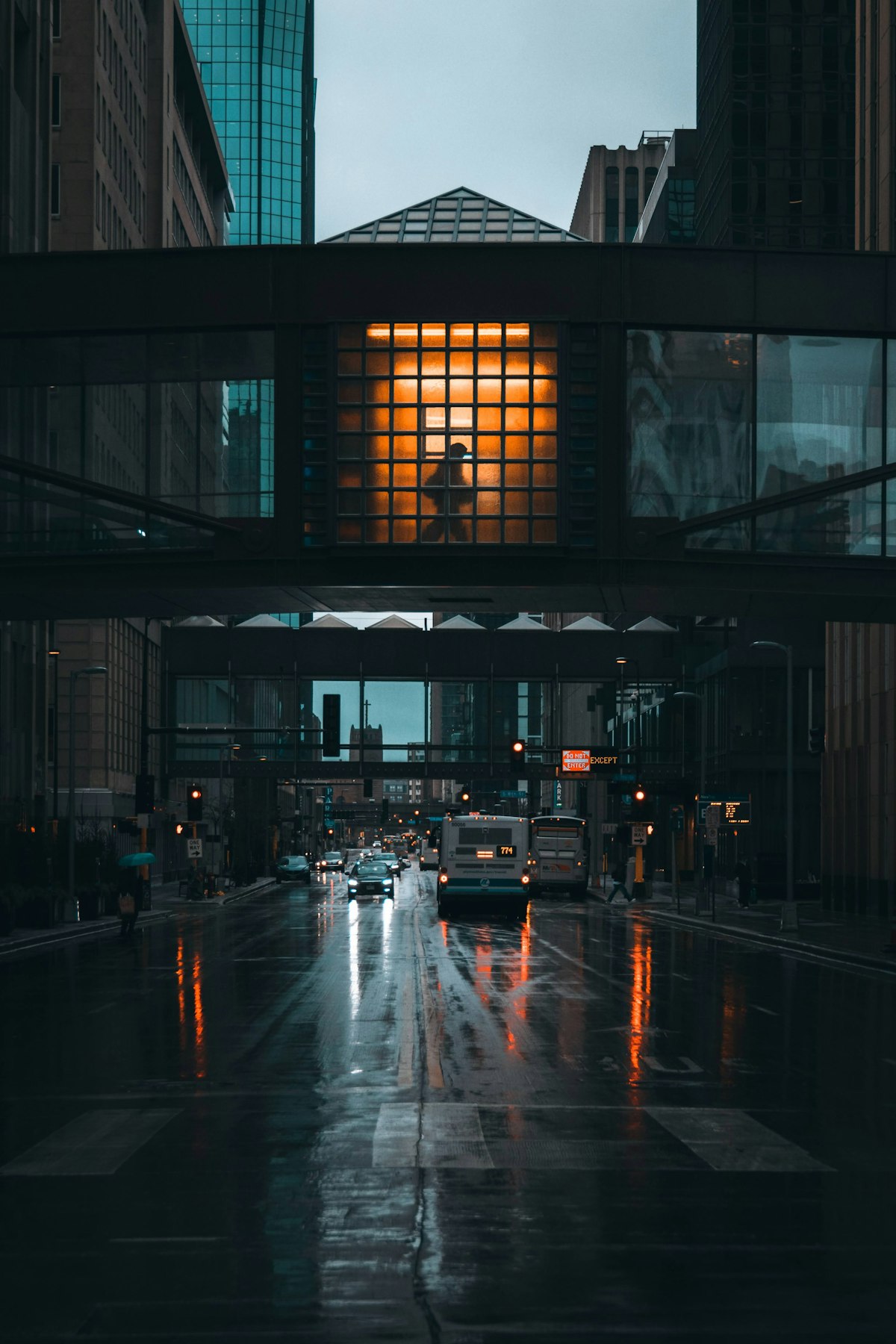
Shooting through glass introduces a second layer of visual information — reflections merge with the scene behind the window, creating depth and mystery that a direct shot would lack. The 56mm focal length compresses the background and isolates the subject from the wider chaos of the street. A moderately fast 1/320s shutter ensures the scene stays crisp despite the complexity of the layered composition.
3. Whimsical Eccentricity in a Crowded Market
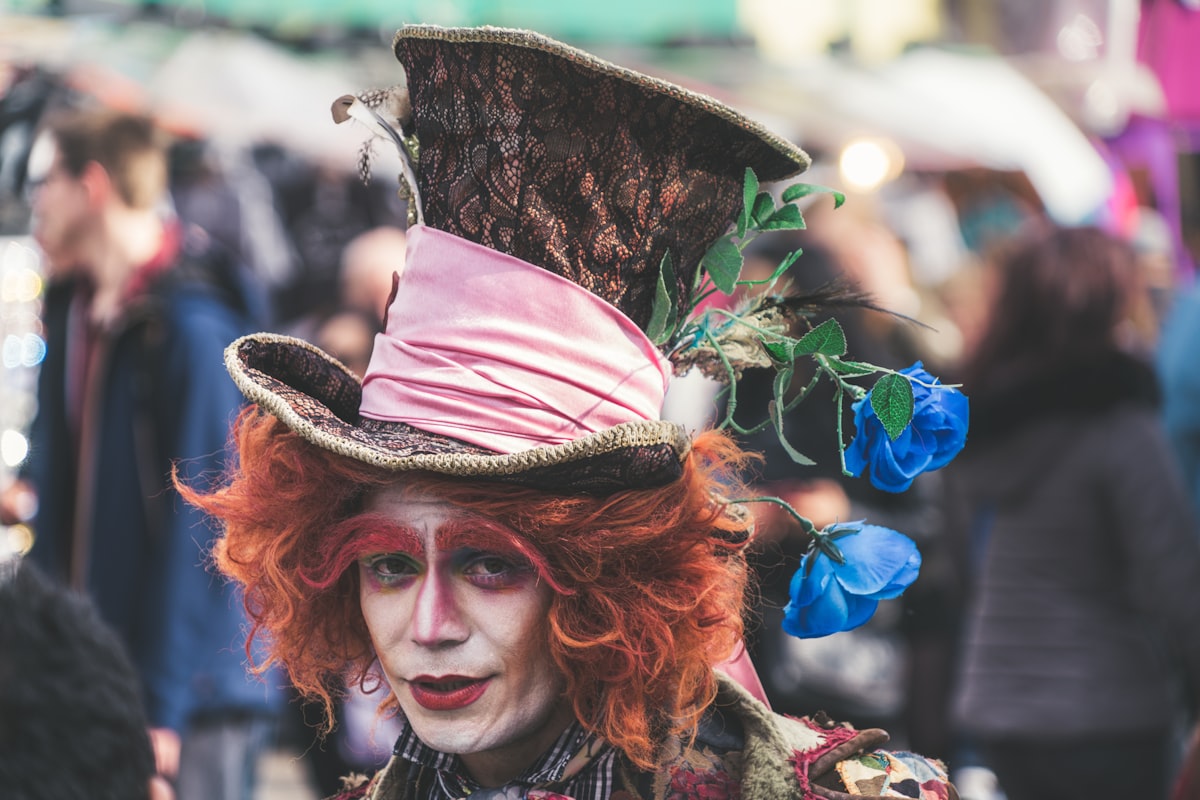
At 198mm, the photographer captured this candid moment from a considerable distance — the subject had no idea they were being photographed, which preserves the authenticity of the expression and body language. The extreme telephoto compression flattens the busy market background into a painterly wash of color. The Sony A7R II’s high-resolution sensor ensures the distant subject remains tack-sharp even when cropped.
4. Flag Between Giants
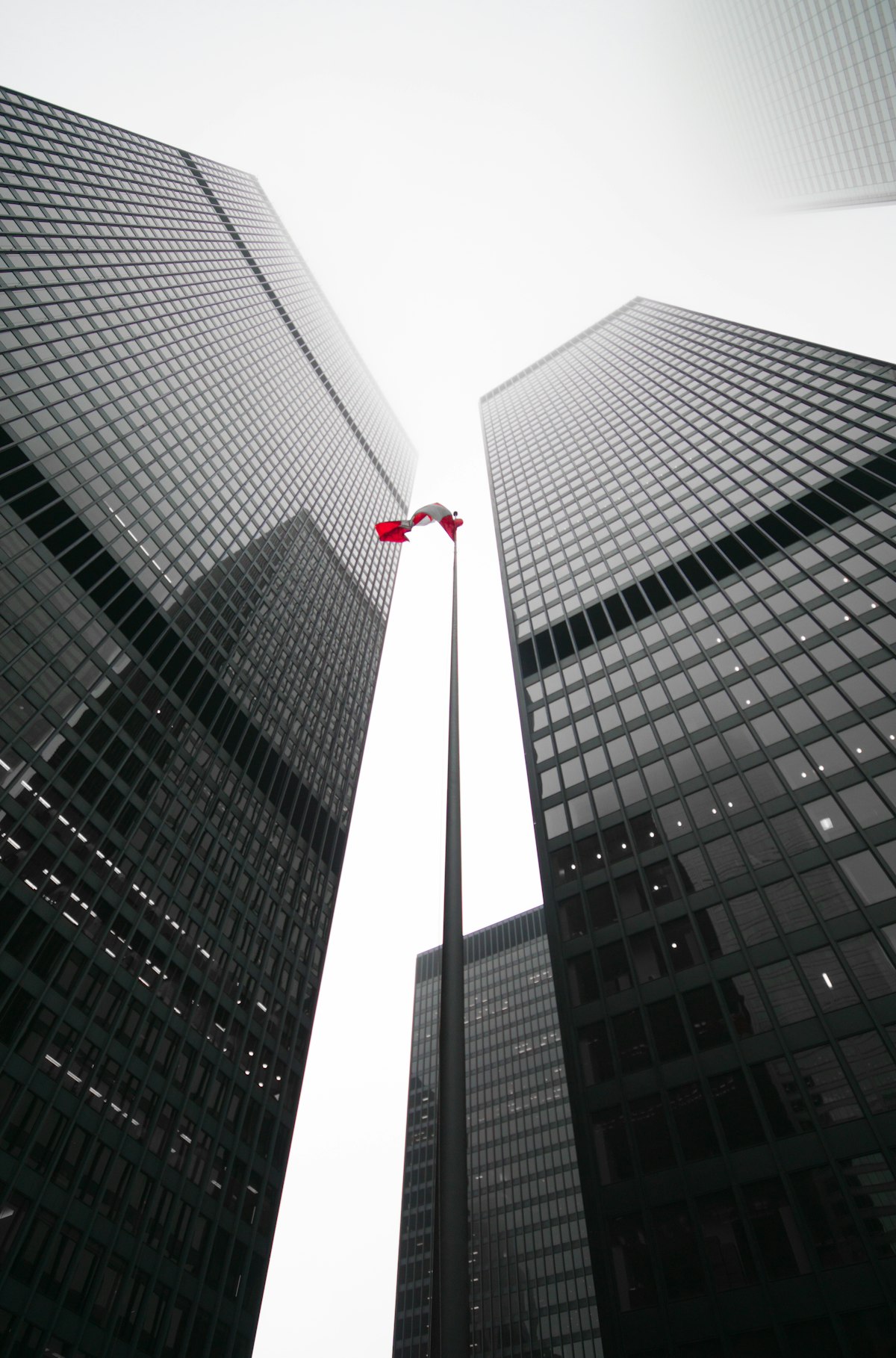
The ultra-wide 12mm focal length on an APS-C sensor creates powerfully converging vertical lines, making the buildings tower dramatically overhead. By pointing the camera straight up, the photographer turned ordinary architecture into an abstract composition with the flag as a perfectly placed focal point. This shot proves that street photography does not always require people — the built environment tells its own stories.
5. Vintage Charm on Cobblestone Streets
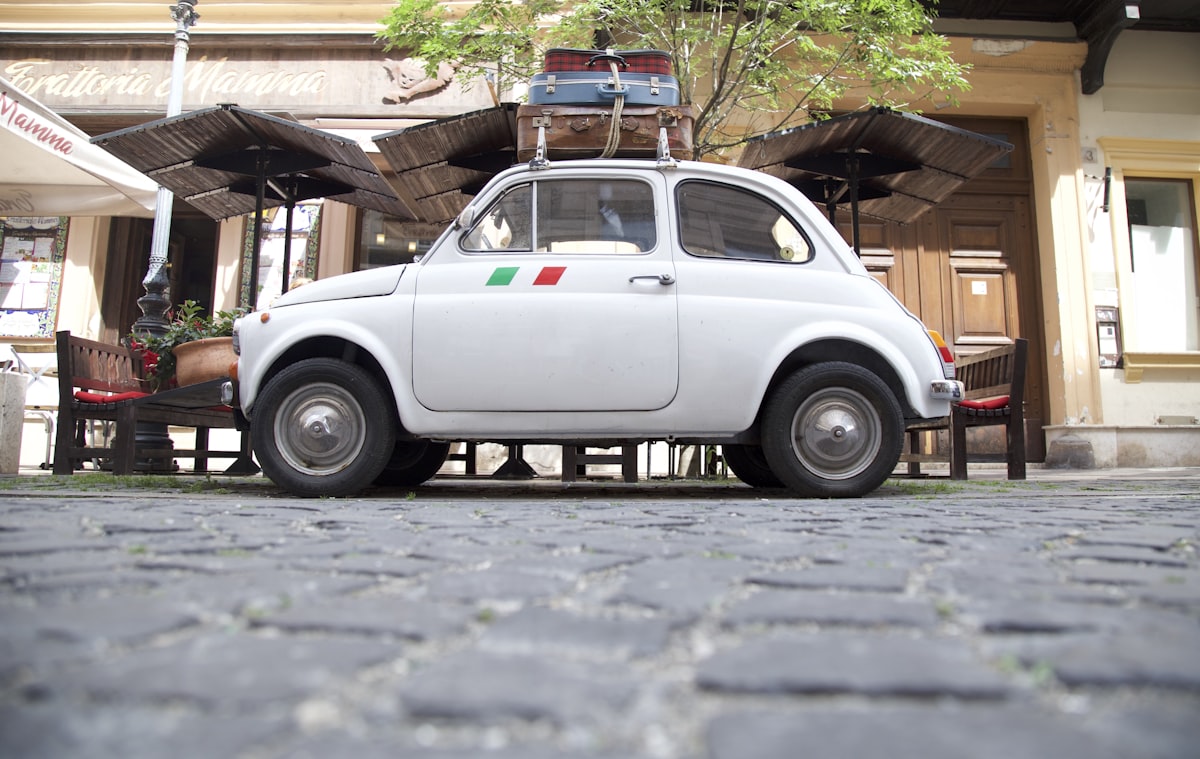
The 24mm focal length is a classic street photography choice — wide enough to capture context and environment, but not so wide that it distorts faces. A fast 1/400s shutter freezes the walking subjects mid-stride without any motion blur. The full-frame Canon 6D handles ISO 400 with virtually no noise, keeping the cobblestones and architectural details crisp and clean.
6. Harmony of Structure and Nature
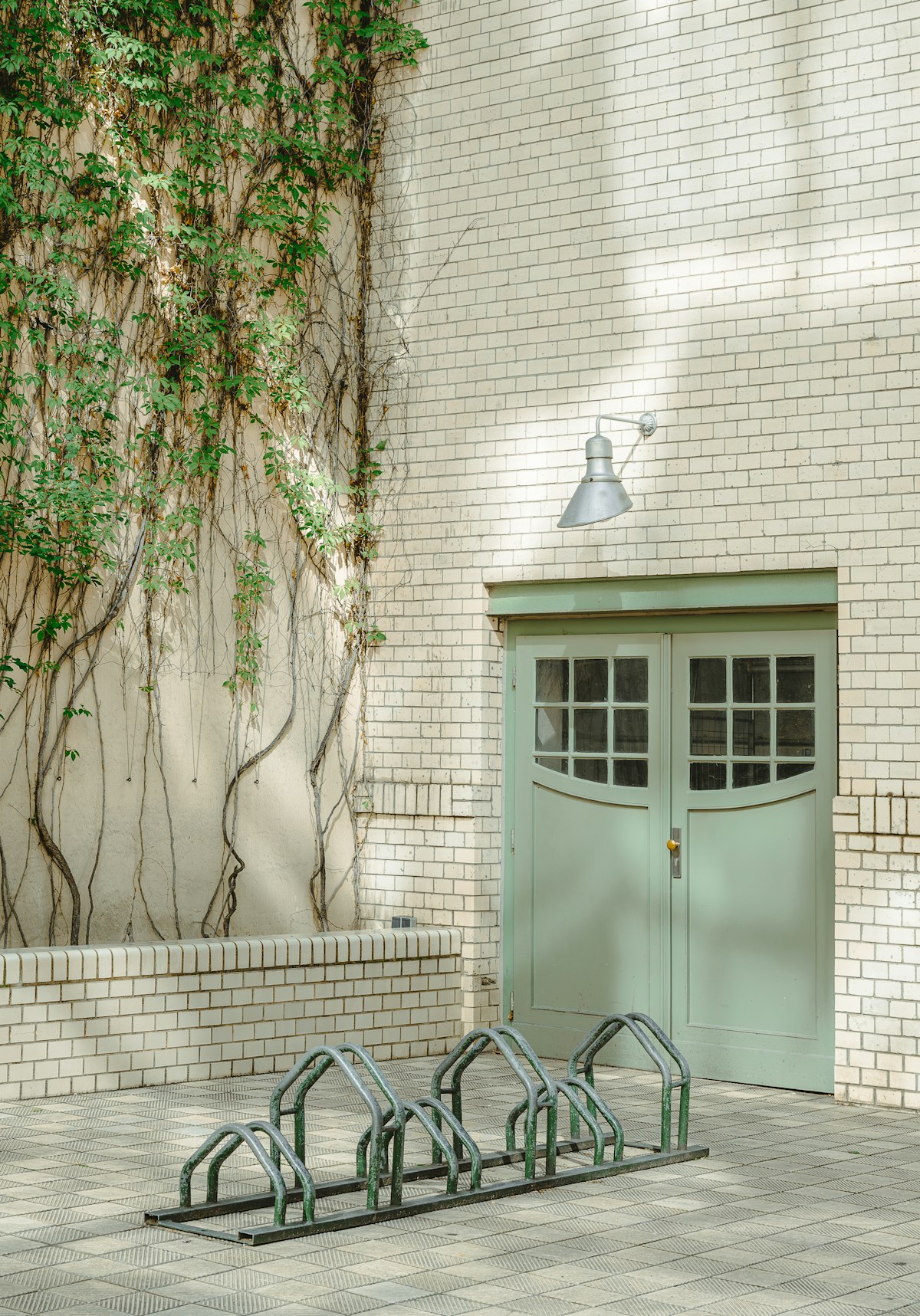
The Nikon Z5 represents the modern mirrorless approach to street photography — lighter, quieter, and with excellent autofocus tracking. At 54mm, the mid-telephoto perspective compresses the relationship between the building and surrounding foliage, creating a sense of visual harmony. ISO 100 ensures maximum dynamic range and color fidelity in this daylight scene.
7. Vibrant Night Trails by the Cathedral
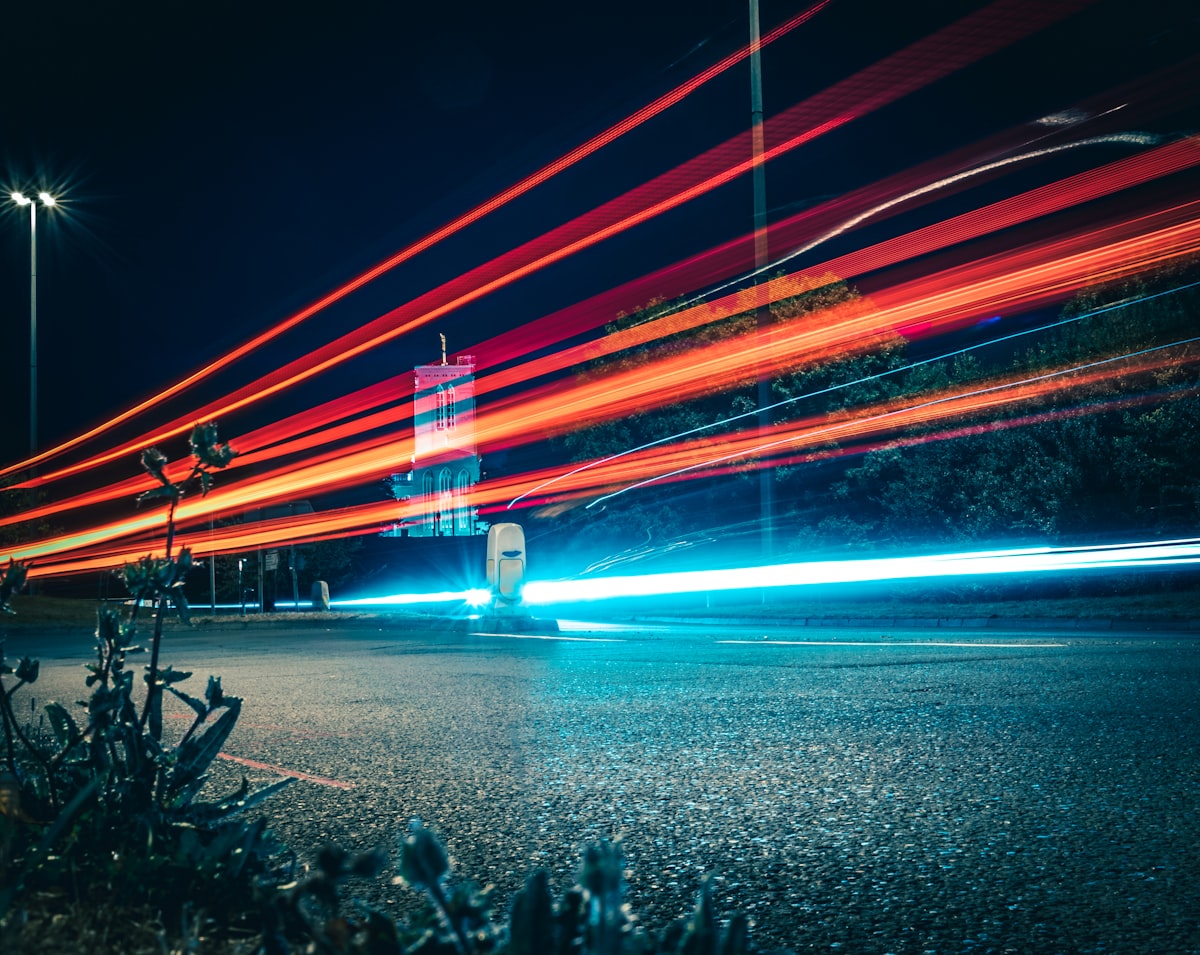
A 30-second exposure transforms passing cars into ribbons of light streaming past the cathedral — a technique that turns an ordinary street corner into something cinematic. The Nikon D3300 is an entry-level DSLR, proving that expensive gear is not a prerequisite for stunning long-exposure work. All that was needed here was a tripod, f/16 for starburst effects on the streetlights, and patience.
8. Bergen Street Photography
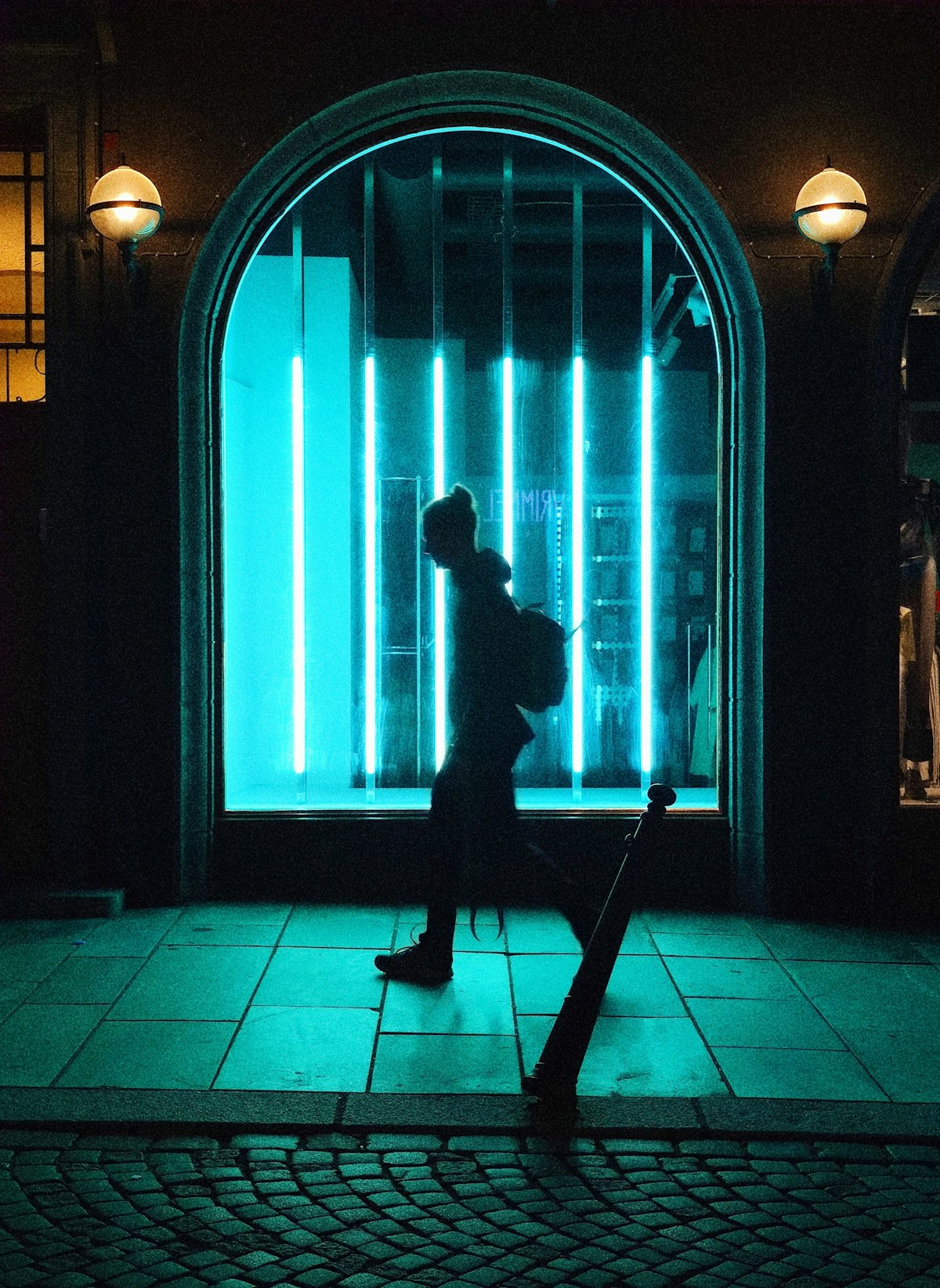
This image was shot entirely on a smartphone — and it holds up beautifully. The Xiaomi’s f/2 aperture gathers enough light to shoot handheld at night without excessive noise, while the phone’s computational photography handles the heavy lifting of noise reduction and sharpening. This is the ultimate proof that the best camera for street photography is the one in a pocket.
What These Photos Teach Us
After studying all eight examples, several powerful lessons emerge that apply to any street photography session:
Focal Length Is a Creative Choice, Not a Limitation
These eight photos span from 8.2mm to 198mm — an enormous range. There is no single “correct” lens for street photography. Ultra-wide lenses (12-24mm) pull the viewer into the scene and emphasize environment. Standard lenses (35-56mm) mimic natural human vision. Telephoto lenses (100mm+) allow discreet candid shooting from a distance. The key is to consciously choose a focal length that matches the story being told.
Shutter Speed Tells the Story of Time
Compare Jack Finnigan’s 1/8-second motion blur with Karim MANJRA’s frozen 1/400s shutter. Both are excellent street photographs, but they communicate entirely different ideas about time and movement. Slow shutters convey energy and flow; fast shutters preserve the decisive moment. Choosing shutter speed intentionally — not just for “correct” exposure — separates snapshots from photographs.
Gear Matters Less Than Presence
The cameras in this collection range from a 2009 Canon 500D to a modern Nikon Z5 to a Xiaomi phone. Entry-level DSLRs, professional mirrorless bodies, and smartphones all produced compelling work. What mattered in every case was being in the right place, at the right time, with the awareness to press the shutter. No amount of gear can replace that.
Light Is Everything
The night shots demonstrate that low light is not a barrier — it is an opportunity. Light trails, neon reflections, and the warm glow of streetlamps create atmosphere that midday sun simply cannot replicate. The best street photographers chase interesting light before they chase interesting subjects.
Your Sunday Challenge: Capture Candid Life
Here is the structured plan for today’s challenge. Block out approximately five hours and follow this timeline:
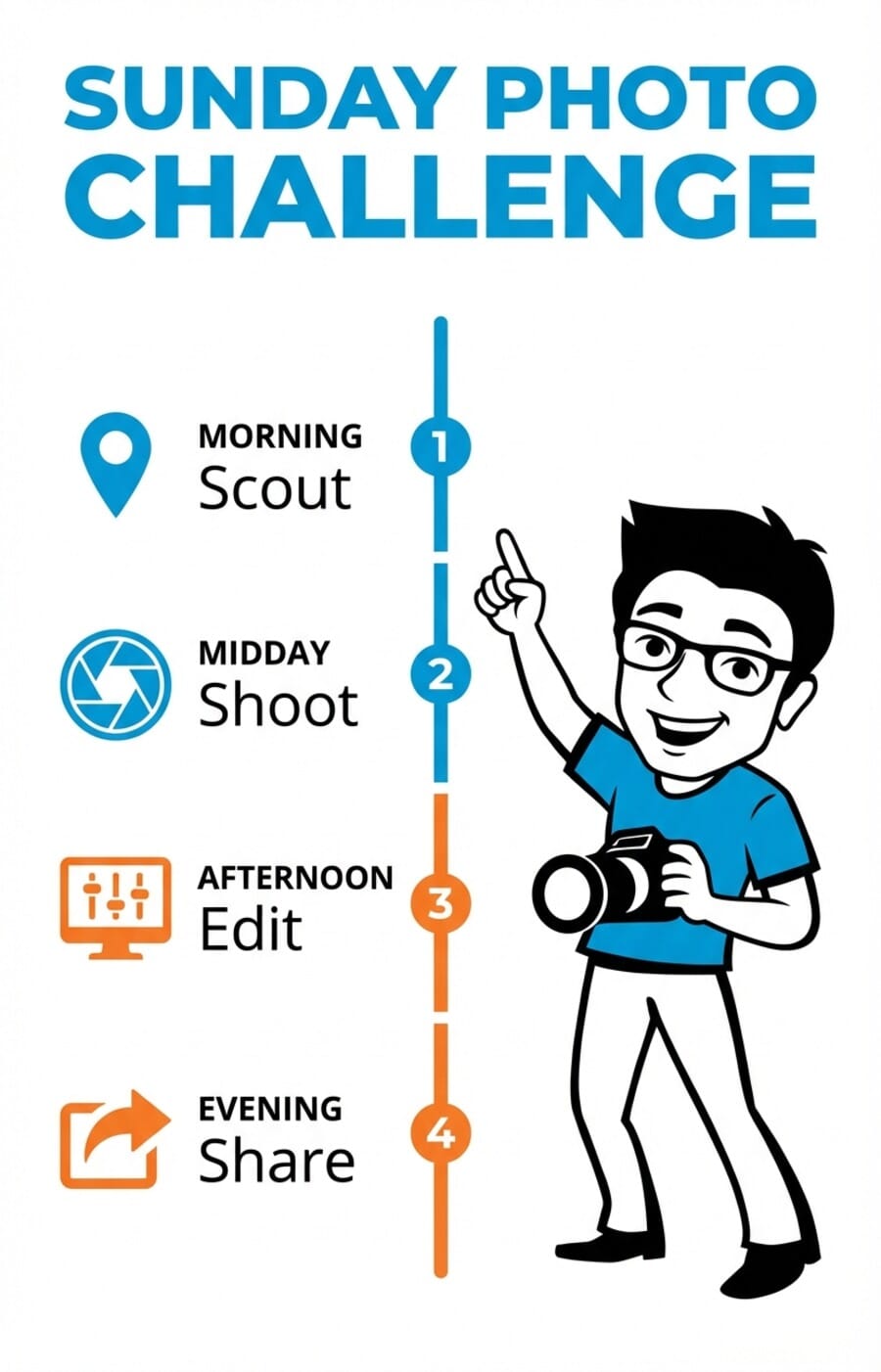
🌅 Morning — Scout (1 Hour)
Choose a location with consistent foot traffic: a downtown area, a market, a transit hub, or a busy park. Spend the first hour simply walking and observing without pressing the shutter. Notice where the light falls, which corners have interesting shadows, where people naturally pause or congregate. Identify three specific spots to return to during the active shooting phase.
☀️ Midday — Shoot (2 Hours)
Return to the scouted locations and shoot aggressively. Aim for at least 100 frames — volume is critical in street photography because candid moments are unpredictable. Try three different focal lengths or perspectives: shoot wide establishing shots, mid-range environmental portraits, and tight telephoto details. Experiment with at least one slow shutter speed (1/15s or slower) to capture motion blur.
🌤️ Afternoon — Edit (1 Hour)
Import all frames and do a first pass to eliminate obvious rejects (out of focus, bad framing, empty moments). From the remaining images, select the best five. For each, apply basic edits: straighten the horizon, adjust exposure, bump contrast slightly, and consider converting one or two to black and white. Resist the urge to over-edit — street photography thrives on authenticity.
🌆 Evening — Share
Pick the single strongest image from the final five and share it on social media with the hashtag #SundayPhotoChallenge. In the caption, mention the camera settings used and one thing learned during the shoot. Sharing completes the creative cycle and invites feedback that accelerates improvement.
Recommended Camera Settings for Street Photography
Street conditions change fast. Use these starting-point settings for four common scenarios, then adjust as needed:
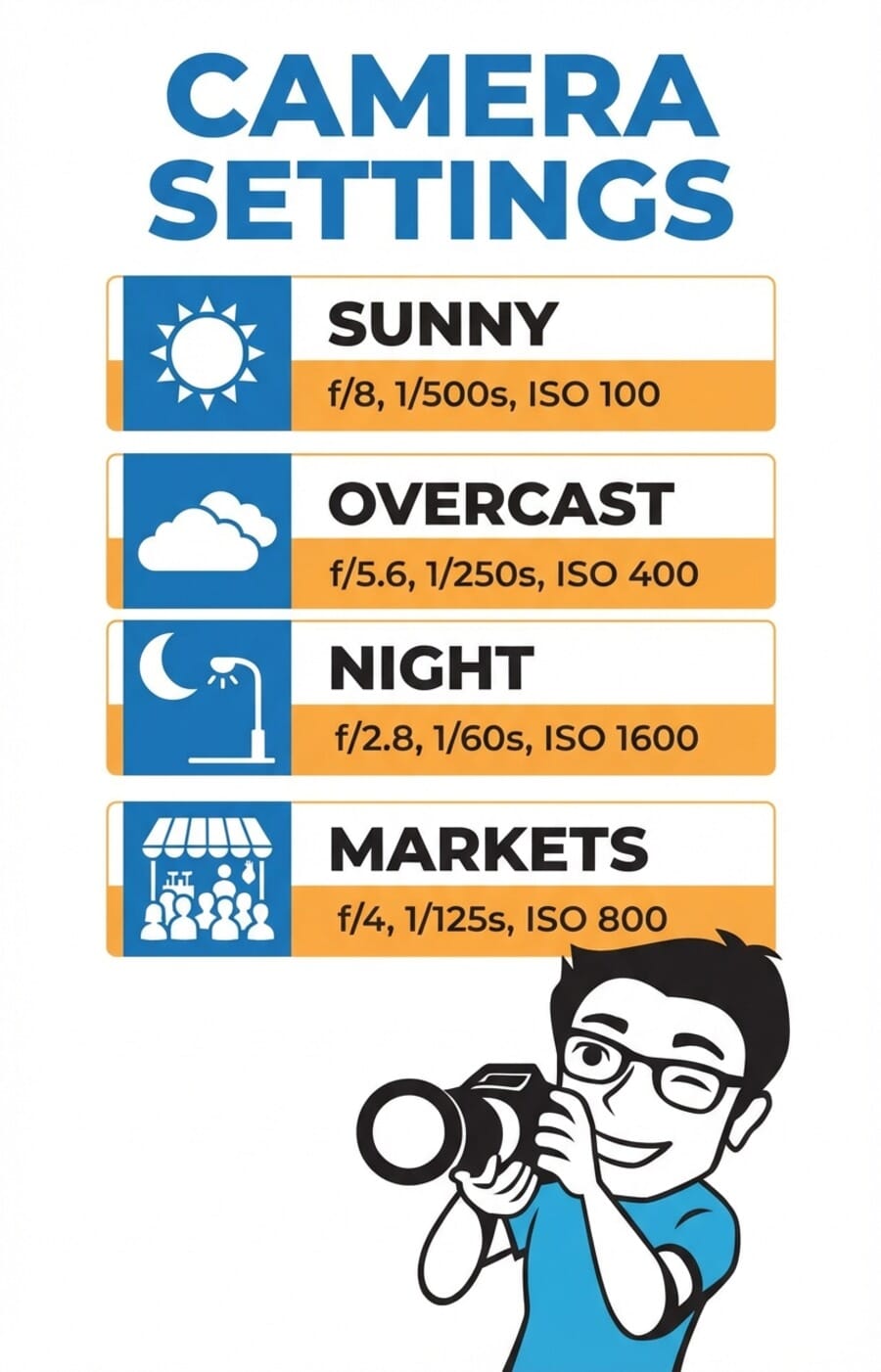
Sunny Streets
Aperture: f/8 · Shutter: 1/500s · ISO: 100–200
Bright daylight allows a fast shutter speed to freeze action and a narrow aperture for deep depth of field. Set focus to manual at approximately 3 meters for zone focusing — everything from 2m to 5m will be acceptably sharp, eliminating autofocus lag entirely.
Overcast / Shade
Aperture: f/5.6 · Shutter: 1/250s · ISO: 400
Open up the aperture one or two stops and raise ISO to compensate for reduced light. Overcast conditions produce beautifully even, diffused light with no harsh shadows — ideal for portraits and candid faces.
Night / Low Light
Aperture: f/2–2.8 · Shutter: 1/60s (handheld) or 15–30s (tripod) · ISO: 1600–3200
At night, shoot wide open and accept higher ISO noise — modern cameras handle ISO 1600 remarkably well. For light trail effects like the cathedral shot above, mount on a tripod, drop to ISO 100, close down to f/16, and use a 15–30 second exposure.
Indoor Markets
Aperture: f/4 · Shutter: 1/125s · ISO: 800
Markets are visually rich but often poorly lit. Use a moderate aperture to keep stall displays in focus while maintaining enough shutter speed to freeze hand gestures and movement. Bump ISO as needed — a slightly noisy sharp photo always beats a clean blurry one.
Frequently Asked Questions
Is street photography legal?
In most countries, photographing people in public spaces is legal because there is no reasonable expectation of privacy in public. However, laws vary by jurisdiction — some countries (notably Germany and France) have stricter rules about publishing recognizable faces. As a general practice, if someone objects to being photographed, respect their wishes and delete the image. For commercial use, model releases are typically required regardless of location.
What is the best focal length for street photography?
The classic street photography focal lengths are 28mm, 35mm, and 50mm (full-frame equivalent). A 35mm lens is the most versatile — wide enough for environmental context but tight enough to isolate subjects. That said, the example photos above demonstrate that compelling street work can be done at any focal length from 12mm to 198mm. Rather than obsessing over the “perfect” lens, pick one focal length and spend the entire day shooting with it to develop a deeper feel for its perspective.
How can photographers approach strangers without being awkward?
The most important technique is confidence. Walk purposefully, keep the camera visible (not hidden), and do not sneak around. Most people either will not notice or will not care. For closer interactions, a smile and a nod after taking the photo goes a long way. Some photographers carry small cards explaining their project. Others prefer to shoot with longer lenses (70–200mm) from across the street to avoid interaction entirely. Both approaches are valid — find the one that matches personal comfort level.
Can street photography be done with a phone?
Absolutely. Joshua Kettle’s Bergen nightlife shot in this challenge was taken on a Xiaomi Mi Note 10 Pro. Modern smartphones have excellent sensors, fast autofocus, and computational photography features that handle challenging lighting surprisingly well. Phones also have a massive advantage in street photography: they are inconspicuous. Nobody gives a second glance to someone holding a phone, making it easier to capture truly candid moments without altering the scene.
What is the best time of day for street photography?
Every time of day offers different opportunities. Early morning provides soft, directional light and empty streets with long shadows. Midday brings the most foot traffic and activity, though harsh overhead sun can create unflattering shadows on faces. Golden hour (the hour before sunset) is universally flattering with warm, low-angle light. Night introduces neon, reflections, and light trails. The honest answer: the best time is whenever there is an interesting intersection of light and human activity. Shoot at all hours and discover personal preferences through experience.