


- Camera-scanning — photographing film negatives with a digital camera and a macro lens — is the workflow serious film shooters are migrating to, and it’s up to ~10× faster than a flatbed scanner.
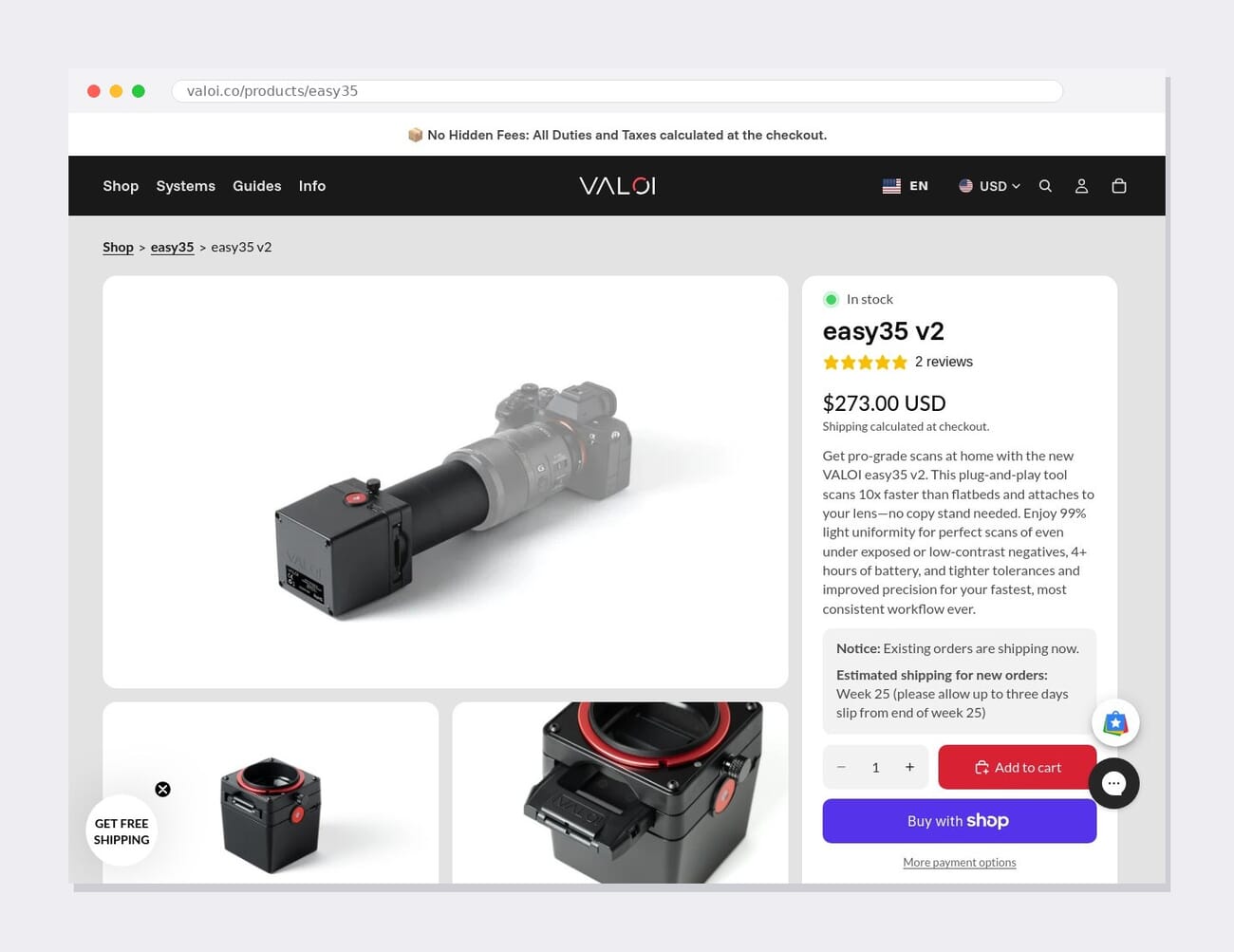
- The Valoi easy35 v2 is a ground-up redesign of that kit: a sturdier injection-molded body, a 99%-uniform CRI 95+ light source, a tighter film holder, ~4-hour battery with USB-C, and full user-repairability.
- It’s around $272 (€229 / £199) — but it only handles capture. You still need a camera, a 1:1 macro lens, and conversion software like Negative Lab Pro.
- If you already own a mirrorless camera and a macro lens, camera-scanning now beats a flatbed on speed and quality. If you don’t, a dedicated scanner is still the cheaper entry point.
Film is back, and the people shooting it have a problem the darkroom never solved well: getting those negatives into a computer quickly, cheaply, and at high quality. For years the default answer was a flatbed scanner. Increasingly, it isn’t — serious shooters are switching to camera-scanning, using a digital camera and a macro lens to photograph their negatives instead. The new Valoi easy35 v2 is the clearest sign yet that this workflow has gone mainstream.
Digital Camera World just reviewed the v2 and came away impressed — better materials, simpler controls, a more even light source, all wrapped around the same fast workflow. But the more interesting question for anyone sitting on a shoebox of undeveloped rolls isn’t “is this a good gadget?” It’s whether camera-scanning is now the better way to digitize film, full stop. Here’s the honest answer.
When you buy through links on our site, we may earn a commission at no cost to you. We evaluate products independently. Commissions do not affect our evaluations.
What Camera-Scanning Actually Is
Instead of laying negatives on a flatbed and waiting for a scan head to crawl across them, camera-scanning treats your mirrorless or DSLR body as the scanner. You mount a 1:1 macro lens, point it at a backlit negative held flat in a holder, and take a photo. The resulting RAW file is then inverted and color-corrected in software. That’s the whole idea — and it’s genuinely fast.

The speed difference is not subtle. A flatbed can take several minutes per frame at high resolution; a camera rig can knock out a 36-exposure roll in about two minutes. Because you’re using your camera’s sensor — often 24MP or more — resolution and dynamic range are excellent, and you can re-shoot a tricky frame instantly instead of re-running a whole scan.
Where the Valoi easy35 v2 Fits
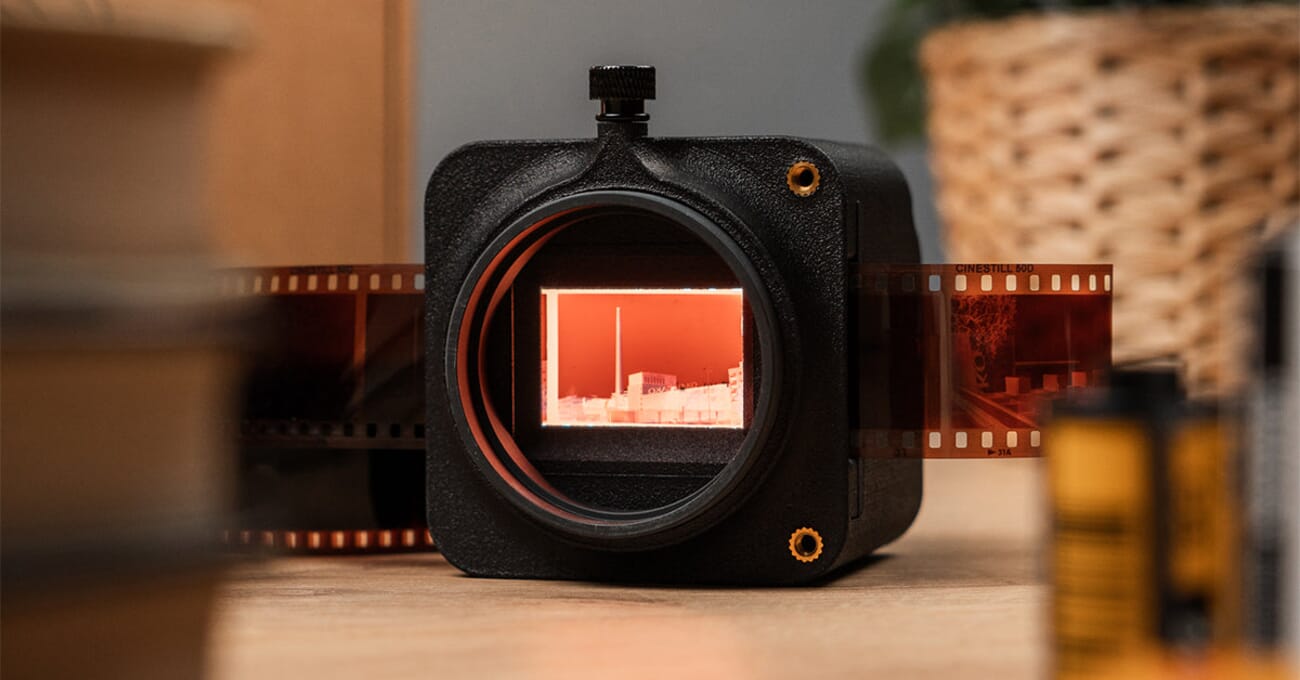
The hard part of camera-scanning has always been the fiddly bits: holding the film dead flat, lighting it evenly, and keeping the sensor parallel to the negative. The easy35 is a self-contained unit that screws onto your macro lens’s filter thread and solves all three — light source, film transport, and alignment in one tube. The v2 is a near-total redesign (available at B&H and direct from Valoi for around $272 / €229 / £199; early preorders ran closer to $240).
What actually changed, and why it matters:
- A far better light source. Edge-to-edge uniformity jumped from 81% to 99%, with a CRI 95+ panel pre-balanced for color negatives. Even illumination is the difference between clean scans and color casts you fight in post.
- Sturdier, tighter build. The old 3D-printed nylon body is now injection-molded ABS with 5–10× tighter tolerances, plus an all-metal rotation mechanism and a spring-loaded five-point film holder for consistent flatness.
- Simpler and longer-lasting. One on/off button (no fiddly brightness/temperature dials), roughly four hours of battery, USB-C power with battery-bypass, and magnetic accessories.
- User-repairable. It’s screwed together, not glued — battery, electronics, and housing are individually replaceable. Rare, and welcome.
Camera-Scanning vs. a Flatbed: The Honest Trade-Off
This is where you have to be honest with yourself about gear you already own. Camera-scanning wins decisively on speed and, with a good macro lens, matches or beats consumer flatbeds on quality. But it is not a single purchase. The easy35 only handles capture — you still need a digital camera, a true 1:1 macro lens, and conversion software (Negative Lab Pro or FilmLab, usually alongside Lightroom).
So the math is simple. If you already shoot a mirrorless camera and own (or can borrow) a macro lens, adding the easy35 v2 turns your existing kit into a scanner that’s faster and sharper than most flatbeds for a couple hundred dollars. If you don’t own that gear, a dedicated scanner is still the cheaper, simpler way in — you don’t want to buy a camera and a macro lens just to digitize a few rolls. And if the easy35’s roughly $273 price is steeper than your project warrants, a dedicated slide and film scanner is the cheaper budget route.

The Catches Worth Knowing
Camera-scanning isn’t magic. Dust is the eternal enemy — a speck on the light source or negative shows up on every frame, so a blower and clean workspace are non-negotiable (the v2 adds a magnetic duster to help). Getting the extension tubes and alignment exactly right takes a little patience the first time. And the software step has a learning curve: a good conversion in Negative Lab Pro is its own small craft. None of these are dealbreakers, but they’re the difference between the glossy “two minutes a roll” promise and your first real session.
FAQ
Do I need a special camera for camera-scanning?
No — almost any modern mirrorless or DSLR works. What matters is a true 1:1 (1.0× magnification) macro lens so a single 35mm frame fills your sensor, plus a tripod or copy stand to keep things steady and parallel.
Is camera-scanning really better than a flatbed?
For 35mm, yes on speed and usually on quality — if you already own the camera and macro lens. Flatbeds still hold an edge for medium and large format on a budget, and for anyone who doesn’t want to buy camera gear just to scan.
How much is the Valoi easy35 v2, and what’s in the kit?
Around $272 (€229 / £199). The kit includes the easy35 v2 unit, a 35mm film holder, a set of distance tubes and filter-thread adapters, and a USB-C cable. You supply the camera, macro lens, and conversion software.
What software do I need to convert the negatives?
The easy35 only captures the image — you invert and color-correct afterward. Negative Lab Pro (a Lightroom plugin) and FilmLab are the popular choices; both turn the orange-masked negative capture into a finished positive.
The Bottom Line
The easy35 v2 doesn’t reinvent camera-scanning so much as remove the last excuses not to do it — the uneven light, the flimsy build, the fiddly controls are gone. For film shooters who already own a mirrorless camera and a macro lens, it makes a strong case that camera-scanning isn’t just a faster option anymore; it’s the default. For everyone else, the workflow is worth understanding before your next gear purchase — because the “scanner” you should buy might be a macro lens.
Featured image: Valoi.
Primary Coverage
- Digital Camera World — Valoi easy35 v2 review – The review this piece is built around — specs, pros/cons, verdict.
- PetaPixel — “Valoi easy35 v2 Promises to Be the Easiest Way to Scan Film at Home” – Launch details and what changed from the v1.
- Valoi — easy35 system (official) – Manufacturer specs, kit contents, and pricing.
Image Sources
- Valoi (product image); Unsplash — Markus Spiske, Caleb Minear – Product and illustrative photography.
PhotoWorkout may earn a commission on qualifying purchases made through links in this post, at no extra cost to you.