

- Hasselblad disqualified a generative-AI image from the Masters 2026 shortlist this week — but only after Reddit and Instagram commenters flagged it. The image had cleared Hasselblad’s internal voting process, the same process the company uses to pick all 70 finalists before the Grand Jury sees them.
- This is not a Hasselblad problem. Every major photography competition currently relies on human reviewers as the primary AI-detection layer. Human reviewers reliably catch the 2024 generation of AI (the hands and ears and text artifacts). They miss the 2026 generation almost completely.
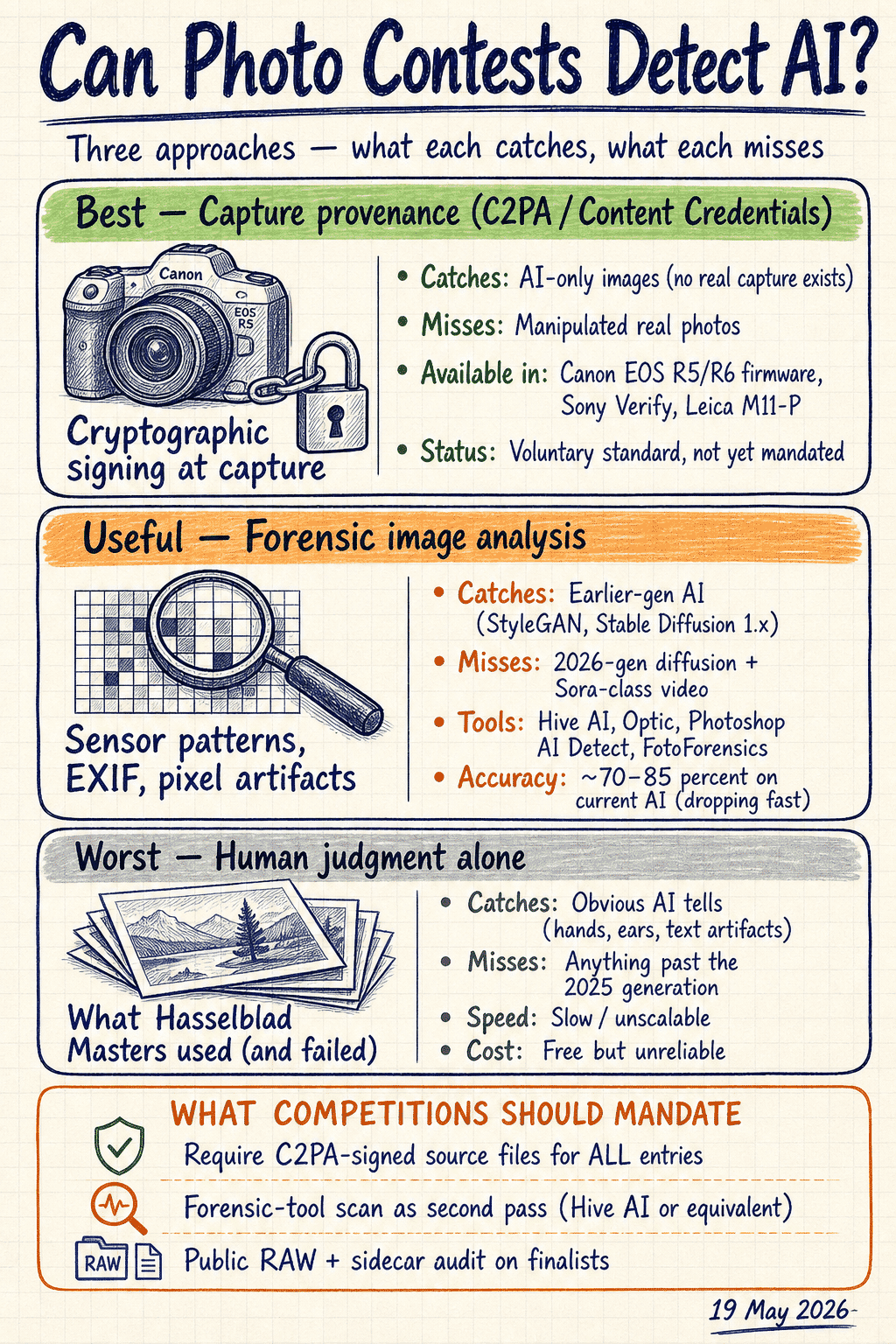
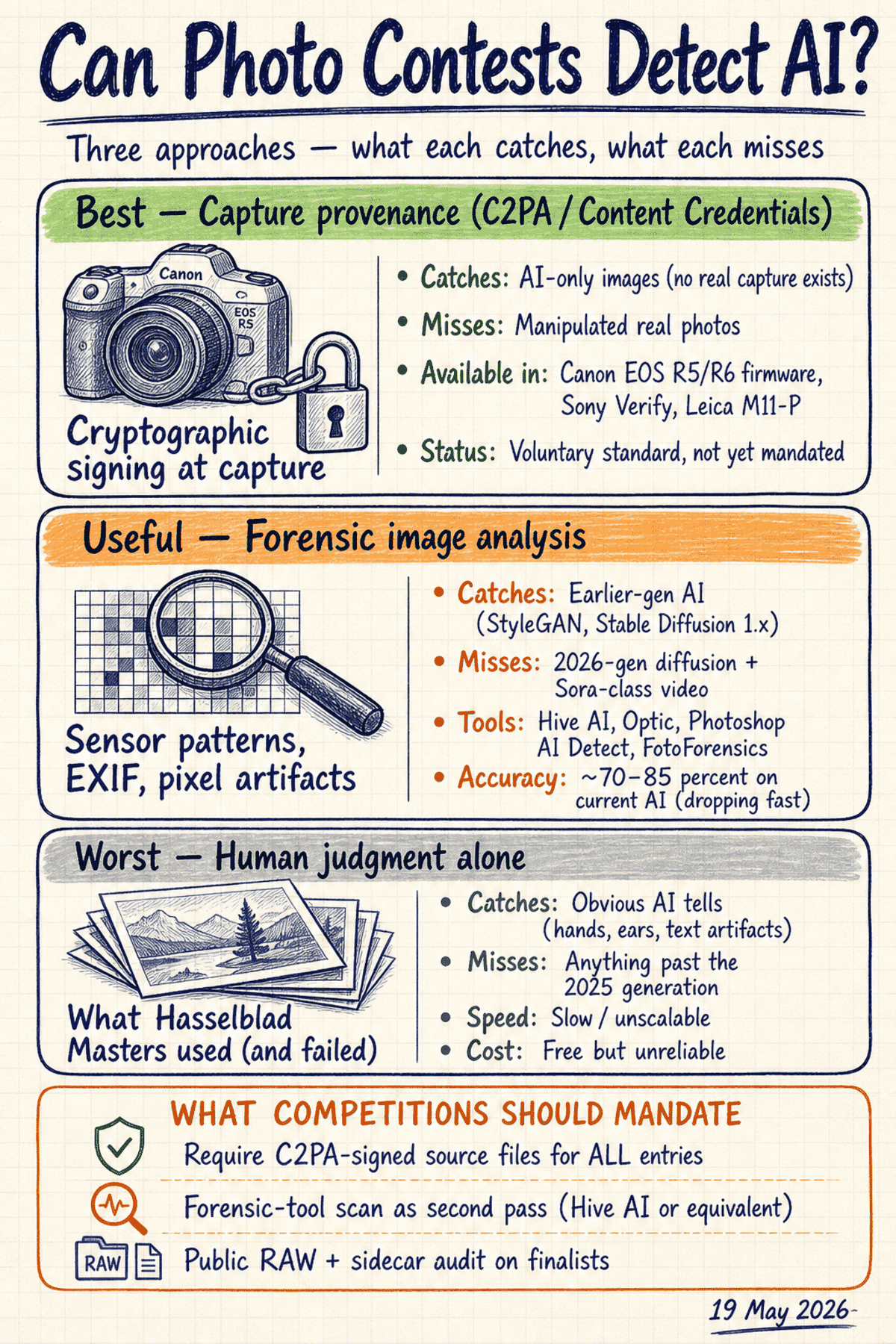
- The technology to fix this exists. C2PA / Content Credentials cryptographically signs images at capture, making AI-generated content trivially identifiable (because no genuine capture event exists). Adoption is voluntary — currently in Canon EOS R5/R6 firmware, Sony Verify, and Leica M11-P. No major photo competition currently mandates it.
- Forensic image-analysis tools (Hive AI, Optic, Photoshop AI Detect) catch around 70-85 percent of current-gen AI, but accuracy drops every quarter as diffusion models improve. The honest answer to ‘can human judges reliably catch a top-tier AI image’ is: not anymore. The fix has to be procedural — mandate C2PA signing on entry, run forensic tools as a second pass, audit finalists’ RAW files.
Update — May 20, 2026. The C2PA discussion in this piece just got a major update. OpenAI announced on May 19 that all images from ChatGPT and the OpenAI API now ship with C2PA metadata and the SynthID watermark, paired with a public verifier at openai.com/verify — eight days after Canon launched a full C2PA newsroom certificate chain (R1 and R5 Mark II, Reuters as pilot). The convergence and what it means for working photographers: OpenAI Watermarks Its Fakes, Canon Signs Real Photos at Capture — Authenticity Just Got Real.
On May 18, 2026, Hasselblad disqualified a photographer from the Hasselblad Masters 2026 shortlist after the entry was identified as generative-AI output. The disqualification happened only because Reddit and Instagram commenters flagged the image within hours of the finalist announcement. Hasselblad’s internal voting process — which selects all 70 finalists from across the seven competition categories before the Grand Jury sees them — had cleared the entry.
The replacement finalist is now in place. The Grand Jury (a panel of working photographers) will pick category winners in late June. The PR damage is contained. But the actual lesson — what photo competitions need to do differently to keep AI out — has not been the story most outlets covered. That’s the question this piece tries to answer honestly.
What Happened (Briefly)
Hasselblad Masters 2026 announced its 70 finalists on April 28 — ten per category across seven categories (Street, Landscape, Portrait, etc.). Within hours of the announcement, commenters on Reddit’s r/photography subreddit and on Instagram flagged a particular Street category entry as showing all the telltale markers of generative AI: anatomical inconsistencies, the kind of mid-frame logical errors diffusion models produce when assembling a complex urban scene, and a quality of light that didn’t match any physical camera response. The accusations propagated through Threads and PetaPixel’s editorial channel within 48 hours.
Hasselblad responded with measured language — “we take the accusations very seriously” and “should any violation be confirmed, the shortlisted qualification of the offending work will be revoked immediately.” On May 18 the disqualification was confirmed. The photographer was removed and replaced with the 11th-place entry from the internal vote, per Hasselblad’s statement to PetaPixel. No public statement was issued beyond that.
The structural detail that matters: the 70 finalists are picked by internal Hasselblad voting, not by the Grand Jury. The Grand Jury sees only the post-shortlist field. Whatever review process Hasselblad uses internally to vet entries before voting clearly didn’t catch this one. Hasselblad has not described that process publicly.
The Three Detection Approaches — What Actually Works
Capture provenance (C2PA / Content Credentials) — the best long-term answer
C2PA — Coalition for Content Provenance and Authenticity — is the cryptographic-signing standard backed by Adobe, Microsoft, Sony, Canon, Leica, Nikon, and the BBC. When a C2PA-aware camera captures an image, it embeds a cryptographic signature in the file’s metadata at the moment of capture. The signature records: who captured it (the camera body), when (timestamp), what edits were applied later, and whether any AI processing was used downstream. The chain is verifiable end-to-end.
For AI-generated images, this is binary: if no camera signed the image at capture, there is no genuine provenance chain. The image fails verification. A photo competition that mandates C2PA-signed source files for all entries closes the AI-generated content vector almost completely.
What C2PA does NOT catch: an image that was genuinely captured but then heavily AI-edited (Photoshop AI generative fill, Topaz Sharpen, sky replacements). Most competitions already have rules about post-processing extent; the C2PA system at least makes those edits auditable from the signed history. Adoption today: Canon EOS R5/R6 via firmware update, Sony Verify on certain Alpha bodies, Leica M11-P at capture. No major competition currently requires the signed file at entry.
Forensic image analysis — useful, but accuracy is decaying
This is the toolkit category that includes Hive AI (the most widely-used commercial detector), Optic, Photoshop’s built-in AI Detect, FotoForensics, and a growing list of academic tools. They look for signatures of AI generation that humans can’t see: pixel-level GAN/diffusion artifacts, sensor-pattern absence (real images carry a unique sensor-noise fingerprint that AI images lack), EXIF anomalies, color-space inconsistencies, frequency-domain patterns specific to particular diffusion model architectures.
Current accuracy on 2024-2025-vintage AI (StyleGAN, Stable Diffusion 1.x, early Midjourney): roughly 85-95%. Current accuracy on 2026-vintage AI (the diffusion models that produced the Hasselblad shortlist entry): closer to 70-80%, with a steep negative trend. The model-vs-detector arms race favors the model — each new generation of diffusion (or Sora-class video model) gets trained, in part, against the leading detectors. By 2027, expect headline detection accuracy on top-tier AI to drop below 60%.
For competitions, forensic tools work as a second-pass filter: run every entry through a detector and flag anything above a confidence threshold for human review. Useful, not sufficient.
Human judgment alone — the approach that failed at Hasselblad
The internal review process Hasselblad used catches what human reviewers can see — fingers fused into mittens, ear cartilage in impossible shapes, text reading “PHOTGRAPHY,” ghosted limbs in crowd scenes. By 2025, top-tier diffusion models had eliminated most of those obvious tells. By 2026, the remaining ones are subtle enough that a tired Hasselblad reviewer flicking through 4,000 entries simply will not catch them in a calibrated number of seconds per image.
Our own real-vs-AI quiz tested PhotoWorkout readers on a calibrated set of mixed images. The median photographer scored about 6 out of 10. Professional photographers averaged 7. Nobody hit 10. The honest answer to “can experienced photographers reliably catch top-tier AI today” is: not at the rate competitions need them to.
What Photo Competitions Should Actually Do
A defensible AI-detection protocol for a 2026-2027 photo competition needs three layers:
- Mandate C2PA-signed source files at entry. Submission requires the C2PA-signed original from a participating camera body. Composite or AI-only entries fail the verification step automatically. This is the single highest-leverage rule. Cameras that already support it ship to roughly 30% of working pros; the rest can be grandfathered with a transition window.
- Forensic-tool scan as a second pass. Every entry that passes C2PA verification gets run through a commercial detector (Hive AI’s commercial tier costs around $0.01-0.05 per image at scale — completely tractable for a contest of any size). Anything above a confidence threshold gets flagged for human review.
- Public RAW + sidecar audit for finalists. Once finalists are selected, require the photographer to submit the RAW file and processing sidecar (Lightroom XMP, Capture One settings file) for public audit. This isn’t novel — World Press Photo, Wildlife Photographer of the Year, and several others already require it for their top finalists. The change is making it a hard gate, not a discretionary follow-up.
None of these are technically difficult. None of them require new technology. They require the competition organizer to choose accuracy over submission volume, and to invest in the verification infrastructure. Hasselblad, World Press Photo, and the National Geographic competitions all have the resources to do this. Whether they actually adopt the protocol before the 2027 cycle is a leadership question, not a technology question.
What This Means for Photographers
Three practical takeaways for working photographers:
- If you shoot with a C2PA-capable body (Canon EOS R5/R6 with the firmware update, Sony Alpha with Verify enabled, Leica M11-P), enable the feature now. Even if your current target competitions don’t require it, the signed provenance protects you from the inverse accusation — “is your image AI?” — when it doesn’t yet have a verification layer. How AI fakes of real events spread is the broader pattern (and Instagram’s anti-editing bet shows social platforms wrestling with the same problem); provenance is the photographer’s defense.
- Keep your RAW + sidecar workflow disciplined. If a major competition disputes your entry, the ability to immediately produce the RAW file + processing chain is the difference between cleared and disqualified. This was already best practice; it’s now table stakes.
- Lobby competitions you enter to adopt C2PA at the entry layer. The contests that move first will protect the credibility of their winners. The ones that don’t will have a Hasselblad-style incident every cycle until the format collapses. Photographer pressure on the competition end matters more than internal Hasselblad reform — the standard moves when the contests demand it.
Frequently Asked Questions
Can I install an AI detector myself to check images?
Yes. Hive AI offers a free demo at thehive.ai. Optic has a free tier at optic.ai/ai-or-not. Adobe’s Content Credentials verifier is free at verify.contentauthenticity.org. For most casual checks these tools are sufficient — but treat the result as advisory, not definitive. A 90% AI-likelihood score doesn’t mean the image IS AI; it means it shares statistical patterns with AI-generated content.
Will C2PA detection be defeatable?
The cryptographic chain itself is essentially un-defeatable using current public cryptography — you cannot forge a C2PA signature from a participating camera without that camera’s private key, and the keys are hardware-bound. The defeat surface is at the edges: someone could photograph a high-resolution print of an AI image with a C2PA-capable camera, producing a signed image that IS a genuine capture but contains AI-generated content. That attack works in theory; in practice it adds significant friction and visible “this is a photo of a print” artifacts. Not a perfect defense, but a real raise of the bar.
Is this just going to keep happening?
Yes, until competitions change their submission requirements. AI image quality improves quarterly. Human detection accuracy has plateaued. Without procedural reform on the contest side, every major contest will have an AI-finalist incident within the next 18 months. The question isn’t whether — it’s which contest leads on real reform first.
Are AI-generated images legal to submit to photo contests?
Most major contests explicitly prohibit AI-generated entries in their rules. Hasselblad Masters does. World Press Photo does. So does the Sony World Photography Awards. Submitting an AI image isn’t a legal violation per se, but it is a rule-violation that gets the entry disqualified — and, increasingly, the photographer banned from future competition cycles. The Hasselblad disqualification this week didn’t include a future-cycle ban, but expect that to become standard within a year.
Image credit: editorial composition and detection-landscape sketch infographic by PhotoWorkout. Reporting credit to PetaPixel and DIY Photography (full citations below). Hasselblad has not released an extended public statement on the disqualification.
Reporting and prior coverage cited in this article:
Primary Sources
- PetaPixel — AI-Generated 'Photo' Disqualified From Hasselblad Masters 2026 (May 18, 2026) – Disqualification confirmation with Hasselblad's official statement.
- PetaPixel — Hasselblad Masters Photo Contest Accused of Shortlisting an AI Image (April 29, 2026) – Original accusations 3 weeks before the disqualification.
- DIY Photography — Hasselblad Disqualifies AI Image from Masters 2026 Competition – Parallel reporting with additional context on the replacement finalist.
- Hasselblad Masters 2026 — Official Competition Page – Competition information, categories, voting, judging schedule.
Detection Tools and Standards
- Coalition for Content Provenance and Authenticity (C2PA) – Official C2PA standards body. Cryptographic signing protocol referenced throughout this article.
- Hive AI — image generation detection – Commercial AI detector with a free demo tier. Most widely-used in editorial verification workflows.