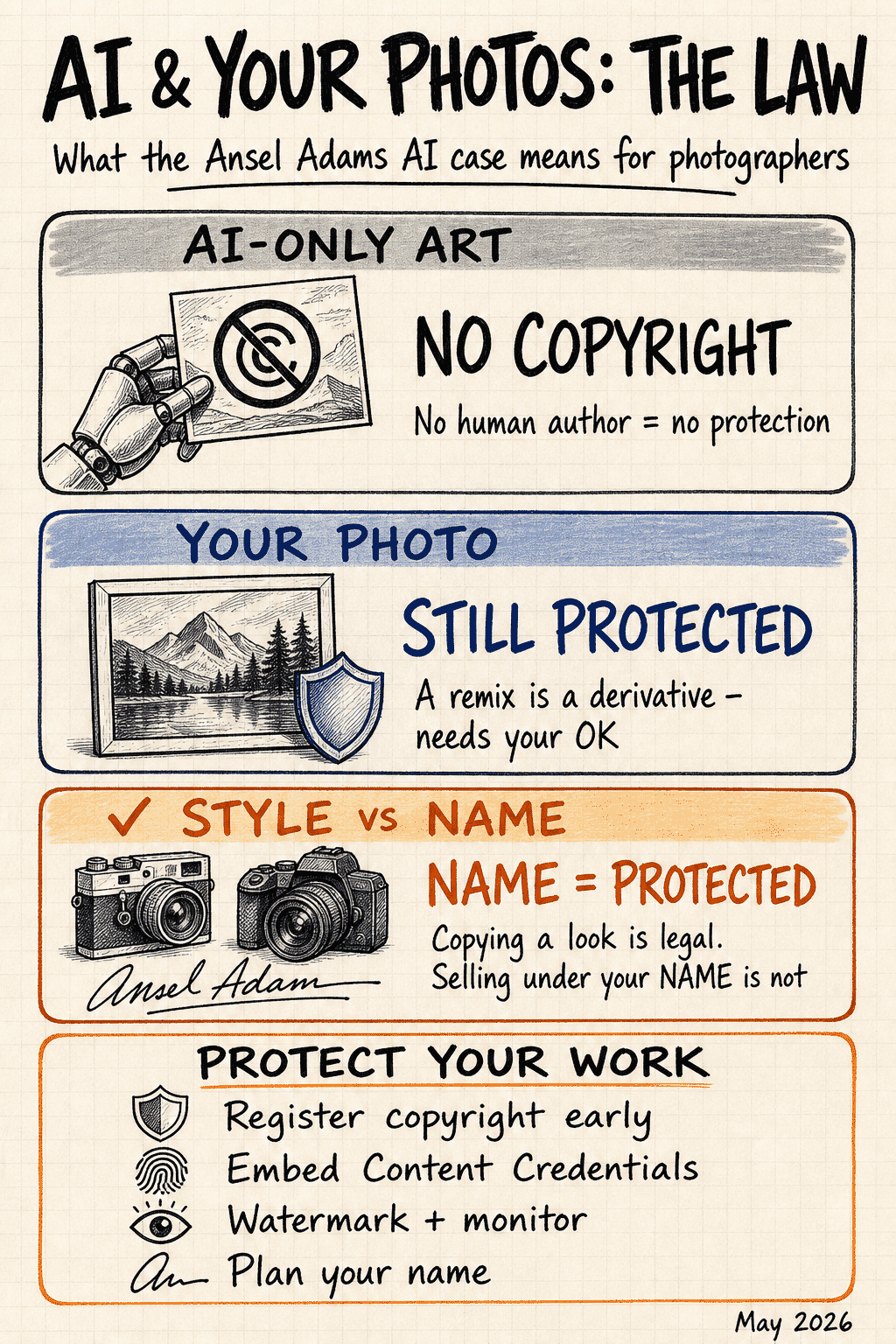


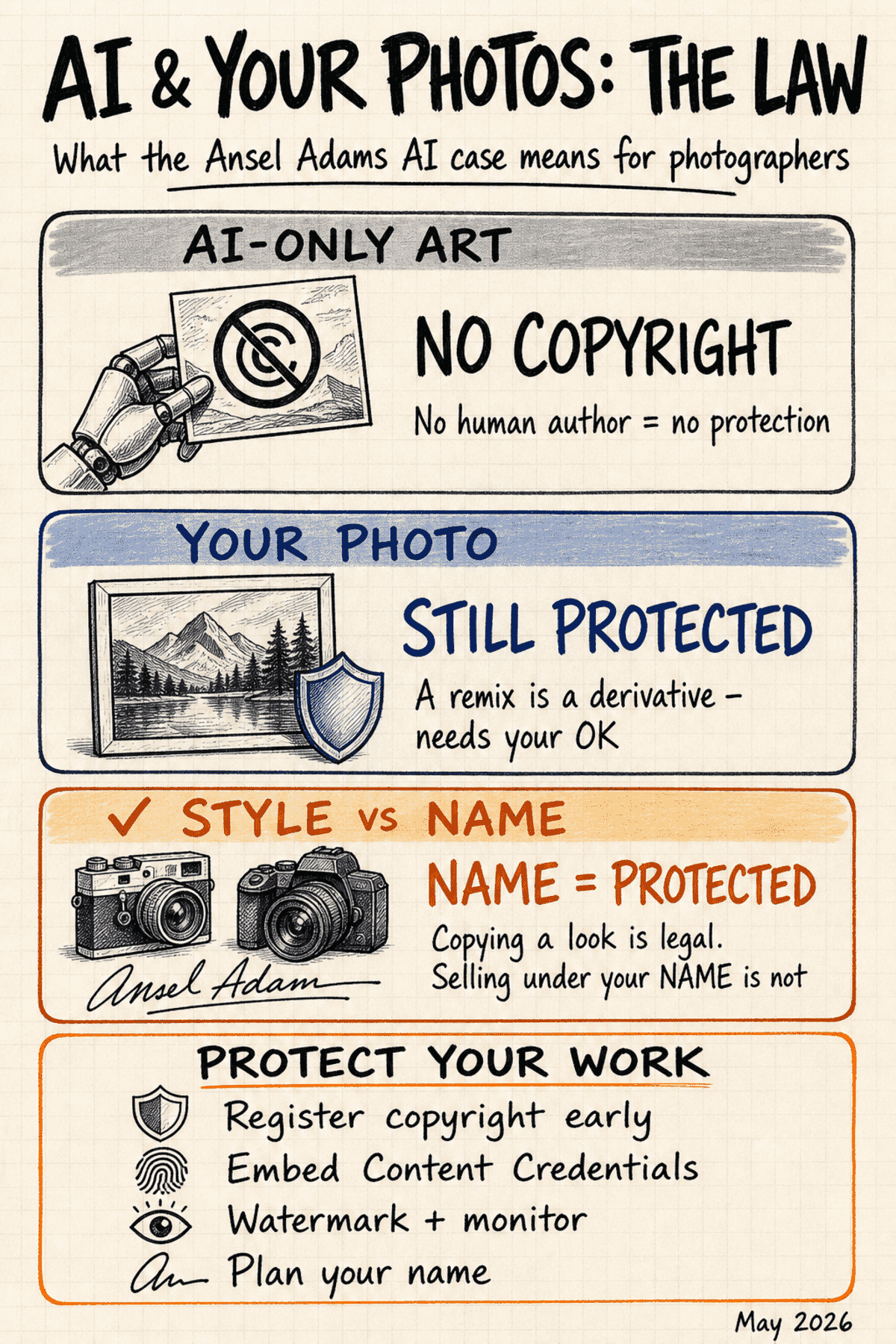
- Danziger Gallery exhibited and priced an AI-colorized version of Ansel Adams’ ‘Moonrise, Hernandez, New Mexico’ at $10,000 during AIPAD’s April 2026 show — without the Ansel Adams Publishing Rights Trust’s permission.
- The Trust’s objection isn’t to AI itself. It’s the unauthorized use of Adams’ name and most iconic image to sell the work, with no human artist credited.
- Under current US law a purely AI-generated image can’t be copyrighted — the Supreme Court let that rule stand in March 2026 — but the original photograph and the artist’s name remain protected.
- The strongest legal lever in cases like this is often the right of publicity, not copyright: most states bar commercial use of a person’s name, and several now extend that protection after death.
- Photographers can protect their own work today: register copyrights promptly, embed Content Credentials and metadata, watermark, monitor for misuse, and address name and likeness in estate planning.
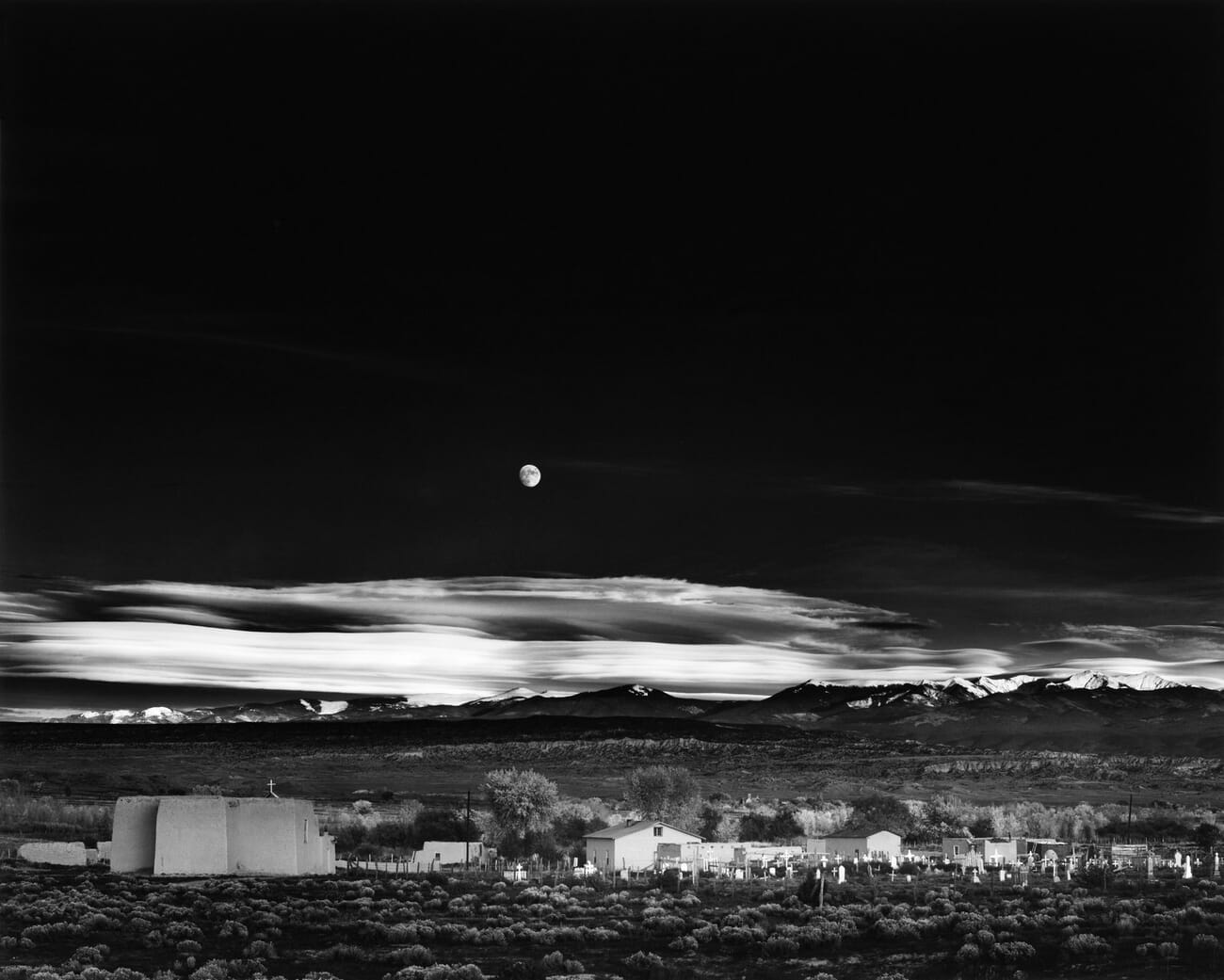
At AIPAD’s April photography show in New York, a framed print on Danziger Gallery’s wall carried a $10,000 price tag and one of the most recognizable images in American photography: Ansel Adams’ Moonrise, Hernandez, New Mexico. Except it wasn’t quite Adams’ photograph. It was an AI-colorized version of his black-and-white masterpiece — and the trust that controls his legacy says it never gave permission.
The story, reported across the photography press and picked up by Engadget and ARTnews, is easy to misread as a simple forgery — a fake passed off as the real thing. It wasn’t. The work was openly labeled as AI-generated. What makes it a genuine legal flashpoint is subtler, and it matters to every working photographer, not just the estate of a legend.
The questions it raises — who owns an AI derivative of a famous image, whether a dead artist’s name can be used to sell it, and what protection any photographer actually has against AI clones — sit in some of the murkiest territory in copyright law right now. Here’s what’s really going on, and what it means for your own portfolio.
What actually happened at AIPAD
The Photography Show, run by the Association of International Photography Art Dealers (AIPAD), took over the Park Avenue Armory in New York from April 22 to 26, 2026. Among the booths, Danziger Gallery displayed an “AI-generated color version” of Moonrise, Hernandez, New Mexico — Adams’ celebrated 1941 photograph of a moon hanging over a small New Mexico village beneath a darkened sky — offered as an editioned print for $10,000.
The Ansel Adams Publishing Rights Trust, which administers his work, says it had no idea. In a public statement, the Trust said it did not authorize, endorse, or consent to the colorized version. Once alerted, it contacted gallery owner James Danziger directly and asked for the work to be pulled. According to the Trust, Danziger went on to invoke Adams’ name and the AIPAD showing while pitching a broader commercial AI-colorization venture involving other artists’ estates.
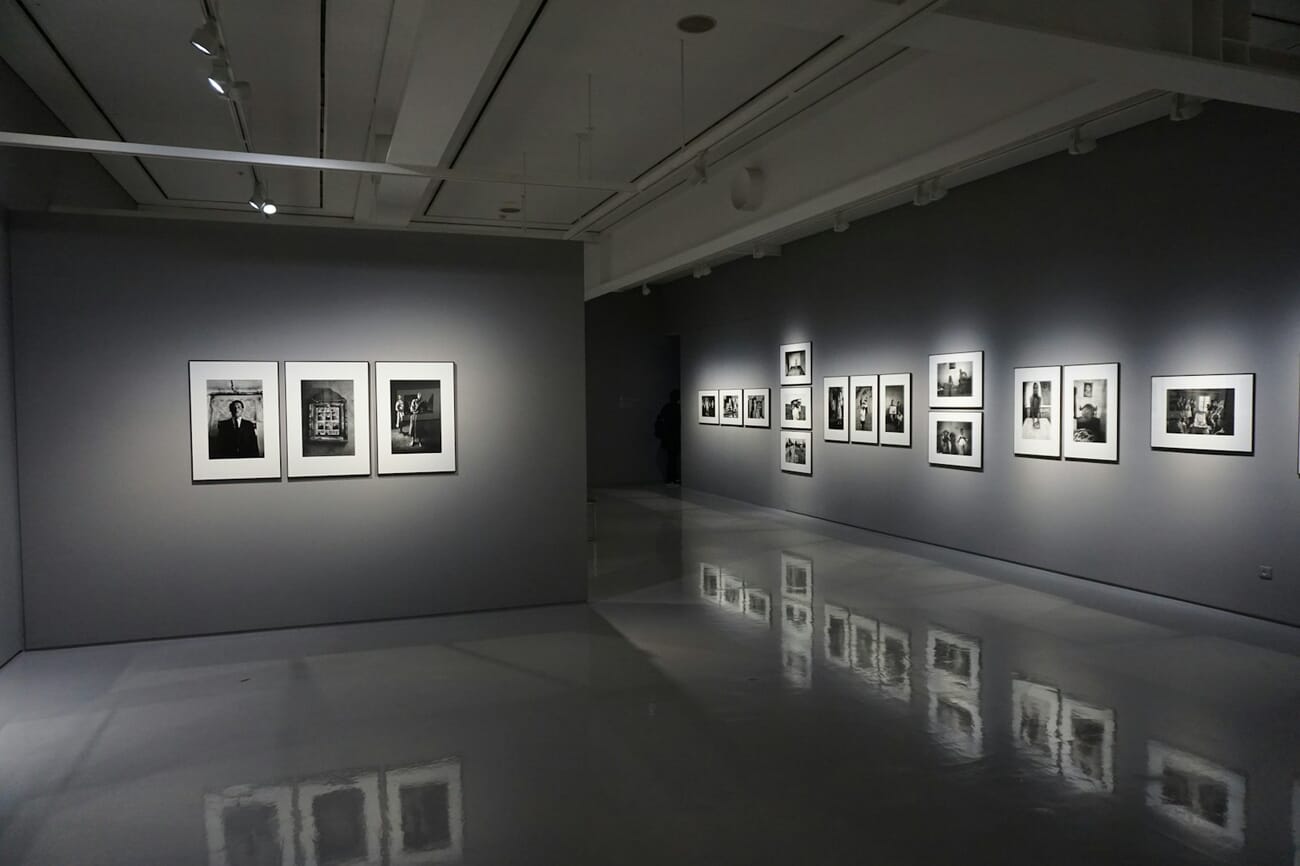
Why this isn’t a “fake passed off as real” story
It would be easy — and wrong — to file this under forgery. The piece wasn’t sold as a genuine vintage Adams print; it was presented as an AI colorization. And the Trust went out of its way to say it has nothing against AI. Adams, it noted, was fascinated by technology and “remarkably prescient about — and excited by — the potential of computers to transform photography.”
The objection is narrower and sharper: using Adams’ name, reputation, and his single most iconic image to sell an unauthorized derivative — while crediting no human artist at all. Strip away the AI angle and the same complaint would apply to anyone slapping a dead master’s name on work he never made. That reframing is the whole point, because it moves the fight out of copyright’s grayest zone and onto firmer legal ground.
The copyright reality photographers keep getting wrong
Three legal facts sit underneath this dispute, and most photographers get at least one of them backwards.
A purely AI-generated image can’t be copyrighted
US copyright law protects works of human authorship — full stop. The Copyright Office has repeatedly refused to register images generated by AI from a text prompt, and in March 2026 the Supreme Court declined to hear a challenge to that position, leaving the rule firmly in place. It’s one of the clearest threads running through how AI is reshaping photography careers and workflows.
It goes further than “no prompt-only art.” In the Copyright Office’s SURYAST decision, even an image built from a photographer’s own base photo run through a chosen art style was refused — because the AI, not the human, decided how the elements combined. Translation: feeding a famous photo into a colorization model doesn’t create a new copyrighted work for whoever pressed the button.
But the original photograph is still protected
Here’s the catch that trips people up. The fact that the AI output isn’t copyrightable doesn’t make the source image fair game. Moonrise is a specific, identifiable work, and an AI colorization of it is a derivative — and the right to make derivatives belongs to the rights holder, not to whoever owns a colorization app. For older photographs the copyright math gets complicated, which is partly why the Trust’s statement leans less on infringement and more on something else entirely.
Style isn’t protected — but a name is a different matter
One thing copyright never covers is style. Shooting sweeping black-and-white Western landscapes with deep tonal range and a zone-system approach is not infringement — Adams didn’t own the look, and neither does his estate. Anyone can work “in the style of.” What you can’t freely do is take his actual photograph and his actual name and put both on something for sale. That distinction — style versus identity — is where the real exposure lives.
Right of publicity: the protection that outlives the photographer
The strongest lever in a case like this often isn’t copyright at all. It’s the right of publicity — the right to control commercial use of your name, image, and likeness. Most US states recognize it, and a growing number extend it after death.
California, long the center of gravity for these claims, protects a deceased person’s name and likeness for 70 years. In early 2026, New York enacted laws expanding posthumous publicity rights to cover AI “digital replicas” of deceased personalities used commercially. Tennessee’s ELVIS Act took aim at AI voice cloning. There’s still no single federal right of publicity, so it remains a state-by-state patchwork — but the direction is unmistakable: using a real person’s identity to sell AI-generated work is getting riskier, not safer.
For Adams, whose name alone carries enormous commercial weight, that’s the cleaner argument. The Trust doesn’t have to win a thorny derivative-work fight over a 1941 negative; it can simply object to his name being used to move a $10,000 print he had nothing to do with.
How to actually protect your own portfolio
Most photographers will never have an estate-sized brand to defend. But the same tools that matter in the Adams case scale all the way down to a working shooter with a portfolio website and a few hundred images online.
Register your copyright — promptly
Copyright exists the moment you press the shutter, but registration is what gives it teeth. In the US, registering with the Copyright Office before an infringement (or within three months of publication) unlocks statutory damages of up to $150,000 per willful infringement, plus attorney’s fees. Without timely registration, you’re limited to provable actual damages — often pennies. Batch-register your best work; it’s cheap insurance.
Embed Content Credentials and metadata
Provenance is your friend. Embedding C2PA Content Credentials and complete IPTC metadata at export stamps your authorship and capture data into the file itself — the same standard Canon is baking into cameras and OpenAI is using to flag AI output. If you’re fuzzy on what’s already in your files, start with the basics of image metadata and Content Credentials. It won’t stop a determined thief, but it builds a documented trail of who made what, and when.
Watermark, license clearly, and monitor
Visible watermarks deter casual lifting; clear licensing terms remove the “I didn’t know” defense — the same discipline that separates photographers who actually earn from licensing their work from those who give it away. Then watch for misuse: reverse image search and monitoring services surface stolen work, and a DMCA takedown notice resolves most cases without a lawyer. Detection is getting harder as AI improves — Hasselblad’s Masters competition only caught an AI entry after the internet flagged it — which makes documented provenance more valuable, not less.
Plan for your name and likeness
This is the Adams lesson in miniature. If your name carries commercial value — and for established photographers it does — address it in estate planning the way any other asset gets handled. Spell out who controls your name, image, and body of work after you’re gone. The estates scrambling to respond to AI today are the ones that didn’t plan for it.
FAQ
Was the AI Ansel Adams image actually sold?
The available reporting says it was exhibited and offered for sale at $10,000 as an editioned print during AIPAD’s April 2026 show. The Ansel Adams Publishing Rights Trust, which says it never authorized the work, asked the gallery to remove it. The coverage does not confirm a completed sale.
Can you copyright an AI-generated photo?
Not if it’s purely AI-generated. US law requires human authorship, and the Supreme Court left that standard intact in March 2026. Works that mix substantial human creativity with AI elements can be registered, but the protection covers only the human-made contribution.
Is copying a photographer’s style illegal?
No. Copyright protects specific works, not styles, techniques, or genres. You can shoot in the manner of any photographer you admire. What you cannot do is reproduce their actual images or use their name to market your own work.
What’s the difference between copyright and right of publicity?
Copyright protects the work — the photograph itself. Right of publicity protects the person — their name, image, and likeness — from unauthorized commercial use. The Adams dispute touches both, but the publicity-rights angle (using his name to sell) is often the stronger claim.
How can I protect my photos from AI cloning?
Register your copyrights, embed Content Credentials and metadata, watermark and license clearly, monitor for misuse, and use available AI-training opt-outs. None of it is bulletproof, but together they create real friction and a documented paper trail.
The bottom line
The AI “Ansel Adams” isn’t really a story about a clever fake. It’s a preview of a fight the entire industry is walking into: when a machine can convincingly remix any famous image, the value — and the vulnerability — shifts to names, provenance, and permission. Adams’ estate has the resources to push back. The practical takeaway for everyone else is to build the paper trail now, while it’s cheap, rather than after a model has already swallowed your portfolio. (This article is general information, not legal advice — for anything involving your own rights, talk to an intellectual-property attorney.)
Image credits: featured and in-body photographs by Kaya Arro, Eric Park, and Zulfugar Karimov on Unsplash. The AI-colorized Moonrise work referenced in this article is deliberately not reproduced here.
Primary Coverage
- Engadget — Ansel Adams' trust says AI-colorized version of his work was exhibited without permission – The Trust's statement and the gallery's response, May 2026.
- ARTnews — Ansel Adams Trust Slams Gallery for AI-Generated Work at AIPAD – Details on the AIPAD presentation and the editioned offering.
Copyright & Publicity Law
- US Copyright Office — Copyright and Artificial Intelligence – Official guidance on the human-authorship requirement.
- CNBC — Supreme Court declines to hear dispute over copyrights for AI-generated material – Coverage of the March 2026 cert denial.
- Crowell & Moring — AI and the Right of Publicity: A Patchwork of State Laws – How posthumous publicity rights and digital-replica laws vary by state.