


- Sony Semiconductor announced the LYTIA L910 — its first mobile image sensor built around LOFIC — a roughly 50-megapixel, 1/1.28-inch stacked sensor that captures about 100 dB, or nearly 17 stops, of dynamic range in a single exposure.
- LOFIC (Lateral Overflow Integration Capacitor) adds a small capacitor to each pixel that banks the overflow charge from bright areas that would normally clip — so highlights and shadows are captured together, in one shot, not stitched from a multi-frame HDR burst.
- It also uses Triple Conversion Gain HDR and an Ultra-High Conversion Gain mode that Sony says cuts random noise by around 30%, for cleaner shadows and low light.
- In plain terms: better-held bright skies, cleaner shadow recovery, and fewer HDR ghosting artifacts on moving subjects — plus 4K HDR video at 60fps.
- Mass production starts this summer, so fall and winter 2026 flagship phones could ship it as the main camera. It’s already being demoed for the Vivo X500 Pro Max.
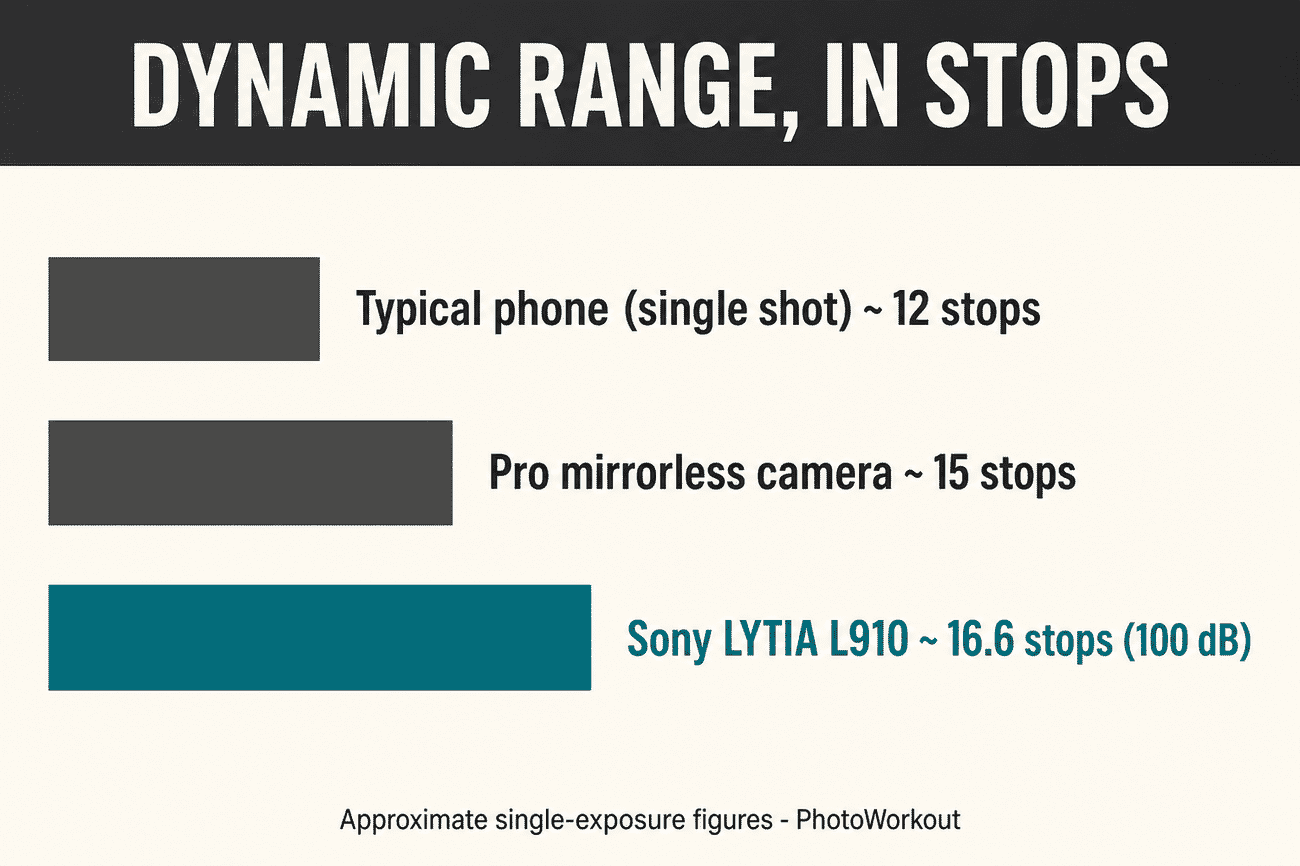
Every year someone claims phone cameras are catching up to “real” cameras, and every year the honest answer is “sort of.” Sony’s newest sensor announcement is one of the more legitimate steps in that direction. The LYTIA L910 is Sony Semiconductor’s first mobile sensor built around a technique called LOFIC, and it captures roughly 100 dB — about 16.6 stops — of dynamic range in a single exposure. For context, that is in the same neighborhood as a high-end mirrorless camera, in a sensor small enough to fit in a phone.
Dynamic range is the unglamorous spec that quietly decides whether your sunset has a glowing sky or a white blob, and whether the shadows are full of detail or full of mush. So a real jump here matters more for everyday photos than another megapixel bump. Here is what the L910 actually does, in plain English, and why LOFIC is the clever part.
When you buy through links on our site, we may earn a commission at no cost to you. We evaluate products independently. Commissions do not affect our evaluations.
What “~17 Stops of Dynamic Range” Actually Means
Dynamic range is the gap between the brightest highlight and the darkest shadow a sensor can record in one frame, measured in stops — and each stop is a doubling of light. So the difference between 12 stops and 16 stops is not 33% more; it is 16 times more range between the brightest and darkest tones the sensor can hold at once. That is the difference between a sky that clips to white and a sky that keeps its clouds and color while the shadows under a tree still show detail.
Today’s typical phone captures roughly 12 stops in a single shot and leans on multi-frame HDR — firing several exposures and merging them — to fake the rest. A good mirrorless camera manages around 15 stops in one exposure. The L910’s claimed ~16.6 stops, in a single shot, puts a phone sensor into pro-camera territory on this one metric for the first time.
What LOFIC Is — and Why It’s Clever
LOFIC stands for Lateral Overflow Integration Capacitor, and the idea is simpler than the name. Every pixel is a tiny well that fills with charge as light hits it. In a normal sensor, once that well is full, any extra light from a bright area simply overflows and is lost — that is what “clipping” a highlight means. LOFIC adds a small capacitor next to each pixel and connects it to the photodiode, so when the well overflows, the extra charge is banked in the capacitor instead of thrown away.
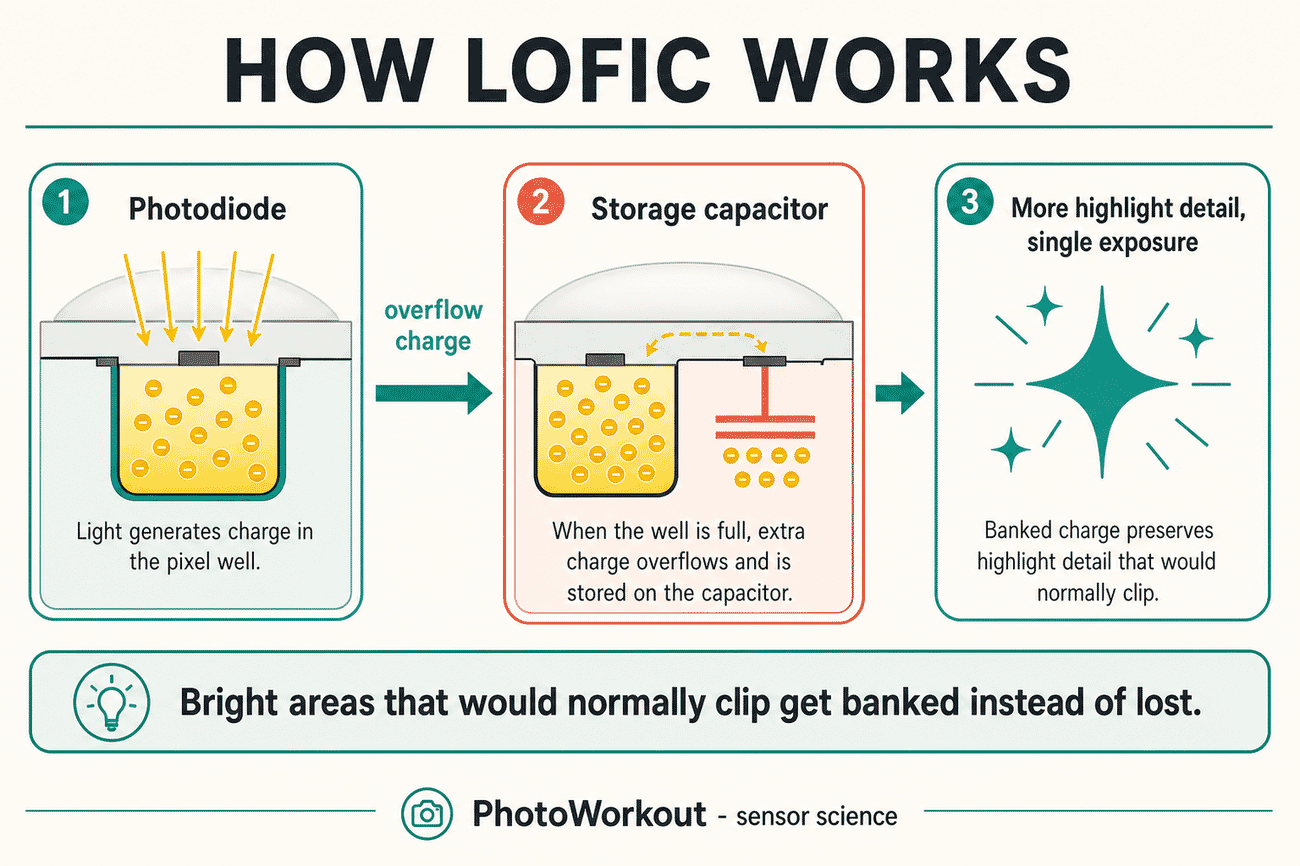
The payoff is single-exposure HDR. Because the sensor can hold both the bright and dark ends of a scene in one frame, it does not have to stack multiple exposures the way phones do today. That eliminates the classic multi-frame HDR problem: ghosting and weird artifacts when something in the scene moves between frames. For action, video, and anything with moving people, a single-exposure approach is genuinely better, not just cleaner on paper.
Triple Conversion Gain and Lower Noise
Two more pieces round out the story. The first is conversion gain — essentially how efficiently the sensor turns captured charge into a voltage signal. Higher conversion gain means less read noise, which is what muddies up shadows and low-light shots. The L910 uses Triple Conversion Gain HDR, blending three different gain settings to cover the full range of a scene, plus an Ultra-High Conversion Gain mode that Sony says reduces random noise by around 30%.
Translated: cleaner shadows, less grain when you lift the dark parts of a photo, and better night performance — on top of the wider dynamic range. It also records 4K HDR video at 60fps, so the benefits carry into video, where blown skies and crushed shadows are even harder to fix after the fact.
What It Means for Your Photos — and the Honest Caveats
Put together, the L910 should mean noticeably better-held bright skies, more recoverable shadow detail, fewer HDR artifacts on moving subjects, and cleaner low-light frames — the parts of phone photography people actually notice. It is a real step in the “phones catching pro dynamic range” story, and on the single metric of single-exposure dynamic range, it genuinely closes much of the gap.
But keep the marketing in perspective. Dynamic range is one spec, not the whole picture. The L910 is still a 1/1.28-inch sensor — large for a phone, tiny next to the full-frame chip in a camera like the Leica SL3-P — so it gathers far less total light, and depth of field, lens quality and processing still separate phones from dedicated cameras. Computational photography is not going away either; LOFIC just gives the software a much better single frame to start from. It is a meaningful upgrade, not the moment phones replace cameras.
Frequently Asked Questions
What is the Sony LYTIA L910?
It is Sony Semiconductor’s first mobile image sensor built with LOFIC technology: a roughly 50-megapixel, 1/1.28-inch stacked CMOS sensor that captures about 100 dB (nearly 17 stops) of dynamic range in a single exposure, with Triple Conversion Gain HDR and 4K 60fps HDR video.
What does LOFIC do?
LOFIC (Lateral Overflow Integration Capacitor) adds a capacitor to each pixel that stores the overflow charge from bright areas that would otherwise clip. That lets the sensor capture highlights and shadows together in one shot, rather than merging several exposures.
Is ~17 stops really as good as a pro camera?
On the single metric of single-exposure dynamic range, it is comparable — a high-end mirrorless camera sits around 15 stops. But the L910 is a much smaller sensor, so it gathers far less light overall, and lens, depth of field and processing still favor dedicated cameras.
Which phones will use it?
Mass production begins this summer, so fall and winter 2026 flagships could carry it as the main camera. Sony is already demonstrating it for the Vivo X500 Pro Max, and other Android flagships are likely to follow.
The Bottom Line
The LYTIA L910 is the kind of sensor announcement that actually earns the hype around phone cameras. LOFIC’s single-exposure approach to high dynamic range is a smarter solution than stacking frames, the ~16.6-stop figure is genuinely close to pro-camera territory, and the noise and video improvements are real. It will not turn your phone into a Leica — physics still favors bigger sensors and better glass — but for the everyday photos where blown skies and muddy shadows do the most damage, the next wave of flagships should be visibly better. Watch for it in late-2026 phones.
Primary Coverage
- Sony Semiconductor Solutions — LYTIA L910 announcement – Official specs: LOFIC, 100 dB DR, Triple Conversion Gain HDR (June 17, 2026).
- PetaPixel — Sony's first LOFIC image sensor promises nearly 17 stops of dynamic range – Coverage and the stops conversion (June 22, 2026).
- Digital Camera World / Y.M.Cinema — LYTIA L910 analysis – Context on LOFIC and flagship-phone adoption.
Image Sources
- Featured concept art, LOFIC diagram, dynamic-range chart and pin — stylized PhotoWorkout illustrations – Original PhotoWorkout editorial graphics; no real product photo of the sensor was used.