


- On July 20, 2026, the European Commission adopted its final 51-page Guidelines on Article 50 and confirmed the companion Code of Practice on Transparency of AI-Generated Content as adequate, less than two weeks before the transparency rules apply on August 2.
- The line photographers actually need: routine edits (exposure, color, cropping, denoise, minor retouching) count as standard editing that does not substantially alter the image, and need no AI label.
- Generative changes are different. A sky replacement, a generative fill that adds or removes real elements, an AI-synthesized background, or a fully AI-generated image can cross into AI-manipulated content that must be disclosed.
- The visible-disclosure duty for deepfake-like manipulations falls on whoever publishes (the deployer); the machine-readable marking duty falls on the AI tool maker (the provider). Penalties for breaches run up to 15 million euros or 3% of global turnover, aimed at systemic non-compliance.
- The Code names C2PA and Content Credentials as the reference marking mechanism, which is why camera-side signing (Leica M11-P, Canon, Pixel) matters. Honest caveat: a credential proves the editing pipeline, not that the photo is true.
For most of the past year, the EU AI Act’s transparency rules have been an abstraction: a law arriving “sometime in 2026” that would make AI content declare itself. That abstraction now has a hard edge. On July 20, 2026, the European Commission adopted the final version of its Article 50 Guidelines and blessed the industry Code of Practice that goes with them, and the rules they interpret start applying on August 2. For photographers and retouchers, the useful question is no longer what the law means in principle. It is concrete: does the edit you just made need an “AI” label?
We covered what Article 50 is and why it matters when the deadline was still on the horizon. This piece is the sequel the photo press has not written yet: with the final rulebook now on the table, here is where the line actually falls between a normal edit and an “AI-manipulated” image that has to say so.
What Actually Landed on July 20
Two documents, both close to the wire. The Commission adopted its Guidelines on the transparency obligations under Article 50, a 51-page interpretive text, and it confirmed that the companion Code of Practice on Transparency of AI-Generated Content had been assessed as adequate. Together they are the practical manual for a law that becomes applicable on August 2, 2026, roughly a week from now.
A caveat worth stating up front: the Guidelines are formally non-binding, and only the Court of Justice of the EU can give the Act an authoritative reading. In practice, though, national market-surveillance authorities and the EU’s AI Office are expected to follow them closely, so they are the best available map of how the rules will be enforced. For a working photographer, treating them as the rulebook is the safe assumption.
The Line That Matters: Standard Editing vs Generative
Here is the single most important thing for photographers, and the part almost no coverage has translated: the obligation to mark AI-manipulated content does not apply where the AI performs “an assistive function for standard editing” or does not substantially alter the input or its meaning. That exemption is written directly into Article 50, and the Guidelines lean on it.
In plain terms, the everyday darkroom work does not trigger a label. Basic color correction, exposure and lighting normalization, cropping and resizing, standard noise reduction and sharpening, and minor retouching such as removing dust spots or a blemish all count as standard editing. They clean up or optimize an image without changing what it fundamentally depicts, so they stay outside the labeling rule even when an AI-powered slider does the work.
The obligation kicks in when the tool stops assisting and starts inventing. If you use generative inpainting to add or remove real elements, synthesize a background the camera never saw, drop in a product or a person who was not there, or replace the sky with a different one, you have substantially altered the image’s semantics. That is the territory the Act wants disclosed, and a fully AI-generated image (a text-to-image render) is squarely inside it.
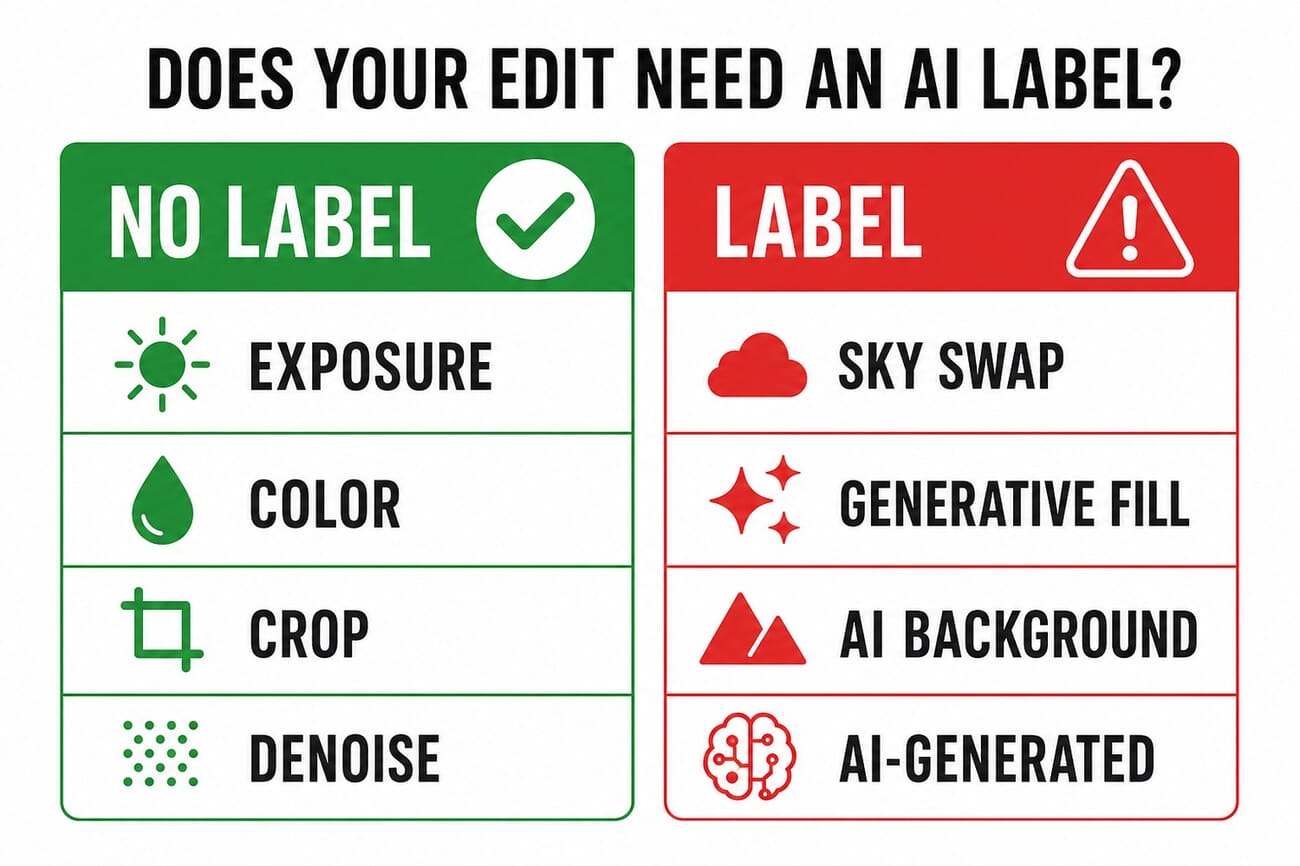
A Retoucher’s Checklist: Does Your Edit Need a Label?
Mapped onto a real editing workflow, the split looks like this.
Generally no label (standard editing):
- Exposure, contrast, white balance, and color grading
- Cropping, straightening, resizing, and lens corrections
- AI denoise and sharpening (Lightroom Denoise, Topaz and the like) as an assistive quality step
- Minor retouching: dust and sensor spots, a small blemish, stray-hair cleanup
Label territory (substantial or generated content):
- Sky replacement on a real scene
- Generative fill or expand that adds or removes meaningful elements
- AI-synthesized backgrounds or inserted objects, products, or people
- Face swaps and AI-generated people
- Fully AI-generated (text-to-image) images
The honest gray zone is content-aware removal. Erasing a distracting tourist from a landscape is generative, but whether it “substantially alters” the scene is exactly the kind of judgment the Guidelines leave to context. The safe reading: if the removal changes what the image is telling the viewer about a real place or event, lean toward disclosure; if it is a cosmetic cleanup that does not change the story, it sits closer to standard editing. When a shot could plausibly be read as a factual record, err on the side of the label.
Who Has to Label What, and the Fines
Article 50 splits the duty in a way that matters for photographers. The provider, the company that makes the AI tool, is responsible for embedding a machine-readable mark in its output so systems can detect that content was AI-generated or altered. The deployer, the person or business that publishes an AI-manipulation that constitutes a deepfake, is responsible for the visible disclosure to viewers, made clearly and no later than the first time someone sees it.
So if you generate or heavily manipulate an image of a real-looking scene or person and publish it, the visible “this is AI” disclosure is on you. The invisible watermark is on Adobe, OpenAI, or whichever tool you used. There is a lighter touch for evidently artistic, satirical, or fictional work, where the disclosure must exist but should not spoil the piece.
The enforcement teeth are real: penalties for breaching these obligations run up to 15 million euros or 3% of global annual turnover, whichever is higher. That scale makes clear the fines are aimed at platforms, agencies, and providers operating at scale, not at an individual hobbyist posting a Generative-Fill edit to Instagram. But the disclosure norm itself applies broadly, and for any photographer doing commercial or editorial work in the EU market, “label the generative stuff” is now the baseline expectation, not a nice-to-have.
Provenance Is the Compliance Tool: C2PA and Content Credentials
The most useful detail in the Code of Practice, for photographers, is which technology it points to. The Commission’s reference mechanism for machine-readable marking is C2PA, the open provenance standard behind Content Credentials. That is the same standard already being built into cameras: the Leica M11-P signs images at capture, Canon has rolled Content Credentials into pro bodies, and Google’s Pixel line embeds C2PA data. The regulation and the camera industry are, for once, pointing at the same plumbing.
For a working photographer, that convergence is the practical takeaway. A provenance record travels with the file, logs what was captured in-camera and what was changed in editing, and gives you a verifiable way to show that your landscape is a photograph, not a render. It also dovetails with the same documentation logic a German court just spelled out for copyright, where the creative decisions you can prove are the ones the law protects.
One caveat to keep honest, though: a Content Credential proves the pipeline, not the truth. It attests to how an image was made and edited, not that what it shows really happened. Provenance is a powerful compliance and trust tool, and it is where the EU is clearly steering the market. It is not, on its own, a guarantee of authenticity, and anyone selling it as one is overstating what the technology does.

Frequently Asked Questions
When do the EU AI labeling rules take effect?
The Article 50 transparency obligations apply from August 2, 2026. The European Commission adopted the final 51-page Guidelines interpreting them on July 20, 2026, and confirmed the companion Code of Practice on Transparency of AI-Generated Content as adequate at the same time.
Do I have to label a photo I only color-corrected or denoised?
No. Standard editing that does not substantially alter the image, including exposure and color adjustments, cropping, resizing, AI denoise and sharpening, and minor retouching, is exempt from the AI labeling obligation under Article 50. These optimize the photo without changing what it depicts.
Does a sky replacement or Generative Fill need an AI label?
Generally yes. Sky replacement, generative fill that adds or removes real elements, AI-synthesized backgrounds, inserted objects or people, and fully AI-generated images substantially alter the image or its meaning, which puts them in the disclosure territory the rules target. Content-aware removal is a gray area judged on whether it changes what the image tells viewers about a real scene.
Who is responsible for the label, me or the software?
Both, in different ways. The AI tool provider must embed a machine-readable mark in its output. The deployer, the person who publishes an AI-manipulated image that constitutes a deepfake, must make a clear visible disclosure to viewers. If you publish heavily AI-altered images of real-looking scenes or people, that visible disclosure is your responsibility.
What are the penalties for not labeling AI content?
Breaches of these transparency obligations can draw penalties of up to 15 million euros or 3% of global annual turnover, whichever is higher. In practice the fines target platforms, agencies, and AI providers operating at scale rather than individual hobbyists, but the disclosure expectation applies broadly across commercial and editorial work in the EU market.
The Bottom Line
The final rulebook does not turn every edited photo into a regulated object. It draws a fairly intuitive line: keep optimizing the image you actually shot and you are fine, start inventing content that was never there and you owe viewers a disclosure. The smartest move before August 2 is not to panic-label everything. It is to know which side of that line your workflow sits on, and to start attaching provenance to your files so you can prove it. The photographers who treat Content Credentials as standard kit, rather than a compliance chore, will be the ones who can say, credibly, that their work is real.
Featured image and infographics: stylized illustrations created by PhotoWorkout.
Primary Documents & Legal Analysis
- European Commission – Transparency obligations under Article 50 of the AI Act – Official summary of the obligations, Guidelines, and Code of Practice.
- Bird & Bird – Commission adopts final Guidelines on Article 50 transparency obligations: first impressions – Analysis of the July 20 final 51-page Guidelines and the standard-editing exemption.
- EU Artificial Intelligence Act – The Transparency Rules: A Practical Guide to Article 50 – Primer on provider vs deployer duties and deepfake disclosure.
- Licentium – Commission Issues Article 50 Transparency Guidelines Effective 2 August 2026 – On the timing and enforcement expectations.
Image Sources
- Featured image, edit-labeling checklist, and vertical pin – created by PhotoWorkout – Editorial illustrations.