


- The Oberlandesgericht Düsseldorf ruled on April 2, 2026 (case I-20 W 2/26) that a business could lawfully feed a professional photographer’s image into a generative AI and publish the restyled, comic-style output. It found no copyright infringement.
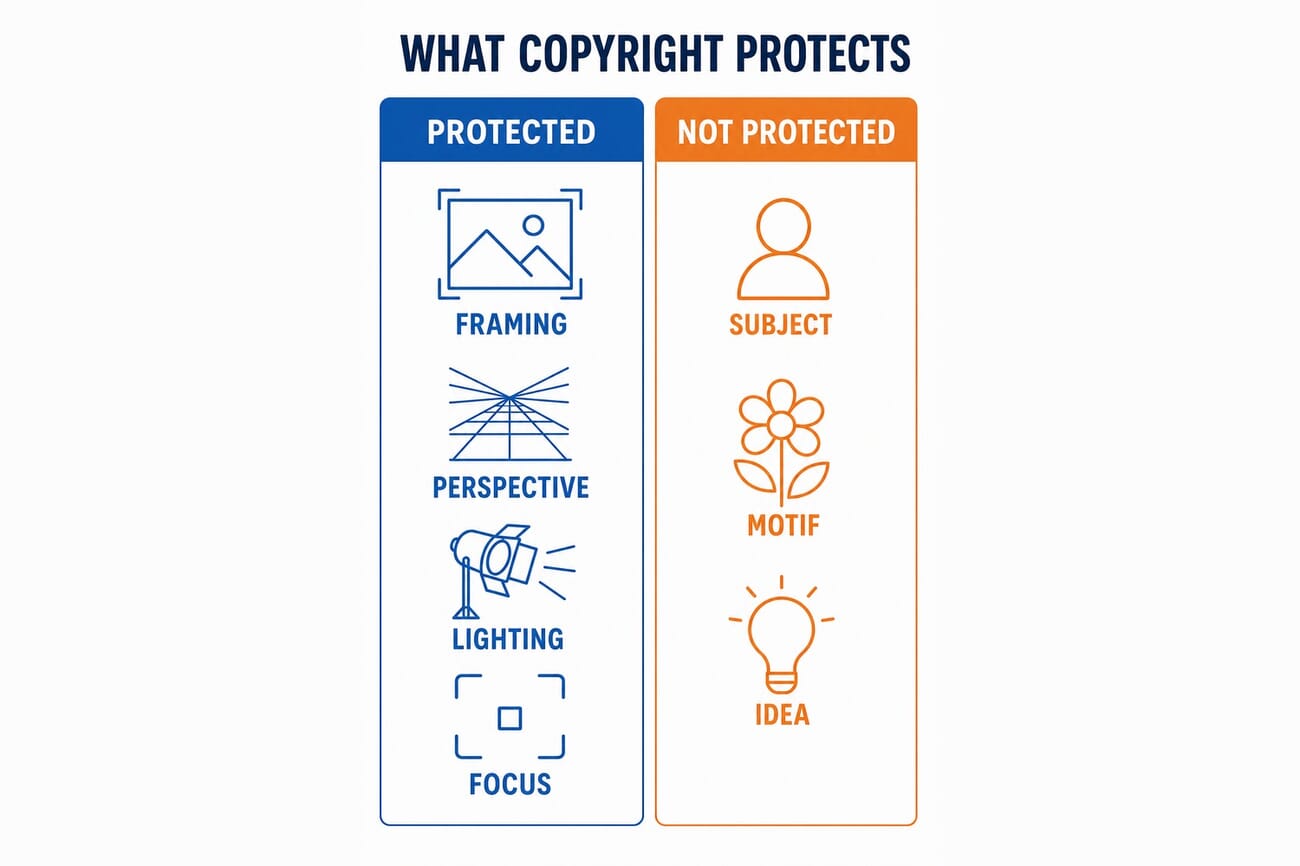
- Copyright protects only a photographer’s individual creative decisions, the choice of framing, perspective, lighting, and the interplay of sharpness and blur. The subject or motif itself, a dog diving for a toy, is free for anyone to reproduce.
- The twist: the court also found the AI image was not itself a protected work, because generic prompting is not enough creative effort. So the derivative belongs to no one. Your photo can be laundered into an image that is neither yours nor theirs.
- It resurfaced in the photo press in late July, just days before EU AI Act Article 50 (August 2, 2026) begins forcing AI-content labeling, a transparency law arriving on top of a copyright regime that just narrowed what photographers own.
- The practical defense is documenting exactly what the court does protect, your framing, perspective, lighting, and focus, and binding those choices to the file with Content Credentials provenance. Caveat: this is a German interim appellate decision, persuasive in the EU, not binding in the US.
A photographer spends years learning to control a scene: where to stand, how to frame it, when the light is right, which slice of the frame to keep sharp and which to let dissolve. A German court has just drawn a hard line around exactly how much of that a photographer actually owns, and the answer is narrower than most shooters assume.
On April 2, 2026, the Oberlandesgericht Düsseldorf (the Higher Regional Court of Düsseldorf) decided a case that reads like a parable for the AI era. A business took a professional photograph, fed it into a generative AI, published the restyled result, and walked away without infringing anyone’s copyright. The photo press only caught up to it this week, and once you see what the court protected and what it left exposed, it is easy to understand why.
The Ruling: A Diving Dog, an AI Restyle, and No Infringement
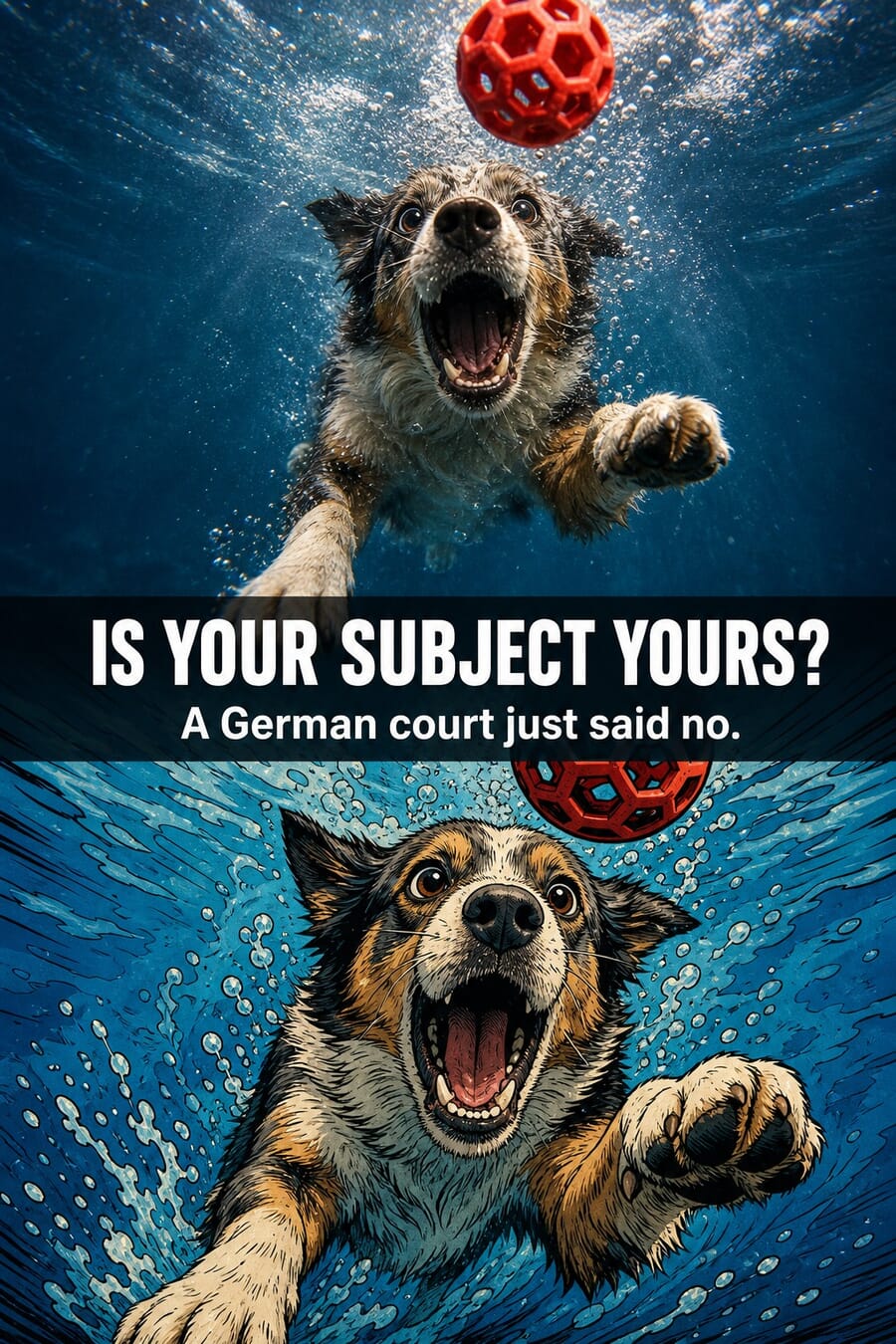
The facts are almost too neat. An underwater specialist photographed a dog lunging at a bright red toy below the surface, the kind of technically demanding shot that takes real skill to light and freeze. After the working relationship with a dog-training school ended, the school fed that photograph into an AI image-to-image tool and published a comic-style version of the same scene on its website. The photographer sued.
The court in Düsseldorf (case I-20 W 2/26) refused to find infringement. Using a copyright-protected photograph as an AI template, and publishing the generated result, does not automatically violate the photographer’s rights. The comic restyle, the court reasoned, kept enough distance from the specific creative choices in the original that it did not reproduce the protected work. The recognizable dog and the recognizable setup were not, on their own, enough.
What the Court Said Copyright Actually Protects
The reasoning is the part photographers need to internalize. In the court’s words, the scope of protection for a photographic work is generally limited to the choice of image composition, perspective, lighting, and the sharpness or blur achieved through the correct combination of aperture and exposure time. The subject matter and motif, it added, are generally not eligible for protection.
Read that carefully. Copyright does not protect the idea of a diving dog, or an underwater toy, or a golden-hour ridge line. It protects only the individual decisions a creator makes in capturing it: where the frame sits, the angle, the deliberate lighting, and the interplay of what is sharp against what is soft. If a later image, AI-made or not, does not carry those specific decisions across, it has not copied the protected work, even when the subject is instantly recognizable as yours.
For anyone who has followed the debate over how a photographer proves an image is real, this is a familiar boundary drawn in unusually precise legal language. The court did not just say the motif is free. It named, almost like a checklist, the four things that are not.
The Twist: The AI Image Belongs to No One
Here is what turns this from a bulletin into a genuinely strange story. The court also found that the AI-generated image was not itself a protected work. The person who made it could not show the kind of significant, human creative influence that copyright requires. Feeding a tool with general, open-ended text instructions, the court held, is by no means sufficient. Prompting alone does not make you an author.
Stack the two findings together and the result is genuinely odd. The original photo’s protection did not reach the restyled copy. The copy earned no protection of its own. So the published image belongs to no one. A photographer’s work can be laundered through an AI into a picture that is neither theirs nor the person’s who generated it, sitting in a copyright vacuum that anyone can pass around.
That vacuum is not a German quirk. It is the same logic surfacing across the industry, from Meta training image models on public photos to the running argument over who controls a delivered file after it leaves the photographer’s hands. The community nerve is real: a widely-shared photography forum thread this month, titled “Model edited my images with AI,” drew hundreds of responses circling the same question, who is allowed to alter your delivered work, and which version counts as the real photograph.
Why This Lands Now: Days Before the EU AI Act Takes Effect
The timing is what makes this urgent rather than academic. The decision surfaced in the photo press just as the clock runs down on Article 50 of the EU AI Act, whose core transparency obligations enter force on August 2, 2026. Article 50 requires that outputs of generative AI systems be identifiable as AI-generated or manipulated, and that people be told when they are looking at synthetic content.
There is a nuance worth stating plainly, because it will matter to anyone tracking compliance. While the obligations apply from August 2, the AI Omnibus agreement of May 2026 gives generative systems already on the market until December 2, 2026 to meet the machine-readable marking requirement specifically. The visible-labeling expectation, though, arrives now.
So two regimes collide in the same fortnight. A transparency law that says AI output must be labeled as AI, layered directly on top of a copyright ruling that just told photographers the subject in their frame was never theirs to begin with. One law forces disclosure of what is synthetic. The other quietly widens the space in which synthetic copies of your work can circulate freely.
What Photographers Can Actually Do About It
The useful move is to read the ruling as a map rather than a defeat. What the court chose to protect, framing, perspective, lighting, and focus, is precisely what a photographer can document. Those are not vague artistic vibes. They are recorded decisions: the exact focal length and vantage point, the lighting setup, the aperture and shutter that placed sharpness here and blur there.
That is the same argument behind keeping your RAW files and their sidecar data as an alibi of authorship, except now a court has spelled out exactly which of those decisions carry legal weight. It is a short bridge from there to Content Credentials and C2PA provenance, the open standard that cryptographically binds capture and edit history to the file. Provenance does not stop someone from restyling your photo. What it does is create a durable, verifiable record of the specific creative choices the court says are yours, and a clear timeline of the original versus any derivative.
Concretely, that means three habits worth adopting now: shoot and archive RAW so your creative decisions are preserved in the capture data; enable Content Credentials at capture or export where your camera or software supports it; and keep your delivery contracts explicit about AI reuse of delivered files, because the law will not fill that gap for you. None of this is a magic shield. It is the difference between being able to document your authorship and simply asserting it.
The Honest Caveats
This is German law, and it deserves to be reported as such. The decision is a Beschluss, an appellate ruling in interim proceedings, not a final judgment from Germany’s Federal Court of Justice. It is persuasive for the European market and a strong signal of where courts are heading, but it is not binding precedent anywhere, and certainly not in the United States, where the questions of AI training and authorship are being fought on very different statutory ground.
It also does not sit alone. German courts have been steadily mapping this territory, including an earlier ruling that a nonprofit dataset operator could scrape and share images for AI training under a research exception. Taken together, the pattern in Germany leans toward giving generative AI room to operate, and toward a narrow, decision-based view of what a photograph actually protects. That direction is worth watching closely, even from outside the EU.
Frequently Asked Questions
What did the German court actually rule about AI and photography?
The Oberlandesgericht Düsseldorf held that feeding a copyrighted photograph into a generative AI and publishing a restyled, comic-style version was not copyright infringement. Copyright protects a photographer’s creative choices (composition, perspective, lighting, and the sharpness or blur set by aperture and shutter), not the subject or motif itself. Because the AI restyle did not carry those specific choices across, it did not infringe.
Does this mean anyone can copy my photos with AI now?
Not exactly. A near-identical reproduction that preserves your framing, perspective, lighting, and focus would still likely infringe. What the ruling allows is reusing the subject or idea of a photo, and generating an image that is stylistically distinct enough to shed your specific creative decisions. The closer a derivative stays to your actual choices, the more protected you remain.
Who owns an AI image made from someone else’s photo?
Under this ruling, potentially no one. The court found the AI output was not a protected work because generic prompting did not show enough human creative effort. Combined with the finding that the original’s protection did not reach the restyle, the result is an image that belongs neither to the photographer nor to the person who generated it.
Does this ruling apply in the US?
No. It is a German interim appellate decision (a Beschluss), persuasive within the EU but not binding precedent anywhere, and it has no direct force in the United States. US courts are addressing AI, training data, and authorship under different laws and reaching their own, still-evolving conclusions.
How can photographers protect their work after this ruling?
Document the exact things the court says are protected: framing, perspective, lighting, and focus. Archive RAW files, enable Content Credentials or C2PA provenance where supported to bind your creative decisions and edit history to the file, and make AI reuse terms explicit in delivery contracts. These steps let you evidence your authorship rather than merely claim it.
The Bottom Line
Strip away the strangeness of a diving dog turned into a cartoon, and the Düsseldorf ruling is a clarifying one. It tells photographers, in unusually specific terms, that the law protects their decisions, not their subjects. That is a narrower ownership than most shooters assume, and in an era where any delivered file can be fed to a model, the gap is exposed. The response is not panic. It is documentation: preserve the creative choices the court respects, bind them to your files with provenance, and write your contracts as if the law will not protect the subject for you, because it just said it will not.
Featured image and infographics: stylized illustrations created by PhotoWorkout.
Primary Ruling & Legal Analysis
- OLG Düsseldorf, decision of 02.04.2026, I-20 W 2/26 (full text, Medien Internet und Recht) – The primary decision on the scope of protection for photographic works and their AI-assisted use.
- Bird & Bird – When Can AI-Generated Content Be Protected: Three German Rulings Draw the Line – Legal analysis placing the ruling in the wider German AI-copyright landscape.
- heise online – AI images in copyright law: when prompting protects and why copying is allowed – On the finding that generic prompting is not enough for authorship.
- beyer.law – OLG Düsseldorf: no copyright infringement through AI-generated image – German-language firm analysis of the decision.
Photo Press Coverage
- Digital Camera World – German court rules against photographer whose original image was used to create AI slop – The July 23 coverage that surfaced the ruling for the photo community.
- PetaPixel – Dog Photographer Loses Copyright Case Over AI-Generated Comic Version of Her Image – Case summary and photographer reaction.
Regulatory Context
- EU Artificial Intelligence Act – Transparency Rules (Article 50) – The transparency and AI-labeling obligations taking effect August 2, 2026.
Image Sources
- Featured image, protected-versus-not infographic, and vertical pin – created by PhotoWorkout – Editorial illustrations.