


- Beni, from Shenzhen startup Mondo Robotics, is a two-wheeled camera robot that autonomously follows and films you. Its Kickstarter has crossed $2.5M with 4,600+ backers at roughly $600 (about $800 retail).
- On paper it is wild: 18 mph top speed, a 10-inch jump, self-recovery when it tips, 1.5 hours of battery, and 4K30 HDR video, with app or wrist-controller steering and rear, side, front, and orbit follow modes.
- It is genuinely real, not CGI. The Verge, PetaPixel, and Notebookcheck have all handled it, and several known filmmakers have posted real footage.
- But it is early. The Verge’s hands-on found the autonomous tracking unreliable (it clipped walls and bumped the reviewer’s foot), and the low-to-the-ground body mostly films upward at you.
- Treat it as a promising crowdfunding pledge, not a finished product. A fall ship date on hardware that still needs work carries real delay and delivery risk.
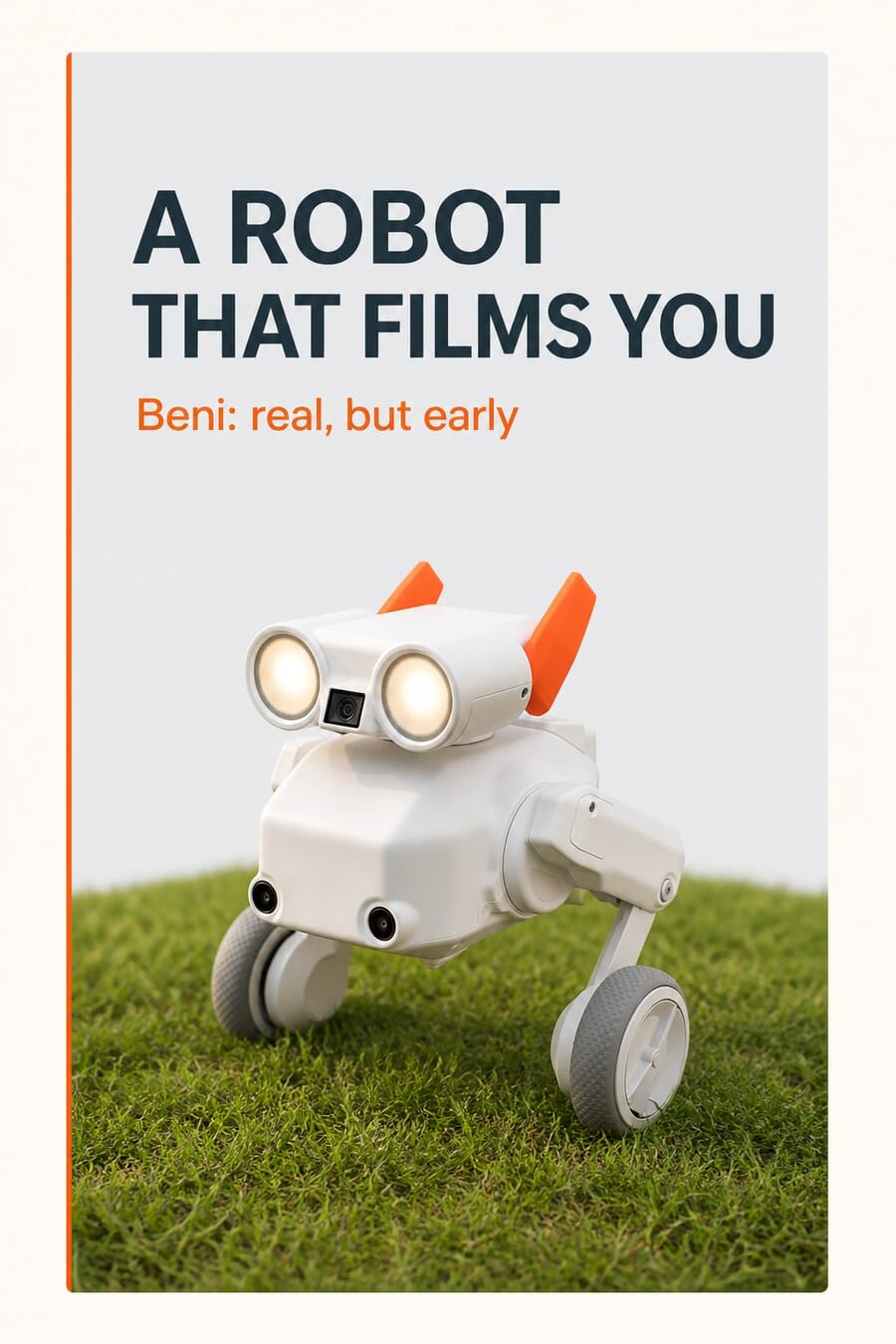
The first time most people see Beni, they assume it is fake. A small white robot on two wheels, with a camera for a face and little orange ears, sprints across a lawn, hops a curb, and keeps its lens locked on a running child. It looks like AI video slop. It is not. Beni is a real robot from Shenzhen-based Mondo Robotics, and its Kickstarter has already blown past $2.5 million with more than 4,600 backers.
The pitch is simple and genuinely appealing: think GoPro, but it runs beside you. No tripod, no second person, no stopping to hit record. For roughly $600 on Kickstarter (around $800 at full retail), Mondo says Beni will autonomously follow and film you in 4K, then use AI to cut your clips into a highlight reel. The question is not whether Beni exists. It does. The question is whether it does what the marketing promises, and whether you should put money down now.
The Specs Are Wild, On Paper
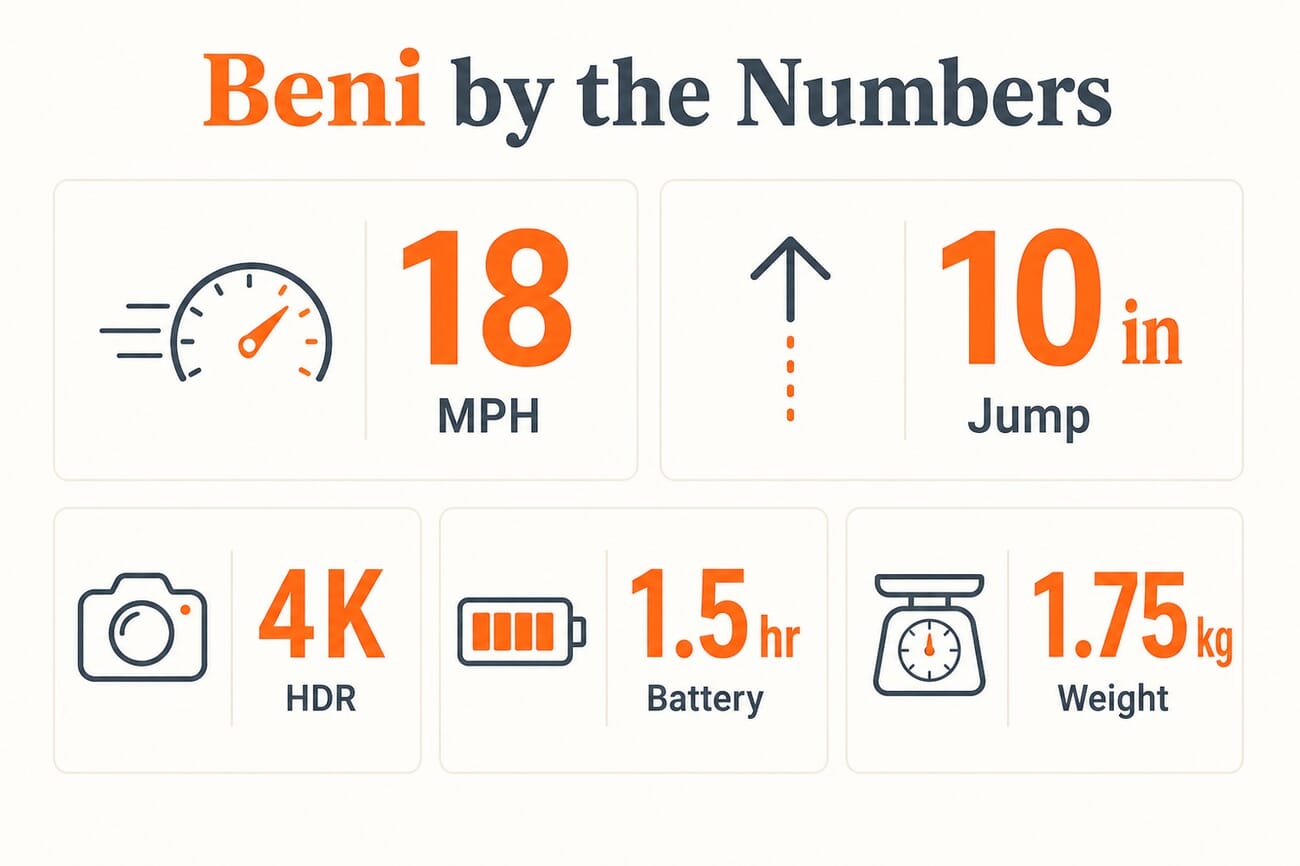
Mondo Robotics quotes a top speed of nearly 18 mph (about 29 km/h), enough, in theory, to keep pace with a skateboarder or a jogger. It claims Beni can jump 10 inches into the air, hop up stairs, and automatically right itself after a crash. The camera shoots 4K at 30fps HDR (with 3K60 and 1080p100 options) to 32GB of internal storage or a microSD card, and the whole thing weighs 1.75 kg. Steering happens through app joysticks or a bundled controller that straps to your wrist, and you can set it to follow from behind, film from the side, run in front, or orbit you like a drone.
There is also a one-tap AI highlights feature that promises to compile your best moments into a ready-to-share reel, skipping the editing. On paper, it reads like a solo creator’s dream, part action cam, part follow drone, part tripod that drives itself.
What the Hands-On Reviews Actually Found
This is where a healthy dose of realism comes in, and to Mondo’s credit, real reviewers have actually driven the thing. The Verge’s Sean Hollister, a 15-year gadget veteran, spent two hours with Beni and was refreshingly honest: “I immediately thought it was AI slop. Then I took the real robot for a spin.” His verdict was that the hardware is a genuine blast, but that “Beni does need work.”
Specifically, the star feature, autonomous tracking, was not reliable in his demo. He had to manually activate the tracking modes, and Beni’s twin 150-degree obstacle-avoidance cameras and ultra-wideband wrist tracker “weren’t enough to keep it from clipping corners, smacking walls, or even running into my foot.” PetaPixel raised a more fundamental limitation: because Beni is small and stays low to the ground, it mostly films upward at you, unlike a human operator who can shoot from a range of heights. That low angle is charming for a pet chasing it around the yard, less flattering for a lot of other shots.
Since then, Beni has landed in front of an even bigger audience. Marques Brownlee, one of the most-watched reviewers in tech, put the robot through its paces in his latest video. His hands-on segment, cued up below, is worth a watch for a real-world look at how Beni actually moves, tracks, and films.
A Drone Alternative, With Real Caveats
The most interesting case for Beni is as a ground-based alternative to a follow drone. Drones are increasingly restricted near airports, hospitals, and nature reserves, and a wheeled robot sidesteps a lot of airspace rules. It slots into the same solo-creator niche as self-flying cameras like the HoverAir and pocket cinema cameras like the DJI Pocket line, and it arrives just as the whole industry chases the pocket follow-cam idea from every direction.
But the caveats are real. Notebookcheck flagged that a 1.75 kg object moving at 18 mph carries genuine kinetic energy, which is a safety consideration around bystanders, and noted that the legal status of running a robot like this in public spaces is murky in many places. This is not a toy you set loose on a crowded boardwalk.
The Kickstarter Reality Check
Here is the part worth slowing down on. Beni is not a product you can buy today. It is a crowdfunding campaign, and backing it means paying now for hardware that Mondo hopes to ship in the fall. Even with a working prototype and credible press demos, that is the exact stage where hardware crowdfunding most often slips. A robot that still needs work on its headline feature, targeting a ship date a few months out, is a schedule that tends to move.
None of that makes Mondo a bad actor, and $2.5 million from 4,600 backers is real momentum. But a pledge is a bet on future delivery, not a purchase with buyer protection. If you back Beni, back it with money you are comfortable waiting on, and possibly waiting longer than promised. The safe move for most people is to wait for shipping units and independent reviews of the retail product before spending $600.
Frequently Asked Questions
What is Beni?
Beni is a two-wheeled camera robot from Mondo Robotics that autonomously follows and films you in 4K. It is currently a Kickstarter campaign, not a shipping product, priced at roughly $600 to back (about $800 at planned retail).
Is Beni real or a scam?
It is real. Working hardware has been tested hands-on by The Verge, PetaPixel, and Notebookcheck, and several known filmmakers have posted genuine footage. It is not CGI or vaporware, though as an unshipped crowdfunder it still carries delivery risk.
How fast is Beni and can it really jump?
Mondo Robotics quotes a top speed of about 18 mph and a 10-inch vertical jump, plus stair-hopping and automatic self-recovery after a fall. These are the manufacturer’s figures; real-world performance under load has not been fully independently verified.
Does the autonomous following actually work?
Partly. In The Verge’s hands-on, tracking had to be triggered manually and the obstacle avoidance let Beni clip walls and bump the reviewer’s foot. The autonomous experience appears to be a work in progress rather than a finished feature.
Should I back Beni on Kickstarter?
Only with money you are comfortable waiting on. A pledge is a bet on future delivery, not a protected purchase, and a fall ship date on hardware that still needs work may slip. Many buyers should wait for shipping retail units and independent reviews.
The Bottom Line
Beni is one of the more charming pieces of consumer robotics in years, and it is refreshingly, verifiably real. If it ships close to its promises, a $600 to $800 robot that films you hands-free could carve out a genuine niche between action cams and follow drones. But it is early, the autonomy is not there yet, and it is being sold as a crowdfunding pledge with all the delay risk that implies. Watch it closely, enjoy the demos, and if you back it, do so with clear eyes and patient money.
Reference
- The Verge: hands-on with the Mondo Robotics Beni – Two-hour hands-on; the source of the tracking and obstacle-avoidance findings.
- PetaPixel: Beni is a cute autonomous camera robot on wheels – Photography-industry coverage and the low-angle limitation.
- Notebookcheck: Beni jumping camera robot – Specs, weight, and the safety and crowdfunding-risk notes.
- Mondo Robotics Beni Kickstarter – The campaign, pricing, and backer figures.
Image Sources
- Beni product photograph – Featured image courtesy Mondo Robotics.
- Specs infographic and pin – Stylized PhotoWorkout illustrations.