

- Kuaishou’s Kling AI launched Kling Image 4.0 on November 17, 2026, in Kling Creative Studio and via API, with native 8K output, series generation and heavy text rendering.
- The 8K claim checks out: a PhotoWorkout test request came back at 9984 by 6656 pixels, a real 66-megapixel file. At screen sizes it reads as a photo; at 100 percent the detail turns slightly painterly.
- Text rendering is the standout. A poster with roughly 450 characters of body copy came back nearly verbatim and legible, something image models have failed at for years.
- Series mode produced four frames of the same person, outfit and location in one request, consistent enough for storyboards and editorial sets.
- API pricing works out to roughly $0.06 per 2K image, $0.09 at 4K and $0.15 at 8K. Free Creative Studio accounts are capped at 2K output, so 8K sits behind paid tiers.
Every image model claims photorealism. Kling Image 4.0, released by Kuaishou’s Kling AI on November 17, 2026, makes a more specific and more testable claim: native 8K output, up to 2,000 characters of readable text in one image, and sets of up to 10 consistent images from a single prompt.
Specific claims can be checked. PhotoWorkout ran Kling Image 4.0 through four tests on the developer API within a day of launch: an 8K realism test, a text-heavy poster, an edit of a real photo, and a four-frame story series. Here is what held up, what did not, and what it means for photographers.
The 8K Claim: Verified, With a Catch
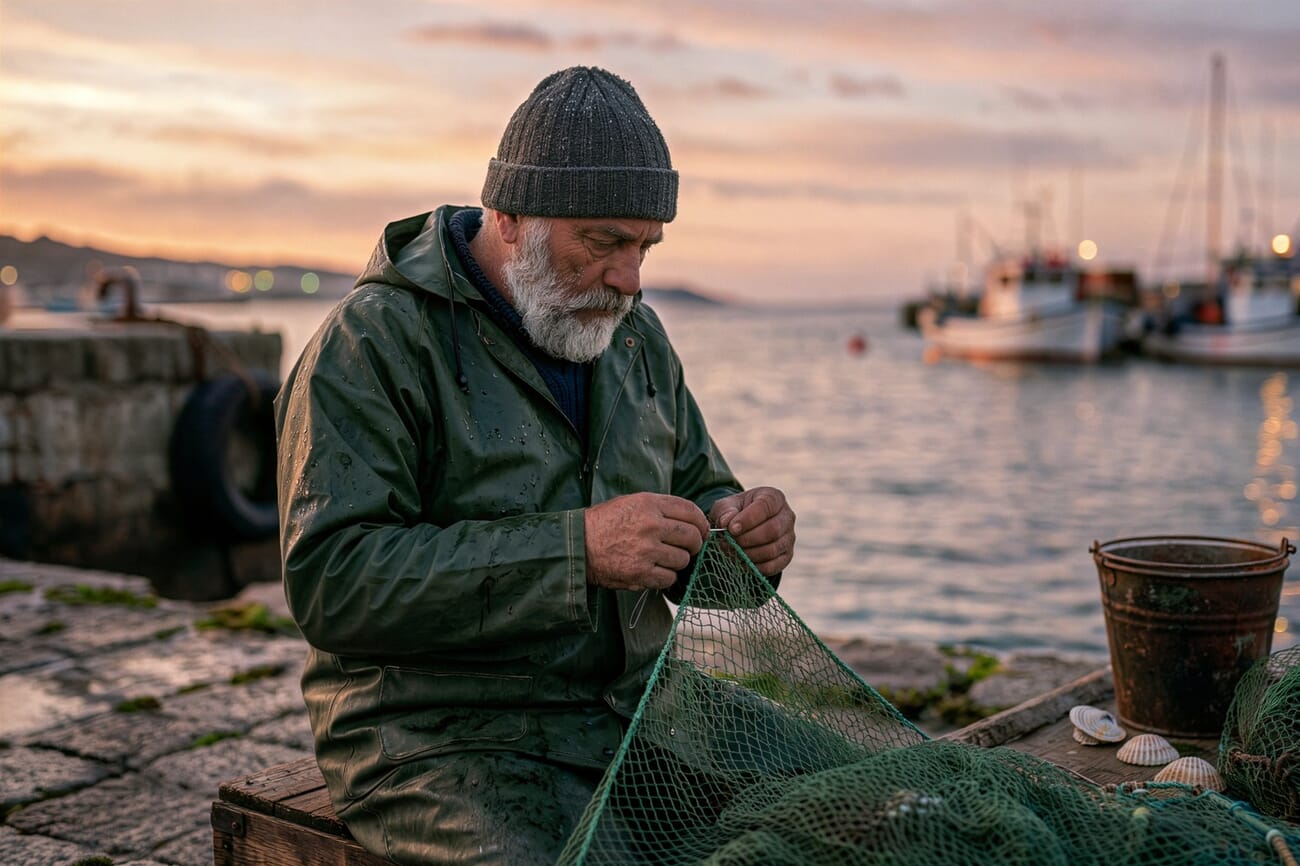
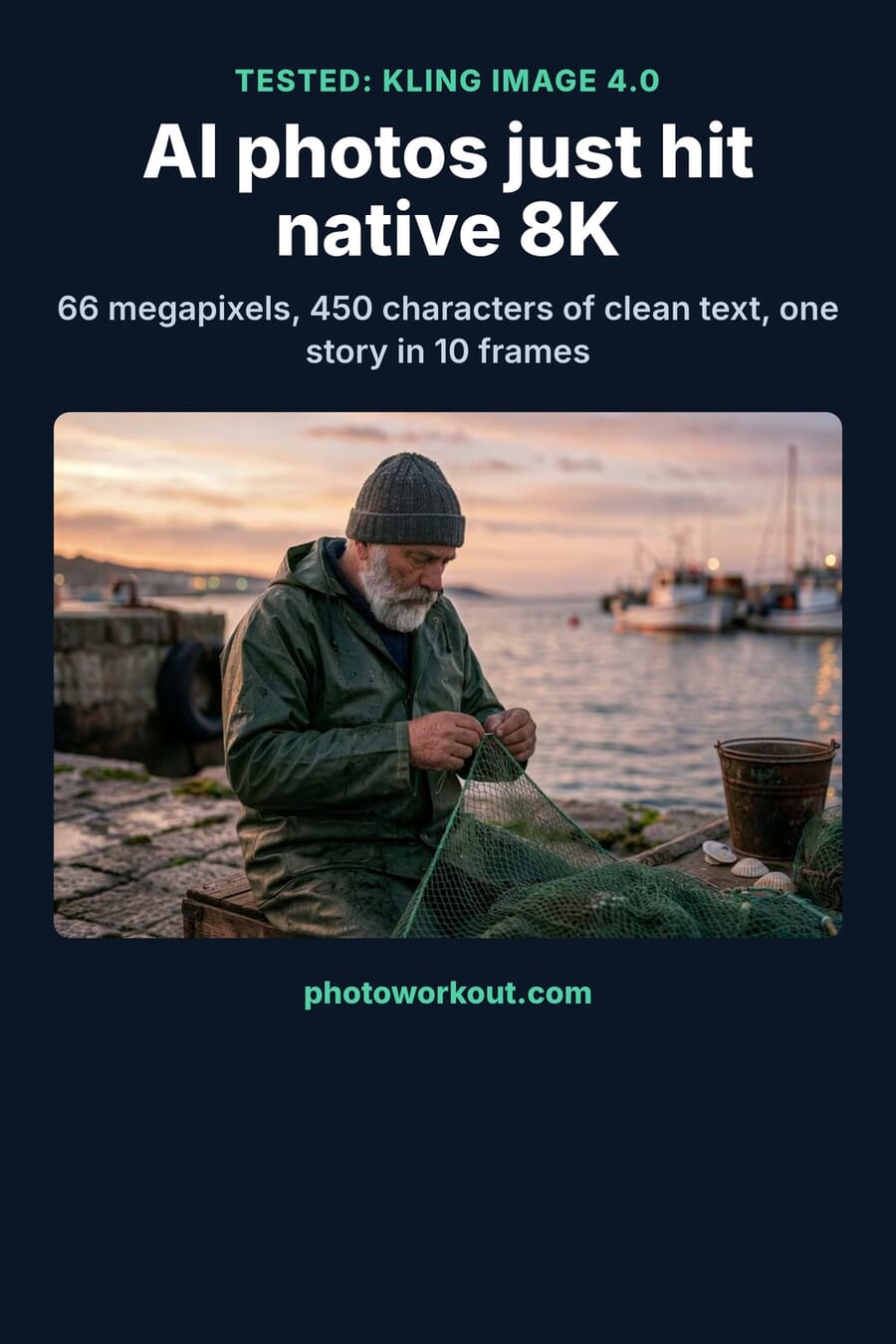
The test prompt asked for a classic photo scenario: a fisherman mending a net on a pier at golden hour, described the way a photographer would, down to the lens and aperture. The API returned a 9984 by 6656 pixel PNG, a genuine 66-megapixel file weighing 138 MB. That is more pixels than any current full-frame camera except the highest-resolution medium format bodies.
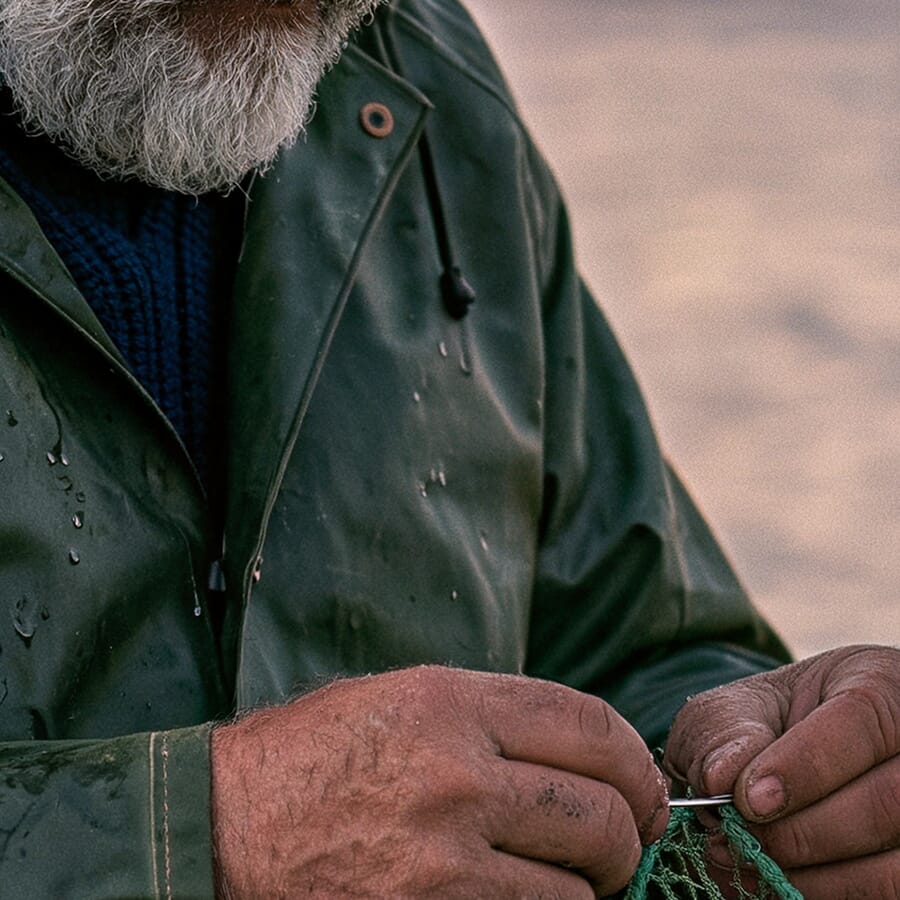
At publication size, the result is unsettlingly convincing: coherent golden-hour light, believable rain droplets on the jacket, harbor bokeh that behaves like a real lens. The catch appears at 100 percent magnification. Beard hair dissolves into painterly strands, the background mottles like watercolor, and fine texture stops behaving like optics. It is real resolution, not camera-grade detail. For web use that distinction is invisible. For a pixel-peeping print buyer, it is not.
Text Rendering: The Actual Breakthrough
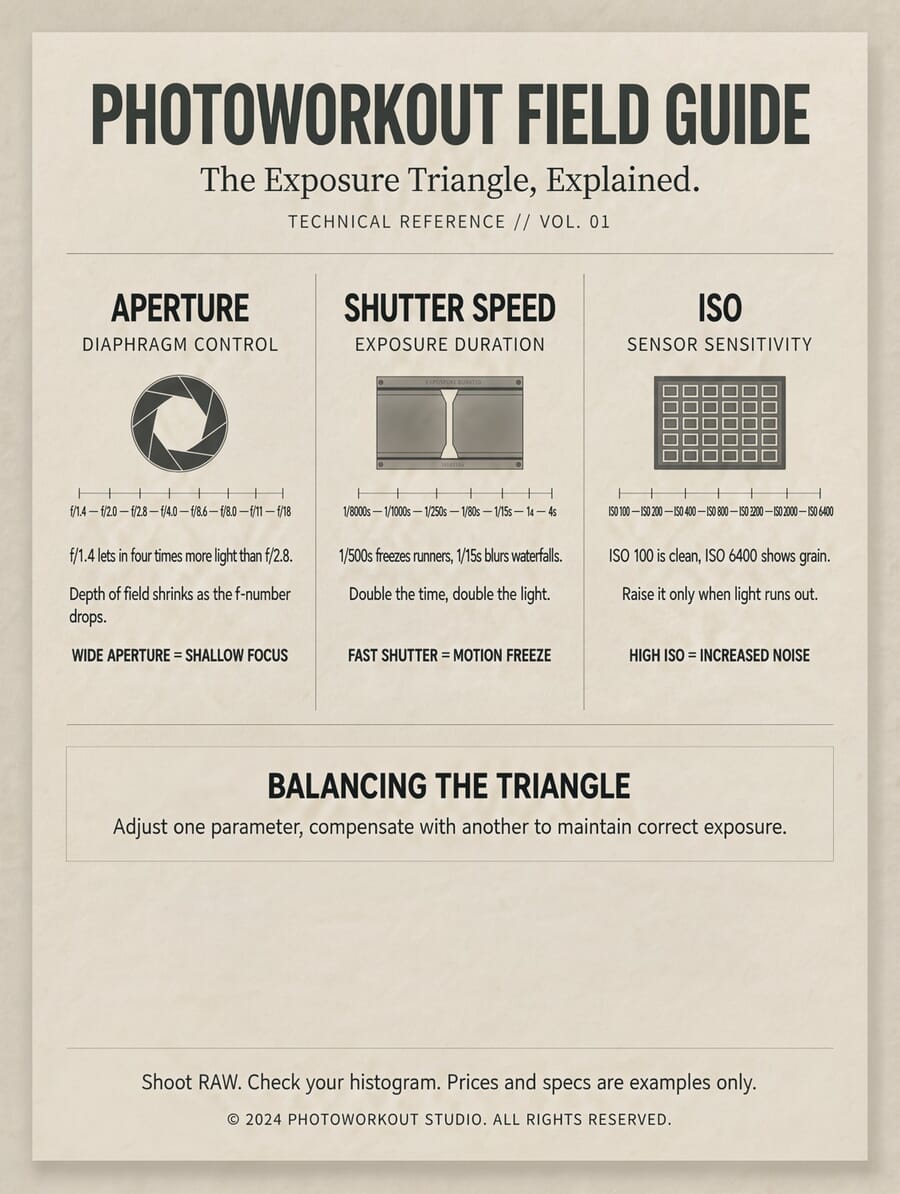
Dense text has been the most reliable way to spot an AI image. The test asked for an exposure-triangle poster with a headline, three titled columns and specific body copy, around 450 characters of exact text. Kling rendered virtually all of it correctly, including small print, consistent typography and clean column layout.
The failures are instructive: an invented f/8.6 on a tiny aperture scale, one garbled micro-label, and a copyright footer the prompt never asked for, dated 2024. Micro-text still drifts. But paragraph-level accuracy at this density beats what OpenAI’s GPT-Image-2.6 showed in PhotoWorkout’s test last week, and Kling claims up to 2,000 characters across seven languages with 70-plus licensed fonts. For posters, ads and product pages, text in AI images has quietly stopped being the tell.
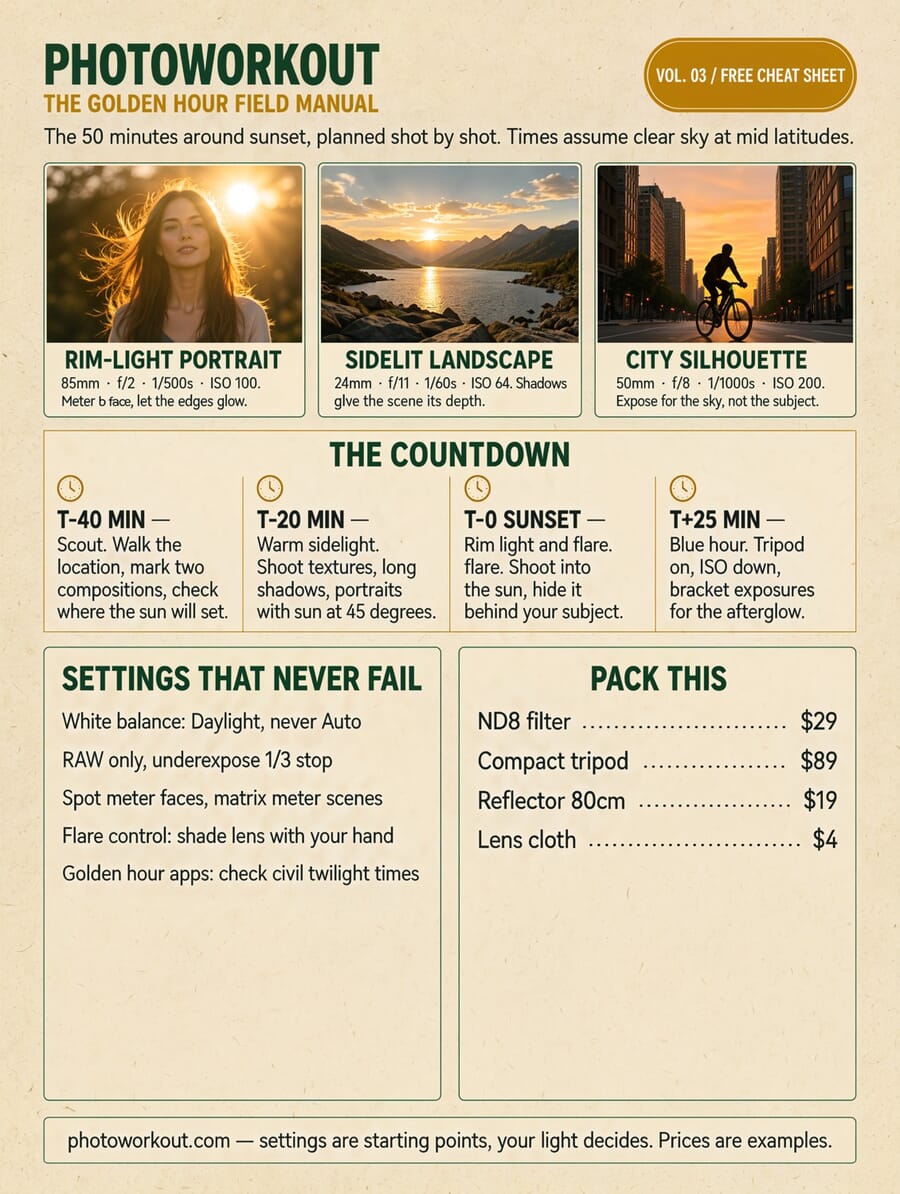
Update, same day: a second, harder text test pushed the density to roughly 1,400 characters: a full cheat-sheet poster with a masthead, three photo cards with camera settings, a four-column timeline, two list panels with dotted price leaders and a footer. Kling produced the entire layout in one 8K generation, photos included, with exactly three text slips: a “Meter b face” where “Meter for the face” was requested, one “glve” for “give”, and a duplicated word in a timeline entry. Everything else, down to the $4 lens cloth line, is verbatim.
Editing a Real Photo
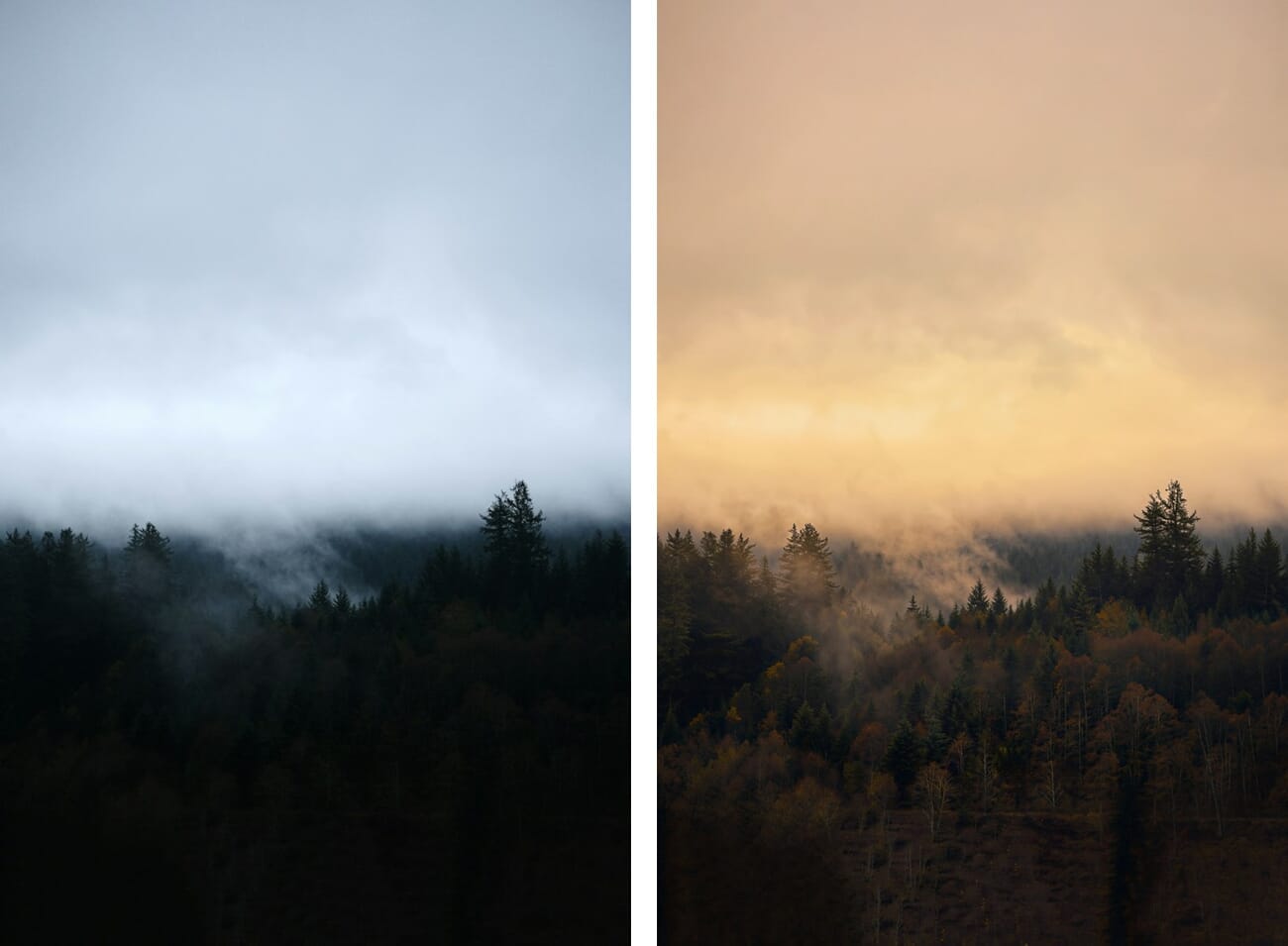
The image-to-image test used a real photograph, a flat, gray foggy forest, with instructions to relight it to late golden hour while keeping the composition untouched. Kling preserved the frame remarkably well: the tree line, the tall conifer, the fog placement all match. It also went further than asked, warming green foliage into autumn tones. The result is attractive and would pass casual inspection, but it quietly changed the season, a reminder that these edits remain regeneration, not adjustment. Photographers wanting Lightroom-style control should treat it as a creative tool, not a develop module.
Series Mode: One Prompt, Four Consistent Frames
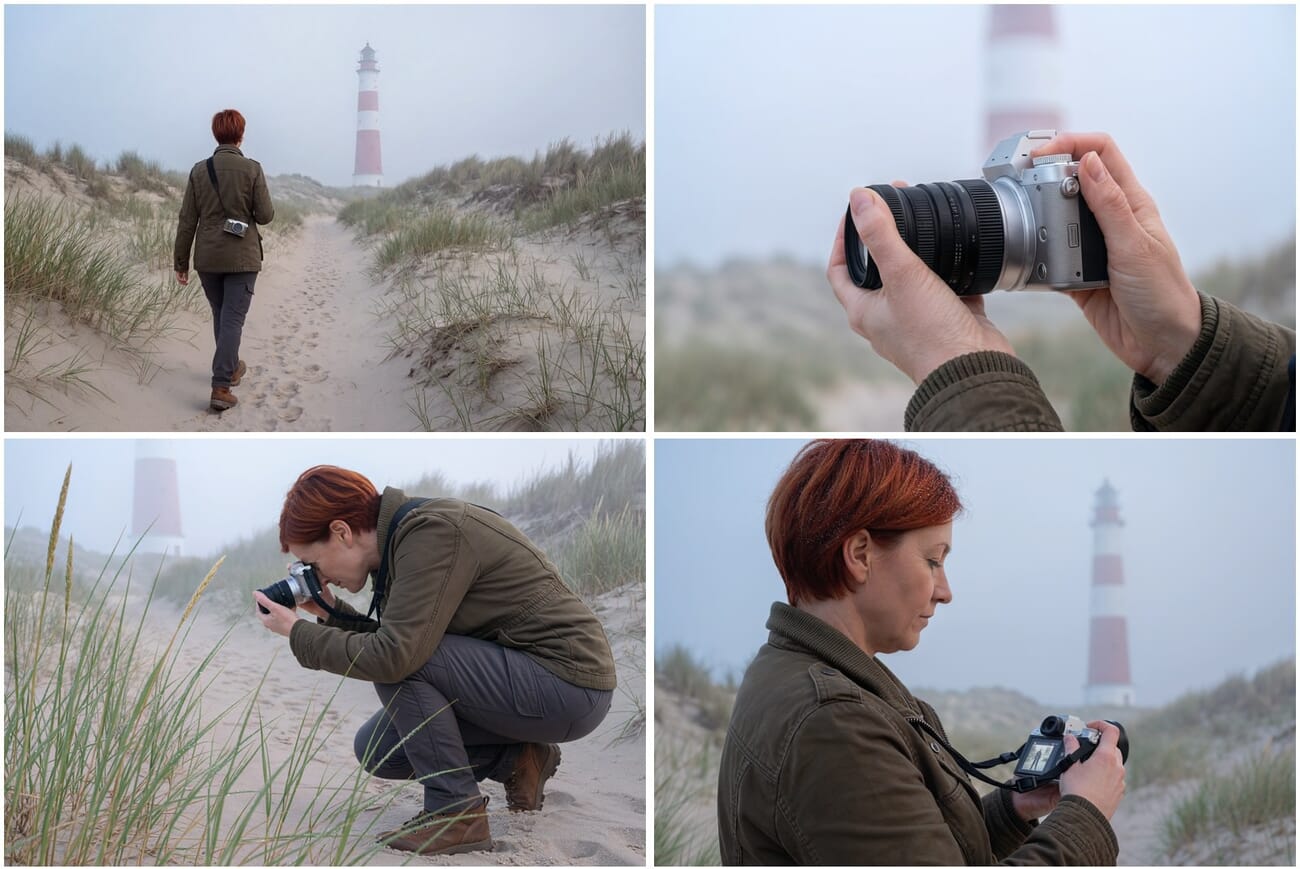
Series mode generated a four-frame photo story in one request: a photographer walking to a lighthouse, adjusting her lens, crouching in beach grass, reviewing shots. The same red-haired woman in the same olive jacket appears in the same fog across all four frames, with story beats followed exactly. The one visible drift: her camera changes shape between frames. For storyboards, pitch decks and editorial sets, this level of consistency from one prompt was not available anywhere a year ago. The mode scales to 10 images per request.
Price, Access and the C2PA Detail
Kling Image 4.0 is live in Kling Creative Studio and on the developer API (model code kling-4.0, with a new request format). API billing is unit-based: at standard package rates, a 2K image works out to roughly $0.06, 4K about $0.09 and 8K about $0.15, with reference images billed at a fraction of a unit each. Prices were checked on November 18, 2026. In the consumer studio, free accounts are capped at 2K output, so the 8K headline feature sits behind paid memberships on that route.
Two further observations from testing. First, every output arrived with C2PA Content Credentials embedded, the same provenance standard camera makers and Adobe are pushing, which means downstream platforms can identify these files as AI-generated if they check. Second, Kling’s own platform now resells competitors next to its models: GPT-Image-2 and 2.5 and Google’s Nano Banana Pro are selectable in the same interface, a sign of how quickly these tools are commoditizing.
What It Means for Photographers
The resolution race matters less than it sounds: 66 soft megapixels do not replace 66 sharp ones, and the 100 percent crop still gives the game away. The text rendering and series consistency matter more. Those are the two capabilities that let AI images replace commissioned work in advertising, product pages and editorial illustration, the market where stock photography already competes. And as convincing 8K files with (or without) provenance metadata spread, the legal fights over AI training on photographers’ work and the question of what counts as a photograph both get sharper. The honest answer from this test: at web resolution, you likely cannot tell anymore. At 100 percent, for now, you still can.
Frequently Asked Questions
What is Kling Image 4.0?
Kling Image 4.0 is Kuaishou’s latest image-generation model, released on November 17, 2026. It generates images at up to native 8K resolution, renders up to 2,000 characters of text, and can produce sets of up to 10 consistent images from one prompt. It is available in Kling Creative Studio and via API.
Is Kling Image 4.0’s 8K output really 8K?
Yes. In PhotoWorkout’s test, a 3:2 request returned a 9984 by 6656 pixel file, about 66 megapixels, which exceeds the 8K video standard of 7680 pixels. Fine detail at 100 percent magnification is softer and more painterly than a real camera file, however.
How much does Kling Image 4.0 cost?
Via the developer API, unit pricing works out to roughly $0.06 per 2K image, $0.09 per 4K image and $0.15 per 8K image at standard package rates (checked November 18, 2026). In the consumer Creative Studio, free accounts are limited to 2K output, with higher resolutions on paid plans.
Do Kling Image 4.0 images carry AI provenance metadata?
Yes. Files generated in PhotoWorkout’s API test contained embedded C2PA Content Credentials, the provenance standard backed by Adobe and major camera makers. Platforms and tools that read C2PA can flag the files as AI-generated, though the metadata can be stripped by re-saving.
Bottom Line
Kling Image 4.0 delivers the spec sheet: the 8K is real, the text rendering is the best PhotoWorkout has tested, and series mode produces genuinely consistent sets. The remaining gap is per-pixel photographic detail, and it is shrinking release by release. The ‘is it a photo’ question now depends on how closely anyone looks, and on whether the C2PA tag survives the upload.
Specifications from Kling's release documentation; all test results are PhotoWorkout's own API generations from November 18, 2026.
Primary Sources
- Kling AI: Kling Image 4.0 release notes – Specs: native 8K, 2,000-character text, 70+ fonts, series mode, layer editing
- Kling AI API documentation: Image 4.0 – Endpoint, request format and parameters
- Kling AI developer pricing – Per-unit image pricing, checked November 18, 2026
- TechNode Global: Kuaishou launches Kling Image 4.0 – Launch confirmation and availability
Testing
- PhotoWorkout API tests, November 18, 2026 – Four generations on the Kling developer API: 8K text-to-image, 4K text poster, 2K image edit, 4-frame series
Image Sources
- Featured image and test images – AI images generated by PhotoWorkout with Kling Image 4.0, labeled in captions
- Forest photo used in the edit test – Original photo via Unsplash/SampleShots; right half of the comparison is the AI edit
- Pinterest graphic – PhotoWorkout graphic; photo element generated with Kling Image 4.0