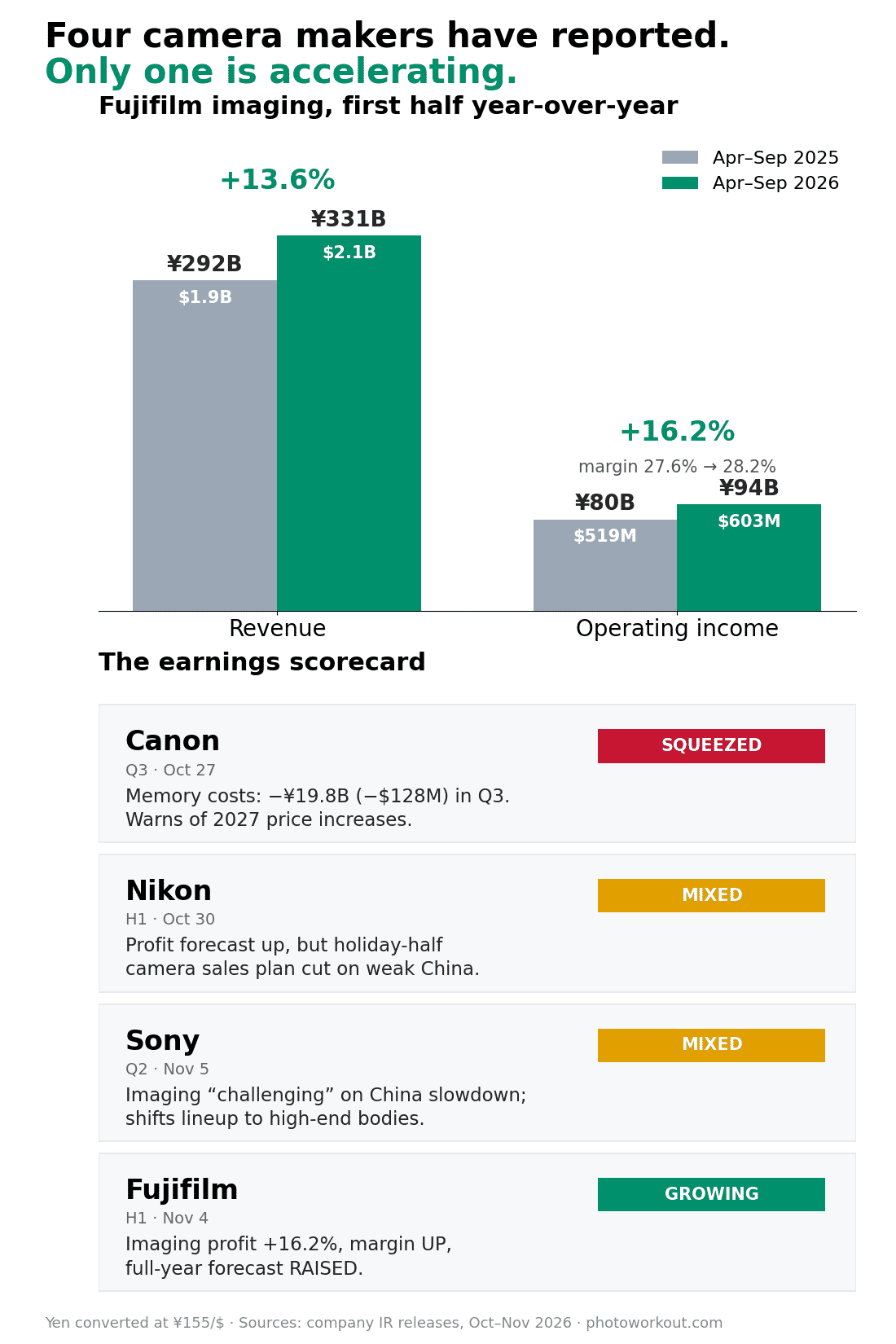

- Fujifilm closed out the camera-maker earnings season on November 4 — and it’s the only one of the big four whose camera business is accelerating: imaging revenue up 13.6% to ¥331.1 billion (about $2.1 billion) and operating income up 16.2% to ¥93.5 billion (about $600 million) for April–September 2026.
- The imaging operating margin went UP, from 27.6% to 28.2% — and Fujifilm raised its full-year imaging revenue forecast from ¥670 billion to ¥680 billion (about $4.3 to $4.4 billion).
- Fujifilm’s group profit fell 10.9% — but the decline comes from its office-printer unit (operating income down 94.4% in the quarter) and healthcare fixed costs, not from cameras.
- The completed scorecard reads: Canon squeezed by memory costs (¥19.8 billion, about $128 million, in one quarter), Nikon dented by weak China demand, Sony hit by both — and Fujifilm absorbing a far smaller memory hit while instax and GFX carry it to records.
- Fujifilm still pays the memory tax — it forecasts a ¥14 billion (roughly $90 million) full-year hit from semiconductor memory and IT component prices — it’s just small enough to outrun.
The last of the big four camera makers has reported, and the scorecard is finally complete. Canon warned of 2027 price increases. Nikon cut its camera sales plan for the holiday half. Sony called its imaging business “challenging.” Then Fujifilm printed its April–September results on November 4 — and broke the pattern entirely.
Fujifilm’s imaging segment grew revenue 13.6%, grew operating income 16.2%, expanded its margin, and raised its full-year forecast. The July–September quarter was the segment’s most profitable ever. For a photography industry that has spent the autumn bracing for the AI memory crunch to reprice cameras, one maker just demonstrated that the squeeze is not hitting everyone equally — and the reasons why matter for anyone planning a camera purchase in 2027.
Fujifilm’s Cameras Are Carrying the Company
The numbers come from Fujifilm’s own half-year earnings presentation, covering April to September 2026 (Fujifilm’s materials label this “FY2026,” the fiscal year ending March 31, 2027). Dollar figures throughout are approximate, converted at ¥155 to the dollar — the Q4 rate Canon itself assumes:
- Imaging revenue: ¥291.5 billion → ¥331.1 billion (+13.6%; roughly $1.9 billion → $2.1 billion)
- Imaging operating income: ¥80.4 billion → ¥93.5 billion (+16.2%; $519 million → $603 million)
- Imaging operating margin: 27.6% → 28.2% — up, not down
- July–September alone: imaging operating income jumped 29.6% to ¥50.1 billion ($323 million), a record quarter, with the quarterly margin leaping from 26.4% to 30.8%
- Full-year imaging forecast: raised from ¥670 billion to ¥680 billion — about $4.3 to $4.4 billion
One stat worth repeating, because some trade coverage has mangled it: the first-half imaging margin went up, from 27.6% to 28.2%. Figures floating around that show Fujifilm’s imaging margin falling refer to the prior full fiscal year, not this half. The arithmetic is simple: ¥93.5 billion of operating income on ¥331.1 billion of revenue is 28.2%.
Yes, Group Profit Fell — but Not Because of Cameras
Headlines about the same report read very differently: “Fujifilm H1 income drops.” Both things are true. Group revenue rose 8.8% to ¥1,711.5 billion ($11.0 billion), but group operating income fell 10.9% and net income fell 12.5% for the half.
Look at where the decline actually sits, though, and cameras are nowhere near it. The Business Innovation segment — office printers and multifunction devices, the legacy Fuji Xerox business — saw its July–September operating income collapse 94.4% to ¥0.9 billion (under $6 million), and it swung to a loss for the half. Healthcare profit for the half fell 85.8%, weighed down by fixed costs in the Bio-CDMO drug-manufacturing business. Imaging, meanwhile, added ¥13.1 billion ($85 million) of operating income year over year.
That mix is the story. Fujifilm survived the death of its film business two decades ago by diversifying away from photography; in 2026, photography is the division bailing out the diversification. It’s the same dynamic PhotoWorkout covered in June, when imaging became Fujifilm’s profit engine — only more pronounced now.
The Completed Scorecard: Four Makers, Three Different Problems
With Fujifilm’s print, every major Japanese camera maker has now reported this earnings season. Read together, the four reports say something more precise than “the industry is struggling” — they show who is squeezed and by what:
| Maker | Report | Camera/imaging read | Main driver |
|---|---|---|---|
| Canon | Q3, Oct 27 | Memory prices cut quarterly profit by ¥19.8 billion ($128 million); Q4 imaging margin to fall further; “price increases from next year onward” | Memory cost |
| Nikon | H1, Oct 30 | Full-year profit forecast raised ~50%, but camera sales plan for the holiday half cut | China demand |
| Sony | Q2, Nov 5 | Imaging called “challenging,” primarily a China slowdown; offsetting memory costs by shifting to high-end bodies | Cost and demand |
| Fujifilm | H1, Nov 4 | Imaging profit +16.2%, margin up, full-year forecast raised; record quarter | instax + GFX + X series |
The distinction matters because the three weak reports are weak for different reasons. Canon’s problem is input cost — it says it has secured the memory components it needs for next year, expects procurement costs to rise, and plans to “offset those increases through price increases from next year onward.” Nikon’s problem is demand — its profit forecast actually went up, but it trimmed camera volume expectations on a weak Chinese market. Sony sits in the middle, citing the China slowdown first while steering its camera mix toward high-end bodies where memory costs are easier to absorb. Lumping all three into one “memory crisis” narrative gets the diagnosis wrong — and the diagnosis is what tells you where prices go next.
Even Fujifilm Pays the Memory Tax — It’s Just Small Enough to Outrun
Fujifilm is not magically exempt from the component squeeze that’s been driving memory prices up all year. Its own deck contains a dedicated slide titled “Financial Impact of Rising Prices for Semiconductor Memory and IT-related Components.” The imaging segment took a ¥2.5 billion ($16 million) hit in the July–September quarter, and Fujifilm forecasts a ¥14 billion ($90 million) full-year drag on imaging — instant cameras and digital cameras named specifically — out of a ¥25 billion ($161 million) group-wide impact.
Set that against Canon’s ¥19.8 billion ($128 million) hit in a single quarter and the difference in exposure is obvious. Part of it is product mix: a large share of Fujifilm’s imaging profit comes from instax instant cameras and film, which need far less semiconductor memory per unit of revenue than a stacked-sensor mirrorless body. The quiet irony is that Fujifilm’s actual materials headache this half was silver — the deck flags rising silver prices against instax film margins, a very analog problem to have in 2026.
Fujifilm’s stated plan is to “minimize the impact of rising prices through pricing measures and sourcing alternative materials and components” — corporate language that leaves the door open to price adjustments without promising restraint. Buyers should not read this report as “Fujifilm gear won’t get more expensive.”
What’s Actually Carrying It: instax, GFX, and the Mid-Range X Series
The growth is not evenly spread across Fujifilm’s camera lineup, and the deck is candid about it. Consumer Imaging — instax instant cameras and film — grew 22.5% in the quarter, powered by mid- to high-priced models like the instax mini Evo and WIDE 400 plus expanded film production capacity. Professional Imaging — the digital camera business — actually declined 5.1% in the quarter.
That dip comes with context: the comparison quarter a year earlier was stacked with new-product launches, while this one wasn’t — the X-T6, widely expected to do the autumn’s heavy lifting, slipped out of the half (FujiRumors connects the professional-imaging decline directly to that delay). What sold instead were GFX medium-format bodies and mid-range X series models like the X-T30 III and X-M5 — and across the half, Fujifilm nearly doubled imaging R&D and related spending, from ¥5.5 billion to ¥9.5 billion ($35 million to $61 million). For the X-T6-shaped hole in the lineup, that spending is the tell: the pipeline is being fed, not starved.
What It Means for Camera Buyers
For photographers, the completed scorecard sharpens the 2027 picture that PhotoWorkout’s October price analysis sketched from the consumer side:
- Canon price rises in 2027 are close to a stated plan, not a rumor — the company says offsetting higher component costs through pricing is its policy “from next year onward.”
- Sony’s shift to high-end bodies means the memory squeeze shows up less as sticker increases and more as a lineup that keeps migrating upmarket.
- Nikon’s issue is demand, not cost — which historically produces discounts, not price hikes, in the regions where demand is soft.
- Fujifilm has the least cost pressure of the four — but also the least incentive to discount, with demand running hot enough to raise guidance. Expect continued scarcity pricing on the hype bodies rather than bargains.

Frequently Asked Questions
Why is Fujifilm growing while Canon, Nikon, and Sony imaging struggle?
Mostly product mix. A large share of Fujifilm’s imaging profit comes from instax instant photography, which barely depends on the semiconductor memory whose prices are surging, and demand for its GFX and X series bodies remains strong enough to raise guidance. Canon’s weakness is memory cost, Nikon’s is soft Chinese demand, and Sony faces some of both.
Is Fujifilm affected by the memory-price surge at all?
Yes — its own presentation quantifies a ¥2.5 billion ($16 million) imaging hit in the July–September quarter and forecasts ¥14 billion (about $90 million) for the full year. The difference is scale: that drag is small relative to ¥93.5 billion ($603 million) of half-year imaging profit, so Fujifilm absorbs it and still grows.
Will Fujifilm cameras get more expensive in 2027?
Fujifilm hasn’t announced increases, but its deck commits only to minimizing cost impacts “through pricing measures and sourcing alternative materials” — which keeps price adjustments on the table. With demand strong, the more likely continuation is scarcity: popular bodies staying hard to find at list price.
What period do these Fujifilm numbers cover?
April through September 2026 — the first half of the fiscal year ending March 31, 2027, which Fujifilm’s own materials label FY2026. The record quarter referenced is July–September 2026.
The Bottom Line
The camera industry’s autumn earnings season ends with an asterisk on the gloom. The memory crunch is real — every maker now quantifies it — but it is repricing the industry unevenly: hardest where bodies are memory-hungry and demand is soft, barely at all where instant film and medium format carry the margin. Fujifilm’s half is proof that “cameras are thriving” and “camera companies are warning” can both be true at once — sometimes inside the same company.
The next data point: holiday-quarter prints in late January, when Canon’s Q4 margin warning and Nikon’s trimmed sales plan either materialize or don’t.
Sources for this article:
Primary Financial Reports
- Fujifilm Holdings — Q2 FY2026 Earnings Presentation (PDF) – Imaging segment revenue, operating income, margin, memory-impact slide, and full-year forecast
- Canon — Q3 2026 Results Speech Notes (PDF) – ¥19.8 billion quarterly memory-cost impact and 2027 pricing policy quotes
- Sony — Q2 FY2026 Earnings Speech (PDF) – Imaging characterized as challenging on China slowdown; high-end mix shift
Coverage & Analysis
- RTTNews — Fujifilm H1 Income Drops, Revenue Rises; Lifts Revenue Outlook – Group-level H1 figures
- TechTimes — Fujifilm Posts Record Quarter as instax Revenue Surges 22.5% – Record-quarter framing and instax growth
- FujiRumors — X-T6 Delay Hurts Results, Imaging R&D Spending Nearly Doubles – X-T6 delay context; ¥5.5B → ¥9.5B imaging R&D/SG&A
- PetaPixel — Canon May Raise Camera Prices Due to Increased Memory Costs – Canon Q&A quotes on 2027 price increases
- CineD — Nikon Raises Profit Forecast by 50% but Cuts Camera Sales Plan – Nikon H1: forecast up, holiday-half camera plan cut on China
Image Sources
- Fujifilm — X-T30 III official product image (featured image) – Official Fujifilm product photography
- Earnings chart and scorecard — stylized PhotoWorkout infographic – Created from company IR data
- Pinterest pin — stylized PhotoWorkout illustration – PhotoWorkout mascot illustration