

- PhotoWorkout ran identical prompts through Kling Image 4.0 and OpenAI’s GPT-Image-2.6 on their raw APIs: a photoreal portrait, a 1,400-character cheat sheet, a real-photo relight and a four-frame story.
- Resolution is a 10x gap: Kling returned a real 66MP file (9984 by 6656), while GPT-Image-2.6’s API rejects anything above roughly 8MP (3072 by 2048 passed, 3600 by 2400 did not).
- The text upset: GPT-Image-2.6 rendered the 1,400-character cheat sheet with zero errors found; Kling made three small slips. A week ago Kling looked like the text champion.
- Kling’s series mode held one character across four frames slightly better, but GPT got surprisingly close using only four separate descriptive prompts.
- Speed goes to GPT (35 to 53 seconds, synchronous) over Kling’s one to four minutes of task polling. Per-image costs land in the same $0.06 to $0.15 range, and both embed C2PA Content Credentials.
Two image models arrived within ten days of each other claiming photographic realism: OpenAI’s GPT-Image-2.6 in early November and Kuaishou’s Kling Image 4.0 on November 17. PhotoWorkout has already tested each on its own. The obvious next question is direct: same prompts, same day, which one actually delivers?
Four rounds, both models on their developer APIs (Kling’s kling-4.0 endpoint and OpenAI’s gpt-image-2.6-sunburst at high quality), November 18, 2026. Every AI image below is labeled. Here is the honest scorecard.
Round 1: The Same Photo Prompt
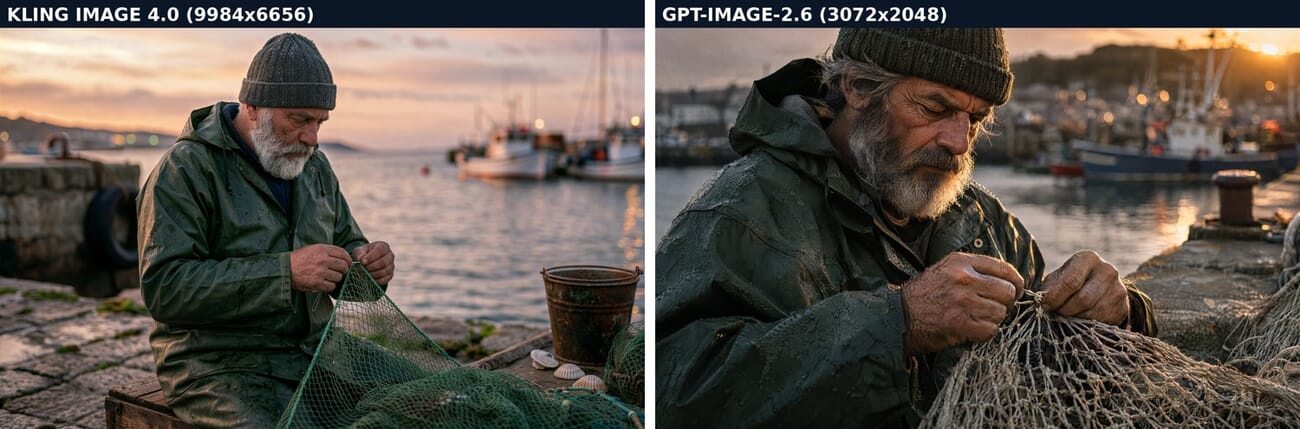
The prompt described a fisherman mending a net at golden hour the way a photographer would, lens and aperture included. Both results pass as photographs at web size. Kling’s reads warmer and more cinematic; GPT’s is grittier, with saltier textures, more weathered hands and a less staged feel. On pure believability, most photographers would likely pick the GPT frame.
The files tell a different story. Kling returned 9984 by 6656 pixels, a genuine 66-megapixel image. GPT-Image-2.6’s API enforces a pixel budget: 3072 by 2048 generates, 3600 by 2400 returns an error, and the longest edge tops out at 3840 pixels. That is roughly an 8-megapixel ceiling, a tenth of Kling’s output, and it matters for cropping and print.
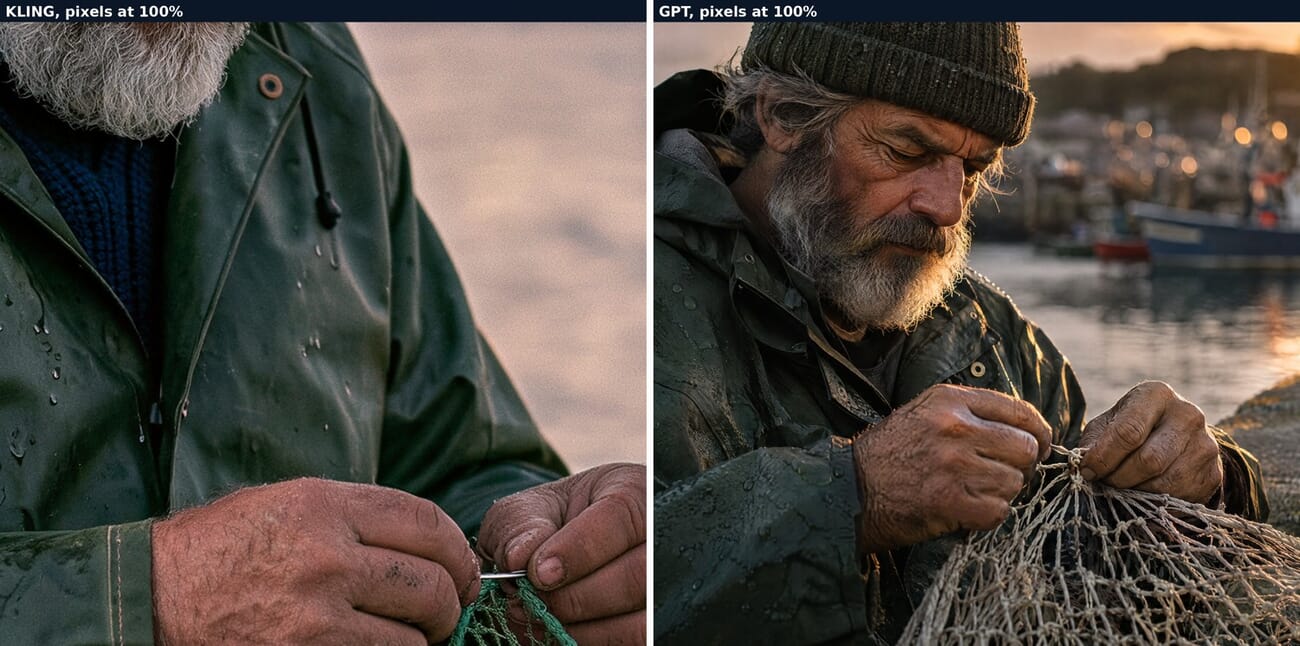
Verdict: GPT-2.6 for per-pixel realism, Kling for resolution headroom. At Instagram sizes, call it taste.
Round 2: The 1,400-Character Cheat Sheet
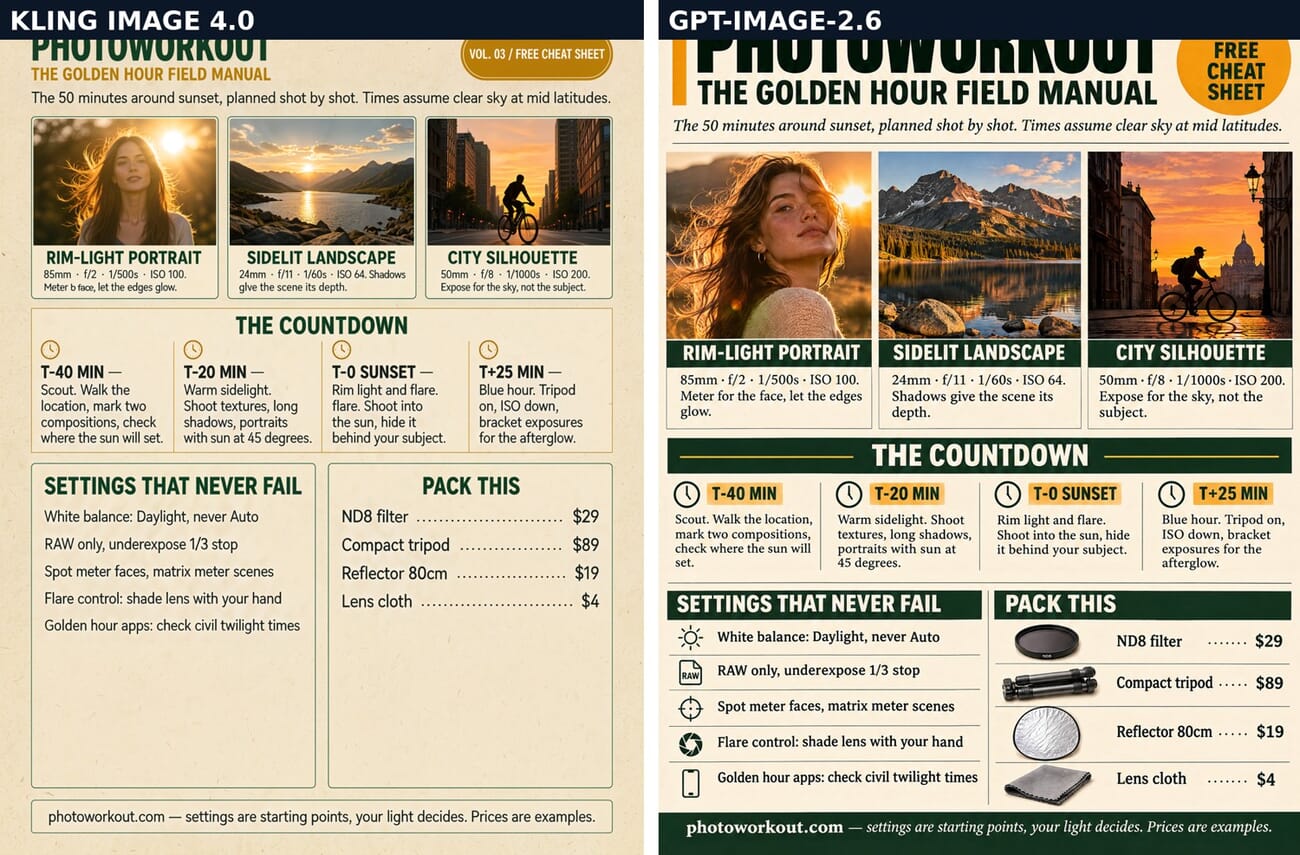
Both models received an identical spec for a PhotoWorkout golden-hour cheat sheet: a masthead, three photo cards with exact camera settings, a four-column timeline, two list panels and a footer, every line written out. Kling’s version, from the earlier standalone test, contained three small slips (a garbled word in one caption, one typo, one doubled word).
GPT-Image-2.6 rendered the whole sheet with zero errors found in checking every line, and went further: it added small product photos next to the gear list and icons next to each tip, none of which were requested, while keeping the layout balanced. A week ago, Kling’s density test looked like the new benchmark. It lasted seven days.
Verdict: GPT-2.6, clearly. For posters, ads and layout work where every character must survive, it is now the safer engine, and it does this at 7MP, not 66.
Round 3: Relighting a Real Photo
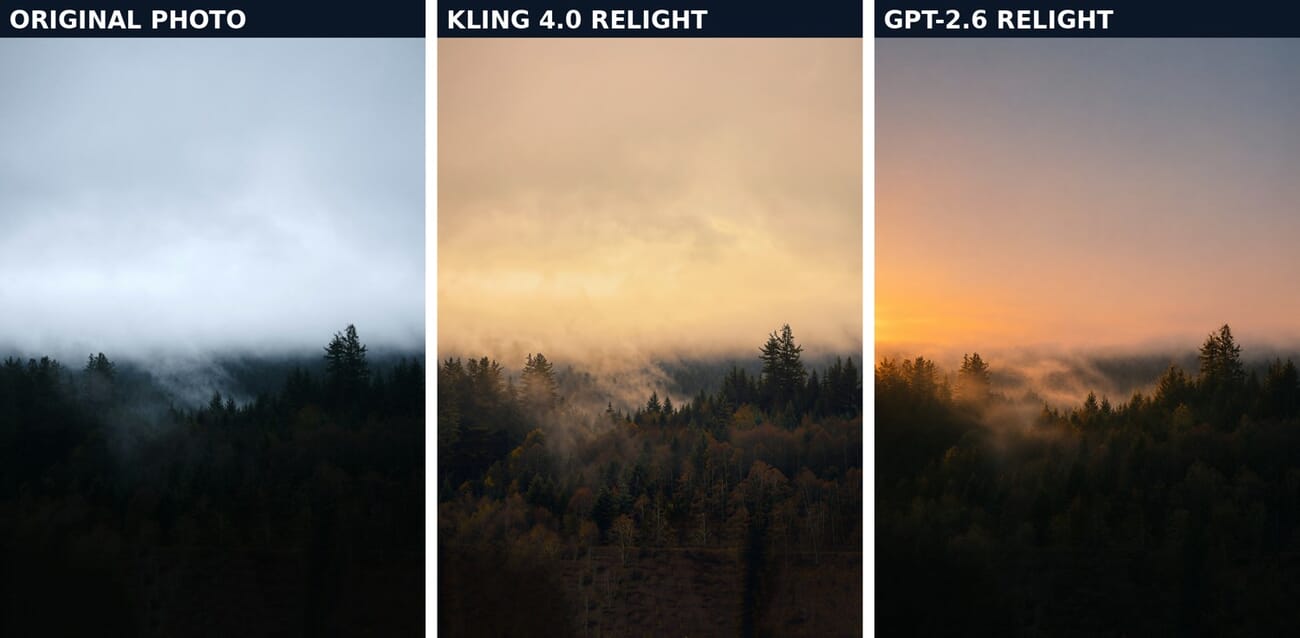
Both models got the same real photograph, a flat gray foggy forest, and the same instruction: relight to late golden hour, change nothing else. Kling preserved the tree line and fog placement almost exactly but warmed the foliage into autumn tones it was never asked for. GPT produced the more dramatic and arguably prettier light, with a visible low sun, but reshaped more of the scene: the sky gained structure, trees shifted, and the overall silhouette drifted further from the original.
Verdict: Kling by a nose for fidelity, GPT for drama. Neither is an adjustment tool; both regenerate the photo, which is exactly what the earlier GPT-Image-2.6 test found when it rewrote handwriting during an object removal.
Round 4: One Character, Four Frames
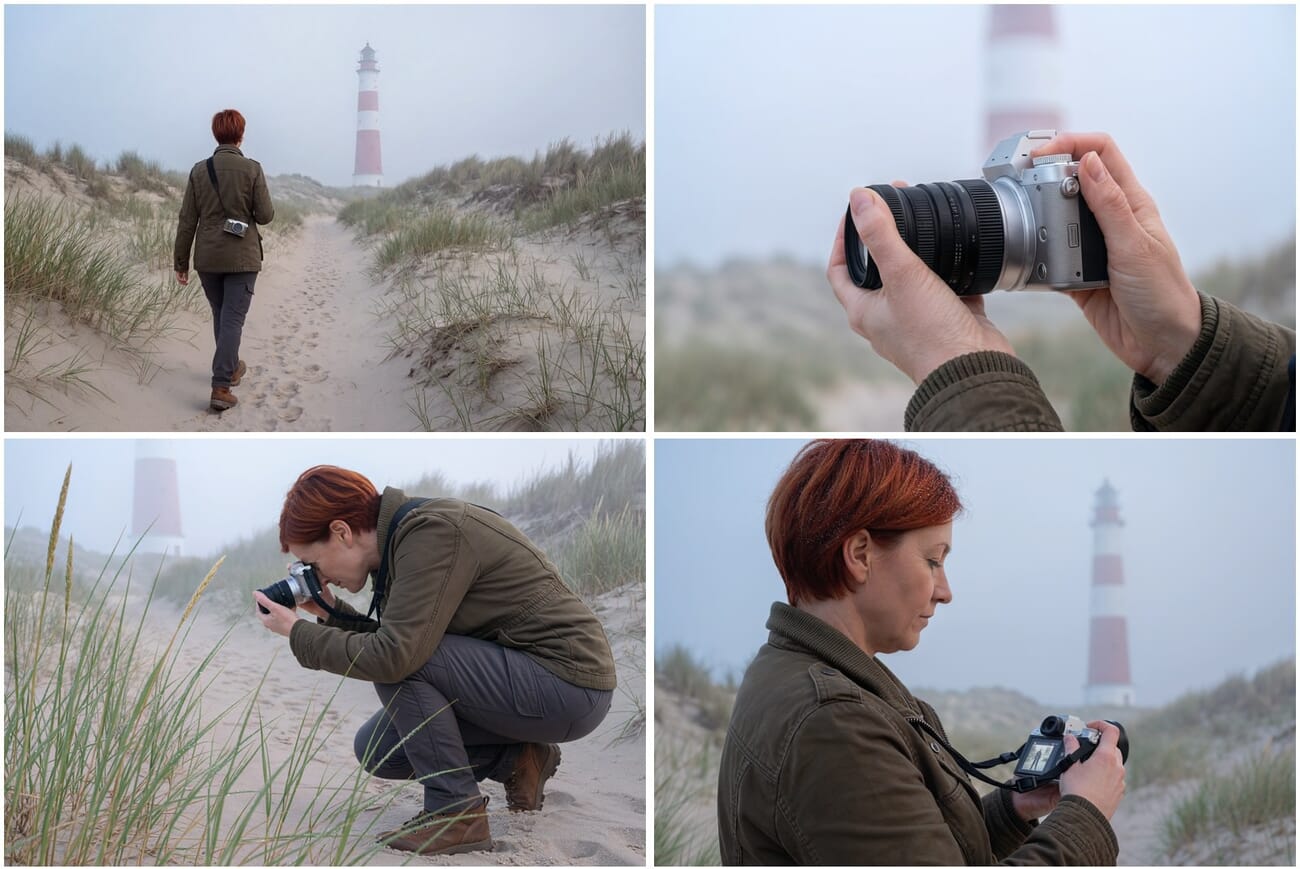
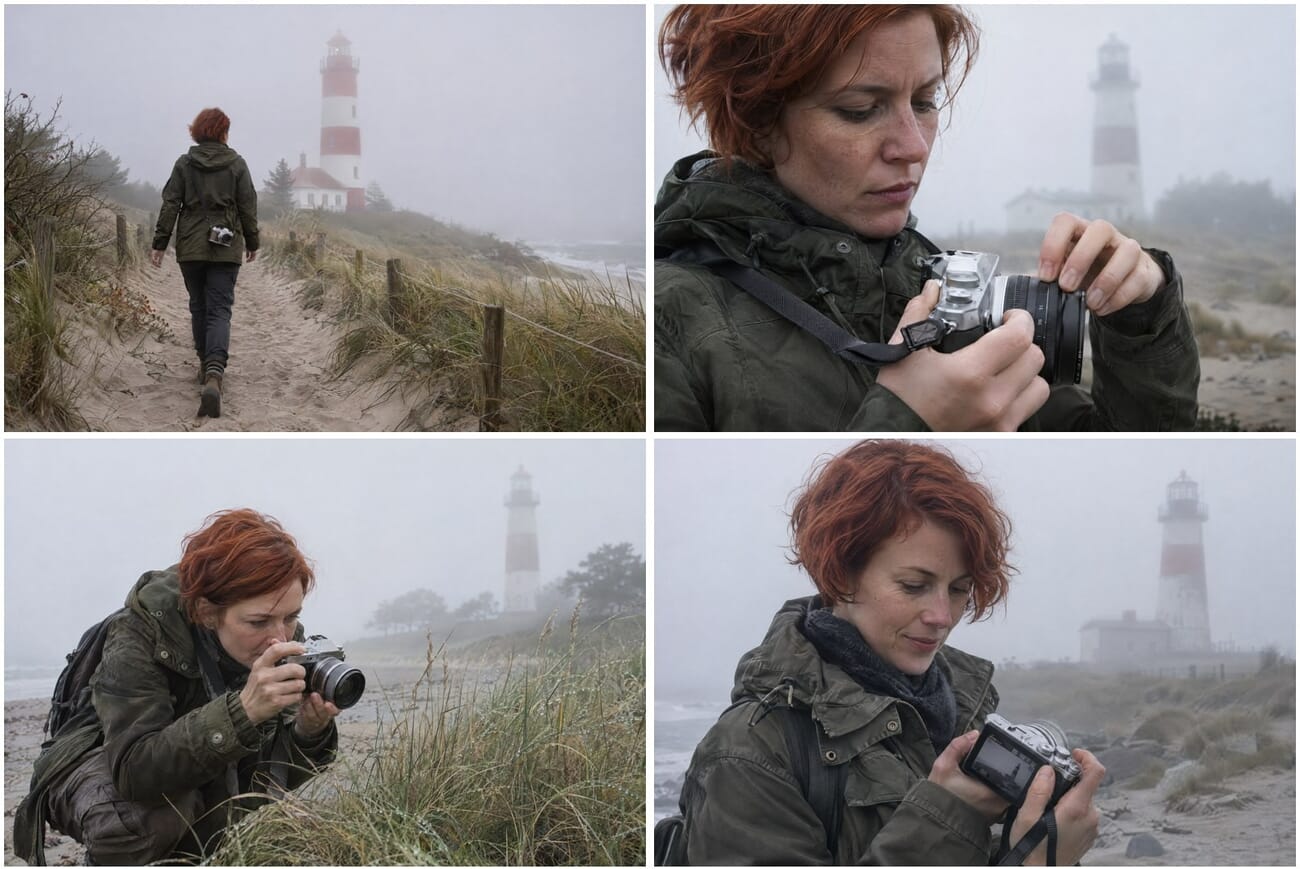
Kling’s series mode generated its four-frame lighthouse story in a single request, and it shows: one lighthouse design, one jacket, one morning. GPT-Image-2.6 has no equivalent, so it got four independent prompts sharing a detailed character description. The result is closer than expected: the same recognizable woman appears in all four frames, though the lighthouse’s proportions, her gear and small details drift between images.
Verdict: Kling, on both convenience and consistency. But GPT’s showing proves detailed descriptions now carry identity surprisingly far without any reference image.
The Numbers Side by Side
| Kling Image 4.0 | GPT-Image-2.6 (API) | |
|---|---|---|
| Max output tested | 9984 x 6656 (66MP), native 8K | 3072 x 2048 (6.3MP); ~8MP budget, 3840px edge cap |
| Dense text accuracy | 3 small errors in ~1,400 characters | 0 errors found in the same spec |
| Series mode | Up to 10 consistent images per request | None; separate prompts only |
| Speed (measured) | 1 to 4 minutes, async task polling | 35 to 53 seconds, synchronous |
| Price per image (approx.) | $0.06 at 2K to $0.15 at 8K | $0.07 to $0.14 at high quality |
| Provenance | C2PA embedded | C2PA embedded |
| Access | API packages or paid studio tiers; free studio capped at 2K | API billing; eligible ChatGPT Pro and Business plans include monthly API credits |
Prices reflect standard package rates and measured token usage on November 18, 2026, and move with volume discounts. One access note for photographers who already pay OpenAI: since late October, eligible ChatGPT Pro and Business subscribers can claim their plan price back as monthly API credits, which covers the Images API. That makes head-to-head testing like this effectively free on the GPT side.
Which One Should Photographers Use?
- For text-heavy design work (posters, cheat sheets, ads): GPT-Image-2.6. Zero errors at 1,400 characters is the new bar.
- For maximum resolution (print, cropping headroom, large displays): Kling Image 4.0. Nothing else ships native 8K today.
- For storyboards and consistent sets: Kling’s series mode, with GPT as a capable fallback.
- For editing real photos: neither, yet. Both regenerate rather than adjust. Treat results as creative variants, not develops.
- For speed in a pipeline: GPT, at roughly a third of the wall-clock time.
The bigger picture: ten days apart, two models from two continents converged on the same capabilities, photographic realism, heavy text, provenance metadata included by default. The ‘which model’ question now changes monthly. The ‘can you still tell it is AI’ question is the one that keeps getting harder, and at web resolution, the answer from both of these is: not reliably.
Frequently Asked Questions
Is Kling Image 4.0 better than GPT-Image-2.6?
Neither wins outright. In PhotoWorkout’s same-prompt tests, Kling wins on resolution (66MP vs an ~8MP API cap) and consistent image series, while GPT-Image-2.6 wins on dense text accuracy, speed and per-pixel realism. Costs are similar.
What is the maximum resolution of GPT-Image-2.6?
On the API, requests above roughly 8 megapixels are rejected and the longest edge is capped at 3840 pixels; 3072 by 2048 was the largest 3:2 size that generated in testing. Kling Image 4.0 returned 9984 by 6656 for the same prompt.
Which AI image model renders text best in 2026?
In this test, GPT-Image-2.6: it reproduced a 1,400-character poster spec with no errors found, while Kling Image 4.0 made three small slips on the identical prompt. Both are far beyond where image models were a year ago.
Do Kling and GPT images include AI provenance metadata?
Yes. Files from both APIs arrived with embedded C2PA Content Credentials in testing, so platforms that read the standard can identify them as AI-generated. The metadata can still be stripped by re-saving or format conversion.
Bottom Line
Pick the tool per job, not per brand: GPT-Image-2.6 for anything with words in it, Kling Image 4.0 for pixels and sets. Then revisit in a month, because at this cadence the scorecard will not sit still.
All results are PhotoWorkout's own API generations from November 18, 2026; specifications and prices were checked the same day.
Testing
- PhotoWorkout same-prompt API tests, November 18, 2026 – Identical prompts on Kling's kling-4.0 endpoint and OpenAI's gpt-image-2.6-sunburst (high quality); timings and sizes as measured
- PhotoWorkout: Kling Image 4.0 test – The standalone Kling results referenced here
- PhotoWorkout: GPT-Image-2.6 test – The standalone GPT results referenced here
Specifications and Pricing
- Kling AI developer documentation and pricing – Unit pricing, checked November 18, 2026
- OpenAI: API credits for ChatGPT plans – Monthly API credit benefit for eligible Pro and Business subscribers
Image Sources
- All comparison images – AI-generated test outputs from Kling Image 4.0 and GPT-Image-2.6, composited and labeled by PhotoWorkout
- Forest photo used in the edit round – Original photo via Unsplash/SampleShots
- Pinterest graphic – PhotoWorkout graphic using labeled AI test images