


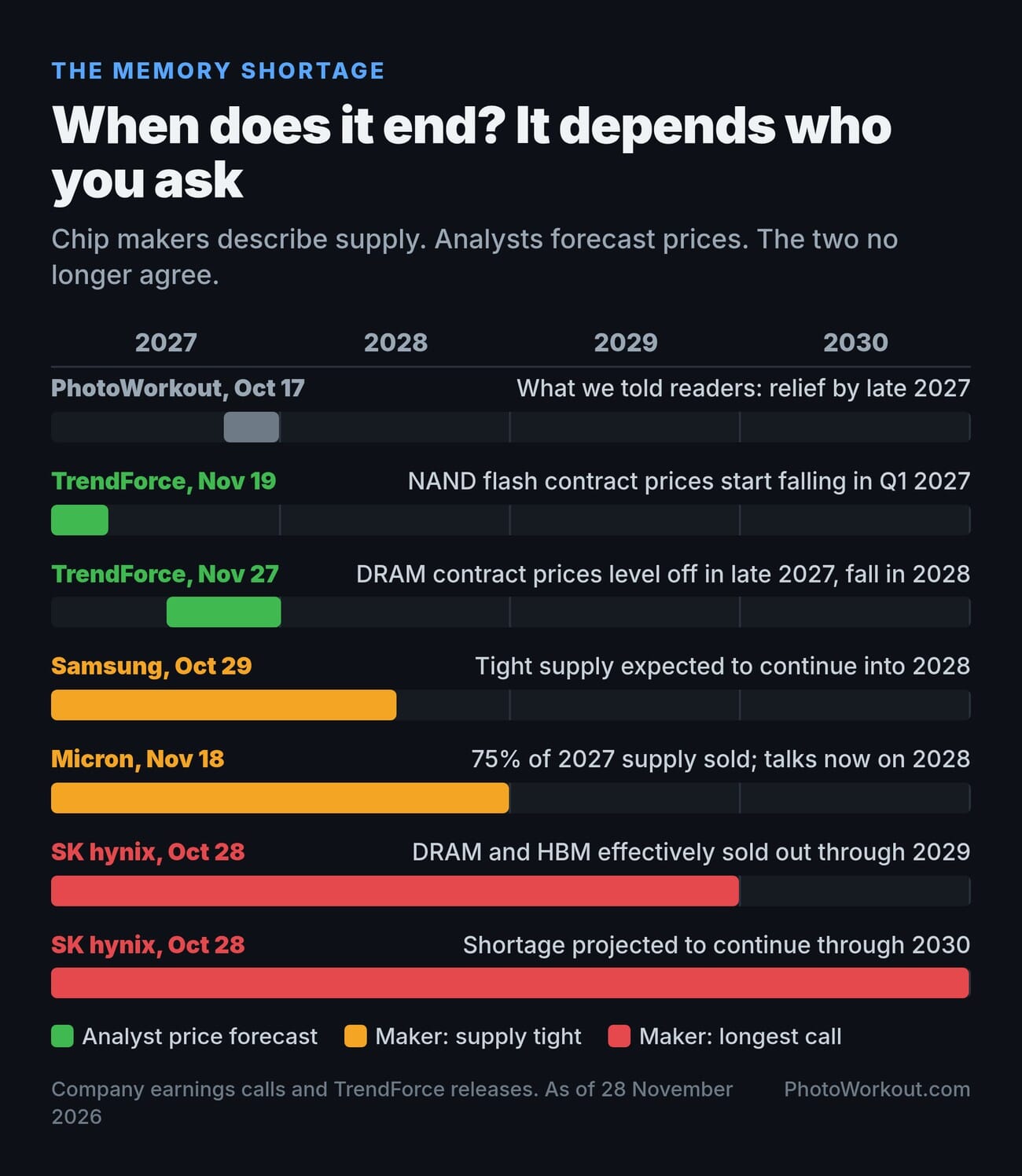
- The chip makers have moved the end date. SK hynix now says the memory shortage is projected to continue through 2030, Samsung expects tight supply into 2028, and Micron’s chief executive says 75% of its 2027 supply is already sold.
- Prices may not follow the same clock. TrendForce forecasts that contract prices for NAND flash, the memory inside cards and SSDs, start falling in the first quarter of 2027, and that DRAM prices level off in late 2027.
- No camera maker has published a 2027 price list. Canon has said that if higher costs persist next year it will pass them on through price increases, and that it does not expect memory prices to decline.
- PhotoWorkout rechecked 12 memory cards first priced in April. Nine cost more, two cost less, and the median change is +12%. Prices are higher, but they are no longer moving in one direction.
- The practical read: a discounted camera body or a RAM upgrade you already planned is worth buying now. Cards and SSDs are worth buying for the work ahead, not worth stockpiling.
Six weeks ago, PhotoWorkout told readers that the memory shortage pushing up camera and card prices was unlikely to ease before late 2027. Since then the companies that make the chips have gone on the record with much longer dates. One of them now says 2030.
That sounds like a simple story: the wait just got three years longer, so buy everything now. The sources say something more useful than that. The chip makers are describing how long supply stays tight. The analysts who forecast prices have, in the same six weeks, started calling for memory card and SSD chip prices to fall in early 2027. Both can be true, and the gap between them decides what belongs on a photographer’s Black Friday list.
This update covers what was actually said, what PhotoWorkout got wrong or needs to revise, and what to buy now versus later.
What the chip makers said, in their own words
- SK hynix, October 28. The company’s third-quarter results carry the heading “Memory supply shortage to persist through 2030.” On the earnings call, management said “our DRAM and HBM volumes for the next 3 years through 2029 are effectively sold out.” Two limits apply. The statement covers DRAM and the high-bandwidth memory used in AI servers, not NAND flash. And it counts signed long-term agreements plus demand still being negotiated. The firmly contracted share is “more than 50%” of 2027 and 2028 capacity, across 14 customers, with prices that float inside an agreed band.
- Samsung, October 29. Asked about 2028 on its earnings call, the head of memory sales said “tight supply conditions are expected to continue into 2028,” and added that macro events could change the picture.
- Micron, November 18. Chief executive Sanjay Mehrotra told an investor summit that “75% of our 2027 is sold out” and that customer talks have moved on to 2028, as reported by Quartz.
There is one more number in circulation: memory inventories at Samsung and SK hynix below 10 days of supply. That is a broker estimate from KB Securities dated September 7, not a figure either company has confirmed, and it has been re-reported with newer dates since.
So the range among the makers runs from 2028 to 2030, and SK hynix is the longest call, not the consensus.
Sold out is not the same as prices keep rising
TrendForce, the research firm whose contract-price forecasts the industry follows, has moved the other way. On September 30 it projected conventional DRAM contract prices up 10 to 15% and NAND flash up 15 to 20% for the fourth quarter. Then came two releases in eight days.
- NAND flash, November 19. TrendForce now forecasts that “overall NAND Flash contract prices will begin declining in the first quarter of 2027,” by 0 to 5%, “with all product categories entering a downward cycle” from the second quarter. The reasons are fast supply growth, order cuts by Chinese cloud companies, and consumer demand that keeps shrinking.
- DRAM, November 27. In its base case, DRAM contract price increases “narrow progressively throughout 2027, with prices potentially leveling off in the second half of the year before declining in 2028.” For the first quarter of 2027 the firm still expects a rise of 5 to 10%, according to Maeil Business.
The mechanism is not mysterious. Buyers are running out of room to pay. IDC reported that smartphone shipments fell 22% in the third quarter and put memory costs at roughly 350% above a year earlier. Morgan Stanley, as reported by Chosun Biz, cut its targets for Samsung and SK hynix this month on the view that the shortage could ease gradually as new capacity arrives from late 2027.
That capacity has dates attached. Micron’s September investor deck puts first wafer output from its new Idaho fab in mid-2027, a second Idaho fab in late 2028 and its first New York fab in 2030. SK hynix’s first Yongin cleanroom is scheduled for February 2027 per Maeil Business.
For photographers the split matters because the two kinds of memory sit in different products. NAND flash is what memory cards and SSDs are made of. DRAM is the working memory inside camera bodies, phones and computers. The forecast relief arrives first for the first group and last for the second. And a forecast is still a forecast: a 0 to 5% dip in contract prices would follow increases many times that size, and store prices follow contracts with a lag.
What PhotoWorkout is revising
The October 17 report said relief was not expected before late 2027. That now needs revising in both directions. For DRAM, and so for the cost of building a camera, the makers’ own statements point later, to 2028 at the earliest. For NAND, and so for cards and SSDs, the best-known price forecaster points earlier.
One figure in that report also needs tightening. Fujifilm’s October 1 increase in Japan ran from 6 to 15% on cameras, according to CineD. The 23% figure applied to Instax products, not to camera bodies.
Camera makers: warnings, not price lists
No major camera maker has announced a 2027 list-price increase that names memory as the reason. CineD, which went through the latest filings from four of them, put it plainly: “None of the companies has announced a price list.” What exists is a set of statements that get firmer as you read down.
- Canon is the clearest. In its October 27 investor Q&A, speaking about the Imaging business, it said: “we have not been able to fully pass these higher costs on through pricing. If these higher costs persist next year, we will absorb them through price increases.” In the same document it said it does “not expect memory and raw material prices to decline next year.” Read together, that is a conditional warning whose condition Canon itself expects to be met. No models, amounts or dates were given.
- Fujifilm puts the memory hit to its Imaging segment at ¥14 billion for the year and says it will limit it “through pricing measures and sourcing alternative materials and components,” per CineD. It has already raised prices in Japan.
- Nikon told investors in November that memory will cost its Imaging business an amount “in the high single-digit billions of yen,” that it has secured supply into the next fiscal year, and that “the outlook for prices remains uncertain,” according to the Q&A reproduced by Nikon Rumors. Its earlier line about possibly passing costs on dates from May.
- Sony said on its November call only that it had minimized the impact of higher memory costs. It raised Japanese prices on Cinema Line cameras and 11 memory cards in September, citing raw material, manufacturing and logistics costs.
- Blackmagic Design is the one company that has raised prices and named memory. On October 20 it increased 36 products. Its cameras were not on the list. The steepest rises were on IP video converters and ATEM switchers, up to about 80%, while its Cloud Store storage units rose around 10%.
The fair summary: a camera price increase in 2027 is likely enough to plan around, and not yet a fact. PhotoWorkout’s camera-maker earnings scorecard tracks how each company is absorbing the cost.
The price check: 12 memory cards, seven months later
On April 28, PhotoWorkout listed Amazon prices for the SD and CFexpress cards worth buying before a round of increases. The same 12 listings were checked again on November 28.
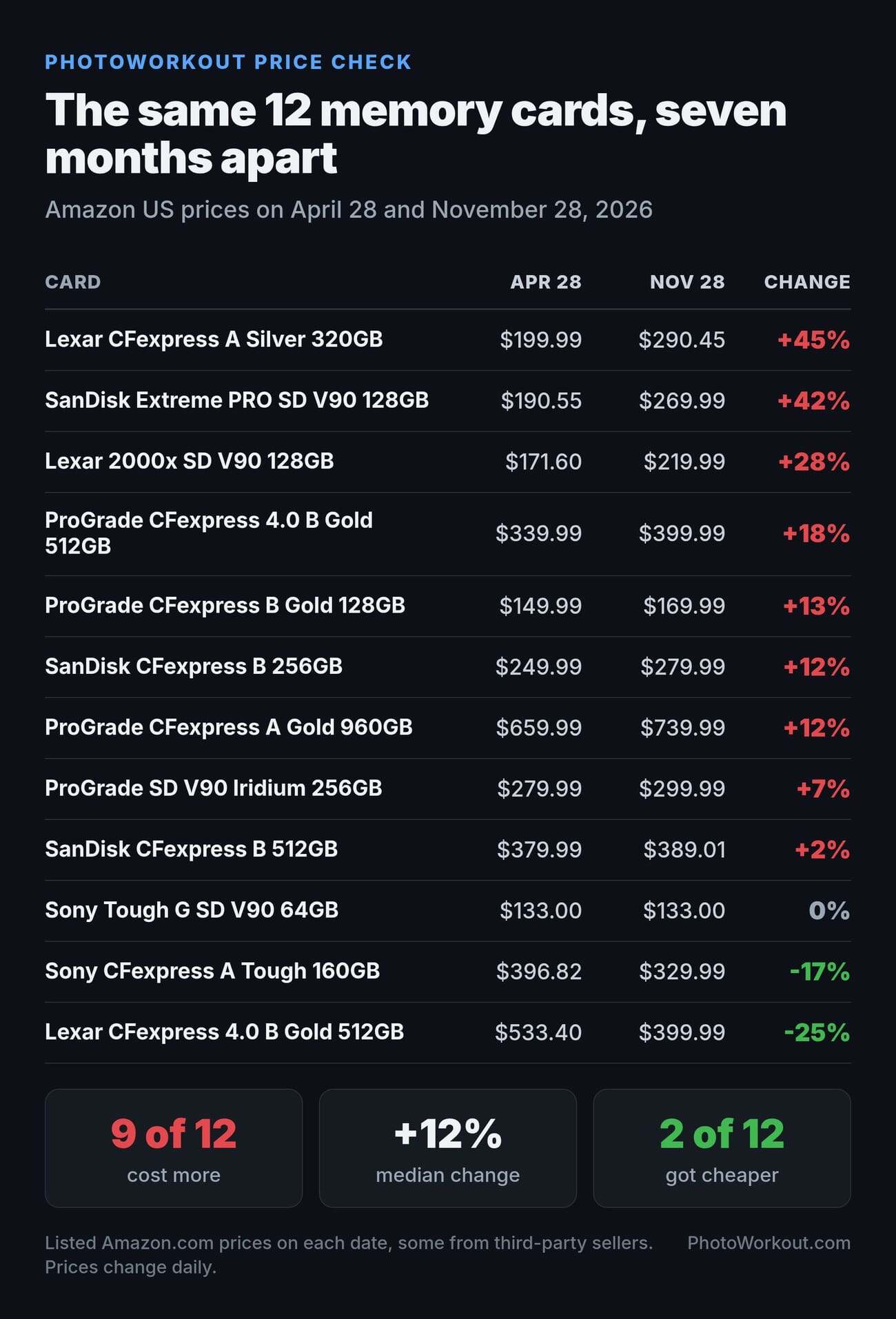
Nine cost more, one is unchanged and two are cheaper. The median change is +12%. The biggest rises are on cards where a single seller sets the price: the Lexar CFexpress Type A Silver 320GB went from $199.99 to $290.45, and the SanDisk Extreme PRO SD V90 128GB from $190.55 to $269.99. The Lexar CFexpress 4.0 Type B Gold 512GB went the other way, from $533.40 to $399.99.
One card shows the shape of the year. The Lexar 2000x SD V90 128GB was $171.60 in April, $233.93 when PhotoWorkout checked in July, and is $219.99 now. That is still far above where it started, but it is below its summer peak. It is a small sample of listed prices, not a market index. It does fit what TrendForce describes: a market that has stopped climbing in a straight line.
The shopping list: what to buy now and what can wait
A camera body or lens you already planned to buy: buy it on sale
This is where the two pressures point the same way. Black Friday discounts on bodies are real this year, and the largest maker has said prices go up next year if costs hold. Waiting for a better price in spring is a bet against both. The running Black Friday deals list has the verified ones, including $700 off the Canon EOS R5. This is a reason to stop postponing a purchase you had already decided on. It is not a reason to buy a camera you did not need.
RAM for an editing computer: sooner is better
DRAM is the part of the shortage with the longest horizon, and TrendForce still expects contract prices to rise into 2027. If a Lightroom or video machine needs more memory, the upgrade is unlikely to be cheaper in six months. The same logic was behind Apple’s mid-cycle Mac price increase.
Memory cards: buy for the work ahead, skip the stockpile
If there are shoots booked and not enough cards, buy them. A genuine Black Friday discount on the card your camera needs is fine to take. Buying a drawer of spares as a hedge made sense in April. With NAND contract prices forecast to dip from early 2027 it is hard to justify now. Among the cards checked, the Sony Tough G 64GB V90 is the same $133 it was in April.
Portable SSDs: same rule, and do the math per terabyte
SSDs have had the roughest year. A price compilation by Original Pricing shows the Kingston NV3 2TB internal drive going from about $150 a year ago to $279.99, a rise of 87%. On Amazon on November 28, the SanDisk 2TB Portable SSD was $269.99 and the faster SanDisk 2TB Extreme Portable SSD was $349.99, which works out to $135 and $175 per terabyte. Buy the working drive the next job needs. Do not expect 2025 prices back in 2027: a single-digit decline comes off a level that roughly doubled.
Long-term archive: a hard drive, not flash
For photos that only need to be kept, flash is the expensive way to do it. The WD Elements 8TB desktop drive was $299.99 on the same day, about $37 per terabyte, roughly a quarter of the cheapest portable SSD above. Two of them in different places is a better archive than one large SSD.

One company on both sides of the shortage
The AI build-out that is draining memory supply also produces enormous amounts of data that someone has to keep. Fujifilm announced on October 29 that it will invest about ¥10 billion at its Odawara site to raise production capacity for magnetic data tape “by approximately five times” compared with fiscal 2025, with the spending spread over fiscal 2026 to 2028. The news drew more than 500 points on Hacker News.
So the same wave costs Fujifilm’s camera division ¥14 billion in memory this year and fills the order book of its tape division. It does not change what an X100VI costs, but it helps explain why Fujifilm sounds less alarmed than its rivals.
Frequently Asked Questions
When will the memory shortage end?
There is no single date. SK hynix projects the shortage to continue through 2030, Samsung expects tight supply into 2028, and TrendForce’s base case has DRAM contract prices leveling off in the second half of 2027 and falling in 2028. NAND flash contract prices are forecast to start falling in the first quarter of 2027.
Will camera prices go up in 2027?
Probably for some brands, but nothing is announced. Canon has said it will raise prices if higher costs persist next year and that it does not expect memory prices to fall. Fujifilm lists pricing as a countermeasure. Nikon and Sony have not committed either way.
Should memory cards be bought now, before prices rise again?
Buy what upcoming work requires. Stockpiling is harder to justify than it was in spring, because the main price forecaster now expects NAND flash contract prices to dip from early 2027, and PhotoWorkout’s recheck of 12 cards found prices mixed rather than uniformly rising.
Why would prices fall if the chips are sold out?
Sold out describes supply committed to large customers, mostly for AI servers and mostly DRAM. Prices also depend on what everyone else can afford. Phone and PC makers are cutting orders and memory capacity per device, new fabs open from 2027, and that is enough for forecasters to expect price increases to slow, then reverse.
Is the shortage the camera makers’ fault?
No. As the October report explained, the cost is real: AI data centers are absorbing memory supply, and camera makers buy the same chips in far smaller volumes. Canon alone put the memory hit to its third-quarter operating profit at ¥19.8 billion.
Bottom line
The shortage has outlasted the date PhotoWorkout gave in October, and the people who make the chips now talk about 2028 to 2030. That is a statement about supply. Prices are starting to tell a second story, earliest for the flash memory in cards and SSDs. For this weekend that sorts the list neatly: take the discount on the body or the RAM you were going to buy anyway, buy the cards and drives the next few months of work need, and leave the stockpile on the shelf.
Facts and prices as of November 28, 2026. Forecasts are the named firms' own and can change.
Chip makers
- SK hynix: Q3 2026 business results – October 28, 2026; shortage projected through 2030
- SK hynix Q3 2026 earnings call transcript (The Motley Fool) – The 2029 sold-out statement and long-term agreement details
- Samsung Electronics Q3 2026 earnings call transcript – October 29, 2026; tight supply into 2028
- Quartz: Micron CEO says 75% of 2027 memory supply is sold out – Remarks of November 18, 2026
- Micron: fiscal Q4 2026 earnings deck – Fab timing for Idaho and New York
- Seoul Economic Daily: Samsung, SK hynix memory stockpiles fall below 10 days – KB Securities estimate, September 7, 2026
Price forecasts and data
- TrendForce: memory contract price forecast for 4Q26 – September 30, 2026
- TrendForce: NAND Flash prices set to decline in 2027 – November 19, 2026
- TrendForce: risk of DRAM contract price declines in 2028 – November 27, 2026
- Maeil Business: TrendForce quarterly DRAM outlook and fab schedules – November 22, 2026
- IDC: smartphone shipments decline in 3Q26 – October 14, 2026
- Chosun Biz: Morgan Stanley cuts Samsung and SK hynix targets – November 10, 2026
- Original Pricing: SSD prices November 2026 – Compilation of retail SSD prices
- Amazon.com listed prices – Checked via Rainforest API on April 28, July 4 and November 28, 2026
Camera makers
- Canon: Q3 2026 analyst meeting Q&A – October 27, 2026
- CineD: Memory costs hit Canon, Fujifilm, Nikon and Sony – November 16, 2026
- CineD: Fujifilm raises camera prices in Japan by up to 15% – Japan increase effective October 1, 2026
- Nikon Rumors: Nikon financial results Q&A – November 10, 2026
- Newsshooter: Blackmagic Design raises prices on 36 products – October 20, 2026
- Fujifilm: production capacity for magnetic data storage tape to increase 5x – October 29, 2026
Image Sources
- Featured image: Manuel Chinchilla / Unsplash – SD card being loaded into a camera; cropped
- Forecast chart, price table and pin – Infographics by PhotoWorkout