
Key Takeaways
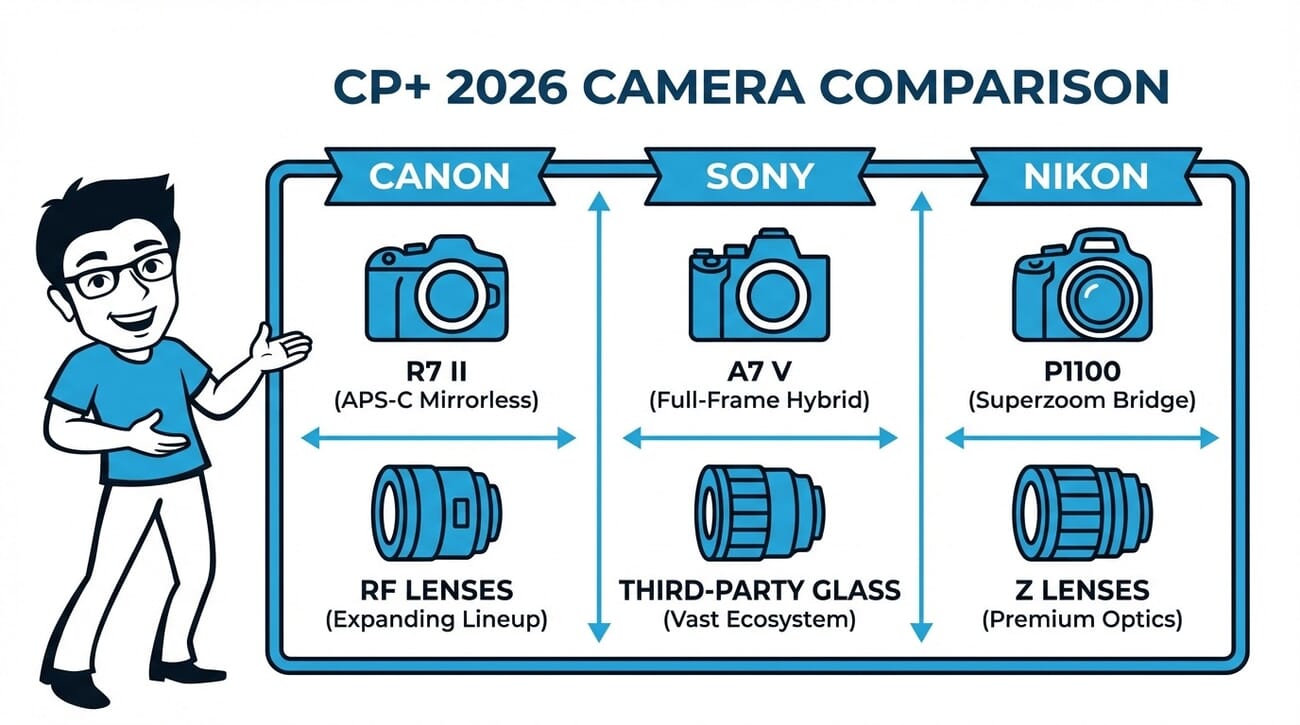
- Canon EOS R7 Mark II is the most anticipated camera at CP+ 2026 — a major APS-C flagship upgrade (jump to Canon)
- Sony A7 V has just launched with 33MP, 4K/120p, and 30fps burst shooting (jump to Sony)
- Nikon Coolpix P1100 brings an insane 125x zoom covering 24–3000mm (jump to Nikon)
- Third-party lenses from Tamron, Sigma, and Viltrox are stealing the show with affordable, compact, pro-quality options (jump to lenses)
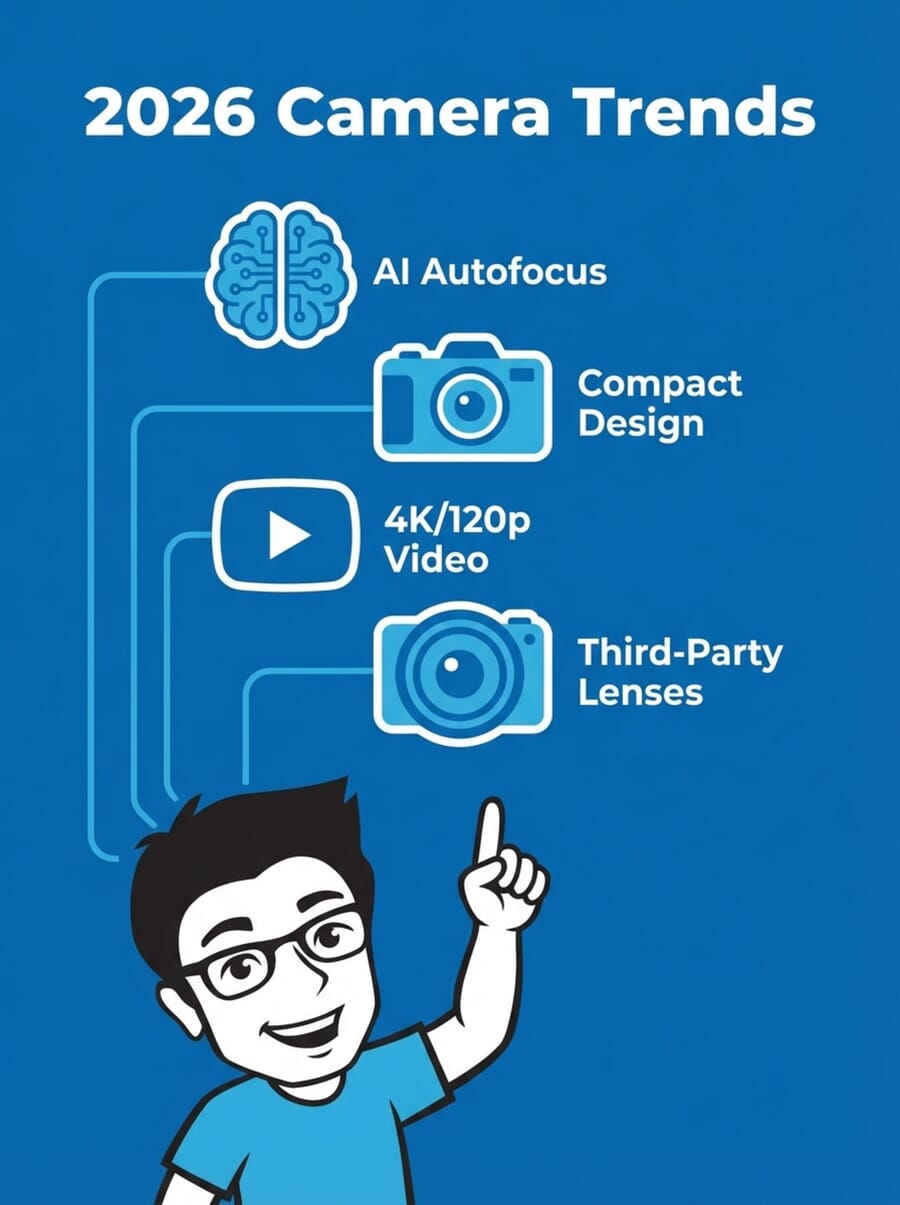
- Key trends: AI-powered autofocus, lightweight gear design, and 4K/120p video becoming the new standard (jump to trends)
Note: CP+ 2026 dates and product announcements are based on confirmed information and credible industry rumors as of February 12, 2026. Specific details may change as the show approaches — check back for updates.
What Is CP+?
CP+ (pronounced “see-pee plus”) is the world’s largest camera and imaging trade show, organized annually by CIPA (Camera & Imaging Products Association). Held in Yokohama, Japan, it draws tens of thousands of photography enthusiasts, industry professionals, and media from around the globe each year.
Think of CP+ as the photography world’s equivalent of CES — except entirely focused on cameras, lenses, and imaging technology. With the discontinuation of Photokina (the former German camera trade show that folded in 2020), CP+ has become the undisputed premier event for camera announcements and hands-on product demonstrations.
Major brands like Canon, Sony, Nikon, Fujifilm, Panasonic, and OM System use CP+ to showcase their latest gear, while third-party lens manufacturers like Sigma, Tamron, and Viltrox strategically time their biggest announcements to coincide with the show. The result is a concentrated burst of photography news that sets the tone for the entire year ahead.
For photographers, CP+ matters because it’s where you get the first real look at the cameras and lenses that will define the next 12 months. Hands-on demos, prototype reveals, and technology roadmap presentations all give a window into where the industry is heading.
When and Where Is CP+ 2026?
Based on previous years’ scheduling patterns (CP+ 2025 ran from February 27 to March 1), CP+ 2026 is expected to take place from approximately February 26 to March 1, 2026, at Pacifico Yokohama — a massive convention center located on the Yokohama waterfront, about 30 minutes south of central Tokyo by train.
In recent years, CP+ has expanded to include a robust online component with live-streamed keynotes, virtual booth tours, and product demonstrations. This hybrid format makes the show accessible to photographers around the world who can’t travel to Japan. The official CP+ website typically offers free registration for online attendees well before the show opens.
Importantly, many manufacturers don’t wait for the show floor to open. Some of CP+ 2026’s biggest product reveals — including new lenses from Tamron (February 19) and Sigma (February 26) — are already scheduled for pre-show announcements. This means the excitement builds steadily throughout late February, with hands-on impressions and demos happening during the show itself.

Canon at CP+ 2026
Canon is bringing a strong lineup to CP+ 2026, headlined by what could be its most important APS-C camera in years.
Canon EOS R7 Mark II — The Most Anticipated Camera of CP+ 2026
The Canon EOS R7 Mark II is shaping up to be Canon’s biggest camera launch of 2026. The original EOS R7 earned widespread praise as Canon’s best APS-C mirrorless camera — a versatile tool for wildlife, sports, and action photography that combined a crop sensor’s reach advantage with RF-mount lens compatibility.
A Mark II version has been spotted in the wild (always a strong signal that a launch is imminent), fueling strong expectations for a CP+ 2026 announcement or at minimum a working prototype showcase. While full specifications remain unconfirmed, photographers are hoping for improvements to autofocus performance (potentially borrowing AI tracking technology from the EOS R5 II), higher burst shooting speeds, enhanced in-body image stabilization, and improved video capabilities.
For wildlife and bird photographers in particular, the EOS R7 Mark II could be a game-changer. The APS-C crop factor gives a built-in 1.6x reach advantage — pair it with Canon’s RF 100-500mm and you’re looking at an effective 800mm at the long end. If Canon delivers meaningful autofocus improvements, this could become the go-to camera for serious wildlife shooters who don’t want to carry (or pay for) a full-frame body.
RF 14mm f/1.4L VCM — A Dream Lens for Astrophotographers
Canon’s RF 14mm f/1.4L VCM has already been officially announced and is generating extraordinary demand — to the point where supply has struggled to keep up. This ultra-wide prime is engineered specifically with astrophotography in mind, combining an f/1.4 maximum aperture (critical for gathering starlight) with a Voice Coil Motor (VCM) for smooth, nearly silent autofocus.
At 14mm on a full-frame sensor, it captures enormous swaths of the night sky, making it ideal for Milky Way photography, aurora shots, and star trail compositions. The L-series designation means it includes Canon’s highest-tier weather sealing and build quality — essential for photographers who spend hours outside in dew-heavy conditions. Expect Canon to feature this lens prominently at their CP+ booth with demo stations.
RF 7-14mm f/2.8-3.5 Fisheye Zoom
Canon has also announced the RF 7-14mm f/2.8-3.5, a creative fisheye zoom lens that serves a niche but enthusiastic audience. The variable focal length offers flexibility that fixed fisheye lenses can’t match, making it useful for architectural photography, extreme wide-angle video, VR content creation, and artistic compositions. While it won’t be on every photographer’s shopping list, it’s an interesting addition that shows Canon continuing to fill out the RF lens ecosystem with unique options.
EOS R5 Discontinued — What It Means
Canon has officially discontinued the original EOS R5, cementing the EOS R5 Mark II as its full-frame high-resolution successor. This isn’t unexpected — the R5 II brought significant upgrades including dramatically improved heat management for extended video recording, enhanced AI-powered autofocus, and better in-body image stabilization. If you’ve been eyeing an original R5, remaining stock at authorized dealers may present attractive pricing as inventory clears.
Sony at CP+ 2026
Sony enters CP+ 2026 riding the momentum of a major new camera launch, while its thriving third-party lens ecosystem continues to expand.
Sony A7 V — The All-Rounder Gets a Serious Upgrade
The Sony A7 V has just been released ahead of CP+ 2026, and early reviews are overwhelmingly positive. This fifth-generation full-frame mirrorless camera packs a 33-megapixel sensor, 4K/120p video recording, and an impressive 30fps burst shooting speed — specifications that would have been flagship-only territory just two years ago.
The A7 series has long been Sony’s best-selling camera line, serving as the go-to “do everything” camera for photographers who shoot portraits, landscapes, events, and video. The A7 V continues that all-rounder tradition with meaningful improvements across the board: enhanced AI subject recognition that can track a wider range of subjects, improved dynamic range for challenging lighting situations, and video features that rival dedicated cinema cameras.
For photographers considering a full-frame mirrorless system in 2026, the A7 V represents an exceptional value proposition — delivering performance that trickles down from Sony’s professional A9 and A1 series at a more accessible price point.
Third-Party Sony FE Lenses Making Waves
Sony’s E-mount continues to have the most extensive third-party lens ecosystem of any mirrorless system, and CP+ 2026 brings several exciting additions. Two Samyang lenses are generating particular buzz:
- Samyang 60-180mm f/2.8 FE — Expected to debut on the CP+ show floor, this fast telephoto zoom could be a compelling alternative to Sony’s own 70-200mm f/2.8 GM II at a fraction of the price. A constant f/2.8 aperture across this range would make it excellent for portraits, events, and sports.
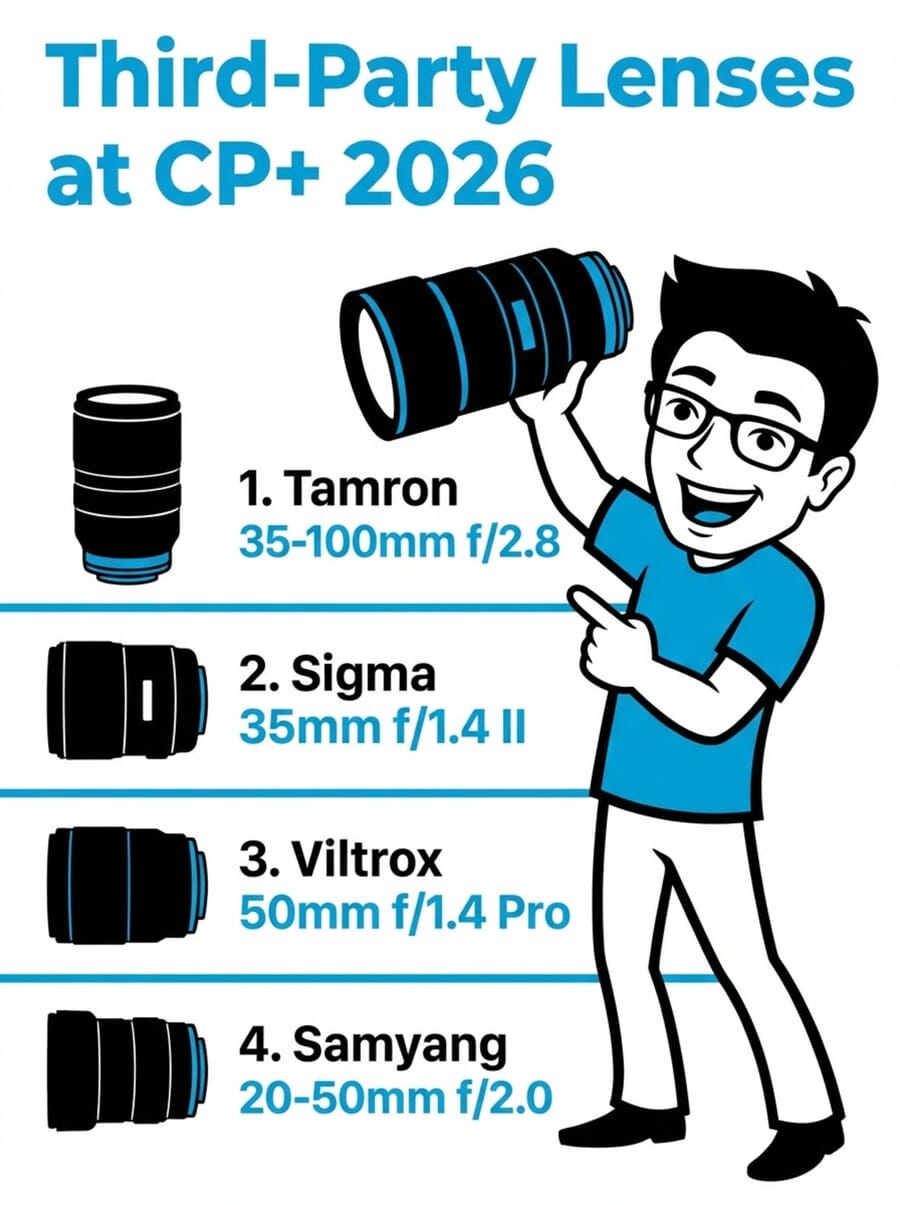
- Samyang 20-50mm f/2.0 FE (prototype) — This is the lens that has photographers talking. A wide-to-standard zoom with a constant f/2.0 aperture is essentially unprecedented. Samyang is reportedly showing this as a prototype and gathering feedback, which suggests it may be 6–12 months from retail — but the concept alone is exciting enough to draw crowds at CP+.
The Meike 85mm f/1.4 II FE is also arriving around CP+ 2026, now featuring weather sealing — a welcome and practical upgrade for portrait photographers who regularly shoot on location in unpredictable weather. At Meike’s typical price point, it offers exceptional value for photographers who want a fast portrait prime without the premium price tag of Sony’s GM series.
Nikon at CP+ 2026
Nikon’s CP+ 2026 presence focuses on accessibility and versatility — expanding the Z-mount system to reach more photographers at different price points and use cases.
Coolpix P1100 — 3000mm of Zoom in Your Hands
Nikon has just launched the Coolpix P1100, and the headline specification is genuinely jaw-dropping: a 125x optical zoom covering a 24–3000mm equivalent focal range. To put that in perspective, with an interchangeable lens mirrorless camera, achieving 3000mm would require a massive telescope-sized lens costing tens of thousands of dollars. The P1100 puts that reach in a handheld package.
Bridge cameras like the P1100 occupy a unique niche in the market. They’re not competing with mirrorless flagships on raw image quality or low-light performance, but for birders, plane spotters, moon photographers, and casual wildlife enthusiasts, the sheer zoom range is unmatched by any interchangeable lens system at anywhere near this price. It’s a reminder that “the best camera” depends entirely on what you’re trying to photograph.
Z 28-400mm f/4-8 VR — The Ultimate Travel Lens
Nikon’s Z 28-400mm f/4-8 VR is a 14x super-zoom for the Z-mount mirrorless system, aimed squarely at travel photographers. While super-zoom lenses always involve some optical compromises compared to dedicated primes or shorter-range zooms, a single lens that covers everything from wide-angle street scenes to distant wildlife is incredibly appealing for travelers who want to minimize gear weight and bag space.
The built-in VR (Vibration Reduction) is essential at the extreme telephoto end, helping to counteract the camera shake that’s inevitable when shooting handheld at 400mm. For photographers planning trips where versatility trumps absolute image quality, this is a lens worth watching at CP+.
Z 24-105mm f/4-7.1 — Making Z-Mount Accessible
The Z 24-105mm f/4-7.1 represents Nikon’s push to make the Z-mount system more affordable and accessible. As a budget-friendly standard zoom, it significantly lowers the barrier to entry for photographers switching from older F-mount DSLRs or considering their first mirrorless camera purchase.
Combined with Nikon’s growing Z-mount lens lineup — now including an increasing number of third-party options — the Z-mount ecosystem is becoming more compelling than ever for budget-conscious photographers. The message from Nikon is clear: you don’t need to spend a fortune to get into modern mirrorless photography.
Third-Party Lenses Stealing the Show
If there’s one overarching theme at CP+ 2026, it’s that third-party lens manufacturers are no longer playing second fiddle to the big three. Companies like Tamron, Sigma, and Viltrox are releasing lenses that rival — and in some cases surpass — first-party options in optical quality, build, and especially value.
Tamron 35-100mm f/2.8 Z-Mount
Tamron is set to officially announce the 35-100mm f/2.8 for Nikon Z-mount on February 19, 2026 — just ahead of CP+. At approximately 560 grams, this lens is remarkably lightweight for a constant f/2.8 zoom covering the portrait-to-telephoto range. For Nikon Z shooters, it offers an attractive alternative to heavier first-party zooms, with a wider starting focal length of 35mm that adds versatility for environmental portraits and event coverage.
Tamron has been on a roll with Z-mount lenses, and this addition continues to strengthen the case for Nikon shooters who want professional-quality glass at reasonable prices and weights.
Sigma 35mm f/1.4 II FE
Sigma’s original 35mm f/1.4 Art was one of the most celebrated and widely used lenses of the past decade — it essentially put Sigma on the map as a premium lens manufacturer. The Sigma 35mm f/1.4 II, scheduled for a February 26 announcement (the first day of CP+), promises to be more compact while maintaining the optical excellence that Sigma’s Art line is known for.
The 35mm focal length remains one of the most popular choices among street, documentary, wedding, and travel photographers. A smaller, lighter version of a legendary lens with updated optical design and autofocus motor technology? That’s exactly the kind of announcement that gets photographers excited.
Viltrox AF 50mm f/1.4 Pro Z-Mount and AF 16mm f/1.8 L-Mount
Viltrox continues its impressive evolution from budget lens brand to serious optical competitor. The AF 50mm f/1.4 Pro for Nikon Z-mount is already available for pre-order, offering near-premium optical performance at a mid-range price point.
Perhaps more significant is Viltrox’s AF 16mm f/1.8 for L-mount — the brand’s first lens for the L-mount alliance (Panasonic, Leica, Sigma). This signals that Viltrox is expanding beyond Sony E-mount and Nikon Z-mount into every major mirrorless ecosystem, which is great news for L-mount shooters who have historically had fewer affordable lens options.
The Bigger Picture: Why Third-Party Lenses Matter More Than Ever
The explosion of high-quality third-party lenses is arguably the best thing happening in photography right now. More competition means better lenses at lower prices for everyone. Nikon’s Z-mount, in particular, is seeing a surge of third-party support from Tamron, Viltrox, and others — making the system significantly more attractive for budget-conscious photographers who may have previously felt locked into Sony’s more mature FE ecosystem.
This trend also benefits camera manufacturers: a richer lens ecosystem makes their camera bodies more appealing, which drives overall system adoption. It’s a virtuous cycle that’s accelerating at CP+ 2026.
Key Trends at CP+ 2026
AI-Powered Everything
Artificial intelligence continues to reshape camera technology in profound ways. At CP+ 2026, expect to see AI subject detection that goes far beyond basic face and eye recognition — modern cameras can now identify and track birds, vehicles, insects, aircraft, and even specific sports movements with remarkable accuracy.
Sony’s A7 V, for instance, features enhanced AI-driven autofocus that learns and adapts from shooting patterns. Canon’s newer bodies are implementing similar AI-powered tracking that can predict subject movement. Beyond autofocus, computational photography features like AI-powered noise reduction, automatic focus stacking, in-camera HDR compositing, and intelligent scene optimization are becoming standard rather than premium features.
Compact and Lightweight Is the New Premium
There’s a clear and accelerating industry shift toward smaller, lighter gear — and CP+ 2026 is where this trend is most visible. Tamron’s 560-gram f/2.8 zoom, Sigma’s more compact 35mm f/1.4 II, and Viltrox’s lightweight primes all reflect a broader reality: photographers want professional-grade optics without the back pain.
This trend extends to camera bodies too, with manufacturers increasingly prioritizing portability alongside performance. The days when “professional” automatically meant “heavy” are fading. Today’s engineering allows smaller designs without the optical compromises that plagued compact lenses of the past.
4K/120p Video Is Becoming Standard
Just a few years ago, 4K/120p video was a flagship-only feature reserved for cameras costing $4,000 or more. The Sony A7 V’s inclusion of 4K/120p in what’s essentially a mid-range full-frame body signals that high-frame-rate 4K recording is rapidly becoming table stakes across the industry.
For content creators and hybrid shooters who work across both photo and video, this is excellent news. Slow-motion capability at 4K resolution — without needing a dedicated cinema camera — opens up creative possibilities that were previously out of reach for many photographers expanding into video work.
Third-Party Lens Ecosystem Maturation
As discussed throughout this guide, third-party lens manufacturers are reaching a genuine tipping point. CP+ 2026 showcases an ecosystem where photographers can build a complete, high-quality lens kit entirely from brands like Sigma, Tamron, and Viltrox — often saving 30–50% compared to equivalent first-party alternatives with minimal (if any) optical compromise.
This maturation is especially significant for Nikon Z-mount and L-mount users, who historically had fewer third-party options than Sony shooters. The playing field is leveling, and that benefits photographers regardless of which system they choose.
Smartphone Integration and Connectivity
Camera manufacturers are finally getting serious about smartphone connectivity — and it shows at CP+ 2026. Improved companion apps, faster wireless image transfer via Bluetooth and Wi-Fi, cloud backup integration, and tighter connections between cameras and mobile devices are all becoming expected features rather than afterthoughts.
The line between “phone photographer” and “dedicated camera photographer” continues to blur, and manufacturers know they need seamless connectivity to attract younger users who expect instant sharing capabilities. Expect several CP+ booths to demonstrate improved mobile workflows and social media integration features.
How to Follow CP+ 2026 from Home

Not everyone can fly to Yokohama, but following CP+ from home has never been easier. Here’s how to stay on top of every announcement:
- Official CP+ website — The CP+ official site (cpplus.jp) has the full exhibitor list, seminar schedules, and livestream links. CIPA typically streams keynotes and booth tours live with English-language options.
- Photography news — CP+ specific coverage:
- Digital Camera World’s CP+ hub — hands-on reviews published within hours of announcements
- Sony Alpha Rumors — real-time Sony and third-party lens updates from show floor sources
- Canon Rumors — Canon-specific leaks and announcements as they drop
- Nikon Rumors — Nikon and Nikon Z-mount lens ecosystem news
- Social media — Follow #CPplus2026 and #CPPlus on X (Twitter), Instagram, and YouTube for real-time photos, first impressions, and hands-on videos from the show floor.
- YouTube photography channels — Creators like Gerald Undone, DPReview TV, and The Camera Store attend CP+ in person and post hands-on first-look videos within hours. Turn on notifications for CP+ week.
Is CP+ Open to the Public?
Yes, CP+ is open to the general public, though registration is typically required. Online attendance is usually free, while in-person tickets may have a nominal fee or be free with advance registration. The in-person event at Pacifico Yokohama welcomes both industry professionals and photography enthusiasts — it’s not an industry-only trade show. Some hands-on demo sessions with popular new cameras and lenses may require advance booking due to high demand, so register early if you’re planning to attend in person.
When Are the Biggest Announcements at CP+?
Many of the biggest product announcements actually happen in the one to two weeks before the show officially opens. Manufacturers want their new products to be the talk of the show floor, so they announce ahead of time and then offer hands-on demos and detailed presentations during CP+ itself.
For CP+ 2026, key pre-show dates include Tamron’s February 19 lens announcement and Sigma’s February 26 reveal. During the show, expect hands-on first impressions, working prototype showcases, firmware demonstrations, and technology roadmap presentations that hint at what’s coming later in the year.
How Does CP+ Compare to Other Camera Shows?
With Photokina defunct since 2020, CP+ stands unchallenged as the world’s largest dedicated camera and imaging trade show. While CES (Las Vegas, January) and IFA (Berlin, September) include some camera announcements, they cover all consumer electronics and photography is just one small segment. CP+ is unique in its exclusive focus on cameras, lenses, and imaging technology — making it the single most important annual event for photography enthusiasts and industry professionals alike.
The Photography Show in Birmingham, UK (typically held in March) is another notable photography-focused event but is smaller in scale, scope, and manufacturer participation. For the biggest announcements and the most comprehensive look at the year’s upcoming gear, CP+ remains the must-follow show.
Final Thoughts
CP+ 2026 is shaping up to be one of the most exciting shows in recent memory. Between Canon’s highly anticipated EOS R7 Mark II, Sony’s impressive A7 V, Nikon’s innovative superzoom technology, and a wave of excellent third-party lenses from Tamron, Sigma, and Viltrox, there’s genuinely something for every type of photographer.
The broader trends on display — AI-powered autofocus and computational photography, lighter and more compact gear design, a thriving third-party lens market, and 4K/120p video becoming mainstream — all point toward a photography landscape that’s more accessible, more capable, and more exciting than ever before.
Whether you shoot landscapes, portraits, wildlife, street, or video, the gear coming out of CP+ 2026 deserves your attention. We’ll be updating this guide as new announcements roll in throughout the show — bookmark this page and check back for the latest CP+ 2026 news and hands-on impressions.
Get the Weekly Photography News Digest
Join photographers who get our top stories delivered every Monday morning. No spam, unsubscribe anytime.